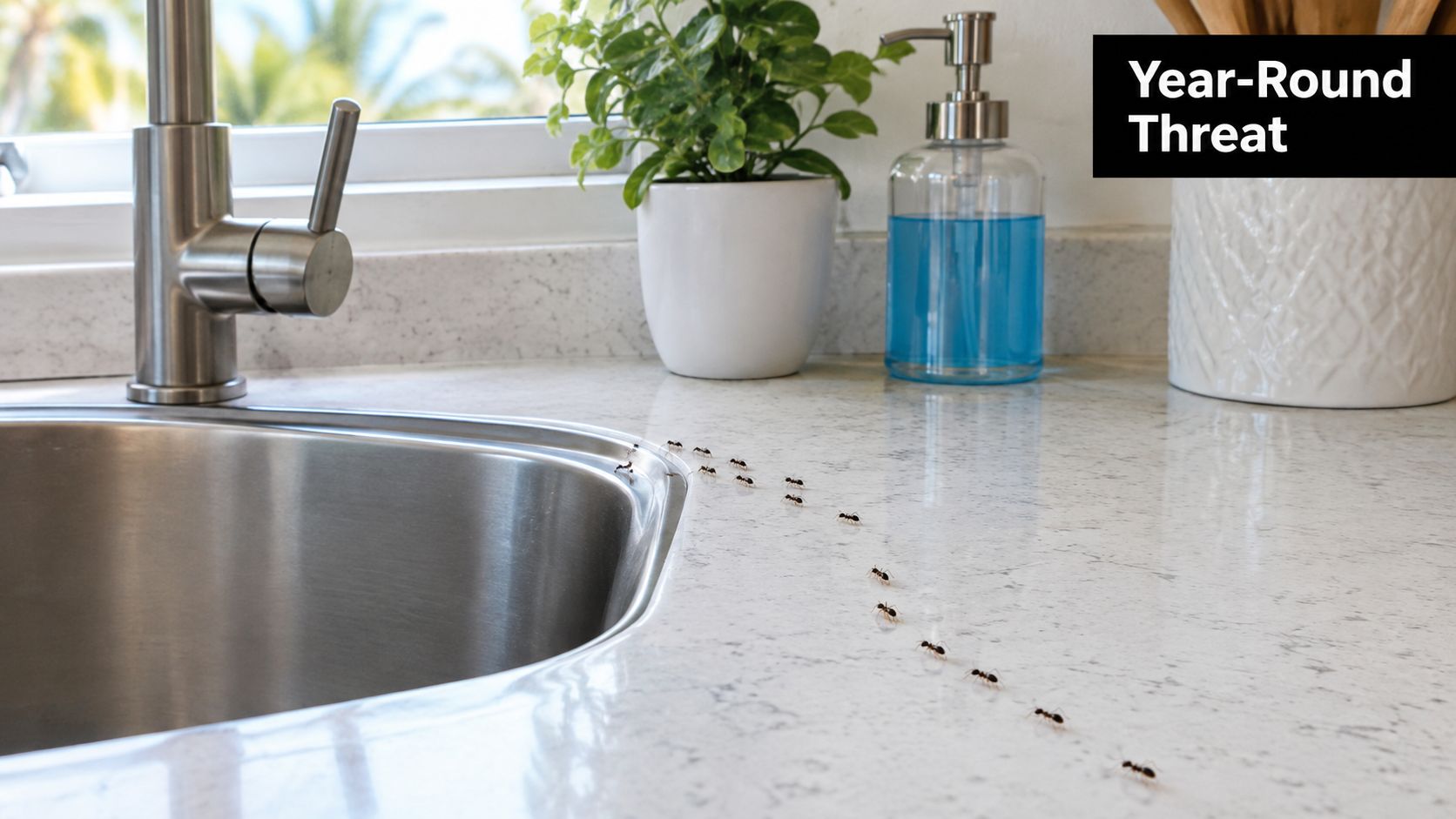
You're in the kitchen before work, and a neat line of tiny ants is moving along the backsplash toward the sink. You wipe them away, spray the counter, and assume the problem is over. By evening, they're back, this time near the bathroom baseboard or sliding through a gap beside the patio door.
That pattern is familiar across Miami, from high-rise kitchens in Brickell to older homes in Kendall, Coconut Grove, Doral, and Hialeah. The right ant control service near me search isn't about finding the fastest person with a spray can. It's about matching the ant species, building type, moisture conditions, treatment method, and follow-up plan to the property.
Table of Contents
- Why Miami Ants Need More Than a Quick Spray
- What to Do in the First Hour and How to Identify the Ant
- How to Vet and Choose an Ant Control Service Near You
- Treatment Options and Realistic Timelines for Lasting Results
- What Ant Control Costs in Miami and When to Pay More
- Your Miami Action Plan and Prevention Tips That Stick
Why Miami Ants Need More Than a Quick Spray
South Florida gives ants plenty of reasons to keep moving indoors. Warm conditions, humidity, irrigation, leaking fixtures, dense landscaping, and shared walls can all support activity around a home. A condo unit in Brickell may have entry points around plumbing penetrations and shared utility spaces, while a Kendall house may have trails connected to mulch, trees, irrigation lines, or slab cracks.
A quick spray can kill the ants you see. It often doesn't answer the more important questions: Where are they entering? What are they feeding on? Is the colony inside a wall, under landscaping, or in a neighboring unit? If those questions go unanswered, the visible trail usually returns.
Why the room matters
A major U.S. pest-management survey found ant infestations in 80% of single-family homes, 82% of apartments and condominiums, 83% of restaurants, and 88% of office buildings. The same ant survey summary identified kitchens as the most vulnerable interior area at 96%, followed by bathrooms at 89% and inside walls at 73%.
Those figures explain why a professional shouldn't treat only the countertop. Kitchens combine food residue, water, warmth, cabinetry, and plumbing access. Bathrooms provide moisture and concealed routes. Wall voids let ants travel beyond the room where you first notice them. A serious inspection follows trails through these connected areas and checks the exterior conditions that keep sending ants back inside.
Miami rule: If the technician only treats the visible trail and doesn't inspect entry points, moisture, walls, and exterior nesting conditions, you're paying for a temporary interruption rather than a property response.
The provider you hire should document species clues, trail locations, likely entry points, treatment products, safety instructions, and follow-up timing. For condos and rentals, that may also require coordination with a landlord, HOA, property manager, or adjacent unit. Pestless acts as a connector, not a treatment company. It can route a Miami-Dade request to licensed and insured local professionals, but the matched technician still needs to inspect the property and recommend the work.
What to Do in the First Hour and How to Identify the Ant
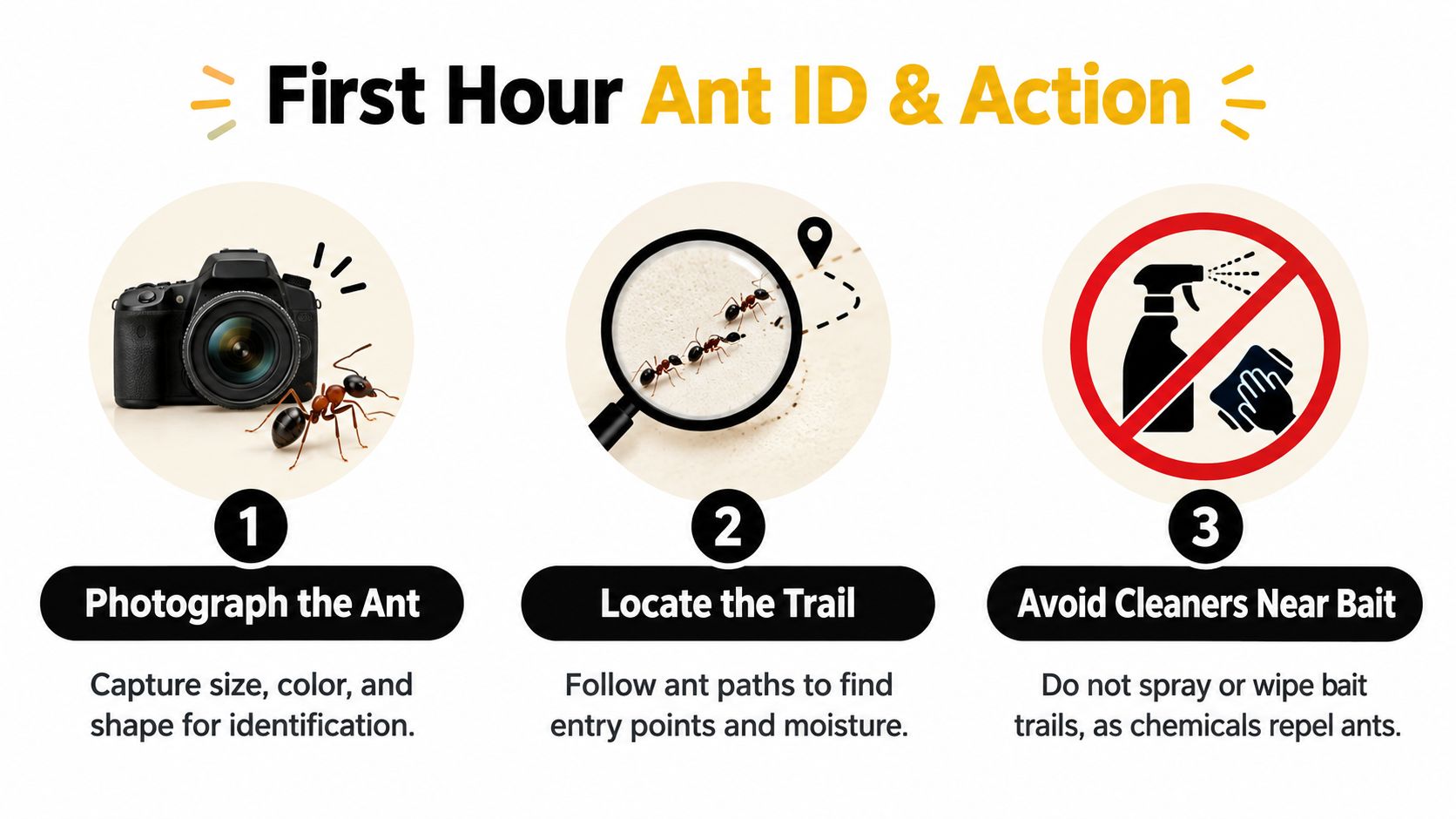
Start by preserving evidence. Take close photographs of the ants beside a familiar object, then capture a wider image showing the trail, nearby sink or plumbing, baseboard, window, door, or exterior wall. Short video clips can help show whether ants are moving in a straight trail, clustering around moisture, or emerging from a crack.
Don't flood the area with household insecticide before the inspection. Strong cleaners and repellent sprays can break the trail that helps a technician locate the entry point. Wipe up food spills and store sweet foods securely, but leave a small active section untouched if it can be done safely.
Build a useful evidence kit
Follow the trail instead of guessing where it starts. Check:
- Kitchen and bathroom moisture: Look beneath sinks, around dishwasher connections, beside toilets, and near condensation or plumbing penetrations.
- Entry points: Inspect window frames, sliding doors, baseboards, utility lines, cracks in stucco, and gaps where pipes enter walls.
- Exterior conditions: Note mulch, dense vegetation, tree branches touching the structure, irrigation overspray, standing water, and damp soil near the foundation.
- Building connections: In condos and apartments, record whether activity appears near shared walls, risers, hallways, balconies, or neighboring units.
Species clues can guide the call, but a photograph is more reliable than a homeowner's guess. Ghost ants are tiny and often appear as fast-moving trails around kitchens, bathrooms, cabinets, and sinks. Carpenter ants are larger and may point to damp wood, wall voids, roof areas, or structural moisture. Fire ants are more commonly associated with outdoor soil, lawns, planted areas, and painful stings, so indoor treatment alone may miss the source.
Use the Florida ant identification guide when comparing general appearance and behavior, then send the photos with your address, property type, rooms affected, first date noticed, and any recent plumbing, landscaping, renovation, or tenant changes. Ask for same-day help when trails are spreading rapidly, occupants are being stung, ants are emerging from electrical or wall openings, or a rental or closing deadline leaves little room for delay.
If the pest turns out to be something else, specialized work matters. Bed Bug Treatment is designed to eliminate every life stage, bugs, eggs, and all.
How to Vet and Choose an Ant Control Service Near You
Don't choose an ant company from the first price displayed in search results. Compare what each provider will inspect, treat, monitor, and guarantee. A low quote can become expensive if it covers only an interior spray and excludes exterior trails, follow-up visits, or concealed nesting areas.
Ask every candidate the same questions:
- Which Florida license covers this work, and is it active?
- Can you provide proof of current insurance?
- Will the technician identify the ant before selecting bait or spray?
- Does the quote include interior inspection, exterior inspection, and entry-point recommendations?
- What happens if ants remain after the first visit?
- Which areas must residents, tenants, pets, or HOA staff prepare?
- Will you document treatment locations and products used?
You can use this Florida license verification guide to check the credential rather than relying on a badge, logo, or verbal assurance. Licensing and insurance don't guarantee excellent workmanship, but skipping those checks is an avoidable risk.
Provider Vetting Scorecard for Miami Ant Services
| Vetting Criteria | What Good Looks Like | Red Flag |
|---|---|---|
| Florida licensing | The provider gives a verifiable, active license without resistance. | The salesperson won't identify the license holder or asks you to take the claim on faith. |
| Insurance | The company explains its current coverage and can provide documentation. | No proof, unclear business identity, or pressure to pay before basic details are confirmed. |
| Species identification | The technician requests photographs and inspects ants, trails, moisture, and nesting conditions. | The company recommends the same treatment before asking what kind of ant you have. |
| Treatment scope | The quote states interior areas, exterior zones, bait or barrier work, and follow-up terms. | “Spray the house” is the entire scope. |
| Monitoring | The provider sets a review window and explains when re-treatment is appropriate. | The technician promises permanent elimination after one visit. |
| Local coordination | The company can work with condo management, landlords, tenants, or HOA rules. | The provider ignores shared walls, common areas, or access requirements. |
A field study on multicolonial ants found that baiting reduced foraging ants at treated structures by an average of 83.0% over 28 days, with reductions reaching 85% by day 7 and 95% by day 21. Only about 25% of the original colonies remained at treatment structures by the end of the study, and trails within 1.5 m of a bait station were more likely to be eliminated, according to the field efficacy study. The practical lesson is simple: treatment placement and monitoring matter more than a flashy guarantee.
Pestless can reduce the initial vetting work by accepting a 60-second request or phone call and connecting Miami-Dade homeowners with licensed, insured professionals. Its stated response window is typically within one business hour during Monday through Saturday, 7 a.m. to 9 p.m. Eastern Time. Treat that as a quote-routing convenience, not a substitute for reviewing the provider's written scope.
Treatment Options and Realistic Timelines for Lasting Results
The best treatment depends on the species and the location of the colony. Baiting works by allowing foraging ants to carry a suitable product back toward the colony. Non-repellent barriers create treated protection around likely entry routes without forcing ants to avoid the area immediately. Targeted nest treatment addresses a known nest or concentrated source directly.
The placement decision is critical. A bait station beside an active trail can intercept ants efficiently. A station placed far from the trail may attract little activity, while a repellent spray directly across a bait route can stop ants from carrying bait where it needs to go.
A Miami technician should also account for rain, irrigation, exterior shade, mulch, landscaping, roof penetrations, plumbing access, and condo rules. Outdoor stations may need protection from weather and maintenance crews. Interior applications may require residents to clear cabinets, keep pets away temporarily, or coordinate access to utility closets and shared service areas.
What the timeline should look like
A credible workflow usually follows this sequence:
- Inspection: The technician confirms the ant, traces active routes, checks moisture and entry points, and records exterior conditions.
- Placement or application: Bait goes near active trails when appropriate. Barriers or targeted treatments address specific routes and nests.
- Early observation: Activity may fall quickly, but fewer visible ants doesn't automatically mean the colony is gone.
- Monitoring window: The provider reviews activity over roughly 2 to 4 weeks, then decides whether additional bait, a barrier adjustment, nest work, or exclusion is needed.
- Prevention work: The homeowner corrects leaks, trims contact vegetation, seals gaps, and manages food and water sources.
Research on urban Argentine ants reported a 98 ± 5% decline in ant densities within 21 days after baiting with fipronil-treated termites. Another Maxforce bait study in Hawaii found a 97.0% maximum decline in monitoring-station foragers, but no plots reached 100% reduction, and the mean reduction after 2 months was 92.1%, as reported in this ant baiting research. These results support a firm homeowner expectation: suppression can be rapid, but eradication isn't something a responsible technician should promise after one application.
Watch for three common mistakes. Don't clean away every active trail before the inspection, don't place bait where ants aren't traveling, and don't cancel follow-up because the kitchen looks clear. In a condo, ask whether neighboring units or common areas need inspection. In a single-family home, ask whether the provider checked the full perimeter rather than only the room where ants appeared.
You can use the video below as a general visual aid, but the property inspection remains the deciding factor.
What Ant Control Costs in Miami and When to Pay More
Price shopping gets messy because “ant treatment” can mean very different work. A basic barrier visit, a one-time interior cleanout, a recurring perimeter plan, and a structural investigation shouldn't be compared as though they were the same service.
Public pricing sources place barrier treatments at roughly $80 to $150, standard one-time visits at $200 to $300, and severe or structural cases at $800 to $1,200 or more, according to this ant extermination cost guide. Those ranges are broad, so use them as questions to ask, not as a guaranteed Miami quote.
What your quote should explain
A lower-cost visit may be reasonable when the evidence points to a small, accessible trail with a clear entry point and no sign of structural moisture. It becomes a poor bargain if the provider excludes exterior inspection, offers no monitoring, or uses a repellent spray where baiting would better fit the species.
Pay more when the job involves concealed activity, recurring trails, suspected carpenter ants, fire-ant activity across planted areas, difficult access, shared-wall coordination, or multiple follow-ups. You're paying for diagnosis, labor, placement, documentation, access planning, and the probability of sustained control, not the amount of product applied.
Recurring service can also make sense for homes surrounded by dense landscaping, properties with persistent moisture, rentals with frequent occupant turnover, and buildings where ants can move between units. The right plan depends on evidence, not a salesperson's automatic upgrade.
Ask this before accepting a quote: “What exactly happens during the visit, what areas are included, and what will you do if activity returns?”
Request written quotes that use the same categories. Compare the inspection scope, treatment method, follow-up timing, service guarantee, preparation requirements, and exclusions. A provider offering a higher price may be the better choice if the scope includes the exterior source and a meaningful review. A cheaper bid may win if both companies propose the same work and credentials.
For a broader explanation of how pest service pricing can vary, review the Pestless pest control pricing guide. Pestless can also help homeowners request multiple no-obligation quotes, giving them a way to compare local providers without treating the lowest number as the automatic winner.
Your Miami Action Plan and Prevention Tips That Stick
Start with evidence, not panic. Photograph the ant, preserve one active trail, note the rooms involved, and record moisture or landscaping conditions. Then request quotes that identify the species, define the treatment area, explain follow-up, and state what the homeowner or property manager must do.
For a Miami-Dade home, rental, or condo, prevention should target the conditions that keep trails active:
- Control moisture: Repair leaks, dry sink cabinets, correct irrigation overspray, and address condensation or damp areas.
- Seal routes: Close gaps around pipes, doors, windows, baseboards, and utility penetrations after the technician identifies likely entry points.
- Manage food: Clean sweet spills, store pet food properly, empty indoor waste regularly, and remove residue from counters and appliances.
- Adjust landscaping: Keep vegetation and mulch from creating direct bridges to walls, and ask the provider whether irrigation or drainage is feeding exterior activity.
- Coordinate shared spaces: Notify the landlord, HOA, or property manager when ants appear near common walls, risers, hallways, balconies, or neighboring units.
- Follow the plan: Keep bait stations undisturbed, follow preparation instructions, and attend the scheduled monitoring visit.
Many homeowners ask whether one-time service is enough. Available service coverage describes one-time ant work as a short-term cleanout, while recurring quarterly plans are positioned as the more effective option for lasting control. The same market coverage says 94% of surveyed pest professionals reported ant infestations as constant or increasing over the past year, as documented in the state of the ant control market report.
Your final checklist is short: identify, inspect, verify, compare, monitor, prevent. If a company skips species identification, licensing, written scope, or follow-up expectations, keep looking.
Pestless Inc. connects Miami and Miami-Dade homeowners with licensed, insured local pest professionals for ant problems and other household pests, without performing the treatment itself. Visit Pestless Inc. to submit a 60-second request, receive zero-cost no-obligation quote options, and choose a provider based on scope, credentials, neighborhood fit, and response time.
Dealing with this pest right now?
Pestless connects you with a licensed, insured Miami pest control provider for a free, no-obligation quote.