You spot a large roach beside the dishwasher in your Coconut Grove condo, then find another near the bathroom. The cheapest quote sounds reasonable until you learn that treating neighboring units is billed as a separate job.
An affordable pest control service solves the right problem without surprise charges or unnecessary pesticide use. I judge affordability by the total cost over a year, the work included, and the risk of paying again. A low first visit means little if the roaches return and the next treatment is a fresh charge.
Table of Contents
- Typical Miami Pest Control Prices by Pest Type
- When DIY Works and When to Hire a Pro
- How to Compare Quotes and Book Without Overpaying
- Questions and Red Flags Before You Sign
- Negotiating and Bundling Without Cutting Corners
- Seasonal Timing and Prevention That Cut Repeat Visits
Typical Miami Pest Control Prices by Pest Type
Read a Miami pest quote in three layers: general household treatment, exclusion work, and specialty treatment. The first number a company advertises usually prices one layer and leaves the others for later. A low first visit can still become the expensive option once callbacks, sealing, and follow-up treatments are billed separately.
Miami quotes vary by pest, home size, and whether you need one-time treatment or ongoing protection. Compare every bid against the same list of work, then judge the twelve-month cost.
| Service | Recurring Plan Terms | What Pushes Price Up |
|---|---|---|
| General interior and exterior pest service | Specify covered pests, scheduled visits, and callback charges | Home size, roach or ant load, multi-story layout |
| Ant control | Ask whether colony monitoring and follow-up are included | Ghost ant nests or colonies inside walls |
| Cockroach treatment, including palmetto bugs and German roaches | Identify whether gel-bait checks and replenishment cost extra | Heavy infestation, shared walls, multi-unit buildings |
| Rodent trapping | Separate removal from droppings cleanup and insulation work | Attic access, extent of activity, trap access |
| Rodent exclusion, including sealing entry points | Usually quoted as a defined repair scope | Gaps, vents, rooflines, and utility penetrations |
| Mosquito control | Specify source reduction and the conditions for repeat service | Lot size and standing-water sources |
| Bed bug treatment | Require monitoring and evidence-based retreatment terms | Units treated, clutter, spread to adjoining rooms |
| Termite inspection | Confirm the inspection fee and any treatment credit | Access to concealed areas and structure size |
| Termite treatment, including liquid or bait systems | Separate installation, monitoring, renewal, and warranty charges | Treatment area, foundation, termite species, and method |
The twelve-month math is easier to see in service events. A general pest quote might include an initial interior and exterior treatment plus three scheduled returns. If ants keep trailing into the kitchen, add two callback visits. If pipe gaps and roofline openings need sealing, add one exclusion repair. That year now contains six or seven service events and a defined repair scope. A higher first invoice that already covers those callbacks and sealing can be the cheaper twelve-month contract. Ask each bidder to price the same set: initial service, scheduled returns, callback allowance, and exclusion scope.
Specialty work needs a separate scope
Bed bugs are a poor place to shop by visit price. University of Minnesota Extension advises evaluating professional treatment over a three-week period without continuing signs, and explains that larger infestations can require multiple treatments. Chemical applications and heat treatment have different preparation, access, and follow-up requirements.
Ask which rooms will be inspected, whether adjoining units need assessment, and what evidence triggers retreatment. Bites alone don't establish the diagnosis, and treating only the bed leaves other hiding places unaddressed.
In Miami properties, inspect the actual construction rather than assuming a concrete-block home has no vulnerable wood. Shared utility penetrations, concealed cabinetry, damp areas, and adjoining units can all change the work required.
Budget rule: Compare the price of a complete treatment scope, not a spray stripped of the work needed to make it effective.
Keep building repairs separate from pesticide charges. If a leaking supply line or drain needs correction, Erica's Plumbing, Air Conditioning & Restoration's guide to budget for Florida plumbing repairs can help you organize that separate expense.
Pestless quote requests are free and come with no obligation. Request written quotes, then compare the included work before accepting an advertised price.
When DIY Works and When to Hire a Pro
DIY saves money when you've identified the pest correctly and can reach the source safely. Buying a stronger product won't compensate for treating the wrong insect or leaving its food and shelter untouched.
The EPA's integrated pest management principles prioritize identification, monitoring, prevention, action thresholds, and the least-risk effective treatment. That's a useful household decision process, not just a professional framework.
| Situation | DIY Reasonable? | Hire a Pro When | Practical Note |
|---|---|---|---|
| Single ant trail near the kitchen | Yes, after identification | Activity persists or returns despite correct bait use | Use labeled bait stations; don't spray over bait or trails |
| A few kitchen roaches | Sometimes, with labeled bait | You see activity across rooms or can't locate hiding places | Place bait only where its label permits and keep it inaccessible to pets |
| Mosquitoes in the yard | Partly | Breeding sources are inaccessible or outside your property | Empty containers and maintain gutters |
| Rodents in attic or walls | Professional help is the better choice | Droppings, gnawing, or noises indicate activity | Plan removal, safe cleanup, and entry-point repairs together |
| Termites or wood damage | No DIY treatment recommendation | Mud tubes, pellets, swarmers, or suspicious wood damage appear | Identify the organism before choosing treatment |
| Bed bugs | Professional assessment recommended | You find live insects or other identifiable evidence | Don't diagnose from bites alone or move suspect furniture between rooms |
| Unknown pest | Start with identification | Photos and inspection still leave uncertainty | Record where you found it and preserve a specimen safely |
Match the method to the problem
An isolated ant trail may respond to bait and food-source removal. Roaches appearing throughout a kitchen need a closer inspection behind appliances, around plumbing, and inside accessible cabinet voids, not repeated spraying across countertops.
For attic activity, Rodent Control should address removing the rodents and sealing the way back in. Don't seal an occupied cavity blindly or sweep dry droppings into the air.
For any DIY pesticide work, use an EPA-registered product labeled for the pest and location. The EPA's health-protection guidance emphasizes following label directions, keeping children and pets away from treated areas, and never using outdoor chemicals indoors.
Set a stop condition before buying more products: persistent activity, spread into additional rooms, or uncertainty about identification means reassess rather than repeat. Photograph the pest beside a size reference and note the location. If you're unsure, describe what you see to us, and we'll connect you with a licensed Miami professional who can identify it and provide a free quote.
How to Compare Quotes and Book Without Overpaying
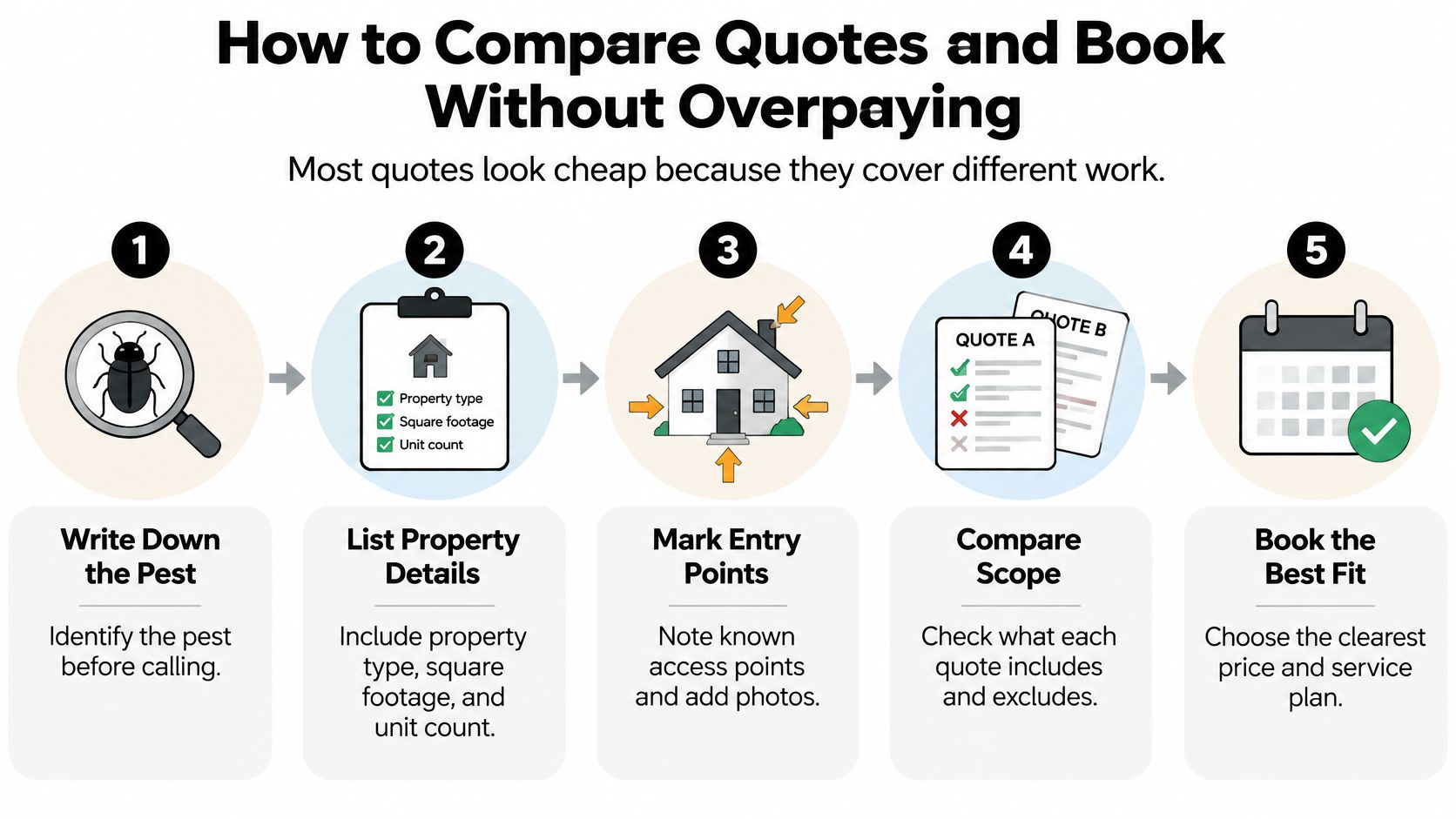
A cheap quote that includes only an exterior application is not comparable to one that includes kitchen baiting and exclusion. The work behind each price differs, so the first number tells you little until the scope matches.
The first-visit price is the least useful number on the page. A spray-only bid and a bid with monitoring and gap repairs are different products, and the annual total is where the difference shows up.
Use a consistent property description so providers aren't pricing different assumptions.
Build a comparable written scope
Document the problem. Record the suspected pest, sighting locations, property type, floor area, unit count, and known entry points. Attach clear photos, but label an uncertain identification as uncertain.
Request equivalent bids. Send each provider the same description. For a condo, explain which areas you control and whether building management must authorize access to common spaces.
Identify the billing structure. Mark each offer as a standalone treatment, recurring agreement, or introductory visit. Ask whether the advertised charge is paid per visit or billed in installments.
Separate the line items. Look for inspection, identification, treatment, exclusion, cleanup, monitoring, and retreatment. Require written approval before added work changes the price.
Get treatment details. Request product names, proposed application locations, and label rates. A technician should be able to explain why a bait, trap, repair, or chemical application fits the finding.
Set the completion standard. Define what evidence counts as resolution and who decides when the job is finished. A promise to treat “until gone” without a written standard gives the seller room to charge again.
Check the contracting name. Make sure the quote names the licensed business that will do the work. Save the credential checks for the pre-signing review so you compare price on equal scope first.
Calculate the annual commitment. Add the initial charge, scheduled service, mandatory monitoring, quoted repairs, and known fees. Keep contingent charges visible rather than treating them as included.
Confirm the appointment terms. Get preparation duties, access requirements, and the monitoring schedule in writing before paying. Put the start date and payment schedule on the same document.
I compare the 12-month number first. A bid that is lower at booking but leaves exclusion and monitoring to you is not the cheaper program.
Require evidence, not just an application
Florida's pest-control statute defines integrated pest management through biological, physical, chemical, and habitat-modification methods, with artificial controls tied to predetermined intolerable pest levels. A practical quote should therefore connect the identification and inspection findings to a treatment decision and a way to measure results.
Request an inspection record showing pest evidence, conducive conditions, recommended corrections, and responsibility for each task. For rentals, document who supplies access, reports leaks, and completes sanitation work. Edinhart Realty and Property Management's discussion of California rental pest prevention offers a useful management comparison, but Florida agreements and applicable law govern a Miami property.
A low price with no written scope is not a discount. It is a smaller job.
Consider a spray-only bid versus a higher bid that includes monitoring and specified gap repairs. The higher bid may cost less over the year, but only if those included tasks address the inspected problem. Don't assign an invented future retreatment cost to make either offer look better.
We're a free referral service, not the treatment contractor. Matching takes about a minute, and you can call (786) 305-7867, Monday to Saturday, 7am to 9pm ET.
Questions and Red Flags Before You Sign
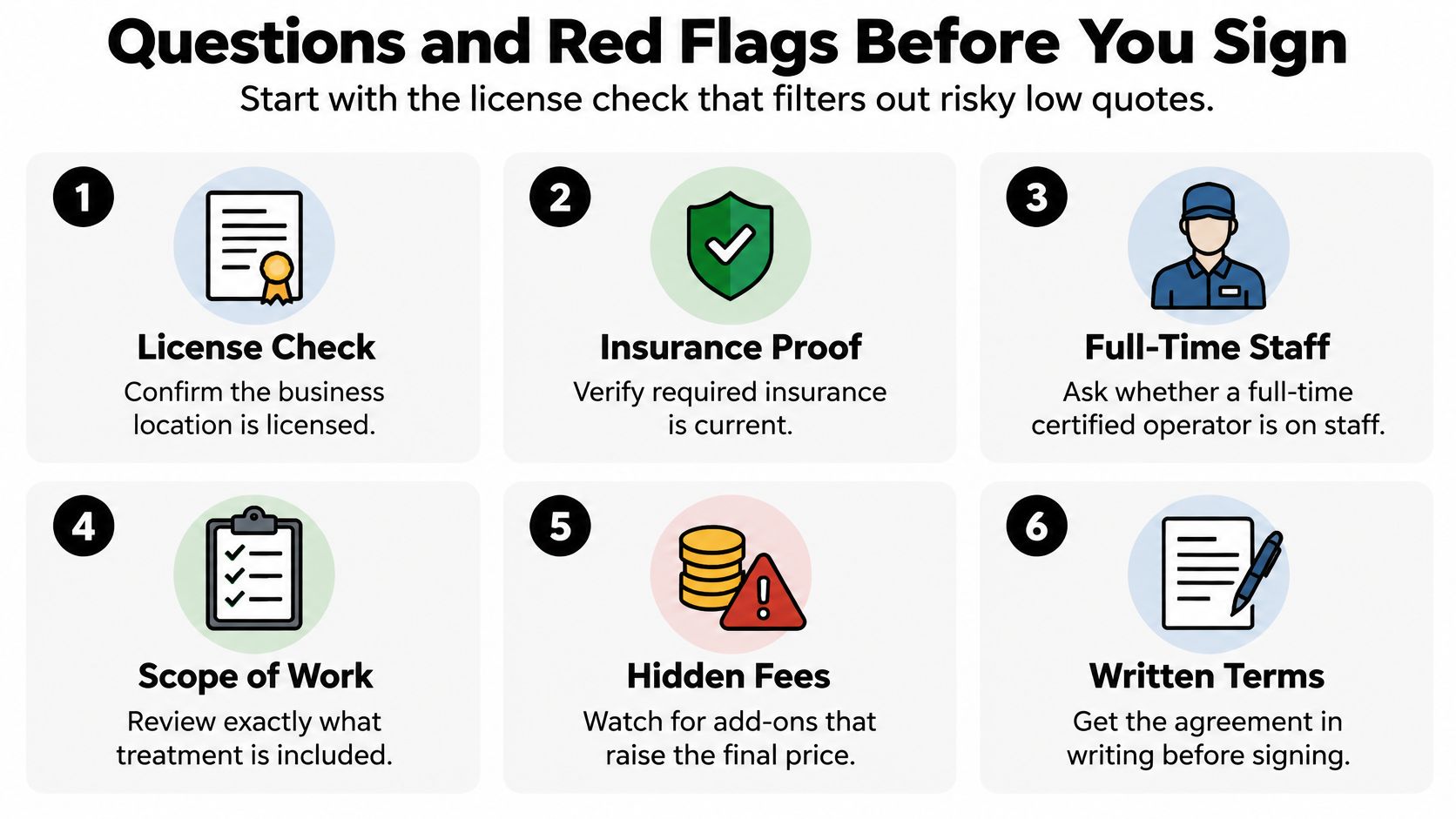
A cheap quote isn't a bargain if the business isn't authorized or insured for the work. Start with credentials before discussing discounts.
The Florida Department of Agriculture and Consumer Services licensing guidance requires structural pest-control business locations to be licensed, carry specified insurance, and have a full-time certified operator in charge. The relevant category matters: General Household Pest and Rodent Control isn't interchangeable with Termite and Other Wood-Destroying Organisms Control.
Use this checklist before accepting the agreement.
Verify the business and the proposed treatment
Match the licensed business location to the name on your contract. Check the insurance expiration date and the scope of coverage, not merely whether someone emails you a certificate. Residential mosquito contractors also need the appropriate business licensing and certified supervision.
Every provider we match holds the pest-control license required by Florida and carries active insurance. Our guide to choosing a licensed pest control professional provides additional context for reviewing credentials yourself.
Ask direct questions before treatment day:
- Products and placement: What active ingredients are proposed, are the products EPA-registered, and where will they be applied?
- Occupant instructions: What re-entry or ventilation instructions apply to this specific treatment?
- Sensitive occupants: What precautions are necessary for children, pets, aquariums, and anyone with relevant health concerns?
- Alternatives: Could traps, bait, exclusion, or localized treatment address the finding instead of a broad application?
- Warranty limits: What ends the warranty, which pests are excluded, and what customer duties affect coverage?
A statement such as safe for pets isn't an adequate instruction. You need the actual preparation, separation, and re-entry directions for the products and application method.
Recognize an incomplete offer
Treat a missing license number, refusal to provide written findings, or pressure to sign immediately as reasons to pause. Cash-only payment or full advance payment doesn't prove wrongdoing, but it warrants clearer documentation and careful review before you proceed.
Be especially cautious about guaranteed eradication after a single visit, a bed bug proposal without preparation instructions, or outdoor pesticide work offered without appropriate authorization. A provider should explain uncertainty rather than promise away access problems or reinfestation risk.
Don't trade documentation for a discount. If the contract doesn't establish the work, exclusions, and remedies, you may have little practical recourse when the result falls short.
Negotiating and Bundling Without Cutting Corners
A Hialeah landlord asks for one combined bid covering ants, roaches, and rodent entry repairs across adjoining rentals. Negotiate the scope and access terms, not just the headline number. Coordinated access, shared inspection work, and a written callback agreement can remove duplicated labor across connected units, and that saving usually outweighs what a headline discount is worth.
The landlord keeps the justified exclusion repairs and drops an exterior application the inspection never supported. That is a scope correction, not neglect.
Removing untested work from a proposal lowers the price. Removing the work that determines whether the treatment holds just pushes the cost into the next quarter, when the same pest problem returns with a second trip attached.
Negotiate logistics and coverage
Bundling pays when the work overlaps. A provider visiting connected units can inspect shared plumbing penetrations once and coordinate tenant preparation on a single schedule. Combining unrelated pests under one general plan does not automatically include specialty treatment or structural repairs, so ask what sits inside the scope in writing.
Requests worth putting on the table:
- Coordinated access: Offer a firm access window for adjoining units so the technician does not need separate return trips.
- Included callbacks: Ask whether monitoring and qualifying retreatment can be included instead of billed per visit.
- Appropriate frequency: Discuss less frequent scheduled service when inspection findings and monitoring support it.
- Transparent discounts: Establish whether an introductory reduction applies to the complete scope or only the initial application.
- Group bidding: Have an HOA or condo board request a consistent scope for participating properties without assuming every unit needs identical treatment.
For a yard with biting mosquitoes, keep Mosquito Control as a separately defined scope unless the agreement explicitly includes it. A household pest package rarely covers outdoor biting insects, and treating the two as the same line item is how homeowners end up paying twice.
Keep essential work intact
Identification, necessary access, justified sealing, and the written monitoring schedule stay in the deal. Those tasks establish whether the provider can deliver the result you are buying.
A better counteroffer: Match the inspected scope and callback coverage, not merely the competing headline price.
Contract length deserves the same scrutiny as the number. Our discussion of no-contract pest control can help you frame questions about flexibility, but the provider's written agreement determines your actual commitment.
For landlords, a bundled agreement should still identify responsibilities unit by unit. Record which resident must clear cabinets, who authorizes common-area repairs, and how the technician will report inaccessible spaces. A discount loses its value when poor coordination prevents completion, because the unfinished unit stays infested and the schedule slips for everyone else in the building.
Seasonal Timing and Prevention That Cut Repeat Visits
CDC surveillance recorded 642,602 reported cases of 16 mosquito-, tick-, and flea-borne diseases from 2004 through 2016, establishing a public-health reason for vector prevention beyond nuisance relief, though reporting and diagnostic practices affect those counts.
A service visit that lowers 12-month cost targets the pest and the inspected conditions with prevention and monitoring included in the scope.
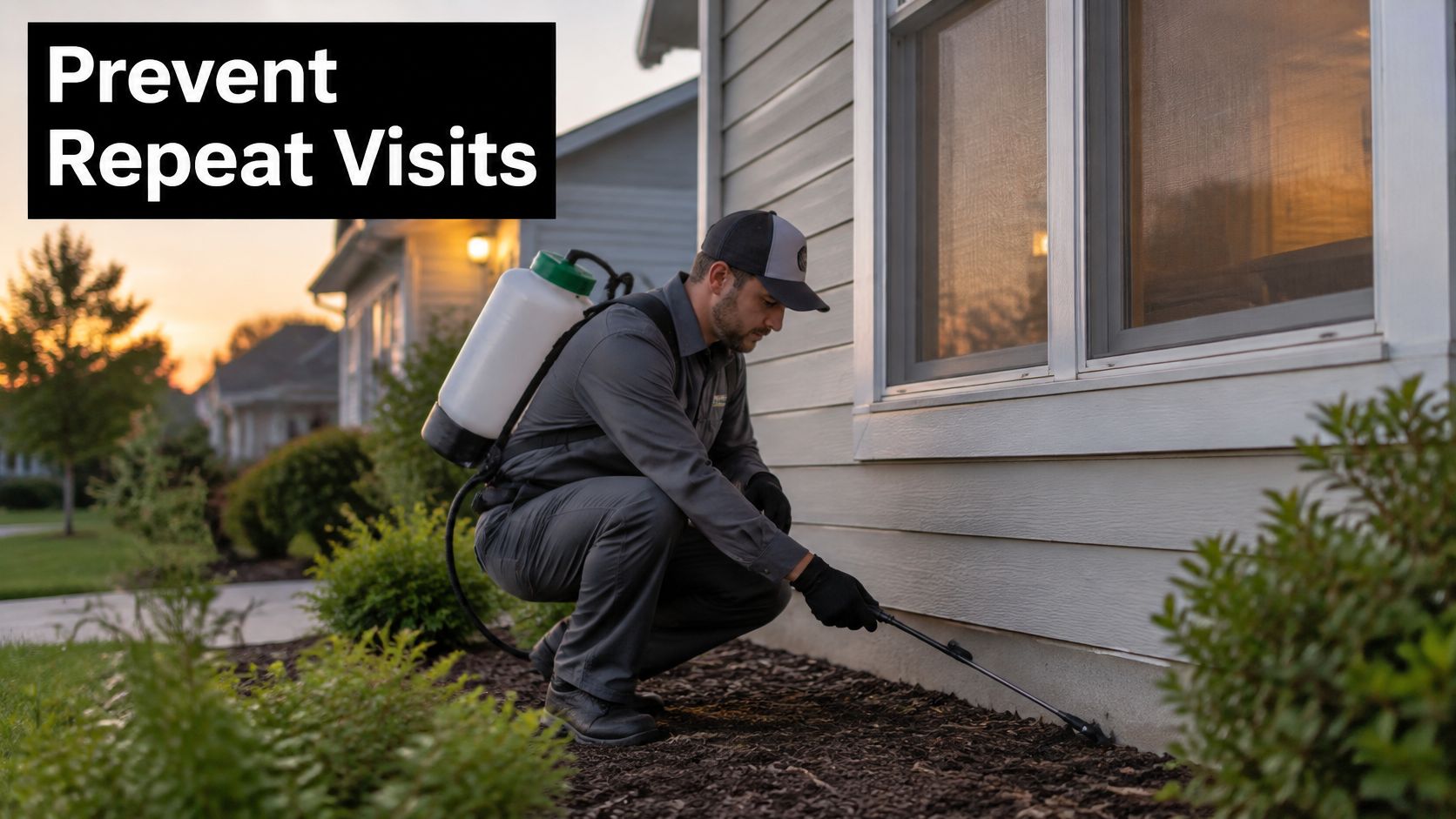
Treat this table as a planning checklist. Actual pest activity varies by property, structure, and moisture conditions.
| Season | Main Pest Pressure | Savings Action |
|---|---|---|
| Spring | Watch for termite swarmers and ant activity | Arrange an inspection when evidence appears; choose ant bait after identification |
| Early summer | Watch mosquitoes and moisture-associated roach activity | Remove breeding sources and reassess service needs after rain |
| Hurricane season | Check for storm damage and newly exposed entry points | Repair accessible gaps before storms and inspect afterward |
| Peak summer | Monitor mosquitoes and roaches around wet, sheltered areas | Clear standing water and ask about flexible appointment windows |
| Fall | Inspect for rodent entry and sheltering activity | Complete justified exclusion and coordinate trapping |
| Winter | Continue checking indoor ants and roaches | Review monitoring records and negotiate the next service agreement |
Prevent the conditions that generate callbacks
Inspect buckets, plant saucers, tarps, gutters, and drainage areas after rainfall. Mosquito source reduction means eliminating standing water or treating it with an appropriate larvicide to stop the next generation. Products stay on your own property and within label directions. Shared drains, neighboring lots, and water bodies need authorization first.
Inside, repair leaks, dry persistently wet cabinet areas, and keep food and trash contained. Outside, trim vegetation away from walls and maintain seals around pipes, vents, and doors while preserving designed drainage and ventilation. Small gaps stay open for repeat ant or roach pressure. Sealed entry points and dry storage cut return trips.
For rental hosts and property managers, cleaning instructions should list food residue removal, waste handling, and maintenance reporting. Vague requests to keep things tidy get ignored. WipesBlog.com's discussion of how to protect customer confidence through cleanliness offers housekeeping context, but a suspected drain-related roach problem still needs inspection rather than improvised chemical treatment.
This video offers another visual reference for pest-control planning.
Schedule around evidence and access
Book an inspection before a renovation conceals suspect wood or closes access to problem areas. After storm repairs, have the relevant entry points checked before assuming the building is sealed.
Ask whether flexible scheduling or quieter appointment periods change the quote. An active infestation should move forward on evidence, because delay usually adds treatment time and cost. Use the winter window to review monitoring records before renewal.
Our guide to sustainable pest management supports the same practical objective: make prevention and monitoring part of the job so chemical treatment is not your only response.
Pestless Inc. connects Miami homeowners with licensed, insured local pest-control professionals for free, no-obligation quotes. Visit Pestless Inc. to describe your pest problem and get matched, then compare the written scope, follow-up terms, and total annual commitment before choosing a provider.
Dealing with this pest right now?
Pestless connects you with a licensed, insured Miami pest control provider for a free, no-obligation quote.