You wiped the counters last night, took out the trash, and sealed the sugar. This morning there's a fresh line of ants marching from the sink base to the pantry, and spraying it will only clear the counter for an hour. That pattern usually means an ant infestation kitchen problem isn't about the crumb you missed. It's about water, a hidden entry point, or a nest you can't reach, and finding that source first is what stops the trail from coming back.
Table of Contents
- Find Where the Ants Enter Your Kitchen
- Identify Which Ant You Have Before You Treat
- How to Clean and Seal the Kitchen in Order
- Why Ants Keep Returning After You Clean
- How Bait Works and When to Change It
- Decide Whether to Call a Licensed Pro
Find Where the Ants Enter Your Kitchen
A trail that reappears every morning is a set of directions to the nest. Pick one trail and follow it before you clean anything. Use a flashlight at dawn or after dark, when foragers are moving, and walk the line slowly from food to disappearance point. Don't wipe it yet, because the route is your map.
Mark the start, any crack, and the spot where ants vanish with small pieces of painter's tape. Note the nearest sink, appliance, pet bowl, or pantry item, and count how many separate areas show activity. A 2018 Mauritius kitchen survey found that 88% of respondents defined an infestation as large numbers of ants appearing in multiple areas of a home. A few ants on one counter is usually a nuisance visit. Trails in the pantry, at the sink, and along a baseboard point to something established.
Turn the trail into a source check
| Where the trail runs | Likely source | First check |
|---|---|---|
| Along the sink base | Slow leak or damp cabinet floor | Dry the cabinet and look for a drip under the trap |
| Behind the dishwasher or refrigerator | Spilled food or condensation under the unit | Pull the kickplate and check the drain line and drip pan |
| Up the wall near a window or outlet | Gap in a wall void or utility penetration | Follow the trail to the exact point it enters |
| Around a switch plate or outlet | Nest in a dark electrical void | Remove the cover plate and look inside with a light |
| From the pantry to the counter | Open or poorly sealed food package | Check every pantry package and container |
| Near a door threshold or foundation | Satellite nest in soil or mulch | Inspect mounds and the soil next to the entry |
Most kitchen trails resolve to one of three causes: moisture, a gap in the structure, or reachable food. If you're still unsure how ants are getting into the house, this table gives you the first place to look for each pattern. Our ant control inspection follows the same logic, checking indoor voids, exterior mounds, and moisture sources to locate the colony itself.
Practical rule: If the trail ends inside a wall, cabinet, or outlet box, stop tracing. That endpoint usually means the colony sits behind the surface you're cleaning.
Identify Which Ant You Have Before You Treat
Two trails can look identical on the counter and still be opposite problems. A ghost ant trail heading for a sweet spill clears up with bait and cleaning, while carpenter ant workers in the same spot mean a colony sitting inside damp wood. Reaching for the spray can first scatters workers, erases the route back to the nest, and wastes bait on a species that ignores it.
Name the ant before you buy anything.
Start with size and color. Put a coin or ruler beside one worker, note whether the head, body, and legs are the same shade, and photograph it against white paper in good light. Then check the supporting signs: frass that looks like coarse sawdust points to carpenter ants, raised soil mounds outside a door point to fire ants, and workers pouring from an outlet or switch plate point to a void nester. Match your photo against the ants common in Florida homes before you reach for a product.
Common kitchen ants in Miami and their first move
| Ant | How to recognize it | Kitchen sign | Right first move |
|---|---|---|---|
| Ghost ants | Tiny, dark head and abdomen with pale legs | Trails along outlets, switch plates and sinks | Map the trail, clean, and use labeled bait; do not spray |
| Sugar ants | Small, brown to yellowish-brown | Straight trails to sweet spills, honey and pet food | Clean sweet spills, seal sugar, then bait beside the trail |
| Carpenter ants | Clearly the largest ant on this list, roughly rice-grain length or longer, black or dark red-black | Sawdust-like frass near damp or hollow wood | Call a licensed pro, since the nest is in wood |
| White-footed ants | Small, dark brown to black with whitish legs | Kitchen trails that follow moisture | Fix the moisture, seal entries, then use bait |
| Red imported fire ants | Reddish-brown, with workers of noticeably mixed sizes | Raised mounds outdoors and trails near doors | Do not disturb mounds; follow the label or call a pro |
The identification also tells you where the colony sits: in wood, in a soil mound, or inside a wall void. That location decides whether your fix is a moisture repair, a sealed entry point, or a professional call, which is why a correct ID saves a second round of cleaning and baiting.
If the photo still will not give you a firm answer, treat the ant as unknown. Clean, seal, and hold off on broad sprays until the identification is firm. I would rather see you wait a day for a clear photo than push an unidentified colony deeper into a wall.
How to Clean and Seal the Kitchen in Order
Clean first and you will clean twice. Wiping a trail before you map it erases the route back to the entry point, and spraying before you seal just moves the column to the next crack. The EPA integrated pest management toolkit favors bait and crack-and-crevice treatments over aerosol, broadcast, baseboard, fogging, or volatile applications, and the sequence below follows that approach. Do each step fully before moving to the next.
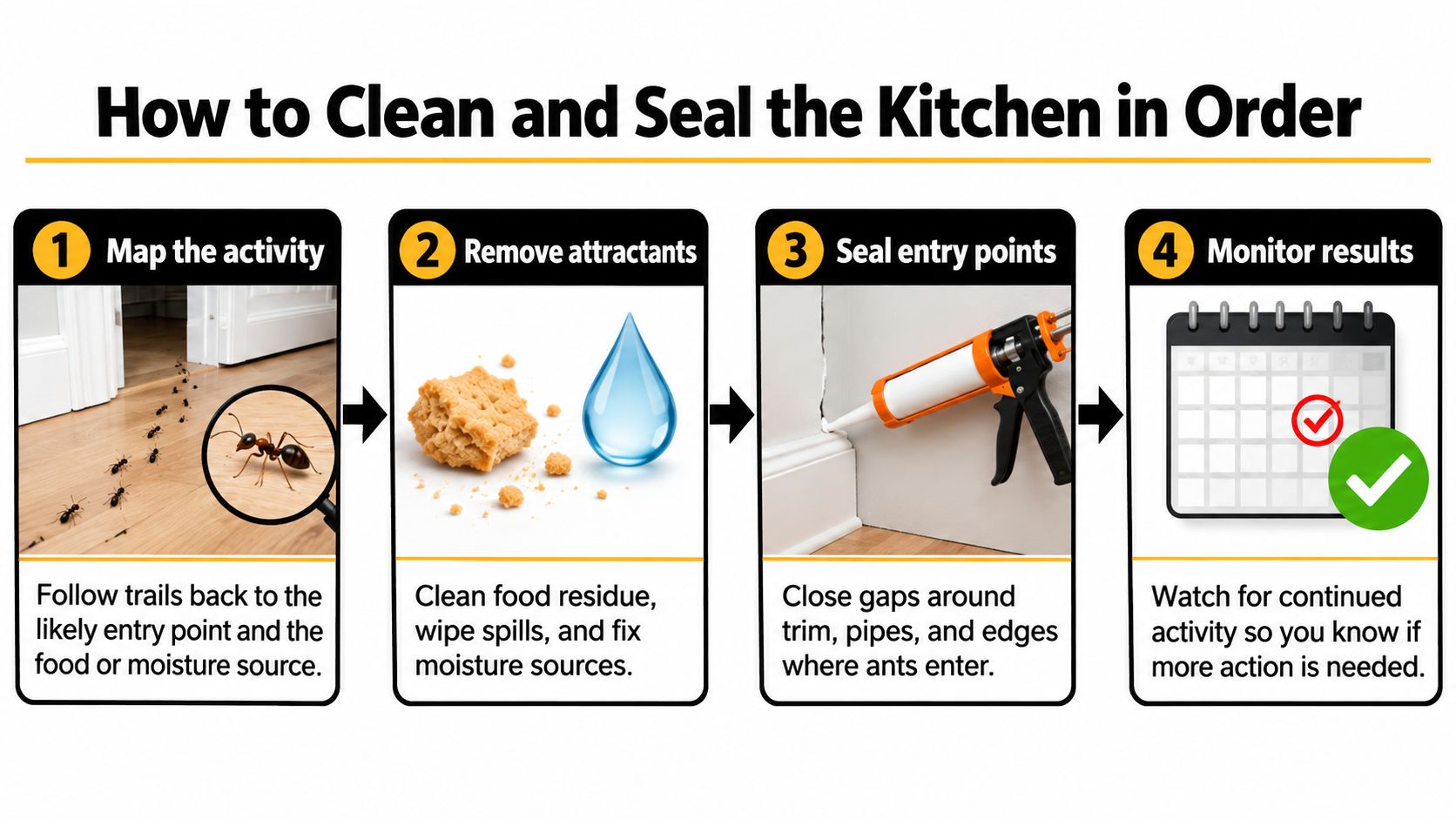
The six steps in sequence
- Map the activity first. Follow each trail to the likely entry point and to the food or moisture source it serves, then tape-mark both endpoints. The common slip is cleaning immediately, which erases the route you needed to find the source.
- Remove attractants. Clean crumbs, grease, sweet spills, appliance undersides, sinks, trash cans, and recycling containers. Pull the toaster and stove forward if you can, and check the drip tray under the refrigerator, since that's an often-missed spot. If regular degreaser won't shift baked-on residue, read up on when stubborn grease needs professional cleaning rather than leave a food film behind appliances.
- Store food in tightly sealed containers. That includes cereal, flour, sugar, rice, and pet food in torn bags. A clip on a bag isn't a seal an ant respects, so use rigid containers with gasket lids.
- Wipe visible trails with soapy water. This removes the pheromone cue guiding other workers to the same food. Do it only after mapping, and don't wipe a trail you're about to bait, because workers need that route to find the bait.
- Seal entryways. Close cracks, plumbing penetrations, cabinet joints, and gaps around pipes with caulk or sealant suited to the gap size. Work slowly along baseboards, backsplash seams, and the holes where supply lines enter the sink cabinet. Small gaps matter, since ghost ants pass through openings you'd barely notice.
- Place labeled bait beside undisturbed trails. Use a gel, paste, or containerized bait exactly as labeled, right beside the route rather than on top of it. Don't spray insecticide on or near bait, because contamination can repel foragers and stop workers carrying it back.
How you'll know it's working
Go back to the tape marks. A sealed joint that stays trail-free is doing its job, while a fresh trail at the same endpoint means a gap you missed or a second entry nearby. The most common failure is spraying visible workers with a repellent product: activity drops briefly, and the nest keeps sending foragers through a crack you haven't found yet.
A steady drop in foragers at the marked endpoints, with no new trails opening in areas that were clear, means the routine is working.
Why Ants Keep Returning After You Clean
A spotless kitchen that still gets ants isn't proof you're cleaning badly. It usually means the colony isn't living on your crumbs. EPA ant guidance identifies moisture control as equally central, noting that small plumbing leaks, standing water, condensation, wet cabinet voids, and grease or food debris around appliances can sustain pests. Removing food reduces foraging, but persistent moisture, an open entry, or a nest in a wall or utility void keeps workers coming.
In South Florida humidity, a slow drip under a sink or condensation on a cold line can support a colony through weeks of perfect counter cleaning. That's why I would audit water before buying another spray.
Work the moisture audit outside in
- Hose bibs and condensate line: Look for pooling water, wet soil against the foundation, or mulch touching the wall near the kitchen.
- Wall penetrations: Check where pipes and cables enter for dark staining, soft drywall, or unsealed gaps.
- Sink cabinet: Feel the floor under the trap and supply lines, and check whether the kickplate stays damp.
- Refrigerator: Inspect the drip pan, water line connection, and condensation on cold pipes behind the unit.
- Behind the stove: Grease and debris collect there and hold moisture against the wall.
Then run three weekly checks. Wipe the sink base dry and look for a returning damp stain, run the dishwasher and inspect the drain hose at the end of the cycle, and tape-mark each damp spot so you can recheck the exact place. Fix any moisture you find, wait one week, and see whether the trail fades before adding product. If it doesn't fade after the leak is dry, the nest itself is likely inside the structure.
How Bait Works and When to Change It
Bait works because workers do not die at the counter. They feed, carry bait back, and share it through the colony, so treatment reaches ants you will never see. Our approach uses slow-acting, non-repellent baits that workers carry back to the queen, which is why patience matters more than instant knockdown.
Keep bait stations out of reach of children and pets and follow the label. The EPA ant training module notes that bait preference can require trial and error, baits must remain fresh, trails should stay undisturbed, and some infestations need sustained maintenance over time. Once the bait is set where the trail runs, the work that remains is timing: how long to leave it, when to switch formulations, and when to reassess.
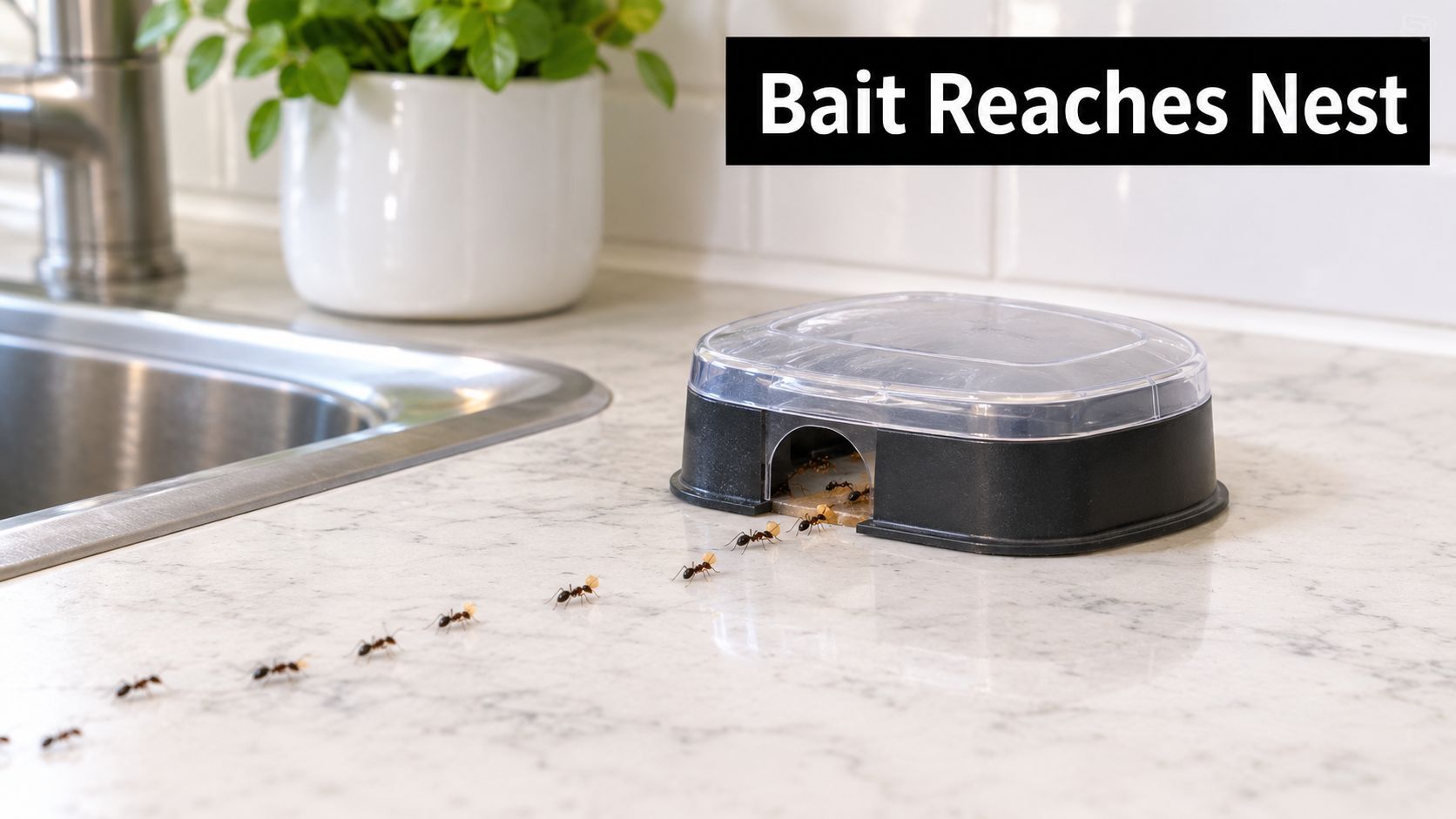
More ants at the bait in the first days usually means workers are recruiting nestmates to the food source. Heavier feeding is a sign the bait is on its way back to the colony. Florida ghost ants add a complication, since they can nest in dark voids including switch plates and electrical outlets, so bait left on the floor may never be found. When the trail disappears into a void, set the bait at the opening the ants are using rather than across the room.
Bait timeline and what to do at each stage
| Days after placing bait | What you should see | Action |
|---|---|---|
| Days 1 to 2 | More ants at the bait is normal | Leave it down and watch where traffic concentrates |
| Days 3 to 5 | Visits begin to taper as workers feed the colony | No action needed while the trail thins; the colony is being fed |
| Days 6 to 10 | Activity still heavy with no clear drop | Test a different bait formulation where feeding was strongest |
This short video shows how workers recruit to bait and carry it back, which helps you judge normal feeding against a bait ants are ignoring.
If activity is unchanged after about two weeks of fresh bait, look for a disturbed trail, an open entry, or a satellite nest. At that point, species identification or a licensed inspection tells you more than a third over-the-counter product will.
Decide Whether to Call a Licensed Pro
Sanitation, sealing, and labeled bait suit a small trail from one food or moisture source with no nest visible in a wall. Beyond that boundary, DIY usually manages symptoms while the colony stays protected. Ant Control through a licensed provider is built around treating the colony, not just the trail, and covers ghost ants, white-footed ants, carpenter ants, and red imported fire ants.
When to handle it yourself and when to call a pro
| Situation | Handle it yourself | Call a licensed pro |
|---|---|---|
| Few ants on one counter, no damp areas | Sanitize, seal and place labeled bait | Only if the trail persists after two weeks of correct baiting |
| Ants from a wall, outlet or cabinet void | Remove the cover plate and seal visible gaps | Yes, the nest is probably out of reach |
| Large black ants with sawdust or hollow wood | Do not treat it yourself | Yes, carpenter ants can damage structure |
| Fire ant mounds near a door or foundation | Do not disturb the mounds | Yes, or follow the label exactly |
| Ants return after a leak repair or sealing | Recheck moisture and entry points | Yes, to inspect hidden voids |
| Rental, condo or multi-unit building | Report the problem to the manager or board | Yes, treatment often has to be coordinated across units |
Renters and condo owners should tell the manager or board early, since ants move between units through shared plumbing and wall voids. When hiring, ask for species identification before any product is applied, confirm the provider is licensed and insured, and check our guidance on choosing a licensed pest control professional. Pestless isn't a pest control company and doesn't perform treatments. We connect Miami-area homeowners with licensed, insured local providers, and our blog offers six free Miami ant guides, including guides on ghost ants, sugar ants, carpenter ants, and winter ants.
Providing details such as when the pest was first noticed and how widespread it seems helps your matched provider prepare. Today, photograph the trail and one ant against white paper, finish the moisture check, and request an inspection if any table row applies.
If your trail leads into a wall, outlet, or damp cabinet void, visit Pestless Inc. to get matched with a licensed, insured Miami provider who will identify the species and inspect the moisture source before treating. Tell us when you first saw the ants and how many areas they're in, and we'll route your request so you can compare a no-obligation quote and choose with confidence.
Dealing with this pest right now?
Pestless connects you with a licensed, insured Miami pest control provider for a free, no-obligation quote.