You've just found a termite swarm near the patio, or you're seeing palmetto bugs in the kitchen every night. A real-estate closing may be approaching, a tenant may be complaining, or your HOA board may be demanding action. The fastest phone number you find may also be the riskiest one to hire.
A licensed pest control professional isn't defined merely by a company logo or a “licensed” claim in an online listing. In Florida, you need to check the business license, the service category, the technician's credential status, and the provider's insurance documentation. That small audit can protect your property, your occupants, and your transaction from a treatment performed by the wrong person with the wrong product.
Table of Contents
- What Unlicensed Pest Control Can Cost Miami Homeowners
- Defining a Licensed Pest Control Professional in Florida
- How to Verify Licenses and Active Insurance
- Minimum Service and Contract Standards to Expect
- Why Local Expertise Matters in Miami-Dade County
- How Pestless Vets and Matches Homeowners to Providers
- Essential Questions to Ask Before Hiring
What Unlicensed Pest Control Can Cost Miami Homeowners
A Miami homeowner once called a low-cost operator after seeing winged insects near a window. The operator arrived quickly, gave a vague explanation, and proposed spraying around the home without a written scope, product information, or proof of insurance. The homeowner focused on the immediate price. The larger financial question was left unanswered: did the property need termite treatment, another wood-destroying-organism service, or a response to a different pest?
That shortcut can turn a small pest problem into a costly property problem. An improper application may damage finishes, affect a tenant, harm a pet, or leave the infestation active. If the work later causes a dispute, the homeowner may struggle to establish responsibility or recover the cost.
Practical rule: Treat licensing and insurance as part of the service, not as paperwork you check after treatment.
Florida requires a pest control business to be licensed before operating and to renew its license annually for each licensed business location, as set out in the Florida pest control statutes. For a homeowner, that requirement creates an accountable business behind the work. Without it, a complaint, reimbursement request, or damage claim may lead only to a phone number and a first name.
The consequences often appear later, during a transaction or dispute. A failed termite treatment can delay or complicate a closing when the buyer, lender, or inspector expects satisfactory documentation. A poorly documented service can leave a property manager unable to answer a tenant's safety question. An HOA board may face arguments over whether it hired an authorized provider and whether the provider had insurance for damage or injury.
Cheap service can become expensive evidence
Licensed pest control has been regulated for generations. California's structural pest control act passed in 1935, after about 25 reputable operators organized in 1932 to push for stronger standards, according to the California pest control industry history. The framework introduced examinations, licensing, reporting, and work criteria, helping define pest control as a regulated trade rather than an informal handyman service.
The recommendation is direct: reject a low quote when the provider cannot document authority for the work, identify the product used, or explain what insurance would cover if something goes wrong. A cheap treatment that fails, creates liability, or disrupts a sale is not a saving. It is an avoidable property expense.
Defining a Licensed Pest Control Professional in Florida
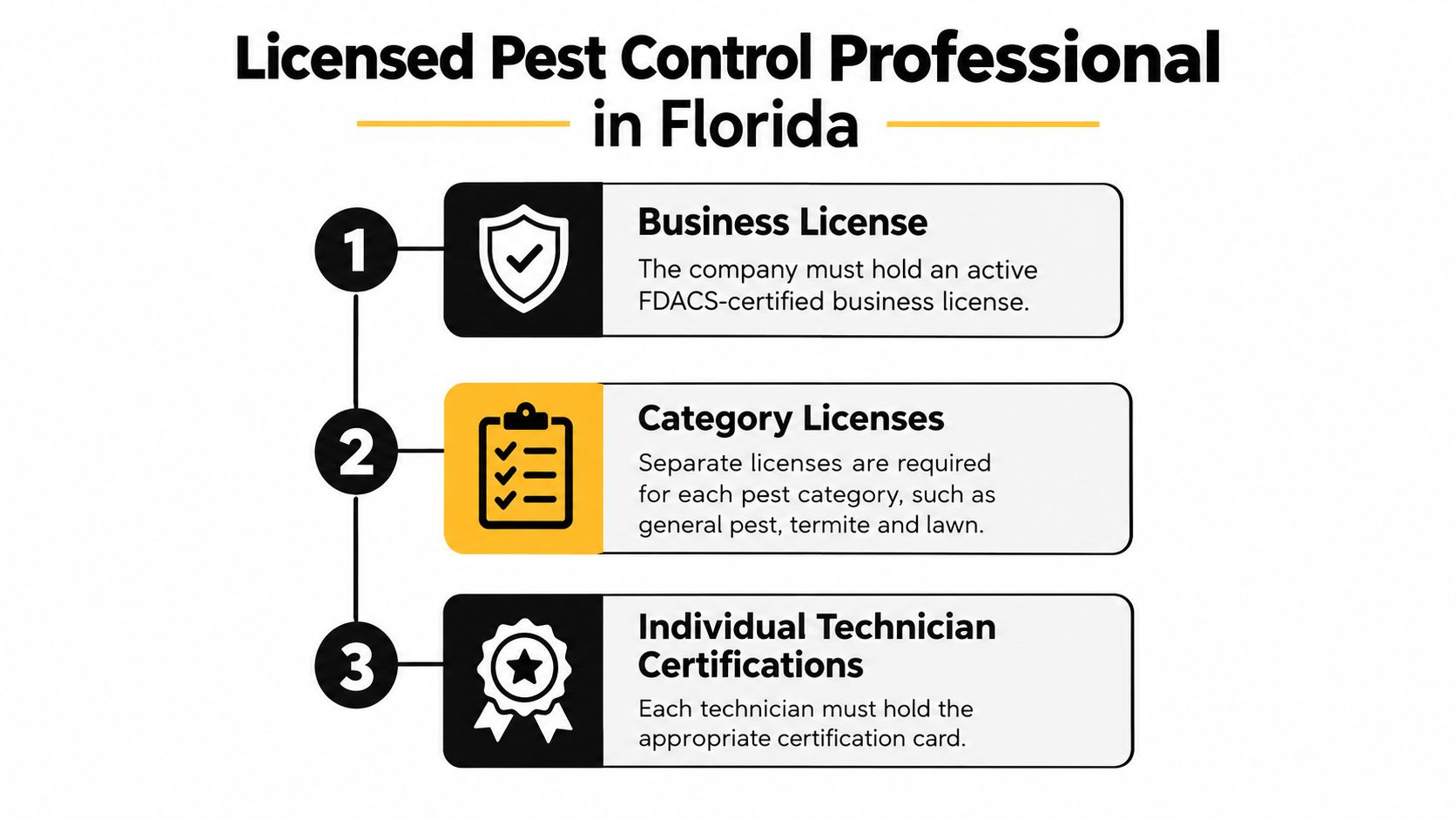
Florida licensing has layers. The company's authorization and the technician's credentials are related, but they aren't interchangeable. Asking only, “Are you licensed?” leaves the most important question unanswered: licensed to perform which service, and who will apply the product?
A business must hold an active license for each licensed location before it operates. That establishes the company's legal standing. It doesn't automatically prove that every person sent to your property holds the appropriate individual credential for the work being performed.
Match the credential to the treatment
The next layer is the service category. A company handling structural pests, termites, or lawn and ornamental applications needs authorization appropriate to that work. A general pest service authorization shouldn't be treated as a universal permission slip for every pesticide application.
Federal rules add another control. Anyone who applies or supervises restricted-use pesticides must be certified as a private or commercial applicator under EPA rules. EPA guidance also requires each company to have at least one certified, licensed commercial applicator in the proper service category. Other applicators may be certified or work under direct supervision.
That supervision model changes the practical question you should ask. Don't just ask whether the company has a certified person somewhere in the organization. Ask whether the lead applicator assigned to your property is certified for the category your treatment requires and whether the technician performing the work is operating under the required supervision structure.
The distinction appears across state systems. Louisiana requires non-licensed workers performing pest control to register as structural pest control technicians, while North Carolina uses a registered-technician route involving training and on-the-job supervision before full certification. The specific labels differ, but the consumer lesson is consistent: the business credential and the on-site worker's status can be different things.
Why property managers need an audit trail
A homeowner may be satisfied with a verbal answer. A property manager, landlord, or condo board needs documentation that can be stored with the property file. Record the company's legal name, licensed location, service category, assigned technician, supervising applicator, product information, and insurance status.
For a plain-language overview of the state-specific distinction, review this guide to Florida pest control licensing. If the problem involves biting insects in the yard, Mosquito Control is a distinct service category to discuss with the provider, rather than assuming every general pest license covers the same work.
How to Verify Licenses and Active Insurance
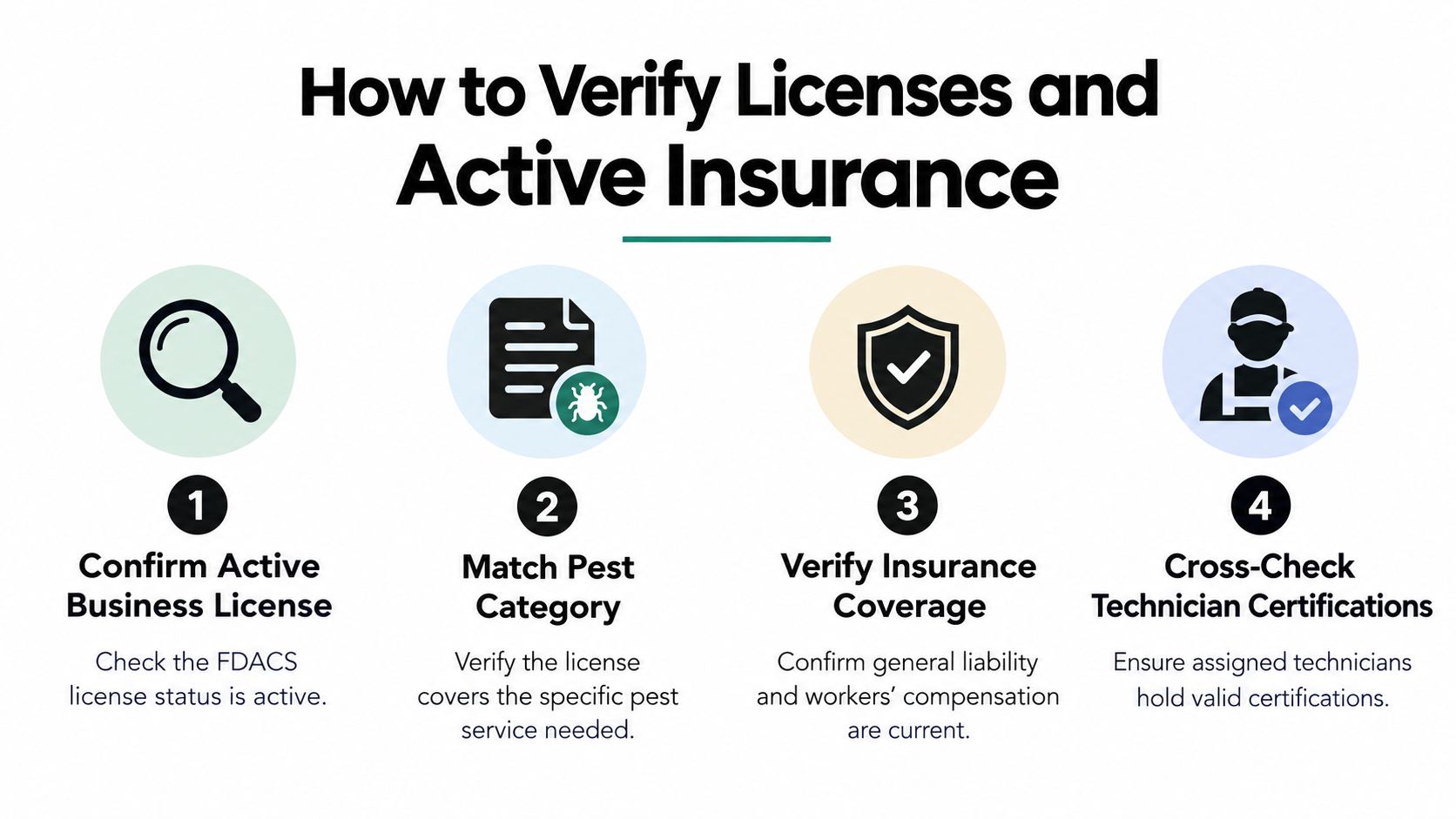
Verification should happen before the technician arrives, not after a problem develops. A professional provider should be able to give you its legal business name, license information, service category, assigned technician details, and insurance documentation without evasion.
Use this four-part check
Confirm the business license. Search the relevant Florida licensing records and make sure the status is active. Check that the legal business name and licensed location match the company that gave you the quote. Florida renews each licensed business location annually, so an old certificate or a screenshot without a current status isn't enough.
Match the pest category. Identify the actual job first. Termites, structural pests, lawn and ornamental work, and mosquito services may involve different category requirements. Ask the provider to state the category covering your treatment, then compare that answer with the license information.
Verify the technician and supervisor. Ask who will perform the application and who holds the applicable commercial applicator certification. If a technician works under supervision, ask the company to explain that arrangement and provide the relevant registration or certification information.
Request current insurance documents. Ask for a Certificate of Insurance, commonly called a COI, showing the insured business name, policy dates, and relevant coverage. General liability insurance matters because pesticide work can create property and bodily-injury claims. Workers' compensation documentation also matters when employees will work on your property.
Illinois requires a commercial structural pest control business license plus proof of insurance, and Ohio requires proof of general liability insurance for pesticide use. Those state examples reinforce a sensible buying standard for Florida customers: don't separate licensing from financial responsibility. For a broader contractor-insurance reference, PIA helps Florida contractors explain why coverage documentation deserves a place in the hiring process.
Read the documents, don't collect them
A COI isn't a guarantee that every possible loss will be covered. It does show whether the provider has supplied current evidence of insurance and whether the named business matches the party you're hiring. If the certificate is expired, lists another company, or omits the type of work involved, stop and ask for clarification.
EPA guidance recommends requesting a copy of the pest control license and pesticide labels before work begins. You can also use this Florida license verification guide as a practical checklist. Keep the documents with your closing file, rental records, or HOA maintenance records.
Minimum Service and Contract Standards to Expect
A professional proposal should tell you what the provider believes is happening, what it plans to do, and what happens if the problem returns. An unlicensed or underinsured operator often offers only a price and a promise. That isn't a treatment plan.
Start with the scope. The written agreement should identify the target pest, the areas to be inspected or treated, access requirements, preparation instructions, and exclusions. If the provider hasn't inspected the property or asked meaningful questions, it can't responsibly promise that a generic spray will solve a specific infestation.
Compare the paperwork before the price
| Standard | Professional expectation | Warning sign |
|---|---|---|
| Pest identification | The proposal names the suspected pest and explains the inspection basis. | “Bugs” or “insects” with no defined target. |
| Treatment scope | The document identifies locations, methods, and customer preparation. | A blanket promise to spray everything. |
| Product records | The provider identifies the EPA-registered product and supplies label information when requested. | The applicator refuses to name the chemical. |
| Safety instructions | The company explains precautions for children, pets, occupants, and reentry. | No written instructions. |
| Retreatment terms | The warranty or retreatment policy states what is covered and what is excluded. | “We'll come back if needed” with no conditions. |
| Pricing | Charges and possible additional work are stated clearly. | A low starting price followed by pressure on site. |
The product label controls how a pesticide may be used. Ask for the label or product name before approving work, especially if the treatment will occur indoors, near food preparation areas, around a child's play space, or near pets. The licensed professional should also explain preparation steps, ventilation, reentry, and any need to remove occupants temporarily.
The contract should make the treatment auditable by someone who wasn't present for the application.
A good warranty doesn't mean every future pest sighting is covered. It should define the covered pest, service area, customer responsibilities, follow-up process, and exclusions such as new construction defects, moisture problems, or untreated neighboring areas. Read those terms before authorizing the job.
For a property sale, retain the inspection report, treatment proposal, product documentation, invoice, and completion record. Buyers, lenders, landlords, and association boards may need a clear record of what happened and which provider performed it.
Why Local Expertise Matters in Miami-Dade County
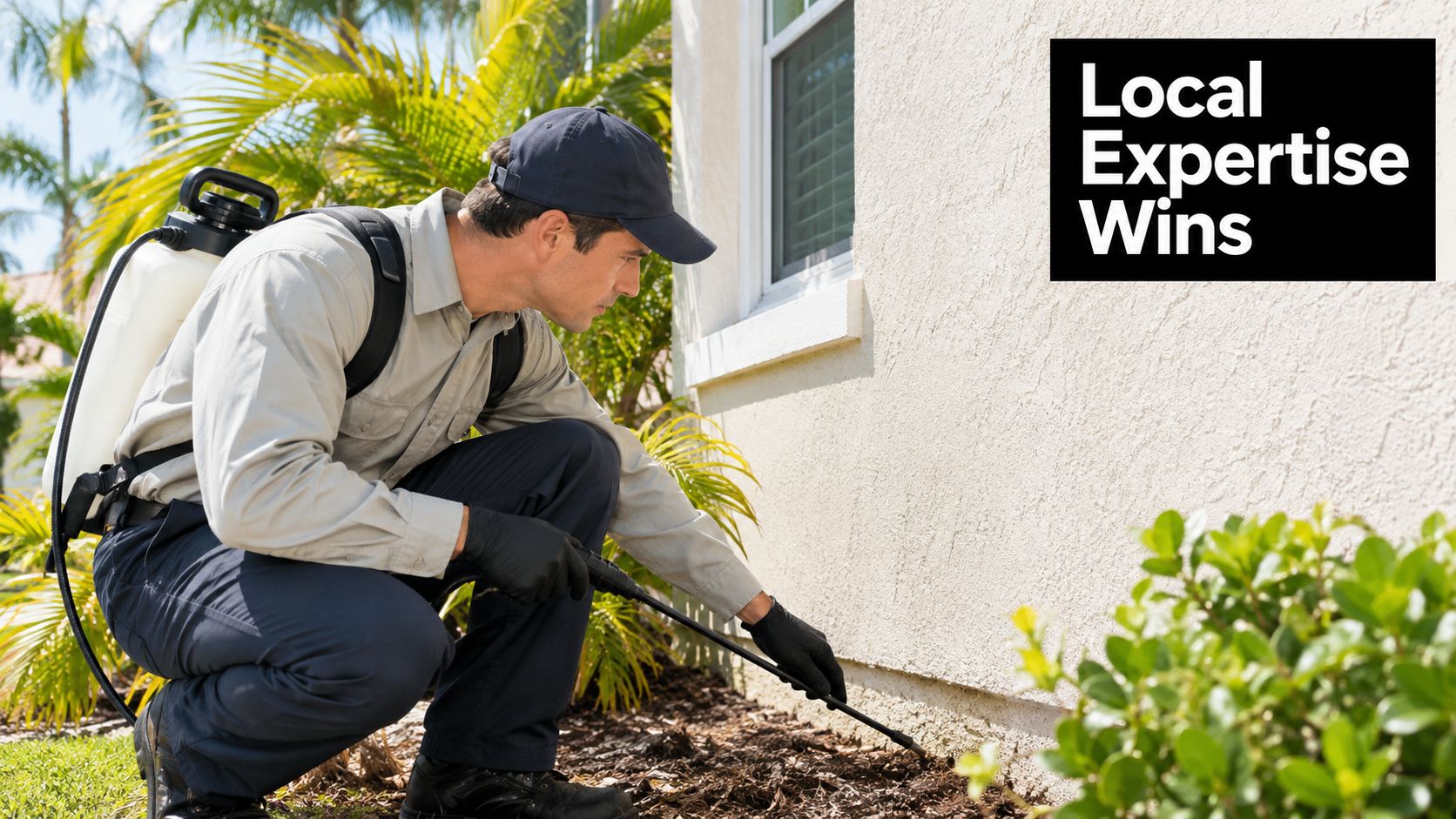
Miami-Dade properties don't behave like properties in a dry inland market. Warm, humid conditions, heavy rainfall, dense development, vegetation, drainage patterns, and building design all affect where pests find food, moisture, and shelter. A licensed provider still needs local field judgment to turn a valid credential into an effective treatment plan.
A Brickell condominium may have shared walls, mechanical spaces, trash rooms, balconies, and association-controlled access. A single-family property in Kendall or Doral may have a larger lot, irrigation, detached structures, dense landscaping, and multiple exterior entry points. The license category must fit the work, but the inspection must also fit the property.
Local diagnosis beats a generic route
Ghost ants can move through wall voids and utility penetrations. Termites require attention to wood, moisture, construction details, and conditions that may support hidden activity. Mosquito pressure depends on standing water, landscaping, drainage, and the use patterns of the outdoor space. Rodent work may require exclusion, sanitation changes, and inspection of rooflines, garages, attics, and utility openings.
That's why a property manager shouldn't order “standard pest control” without describing the site. Tell the provider whether the building is a condo, rental, short-term rental, commercial property, or detached home. Mention recent renovations, leaks, landscaping, neighboring construction, prior treatments, and any restrictions on access or chemical use.
The right local provider will connect those details to the service category and the treatment record. It won't treat a Miami-Dade property as an interchangeable stop on a route.
For a closer look at how a licensed team approaches a property, review this short video before you compare proposals.
Ask for a plan that separates immediate control from correction of the conditions attracting pests. A treatment may reduce visible activity, but cracks, moisture, food access, damaged screens, or unsealed penetrations can keep the problem alive. Local expertise helps the provider identify those conditions without pretending that one application solves every property defect.
How Pestless Vets and Matches Homeowners to Providers
Manual vetting takes time, particularly when you're dealing with a termite concern before closing, a tenant complaint, or an infestation in a vacation property. You need to confirm more than a company name. You need the appropriate Florida license, the service category, active insurance, and a provider familiar with the property's neighborhood and pest conditions.
Pestless Inc. is a matching service, not a pest control company. Homeowners describe the issue through a short form or phone call, and Pestless routes the request to local providers that hold the relevant Florida licensing and active insurance information. The homeowner can then compare quotes and decide which professional to hire.
A useful filter for time-pressured decisions
The value of a matching service is not that it eliminates your responsibility. You should still ask for the documents, confirm the treatment category, and read the contract. The advantage is that the initial pool of providers has already been screened around the credentials most homeowners forget to check.
Pestless serves Miami and Miami-Dade County homeowners, landlords, property managers, homebuyers, sellers, short-term rental hosts, and HOA or condo boards. Requests can cover termites, cockroaches, ghost ants, rodents, mosquitoes, or bed bugs. The service supports zero-cost, no-obligation quote comparisons, with typical responses within one business hour during its stated operating period of Monday through Saturday, 7 a.m. to 9 p.m. Eastern Time, as described by Pestless.
That process is useful when speed matters but documentation still matters more. Give the service enough detail to route the request correctly, including the pest, property type, location, urgency, previous treatment, and any real-estate or association deadline. Then treat each quote as a proposal to audit, not as an automatic approval.
Essential Questions to Ask Before Hiring
Use the first phone call to expose gaps. A credible company won't object to specific questions about licensing, supervision, insurance, products, or retreatment. An evasive answer is a hiring signal, and you should move on.
Ask these questions in order:
What is the company's exact legal name and licensed business location? Compare the answer with the license record and the name on the quote and invoice.
Is the business license active for the location serving my property? Florida's location-specific renewal structure makes this more useful than accepting an old certificate.
Which license category covers this treatment? Make the provider name the category for termites, structural pests, lawn and ornamental work, mosquito service, or another specific job.
Who will perform the application? Get the technician's name and ask whether that person is registered, certified, or working under direct supervision.
Who is the certified lead applicator? Ask whether the supervisor holds the correct category for the treatment being proposed.
Can you send a current Certificate of Insurance? Check the insured name, policy dates, general liability coverage, and workers' compensation documentation where applicable.
Which EPA-registered product will you use? Request the product label and ask where and how it will be applied.
What must I do before and after treatment? Get written instructions for pets, children, food, ventilation, reentry, and preparation.
What does the warranty or retreatment policy cover? Ask about exclusions, follow-up timing, customer responsibilities, and additional charges.
What will I receive after the visit? Require an invoice, service report, treatment locations, product record, and any recommendations for repairs or exclusion.
If you're managing a larger transaction or association contract, keep a separate legal review for unusual liability terms. A resource covering questions to ask a Miami business lawyer can help frame broader vendor questions, although it doesn't replace confirmation with Florida's licensing authorities or your own attorney.
Pestless Inc. connects Miami-Dade homeowners, landlords, property managers, and boards with licensed, insured pest control professionals for zero-cost, no-obligation quote comparisons. Describe the problem and visit Pestless Inc. to start with a vetted local provider instead of gambling on the first unverified number.
Dealing with this pest right now?
Pestless connects you with a licensed, insured Miami pest control provider for a free, no-obligation quote.