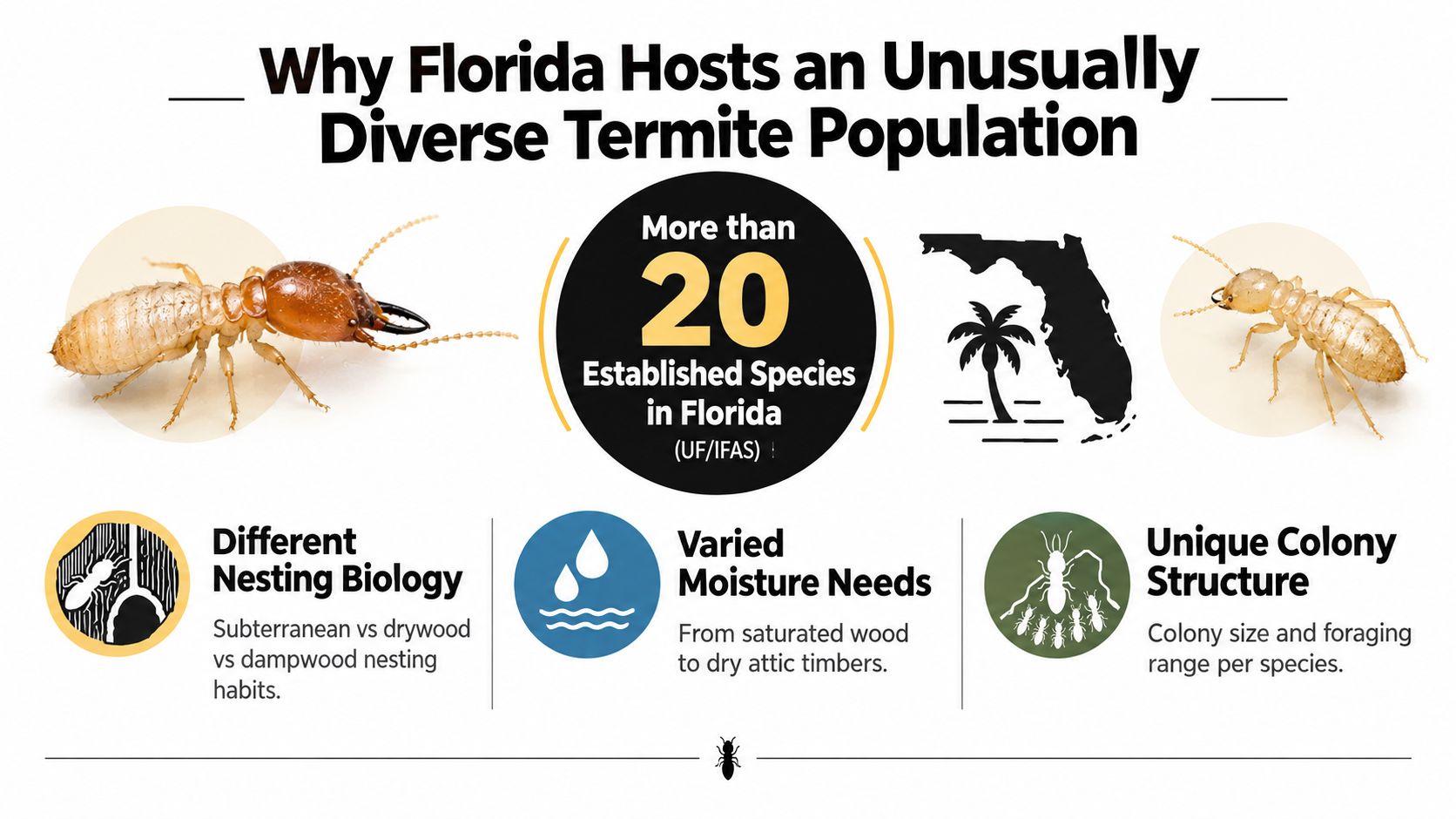
Florida doesn't have a simple termite story. UF/IFAS reports 20 termite species are established in Florida, while a UF/IFAS news release notes 21 established species, reflecting updates in research and classification over time. It also reports 14 are native and 6 are invasive, and only a handful are major structural pests (UF/IFAS termite diversity guide). That single fact changes how a Miami homeowner should think about termites. The first question isn't “Do I have termites?” It's which termite is it?
That distinction matters because different termites live in different places, enter buildings in different ways, and leave different clues behind. A mud tube on a slab edge points you one direction. A pile of pellet-like frass on a windowsill points you another. In Miami-Dade, where native termites overlap with invasive species that are spreading, getting the category wrong can send you toward the wrong treatment and more damage.
Table of Contents
- Why Florida Hosts an Unusually Diverse Termite Population
- The Three Structural Termite Groups Found in Florida
- Native Subterranean Termites in Florida
- Invasive Subterranean Termites Expanding Across Florida
- Drywood and Dampwood Termites Common in Florida Homes
- Termite Risk Across Miami-Dade Neighborhoods
- Treatment Implications by Termite Type
- Inspection and Next Steps for Miami Homeowners
Why Florida Hosts an Unusually Diverse Termite Population
Florida's termite variety is not an accident. It is what you would expect in a state where warm temperatures, high humidity, dense coastal development, and constant movement of plants, lumber, boats, and cargo all overlap. For termites, Florida works like a year-round greenhouse with a busy shipping network attached.
Why the state keeps producing new termite problems
Start with climate. Much of Florida gives termites a long feeding and swarming season, and South Florida often gives them no real winter shutdown at all. A species that might struggle after repeated freezes farther north can keep reproducing here.
Then add human movement. Infested wood, mulch, railroad ties, pallets, potted plants, and even structural materials can move termites from one property to another or from one region to the next. In a place like Miami-Dade, ports, dense neighborhoods, remodeling activity, and older housing stock create repeated chances for species to arrive, survive, and spread.
UF/IFAS has also documented that the range of some invasive termites is shifting within Florida rather than staying fixed in the same pockets year after year. That matters for homeowners because a termite once treated as a problem in one metro area can become relevant in another. The article's later sections use that spread-based view, including the 2026 Formosan expansion finding, so identification is tied to where a species is showing up now, not just where an old guide says it used to be.
Why this matters at the house level
Homeowners usually notice damage signs, not termite biology. You see a swarm by the window, soft trim near the patio door, or a few odd pellets on the sill.
Those clues only make sense if you match them to the kind of termite behind them.
- Climate tolerance matters: Some termites handle Florida's heat and moisture with little difficulty, which helps them persist in neighborhoods year after year.
- Introduction pathway matters: A species that spreads mainly through natural swarming behaves differently from one that also hitchhikes in infested materials.
- Local range matters: In Miami, the question is not only what the insect looks like. It is whether that species is known to be established, expanding, or newly turning up in nearby parts of South Florida.
A good comparison is weeds in a lawn. Two weeds can both be green, but one spreads by seed, another by runners, and each calls for a different response. Termites work the same way. Similar damage can come from very different insects.
UF/IFAS groups the termites people encounter in Florida into subterranean, drywood, dampwood, and higher termites, with the main structural problems concentrated in subterranean and drywood types, as described in the UF/IFAS Featured Creatures termite overview. For a Miami homeowner, the practical lesson is simple. Florida does not have one termite pattern. It has several, and the range of some species is still changing.
The Three Structural Termite Groups Found in Florida
Florida homeowners usually run into three termite groups that matter structurally: subterranean, drywood, and dampwood. That three-part split sounds simple, but it does real work during an inspection. It helps you sort signs by how the colony lives, where it gets moisture, and how it enters a house. In South Florida, that matters even more because the mix of species is not static. UF and UF/IFAS tracking has shown that some termite ranges are shifting, including the continued spread of invasive subterranean termites discussed later in this article.
A useful way to read these groups is to treat them like three different plumbing problems. The stain may show up on the same wall, but the source is different. One problem comes from the ground, one is sealed inside the wood, and one usually follows chronic moisture.
The simplest field clue for each group
Subterranean termites stay connected to the soil or another reliable moisture source. In houses, the first clue is often a mud tube on a foundation wall, slab crack, pier, or hidden framing surface. The tube works like a covered hallway that keeps the insects moist while they travel.
Drywood termites live inside the wood they are eating. They do not need soil contact, so their clue is usually frass pellets below a tiny kick-out hole or inside a window track, sill, or attic area.
Dampwood termites need wood with sustained moisture. In a structure, they are more often tied to wet, decayed, or repeatedly soaked wood than to sound, dry framing.
| Group | Typical Nest Site | What a Homeowner Often Finds | Moisture Dependence |
|---|---|---|---|
| Subterranean | Soil, then hidden travel into wood | Mud tubes, concealed feeding, swarmers near entry points | High |
| Drywood | Inside the wood itself | Pellet-like frass, kick-out holes, localized hollow spots | Moderate |
| Dampwood | Very wet or decaying wood | Soft damaged wood near leaks, rot, or heavy moisture | Very high |
Matching the clue to the category
Misidentification happens. Drywood frass gets mistaken for sawdust. Mud tubes get dismissed as dirt splashed up by rain. Dampwood activity gets blamed on rot alone.
Location usually clears up the confusion.
Pellets that appear beneath a tiny hole in a door frame or windowsill point in a different direction than damp, mud-lined shelter tubes rising from the slab. Wet, crumbling wood near a persistent leak suggests a moisture-driven problem first, then a termite question second. For quick visual comparisons, FullScope Pest Control termite types gives a homeowner-friendly side-by-side reference. If signs already suggest active structural feeding, Termite Control refers to the service category used to stop further damage and identify which termite group is present.
One short rule helps. Tubes usually mean a moisture connection. Pellets usually mean an in-wood colony. Saturated wood usually means inspect for dampwood and the water source together.
Native Subterranean Termites in Florida
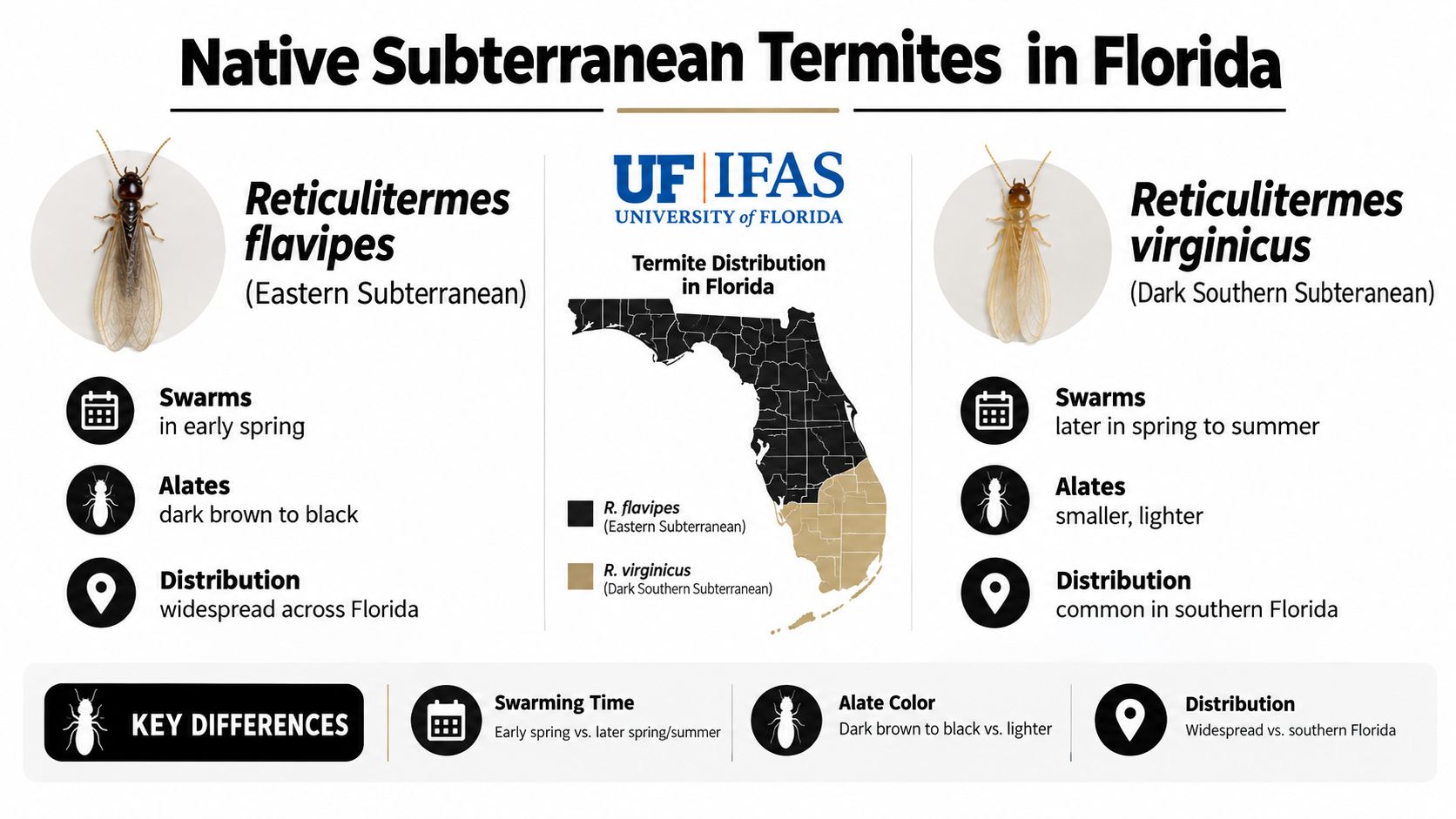
Florida's native subterranean termites still account for a large share of the tube-building activity homeowners find first. The two species that matter most in structures are the Eastern subterranean termite (Reticulitermes flavipes) and the Dark southern subterranean termite (Reticulitermes virginicus). Both occur across the state, so a Miami infestation does not need an invasive explanation to be real.
What makes the native pair hard to tell apart
At wall level, these species behave so similarly that homeowners usually notice the signs before they notice the termite. Mud tubes on a stem wall, soft trim near a door frame, or a brief swarmer event near a window often point to Reticulitermes activity as a group, not to one species with confidence.
That confusion is normal.
A phone photo rarely captures the traits an entomologist would want. Swarmer color can help a little. Eastern subterranean swarmers are often described as darker overall, while Dark southern subterranean swarmers may look somewhat lighter and a bit smaller. In practice, lighting, wing loss, and the condition of the specimen can blur those differences fast.
For a Miami homeowner, the better field question is usually: Where are they entering? Native subterranean termites stay connected to moisture in the soil. They move into a house through expansion joints, plumbing penetrations, slab cracks, porch connections, and wood that sits too close to grade. That pattern matters more than slight color differences on a dead swarmer found on the sill.
To see the native pair side by side, this short video helps:
Why native subterranean termites still deserve close attention
Homeowners in South Florida often hear so much about Formosan spread that they start treating every mud tube like an invasive species story. Native subterranean termites remain part of the day-to-day structural risk picture, especially in older homes, homes with chronic moisture around the slab, and properties where soil-to-wood contact has been ignored for years.
A simple way to think about them helps. Native subterranean termites work like an underground utility line. The colony stays in the soil, then sends protected foraging routes into the structure. What you see on the surface is often just the covered roadway, not the main population.
That is also where the range question becomes useful. Species photos tell you what an insect looks like. Spread data tells you what is becoming more common in your area. For Miami-Dade, that means keeping two ideas in view at once: native Reticulitermes are still common candidates when tubes appear, and the broader South Florida termite picture is changing as other subterranean species expand. Good identification starts with the evidence at the house, then places that evidence in the shifting map of termite distribution across Florida.
Invasive Subterranean Termites Expanding Across Florida
Across Florida, the termite map is not standing still. UF researchers tracking spread over time have documented invasive subterranean termites pushing beyond their earlier South Florida footholds, with Formosan termites now established through much of the state's coastal and urban corridor. That matters in Miami because identification is no longer only about matching a photo to an insect. It also means asking whether the species showing up in your wall has become more common in your neighborhood over the last decade.
Why these invasive species change the risk picture
The two invasive subterranean termites Miami homeowners hear about most often are the Formosan subterranean termite and the Asian subterranean termite. Both live in the same broad structural category as native subterranean termites, but they can behave differently in the field. Colonies may become very large. In the right moisture conditions, they can also build carton material above ground, which can make the infestation pattern look less tied to simple soil contact than owners expect.
UF termite specialists have also reported hybrid colonies between Formosan and Asian subterranean termites in South Florida (UF/IFAS subterranean termites topic page). For a homeowner, that does not mean every inspection turns into a genetics question. It means visual ID alone can be less reliable, especially when swarmers from invasive species overlap in color and season.
A good comparison is hurricane prep. Knowing a storm exists is one level of awareness. Knowing whether your specific block floods tells you what to do next. Termite spread data works the same way. Species photos help you recognize the insect. Range expansion tells you which suspects deserve more attention in Miami now than they did years ago.
| Species | Body Color | Swarm Timing in FL | Primary Range | Nest Behavior |
|---|---|---|---|---|
| Eastern subterranean termite | Typically darker swarmer appearance | Often noticed in spring | Statewide | Soil-based colony, mud tubes |
| Dark southern subterranean termite | Often lighter than Eastern swarmers | Often later than Eastern in warm periods | Statewide | Soil-based colony, mud tubes |
| Formosan subterranean termite | Yellowish-brown swarmer tones often noted in field ID | Warm-season swarms often attract attention at lights | Widely established in coastal counties and major urban areas | Can form large colonies and above-ground carton nests |
| Asian subterranean termite | Yellowish-brown tones can resemble Formosan | Warm-season swarming behavior can overlap | Expanding beyond its earlier South Florida concentration into additional Florida cities | Can form above-ground nests in suitable conditions |
What makes Miami-Dade different
Miami-Dade has a long history with invasive termites, so inspectors here often have to sort a narrower question than homeowners expect. The question is not just whether termites are present. The question is which subterranean termite is present, and whether the pattern at the structure fits a native soil forager, an invasive species, or a case where samples need closer review.
That species-level distinction affects what evidence matters. Swarmers at lights, carton nest material, heavy mud tubing, repeated activity around dense urban construction, and the local spread history all help frame the ID. A calm inspection works better than a guess.
One practical note. If you're researching household pest services, keep categories separate. Bed Bug Treatment addresses a different problem entirely, with the goal to eliminate every life stage, bugs, eggs, and all. That has no bearing on termite diagnosis, but homeowners sometimes mix service names when requesting help online.
Drywood and Dampwood Termites Common in Florida Homes
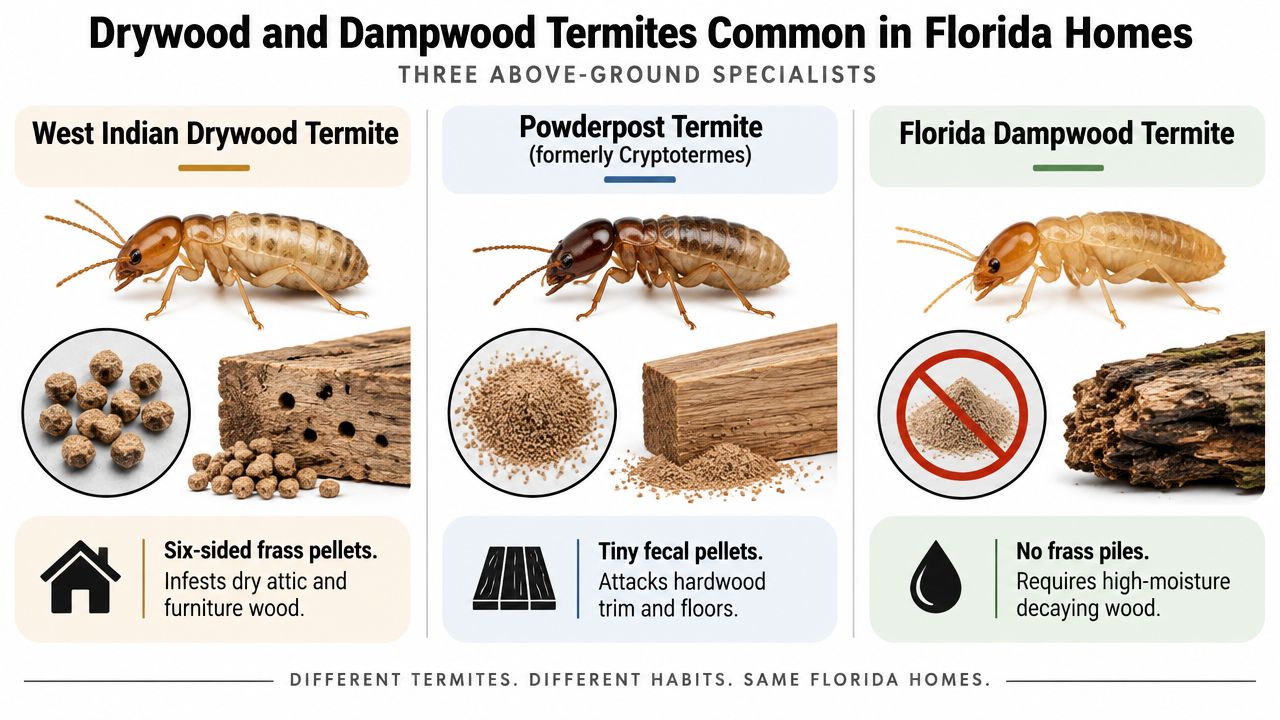
The above-ground wood specialists cause a different kind of confusion because homeowners often never see soil contact at all. These colonies may live entirely inside the wood they consume. In Florida homes, the most practical names to know are West Indian drywood termites, powderpost drywood termites (often associated in older materials with Cryptotermes), and Florida dampwood termites.
The clue most people miss
Drywood termites don't need contact with the soil. That's why homeowners can find activity in attic framing, door trim, soffits, window casings, cabinets, or furniture and still have a termite problem with no mud tubes anywhere.
The classic sign is frass. Drywood termites push pellet-like waste out through tiny openings, and those pellets collect in small piles below the infested spot. If you're not sure what termite damage tends to look like in trim, drywall, and framing, Pestless has a useful visual guide on how to identify termite damage.
How drywood differs from dampwood
West Indian drywood termites are especially important in Florida because their colonies can live in relatively dry structural wood. Powderpost drywood termites can show up in smaller wood members or hardwood components. Florida dampwood termites, by contrast, usually need much wetter conditions and are more often tied to leaks, decayed wood, poor ventilation, or long-term moisture intrusion.
Dry pellets suggest drywood termites. Wet, softened, decaying wood suggests you should also look for the moisture source.
A windowsill with six-sided pellets tells a very different story than a porch beam that stays damp after every rain. One points to a sealed colony inside dry wood. The other often points to wood that has already become attractive because water got there first.
Termite Risk Across Miami-Dade Neighborhoods
Miami-Dade doesn't have one uniform termite pattern. A condo corridor near the coast, a tree-heavy older neighborhood, and an inland suburb can all have termite pressure, but not for exactly the same reasons. The useful question isn't “Is Miami high risk?” It's which termite pressure is most plausible on this block?
A recent reporting summary on UF-related findings notes that, in March 2025, UF/IFAS reported Formosan subterranean termites, Asian subterranean termites, and West Indian drywood termites are expanding their reach, that Asian subterranean termites have recently been detected in multiple Central Florida cities, and that a 2026 study found Formosan termites could be detected in all of Florida before 2050, which is a projection rather than a current condition (coverage of the 2026 projection).
How neighborhood context changes what inspectors prioritize
In the urban core, dense development, concrete interfaces, utility penetrations, and lighting that attracts swarmers all shape inspection strategy. Along the coastal condo belt, invasive subterranean pressure remains a live concern because the broader spread pattern strongly favors coastal and urban environments. In older residential pockets, drywood termites often become part of the conversation because aging trim, rooflines, and attic wood create many small entry opportunities.
| Neighborhood Zone | Dominant Termite Threat | Secondary Risk | Exposure Driver |
|---|---|---|---|
| Coastal urban corridor | Invasive subterranean termites | Drywood termites | Coastal establishment patterns, dense urban construction |
| Older tree-canopied neighborhoods | Drywood termites | Native subterranean termites | Aging wood features, repeated entry points, landscaping contact |
| Inland suburbs | Native subterranean termites | Expanding invasive subterranean termites | Slab edges, soil contact, regional spread into urban centers |
| Canal-side and persistently moist lots | Native subterranean termites | Dampwood termites | Moisture, wet wood, drainage or ventilation issues |
A practical Miami-Dade reading of the map
If your home is near the coast or in a dense urban neighborhood, an inspector should think carefully about invasive subterranean termites before assuming a simple native Reticulitermes problem. If you're in an older inland neighborhood with repeated attic or trim complaints, drywood termites may rise higher on the list. If the structure has chronic leaks or wet exterior wood, dampwood should stay in the differential.
That's why a county-level termite conversation is more useful than a generic statewide warning. Miami-Dade doesn't just have termites. It has overlapping termite pressures.
Treatment Implications by Termite Type
Treatment works best when it matches the termite's biology. A colony in soil behaves very differently from a colony sealed inside dry wood, so the control method has to match the way that species lives and feeds.
A simple field rule helps here. Subterranean termites travel back and forth from hidden nesting areas and need a route into the structure. Drywood termites can stay inside the wood they are eating. Dampwood termites usually signal a moisture problem first and an insect problem second. That difference shapes the whole plan.
Soil-connected termites need a route-focused plan
For native subterranean termites, treatment usually aims to cut off movement between soil and house. In practice, that often means a liquid treatment in the soil, a baiting system, or both, depending on slab details, additions, porches, and utility entry points. Treating only the visible mud tube is like patching one lane of a road while leaving the highway open elsewhere.
In Miami, species identification matters even more because invasive subterranean termites are spreading through urban areas, not just showing up as isolated curiosities. Formosan and Asian subterranean termites can use wall voids, expansion joints, and hidden structural pathways that make a limited spot treatment easy to outgrow. The 2026 expansion finding matters here because it changes the inspector's starting assumption in neighborhoods where invasive activity was once considered less likely.
| Termite Type | Primary Treatment Direction | Secondary / Localized Option | Common Treatment Mistake |
|---|---|---|---|
| Native subterranean termites | Soil treatment, baiting system, or both | Void treatment where live activity is confirmed | Treating tubes only and missing the colony's access route |
| Formosan or Asian subterranean termites | Structure-wide perimeter and entry-point treatment with follow-up monitoring | Treatment of active above-ground sites if present | Assuming invasive activity is a routine native infestation |
| Drywood termites | Localized wood treatment if activity is confined and mapped | Whole-structure fumigation if evidence is scattered or widespread | Treating one visible pocket while separate colonies remain elsewhere |
| Dampwood termites | Moisture correction and removal or repair of damaged wood | Local treatment of affected wood | Leaving leaks, wet framing, or poor drainage in place |
Drywood termites require wood-by-wood decisions
Drywood termites call for a different approach because there is no soil connection to intercept. If frass pellets, kick-out holes, and damaged trim point to a small, isolated infestation, a localized in-wood treatment may be reasonable. If evidence shows up in several rooms, in attic members, or along multiple trim lines, the structure may have more than one colony.
That is where inspection quality matters most. The question is not which treatment sounds easier. The question is whether the infested wood can be mapped with confidence. Homeowners comparing localized treatment with broader drywood options may find this explanation of no-tent termite treatment useful.
Dampwood control starts with fixing the wet wood
Dampwood termites often act like a moisture warning flag. They are less a sign of broad structural spread and more a sign that a piece of the building has stayed wet long enough to become inviting.
A leaking roof edge, irrigation hitting siding, poor crawlspace ventilation, or chronically wet trim can keep the problem active even after the insects in one board are killed. Replace the damaged wood without correcting the moisture source, and the next piece of wood may become the next feeding site.
A good treatment plan answers two practical questions. Where is the colony living? How is it reaching the wood?
That is why termite identification in Florida is not just a photo-matching exercise. In Miami-Dade, it also means reading the species against a shifting range map, especially for invasive subterranean termites that are spreading into more neighborhoods over time.
Inspection and Next Steps for Miami Homeowners
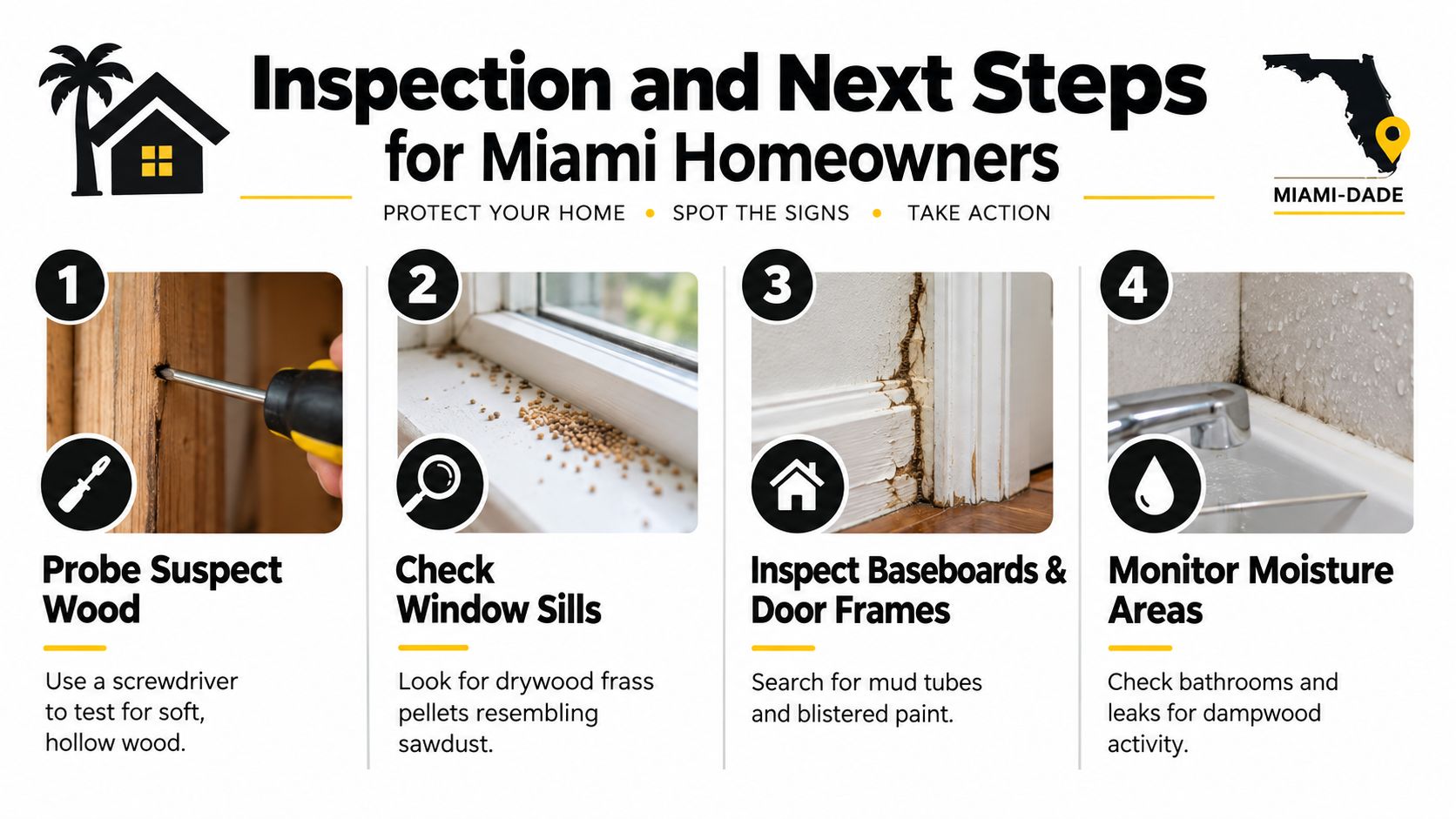
A calm inspection routine beats panic every time. You don't need to diagnose every termite species yourself, but you can gather better evidence before calling for help.
What to check before you call
Start where termites leave the most recognizable signs.
- Probe suspect wood: Use a screwdriver on soft trim, swollen baseboards, porch wood, and window frames. You're checking whether the surface gives way unusually easily.
- Look below windows and doors: Drywood frass often collects on sills, flooring, or furniture below the infested wood.
- Scan slab edges and walls: Subterranean termites often leave mud tubes at foundations, garage edges, or where utilities enter.
- Photograph swarmers: If you see winged insects near lights, collect a clear photo and, if possible, a few shed wings in a bag or container.
What the licensed inspector adds
A Florida termite inspection is more than a quick look with a flashlight. In real estate transactions, buyers and sellers may encounter a WDO inspection report, which focuses on wood-destroying organisms and visible evidence. A licensed professional also checks the places homeowners tend to miss, such as hidden wall voids, sub-slab access points, moisture-compromised areas, and signs that suggest a larger pattern than the one visible symptom.
For a homeowner who's never scheduled one, this overview of what to expect during a termite inspection can help you prepare questions and understand the process.
What credentials and quote questions matter
When comparing providers in Florida, ask about the operator's license status and whether the company is authorized for termite work. For treatment, homeowners should verify that the company holds the proper termite-related certification and active insurance. Then ask practical questions:
- Ask for the termite type identified: The quote should name the likely termite group, and ideally the species when the evidence supports it.
- Ask how the treatment matches the biology: A good proposal explains why it's using baiting, trenching, localized wood treatment, fumigation, moisture correction, or a combination.
- Ask what follow-up looks like: Monitoring matters most when subterranean pressure is ongoing or invasive species are plausible in the neighborhood.
If you want help comparing options, Pestless Inc. is a matching service, not a treatment company. It connects Miami-Dade homeowners with licensed, insured local pest professionals so you can compare quotes from companies already working in neighborhoods where termite patterns vary from coastal high-rises to inland subdivisions.
Good termite decisions start with a clear ID, a neighborhood-aware inspection, and a treatment plan tied to the termite's actual behavior.
Pestless Inc. helps Miami-Dade homeowners connect with licensed, insured pest control professionals who understand local termite pressure, including the difference between drywood issues, native subterranean activity, and expanding invasive risk. If you want help comparing zero-obligation quotes from local providers familiar with your neighborhood, visit Pestless Inc..
Dealing with this pest right now?
Pestless connects you with a licensed, insured Miami pest control provider for a free, no-obligation quote.