Heat is generally the faster, more thorough choice for a single-family home, while chemical treatment remains necessary when multi-unit exposure makes residual protection and coordinated follow-up essential. Professional heat treatment targets all life stages, but it must reach about 49–52°C for 20–30 minutes under low relative humidity, and chemicals can fail when local bed bug resistance is high.
You're in a Miami bedroom, staring at dark spots along the mattress seam while your family asks whether the bites will stop tonight. The obvious choice seems simple: heat the room or spray it. In practice, the right answer depends on whether you live in a detached house, a condo, an apartment, or a short-term rental, how far the infestation has spread, and whether bed bugs can move back from another unit.
I've seen both methods fail when someone rushes preparation, treats only the visible bugs, or ignores neighboring units. Heat can clear a properly isolated home quickly, but it has no residual activity after the equipment leaves. Chemicals can leave ongoing protection in treated areas, but resistance, missed harborages, and incomplete follow-up can turn a supposedly cheap spray into a long cycle of repeat visits.
| Decision factor | Heat treatment | Chemical treatment |
|---|---|---|
| Main strength | Rapid, nonchemical treatment of all life stages when lethal conditions reach hiding places | Residual activity and targeted treatment of cracks, edges, and connected spaces |
| Main weakness | No residual protection after temperatures normalize | Resistance and incomplete contact can reduce reliability |
| Best fit | A contained infestation in a single-family home | Multi-unit coordination, supplemental control, and situations needing residual protection |
| Miami concern | Humidity, room geometry, and cold spots can undermine performance | Reinfestation from adjacent units can continue unless management coordinates treatment |
If you need a licensed local assessment, Pestless bed bug treatment services can connect Miami-Dade homeowners with pest professionals who understand the difference between treating one room and managing a building-wide problem.
Table of Contents
- Heat Treatment vs Chemical Options in Miami
- How Heat Treatment Works for Bed Bugs
- Understanding Chemical Treatment Limitations
- Comparing Speed Cost and Safety Outcomes
- When Heat Fails and Chemicals Offer Residual Value
- Choosing the Right Bed Bug Treatment Strategy
Heat Treatment vs Chemical Options in Miami
Why the property matters more than the product
A detached home in Kendall or Coconut Grove gives you more control over the treatment boundary. You can remove people and pets, prepare the rooms, inspect luggage and furniture, and avoid an immediate return from a neighboring unit. In a Brickell condo, the treatment boundary may be only one bedroom while bed bugs travel through belongings, hallway traffic, shared laundry areas, or adjacent apartments.
That difference changes the recommendation. For a contained infestation in a single-family home, I usually favor professional heat because it addresses eggs, nymphs, and adults in one controlled process without relying on insecticide susceptibility. For an apartment or condo, I want a building plan, not a one-room promise.
Heat also has a practical advantage for residents who want to avoid pesticide residue in sleeping areas. But it isn't automatically safer just because it doesn't use insecticide. Improvised heating can create fire, electrical, and property-damage risks, while professional crews must monitor temperatures in the coolest parts of the room rather than trusting a single thermostat.
Miami rule: Choose the method that matches the path bed bugs can take after treatment, not just the room where you found the first bug.
The decision changes in dense housing
A renter may treat the bedroom perfectly and still see activity because the source is another unit. A landlord may need access to several apartments, clear tenant instructions, and follow-up inspections. A short-term rental host has another complication, because luggage and guest turnover can reintroduce bugs after a successful treatment.
Chemical treatment often enters the plan here because it can provide residual activity in selected areas after the room returns to normal temperature. That doesn't make a chemical-only program reliable by default. It means the strongest strategy may combine a thermal reset with carefully selected products, monitoring, and cooperation from property management.
The phrase bed bugs heat treatment vs chemical sounds like a simple contest. Miami conditions make it a risk-management decision. Heat usually wins on speed and life-stage coverage in a contained home. Chemicals become more valuable when reinfestation routes, connected units, or hidden harborages require continuing protection.
How Heat Treatment Works for Bed Bugs
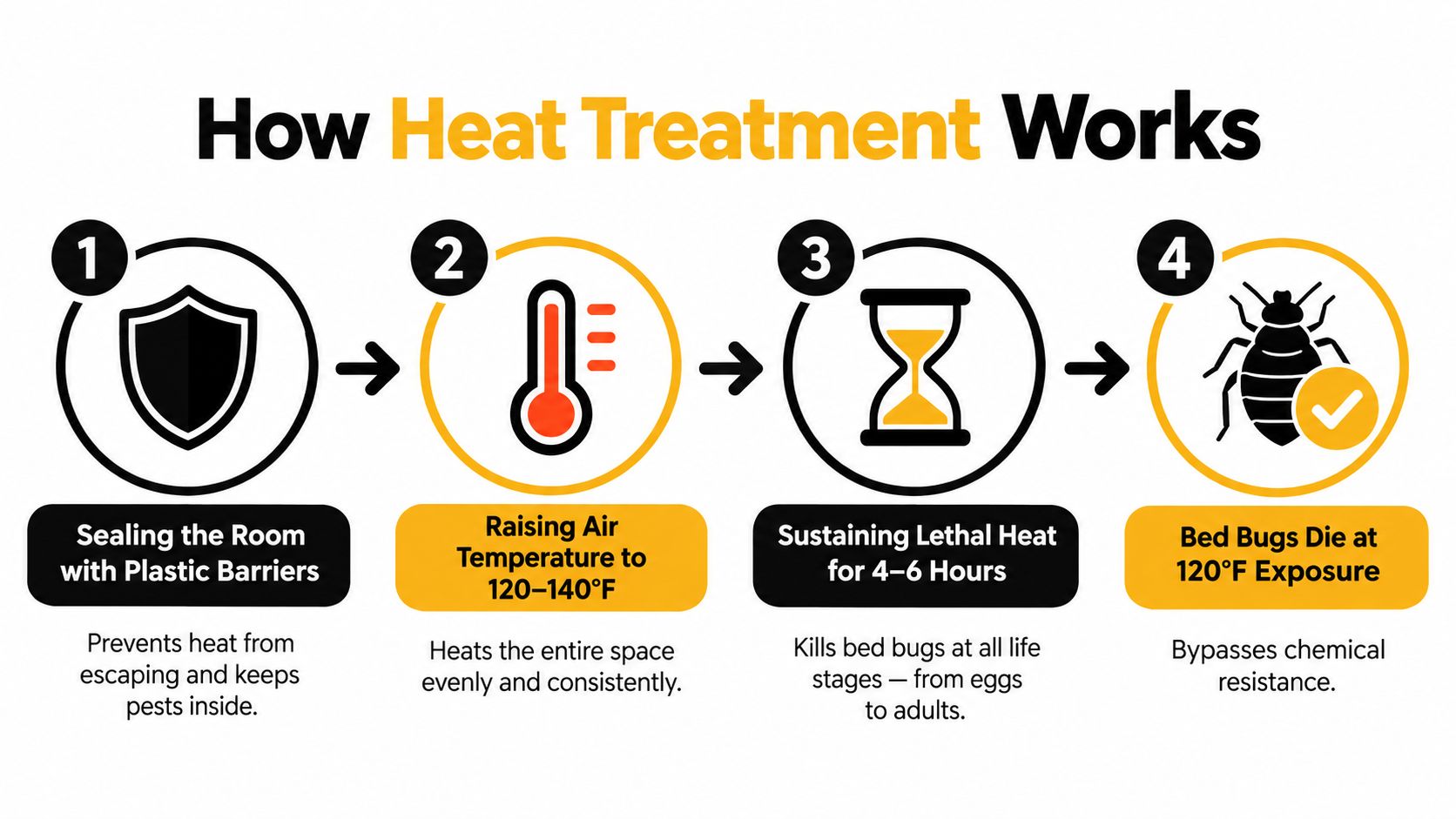
Heat works by forcing the entire treatment area, including objects and hiding spaces, to reach a lethal temperature for a controlled period. It doesn't depend on a bug walking across a treated surface or consuming a product. That makes thermal treatment especially useful when bed bugs are tucked inside seams, joints, cracks, and furnishings.
Research on bed bug control found that adults can begin dying at about 41°C, with the required exposure time falling as temperatures rise to roughly one minute at 49°C. Eggs need more heat, with a reported lethal threshold around 54.8°C, so a professional can't judge success by the warm air near the center of the room. The coldest protected location must reach the required condition. See the bed bug temperature and exposure research for the underlying findings.
Why heat bypasses resistance
Heat attacks the insect physically through temperature, so pyrethroid resistance doesn't change the thermal threshold. When a professional raises the room and contents evenly, the treatment can kill eggs and mobile stages without requiring each insect to contact a chemical deposit.
That advantage has limits. Heat doesn't create a protective barrier once the equipment is removed. If a bug survives in an untreated area, or a new bug enters from another unit, normal room temperature gives it a place to recover and reproduce. A successful thermal treatment therefore needs both accurate monitoring and a plan for preventing reintroduction.
The bed bug heat treatment service guide is useful for understanding why equipment, preparation, airflow, and temperature checks matter more than just turning up a heater. A Bed Bug Treatment can target every life stage, including bugs and eggs, but the result still depends on reaching the hidden cold spots.
Professional operators use heaters, air movement, and sensors to identify uneven temperatures. Miami's humidity matters because practical guidance calls for maintaining about 49–52°C for 20–30 minutes under low relative humidity, according to Penn State Extension's bed bug management guidance. Moist air and damp materials can make heat delivery less predictable, so a crew must verify the treatment conditions rather than rely on the room's apparent warmth.
Understanding Chemical Treatment Limitations
Chemical treatment succeeds only when the product reaches the insect, remains effective at the application site, and matches the resistance profile of the local population. That last condition is where many homeowners get misled. A spray can kill exposed bugs while leaving resistant or protected bugs behind, creating the impression that the infestation returned from nowhere.
The resistance evidence is serious. One review found 14 of 16 U.S. populations resistant to pyrethroids when tested at 10 times the maximum labeled rate of deltamethrin, as reported in this peer-reviewed bed bug resistance review. A separate 2023 study in the same body of evidence reported 69% of 13 field-collected populations with high resistance ratios above 91.9, and some populations showed less than 5% mortality at the highest tested concentration.
What a chemical program needs
The answer isn't to spray more aggressively. It's to use a licensed professional who identifies harborages, selects products lawfully, rotates or combines tools where appropriate, and schedules follow-up inspections. Chemical programs can require repeated access because eggs or sheltered insects may escape the first application, and a single pass rarely compensates for clutter, wall voids, or untreated belongings.
Some active ingredients still perform well against particular resistant strains. A resistance review reported close to 100% mortality in cited studies for compounds such as chlorfenapyr or micro-encapsulated chlorpyrifos, but that result doesn't justify assuming every product works in every Miami home. Product performance depends on the population, formulation, label directions, placement, and technician execution. The EPA's do-it-yourself bed bug guidance also warns against unsafe or improvised approaches.
The practical issue: A chemical label tells you how a product may be used. It doesn't guarantee that the bed bugs in your building remain susceptible to it.
Chemical treatment still has a place. It can protect cracks, edges, and connected areas after the initial treatment, and it may be necessary where heat can't be applied safely to sensitive materials. But over-the-counter spraying is a poor substitute for diagnosis. Foggers and repeated surface sprays can scatter the problem, expose occupants, and leave the most important harborages untouched.
Comparing Speed Cost and Safety Outcomes
Homeowners often compare the invoice first. That's understandable, but the cheaper-looking option can cost more if it requires repeated preparation, missed work, tenant coordination, and follow-up visits. The useful comparison includes speed, safety, disruption, and the chance that the treatment must be repeated because the source was never contained.
| Criterion | Heat | Chemicals |
|---|---|---|
| Speed | Often designed as a concentrated treatment event for a contained property | Usually slower because inspection, applications, and follow-up are part of the program |
| Cost pattern | Higher single-event cost is common, but no invented dollar figure should guide the decision | Lower per-visit pricing may become less economical when repeated visits are needed |
| Preparation | Requires removing heat-sensitive items, opening spaces, and creating access for airflow | Requires careful preparation, washing or drying appropriate items, reducing clutter, and following re-entry instructions |
| Safety profile | No pesticide residue, but high temperatures and electrical equipment require professional controls | Uses regulated products, with exposure precautions for children, pets, and occupants |
| After-treatment protection | No residual activity once the area returns to normal temperature | Selected products may leave residual activity where the label permits |
The bed bug treatment cost guide can help you think about price as part of a larger treatment plan rather than as a standalone number. Ask what the quote includes, whether monitoring is included, how follow-up works, and who handles neighboring units.
Speed favors heat, but only under control
A well-managed thermal treatment can be completed far faster than a chemical program that depends on multiple visits. That matters in Miami rentals, hotels, and homes where residents can't tolerate weeks of uncertainty. Heat also avoids pesticide residue, which appeals to families and pet owners.
The safety trade-off is different, not absent. Crews must protect heat-sensitive electronics, aerosols, medications, waxes, plants, and other materials. They must also control power loads, airflow, and temperature gradients. A hardware-store space heater is not a bed bug treatment system.
Miami humidity changes the preparation equation
South Florida's moisture can complicate drying, storage, and heat delivery. Wet fabrics, dense piles, overstuffed furniture, and tightly packed closets create areas where temperature movement is less predictable. Low relative humidity is part of the practical heat target, so technicians need to measure conditions and not assume that a hot room has treated every item evenly.
Chemicals avoid the high-temperature phase, but preparation is still substantial. Occupants must follow the technician's instructions, avoid moving infested belongings into clean rooms, and respect re-entry and cleaning directions. The safest option is the one the household can execute correctly, not the one that sounds easiest in an advertisement.
When Heat Fails and Chemicals Offer Residual Value
Heat fails when the operator treats the air instead of the infestation. A room can feel hot while a cold spot remains inside a crowded cabinet, thick upholstered item, packed closet, or protected fabric fold. If the treatment doesn't expose those locations to lethal conditions for long enough, surviving bugs can emerge later.
The same principle applies to steam, which is useful for seams and other targeted areas but has a limited delivery range. A 2025 global review found near-instant mortality for surface-exposed bed bugs, while efficacy fell to about 89% when bugs were shielded under fabric, as described in the global review of thermal and steam control methods. The lesson is clear. Thermal tools work best when technicians match delivery method to the hiding place.
Where residual protection changes the choice
Heat has no residual activity. Once the room cools, it doesn't stop a new bug from entering through a hallway, a suitcase, a shared laundry area, or an adjoining wall. This is the central weakness in condos and apartment buildings, where the treated unit may not be the only source.
A properly selected chemical product can leave residual activity in permitted locations after application. That makes it valuable around bed frames, baseboards, cracks, and building interfaces, provided the product is effective against the local population and applied according to its label. Residual control doesn't fix a resistant population, poor sanitation, or an untreated neighboring unit. It buys protection only where the program has been correctly designed.
Use heat to reset the room. Use residual tools to manage the routes that can bring bed bugs back.
This is why I don't recommend treating heat and chemicals as competing ideologies. In a detached house with a contained problem, heat may be enough when preparation and monitoring are excellent. In a high-rise, a coordinated plan may use heat inside affected units, targeted chemical applications in suitable areas, inspections of adjacent units, and resident education.
The same building-level logic applies to other pest pathways. If a property also needs Rodent Control, removing the animals and sealing entry points addresses a different problem than bed bugs, but it reflects the same principle: eliminate the current source and close the route back in.
Choosing the Right Bed Bug Treatment Strategy
Start with the building, not the spray aisle. A single-family home with activity confined to one bedroom is the strongest candidate for professional heat. A condo, apartment, dormitory, or rental needs management involvement because another unit can undo a technically successful treatment.
Use this decision filter
- Choose professional heat first when the infestation is contained, the home can be vacated during treatment, sensitive belongings can be removed, and you want rapid nonchemical control of eggs and mobile stages.
- Choose a chemical program first or alongside heat when residual protection is important, high temperatures could damage property, or the technician identifies areas that thermal equipment can't safely reach.
- Demand coordinated building action when you live in a multi-unit property, see activity after treatment, or share walls, laundry facilities, hallways, or furnished common areas.
- Reject DIY improvisation when the plan involves space heaters, sealed rooms without monitoring, or repeated consumer sprays. Those approaches create risk without proving that the coldest hiding places were treated.
- Insist on follow-up when the source isn't obvious. Treatment should include inspection, documentation, and a plan for monitoring rather than a promise based only on how the room looks immediately afterward.
My recommendation for Miami properties
For a Miami homeowner in a detached property, I'd choose professional heat when the infestation is localized and the crew can verify temperatures throughout the treatment zone. I'd add targeted chemical work only where the inspection shows a need for residual protection or inaccessible harborages.
For a renter or condo owner, I'd notify management before moving belongings or booking treatment. Purdue Extension guidance explains why combined or coordinated protocols are often necessary in multi-unit buildings, because heat has no residual effect and chemical-only treatment faces resistance problems, as outlined in its bed bug control guidance for shared housing.
Don't confuse immediate relief with permanent protection. After treatment, keep sleeping areas positioned for inspection, avoid bringing in used furniture, inspect luggage after travel, and report activity quickly. If you also need Mosquito Control, keep that separate from the bed bug plan and address each pest according to its own entry and breeding conditions.
The right answer to bed bugs heat treatment vs chemical is usually straightforward. Use heat for speed and whole-room life-stage control in a contained home. Use chemicals for residual value and inaccessible areas. In multi-unit Miami housing, coordinate both when the building's reinfestation routes make a one-room fix unrealistic.
Pestless Inc. connects Miami and Miami-Dade homeowners with licensed, insured pest control professionals for bed bug assessments and treatment options, including heat, chemical, and coordinated approaches where appropriate. Visit Pestless Inc. to describe your situation through the short form and compare no-obligation local options.
Dealing with this pest right now?
Pestless connects you with a licensed, insured Miami pest control provider for a free, no-obligation quote.