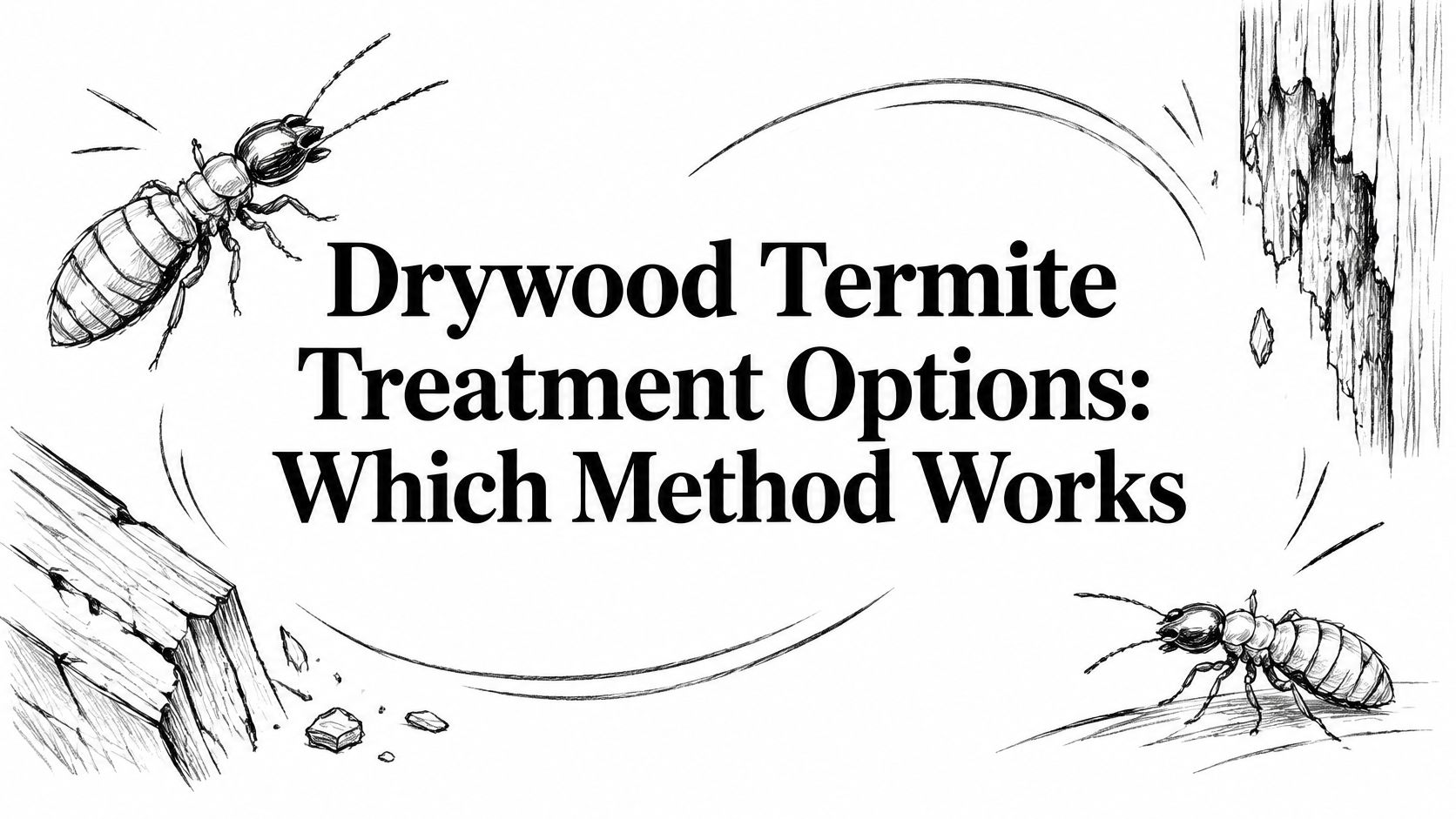
You wiped a small pile of what looked like coarse sand off the windowsill on Saturday. By Thursday there's another pile in the same spot, plus a few grains dusting the floor below a window frame. The wood feels solid, there are no mud tubes near the foundation, and nothing outside looks damaged. That combination confuses plenty of Miami homeowners, because the usual termite advice about treating the soil around the house doesn't explain what you're looking at.
Those pellets came out of a hole in the wood above the sill. The insect that pushed them there lives inside the board, not in the yard. That one fact reshapes the entire solution.
What follows is a plain-language walk through the drywood termite treatment options a licensed professional chooses between, and why the choice follows where the colonies are hiding rather than which product sounds strongest.
Table of Contents
- Why Drywood Termites Need Different Treatments
- Drywood Termite Treatment Options Compared
- Whole-Structure Fumigation and Heat Treatment
- Localized Spot, Foam and Borate Treatments
- How an Inspection Narrows the Right Method
- What Drywood Termite Treatment Costs Depend On
- Book a Licensed Inspection Before Choosing a Treatment
Why Drywood Termites Need Different Treatments
You found the pellets, so you already know something is living in the wood. Drywood termites spend their whole lives inside dry, sound lumber. They don't need soil contact, they don't build mud tubes, and they don't need a moisture problem to thrive. That's the first thing to unlearn, because subterranean termites are commonly pictured as living in soil and traveling up into a building through mud tubes. A soil barrier around a foundation stops them. It does nothing to a colony that never touches the ground. If you're not certain which species you have, this breakdown of the types of termites in Florida separates them clearly.
Spread happens through connected framing, furniture, trim, and flooring, and a mature colony in one wall void can send swarmers into a roof member on the other side of the house. So a building can hold one colony in a bathroom vanity and a second, unrelated colony eight metres away in an attic rafter. Treating one says nothing about the other.
Reading the Pellets Correctly
The droppings are called frass. They're hard, roughly the size of a grain of sand, and have six concave sides, which you can see with a magnifying glass. Termites push them out through kick-out holes, pinhole openings in the wood surface, and the piles collect directly below. Fresh, uniform pellets appearing under the same hole week after week mean activity now. Pellets mixed into old dust and cobweb are older evidence.
The test that settles it: clean the pile away, mark the date, and look again in five days. New pellets in the same place mean a live colony above that spot, not a leftover mess.
Swarmers are another signal. These are the winged reproductives, reddish-brown insects that fly toward windows and lights on warm evenings to start new colonies. Seeing them indoors usually means a colony matured inside the building or just outside it.
Mopping the puddle while the leak runs in the ceiling is the right picture for spot spraying one visible hole. The method has to follow every colony, and an inspection is what answers where they are.
Drywood Termite Treatment Options Compared
Here are the five routes on one page, ordered from widest reach to narrowest, so the trade-offs sit side by side before the detail.
| Option | Where it applies | Occupants leave | Residual protection | Best fit |
|---|---|---|---|---|
| Whole-structure fumigation | Entire building, all colonies | Yes, for several days | None | Widespread, hidden or inaccessible colonies |
| Whole-structure heat treatment | Entire building | Usually yes, during treatment | None | Large structures where fumigation logistics are a barrier |
| Localized spot or foam treatment | Visible galleries and located colonies | Usually no | Only with borate-based products | Small, accessible infestations |
| Borate wood treatment | Exposed or accessible wood | No | Yes, on treated wood | New or repaired framing and preventive protection |
| Experimental insect growth regulator | Research stage | Not applicable yet | Not yet established | Not yet a standard option for homeowners |
Whole-structure fumigation reaches every gallery in the building because the gas fills voids, wall cavities, and roof assemblies that no spray gun can enter. The cost is the move-out. Whole-structure heat does the same job with temperature instead of gas and leaves no chemical residue, which suits buildings where tenting is logistically hard.
Localized spot and foam treatment is lighter and cheaper because it targets one mapped area, and it reaches only the wood the applicator can access and fill. Borate treatment is different in kind: it protects wood that's exposed or newly installed, so it earns its place during repairs and construction more than as a rescue treatment for an active, hidden infestation.
The fifth row is research, not a service you can book. Bistrifluron is an experimental insect growth regulator, a class of compound that interferes with molting so the colony can't mature and declines over time. A 2025 study published in the Journal of Economic Entomology reported 95.7% mortality in western drywood termites when they could choose between treated and untreated wood, and roughly 99% mortality under continuous exposure, as Mirage News summarized. Those are controlled test results, not a product sitting on a truck in Miami today.
Three takeaways hold across the whole table:
- No method wins everywhere. A single window frame and a house with activity in three separate zones need different answers.
- Methods without residual protection still need follow-up. Moisture correction, exclusion work, and repair of damaged wood protect what the treatment killed.
- No method can be chosen before colony locations are known. The inspection decides, not the label.
When a provider pitches something new, ask whether it's registered for drywood termites, what the label requires, what residual protection is expected, what the follow-up plan is, and what happens if activity continues. Whole-structure options are heavier but reach hidden colonies. Localized options are lighter but reach only what the inspector can see.
Whole-Structure Fumigation and Heat Treatment
A house can look fine from the driveway and still hide several drywood colonies inside framing no one can open. Whole-structure work exists for that situation: the treatment has to reach wood the inspector cannot drill into, not only the boards that show pellets. The infographic below shows how fumigation and heat each cover a building.
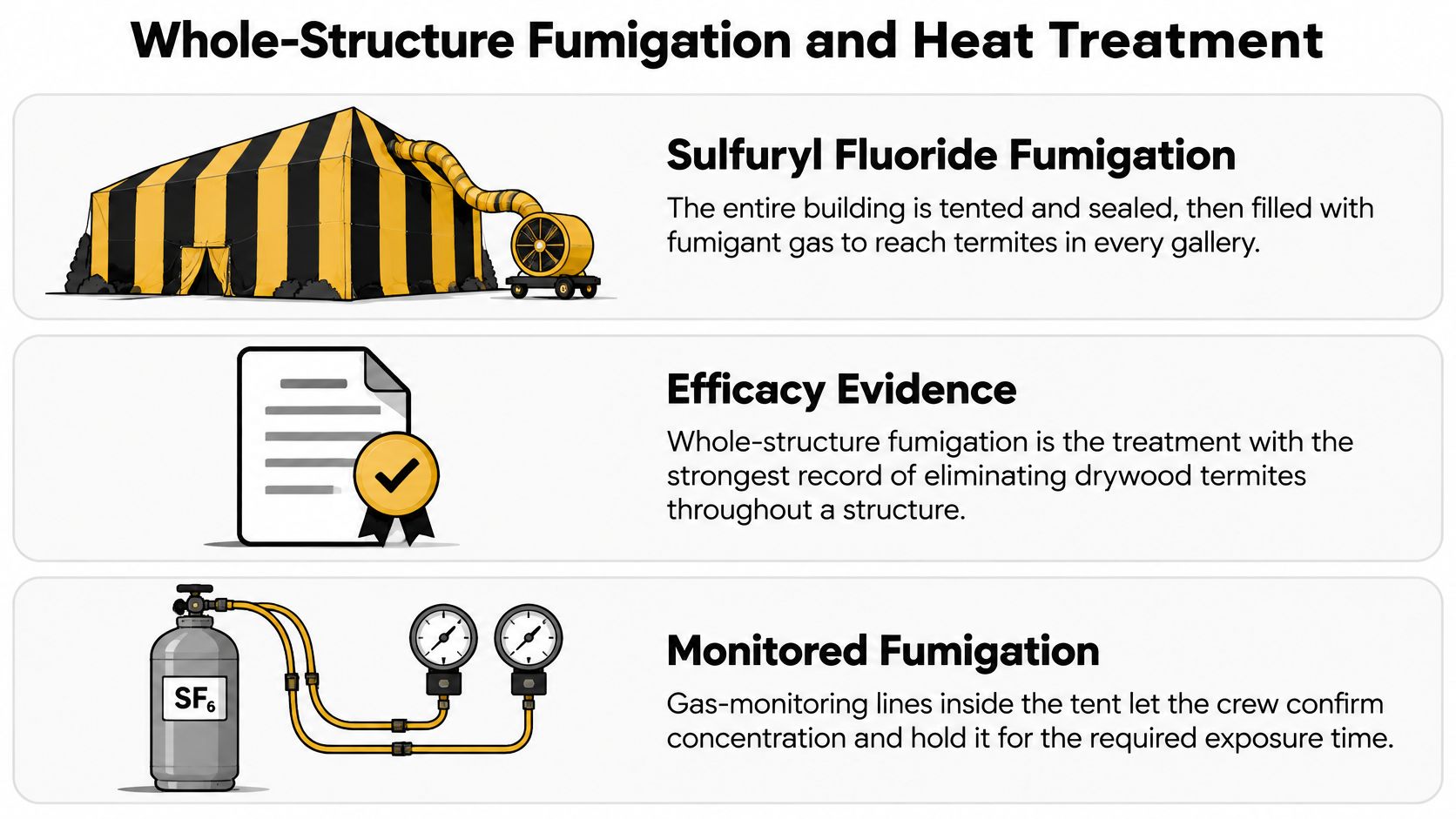
Sulfuryl fluoride fumigation works like sealing a jar and filling it with gas. Crews tent the entire building, seal the seams, and release a gas that moves through galleries the eye never sees. Reported fumigant efficacy is greater than 99%, according to the University of Arizona extension publication. That reach is why fumigation fits large, concealed, or widespread infestations once the inspection has mapped activity in more than one zone.
Two details decide whether that gas finishes the job. Monitored fumigation runs gas-monitoring lines inside the structure. The crew reads the concentration, confirms it hit the target, and holds it for the required exposure time. That monitored hold is the version with the highest treatment-success rate. Nonmonitored work can fail when the target concentration is not maintained. Termites that survive a weak dose stay in the same boards, so the colony the inspection found is still there after the tent comes down.
Occupants, pets, and plants leave for several days while the building is fumigated and then aerated. Licensed applicators follow the product label on building preparation, pilot lights, gas monitoring, and clearance before anyone re-enters.
Fumigation leaves no residual protection. It ends the infestation that is present and does nothing to stop a new colony from starting later. Post-treatment inspection, moisture control, exclusion, and repair of vulnerable wood stay part of the job.
Whole-structure heat treatment raises the temperature of the building until the wood itself, not just the air, reaches a lethal level and holds it there. Heat kills termites in every life stage, including eggs, and leaves no chemical residue. It is often the practical choice when tenting logistics are the barrier, for instance a site or a schedule that makes a tent difficult.
A short walk-through of whole-structure heat treatment shows how crews bring a building up to temperature and hold it.
Heat needs its own plan. Heat-sensitive contents have to be moved out or protected: electronics, artwork, medications, pressurized containers, candles, and vinyl items. Anything the crew cannot move or shield has to be accounted for before the heaters go on.
When whole-building treatment is the defensible call: activity in widespread areas, multiple infestation zones, framing that can't be opened or reached, or fresh pellets returning after spot work. Any one of those findings points away from a targeted treatment, because a product name does not locate a colony the inspection never found.
Localized Spot, Foam and Borate Treatments
Localized work fits a narrow, specific picture: one accessible board, or a small area the inspector has mapped and fully defined. A single infested window frame, a piece of furniture, an exposed attic rafter the technician can reach with a drill and a probe. That's the zone where staying in the house and treating one section makes sense.
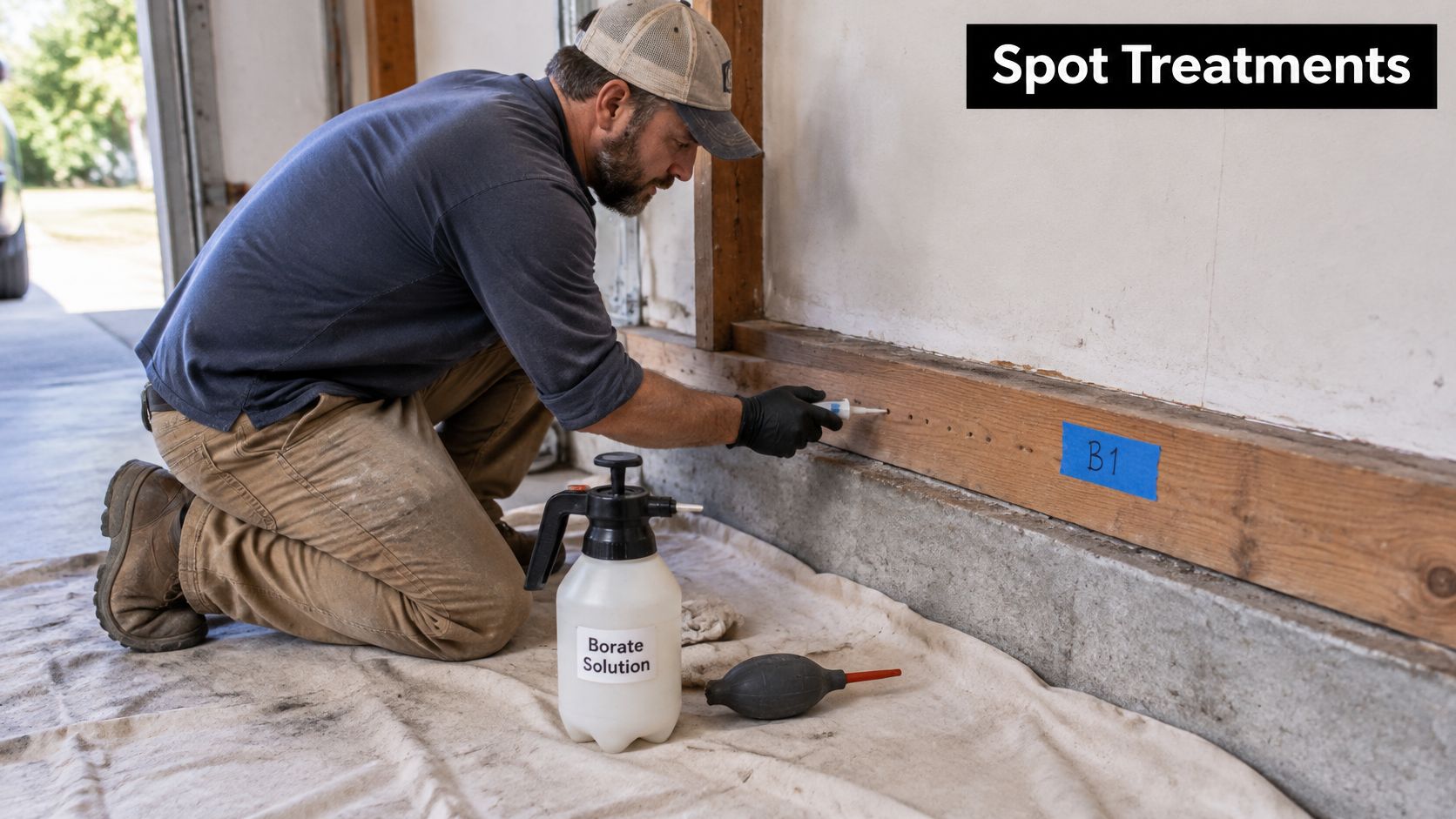
The mechanics are about access and coverage. A technician treats by injecting liquid or foam into the kick-out holes and the galleries behind them, or by placing dust or aerosol inside a void. Foam expands into irregular cavities, which is why it contacts termites a plain surface spray would glide past. The applicator uses the termites' own exit holes where they exist, drills small access points where they don't, fills the galleries, and seals the openings afterward. The whole method rests on reach: treatment stops where the tool stops, and any gallery beyond that point keeps its colony.
Borate products work differently. Applied to wood surfaces or injected into new and repaired framing, they soak into the fibers and give the treated wood residual protection against future termite entry. That makes borates most valuable during construction, after a repair, or as a protective step on exposed attic framing, rather than as a rescue for termites buried deep in a beam.
Where localized work runs out of road:
- Missed colonies in roof assemblies and wall voids. If a colony sits behind the surface the technician treated, nothing touches it.
- Repeat activity after spot work. Fresh pellets in the same area six months later mean the first attempt didn't reach every gallery.
- Untreated wood left exposed. Neighbouring boards stay vulnerable, and swarmers from a surviving colony can start again.
If you want a licensed provider to look before anything is drilled, termite control starts with locating the colonies, because stopping silent structural damage before it spreads depends on treating the right wood. The rule of thumb is blunt: if the inspector can't define the affected wood, localized treatment is a guess with a price tag.
How an Inspection Narrows the Right Method
A drywood colony in a door frame and a subterranean colony entering through a foundation crack call for different work. Once the insects are in hand, they do not look alike. Soil treatment cannot reach termites that never touch the ground. Wood treatment cannot stop a colony that lives in the soil and only uses the crack as a door. The hiding place, not the product name, decides the method.
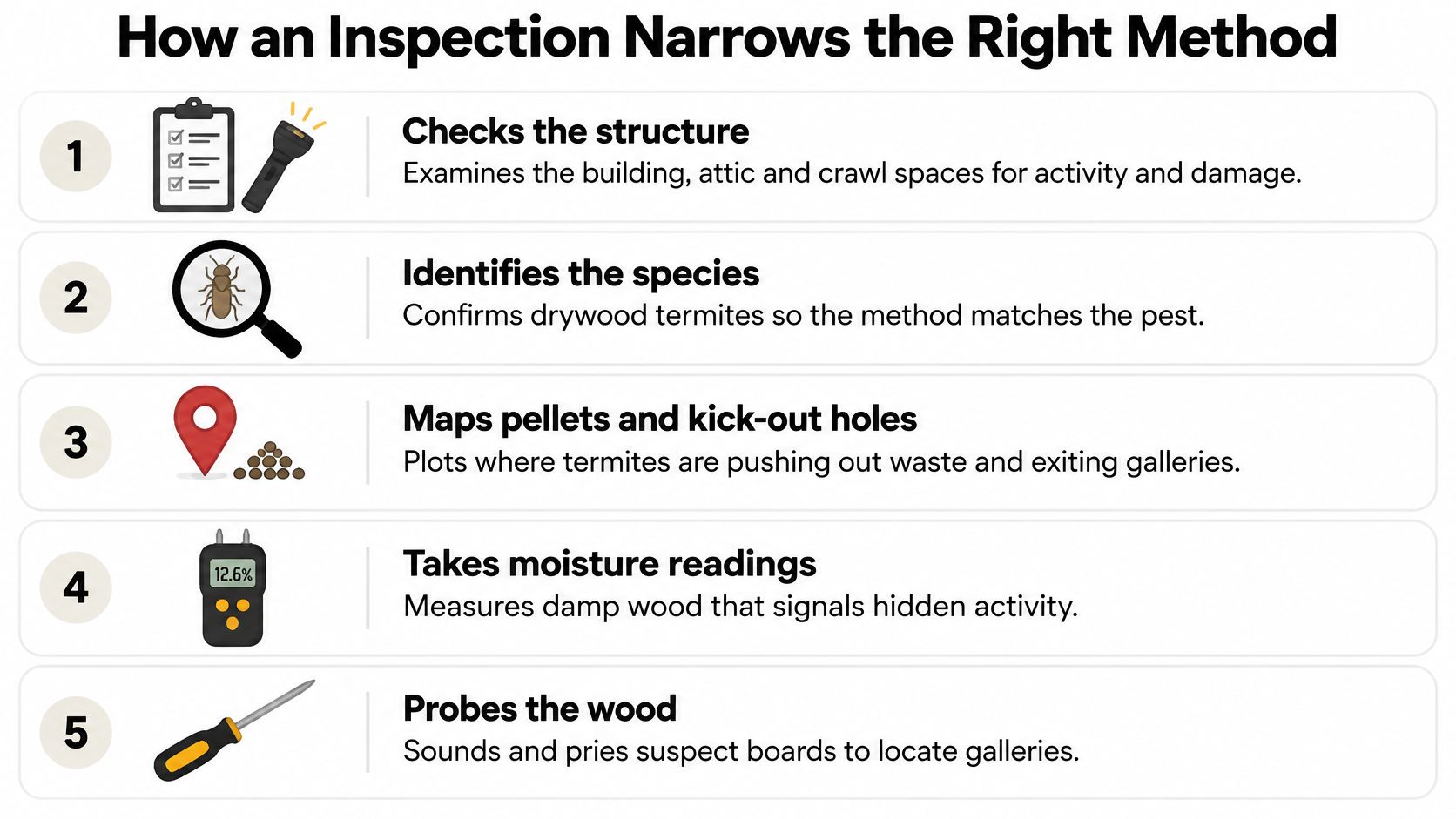
The visit follows that logic in order. A licensed inspector checks the structure, the attic, and the crawl spaces and identifies the termite species. The inspector maps pellets (the hard fecal droppings drywood termites push out) and kick-out holes (the tiny exits those pellets use), takes moisture readings on suspect wood, and probes and sounds boards to locate galleries, the tunnels chewed inside the wood. A certified applicator then treats the affected wood, the soil, or the foundation. The written report has to match that sequence, so the method follows the colonies found.
Species comes first because it removes options before anyone quotes a price. Location comes second, and it carries the most weight. One finding can reroute the whole plan, the way finding one wet room on a floor plan tells you whether you patch a single board or treat the building.
| Situation | Method to consider | Why it fits |
|---|---|---|
| Colonies confined to one accessible board | Localized treatment | Access allows full coverage of the colony |
| Activity in several zones or inaccessible framing | Whole-structure fumigation or heat | Hidden colonies are likely to be missed by spot work |
| Repeat pellets after spot treatment | Whole-structure treatment | Spot work has not reached every colony |
| New or repaired framing with no activity | Borate treatment | Protects wood before termites enter |
| Swarmers seen with no located colony | Full inspection before any method | The colony location must be confirmed first |
UC Integrated Pest Management guidance makes the same point from the other direction: localized treatment is appropriate only when inspection can confidently define the affected wood and the applicator can access and treat the entire colony area, as set out in the UC IPM drywood termite guidance. When that confidence is missing, the method has to widen.
Bring five things to the appointment:
- Where the pellets appeared, room by room, including any spot you cleaned up and any date you can recall.
- Whether pellets returned after an earlier treatment, and what that treatment was.
- Whether framing is accessible, or whether attic and wall areas are closed off.
- Whether swarmers or shed wings were seen, and roughly when. If swarmers are active now, say so when you request the quote so Pestless can prioritize a faster response.
- Any other wood damage, from soft window trim to a floor that flexes.
The question that drives everything is straightforward: where is every colony? A price set before that answer only covers the wood someone has already seen. For a clearer picture of what the visit involves, this guide to what happens during a termite inspection walks through it.
A report that names a treatment without naming the colonies it treats describes a sale, not a finding. The colonies on that page are what narrow the method.
What Drywood Termite Treatment Costs Depend On
Price follows the work the inspection finds. That's why two quotes for the same house can differ by a wide margin and both be honest about the number, because they describe different scopes.
These are the variables that move the figure:
- The species, since a drywood infestation and a subterranean one call for entirely different work.
- The size and layout of the building, including how much of it is framed in wood that's reachable.
- The number of infested zones, because three separate areas mean three times the access and coverage.
- Accessibility, since closed wall cavities and roof assemblies push a job toward whole-building work.
- The method itself, because tenting or heating a building is a bigger operation than treating one frame.
- Whether moisture correction, exclusion, or wood repair is included, which is real labour that some quotes leave out.
A low spot-treatment bid can be lower because it reaches less. If the inspection couldn't confirm every colony, that number doesn't cover the ones nobody found.
Ask each provider the same six questions:
- Does the quote include the inspection and a written report?
- Does it name the method and the reason for it?
- What preparation do occupants, pets, plants, and contents need?
- Is a post-treatment inspection included?
- Is any residual protection included, and where?
- Which repairs are excluded?
Compare bids only after each one names the same colony locations and the same method, so the prices describe identical work. For more on how these figures run in South Florida, this overview of termite treatment cost in Florida covers the local picture.
Book a Licensed Inspection Before Choosing a Treatment
Pellets on a windowsill show that drywood termites have been active nearby. They do not show how many colonies are inside the wood, or which beams they occupy. Each drywood colony lives in the timber it eats, like a separate apartment rather than one nest under the yard. Subterranean termites travel through soil, so a liquid soil barrier or a baiting system can cut that path. A drywood colony does not use it. Localized drywood treatment has to reach the infested wood itself. Termite treatment plans use liquid soil barriers, baiting systems, or localized drywood treatment, matched to the infestation. The inspection findings decide that match. A product name chosen on a phone call does not.
Pestless Inc. connects Miami and Miami-Dade homeowners with licensed, insured pest professionals through a short online form or a phone call. Most licensed providers in the Pestless network can schedule a termite inspection within a day or two. Pestless does not perform the treatment. It routes the request to a local provider who holds a Florida license and active insurance.
Four steps keep the choice tied to those findings.
- Request an inspection. Describe what you found and where. If you are seeing active termite swarmers, say so when you request the quote so Pestless can prioritize a faster response.
- Check the written report against the inspection checklist above. If a required line is missing, ask for it before you compare bids.
- Test the recommendation. Place the proposed method next to the comparison table and the findings. If the method covers less of the building than those findings describe, ask why.
- Get the follow-up in writing. Name the post-treatment inspection, any residual protection, and which wood repairs are included before work starts.
Repeat pellet cleanups are a signal to map the colonies before you pick a method. Request a no-cost, no-obligation quote, tell them what you have seen, and visit Pestless Inc. to get matched with a local provider.
Dealing with this pest right now?
Pestless connects you with a licensed, insured Miami pest control provider for a free, no-obligation quote.