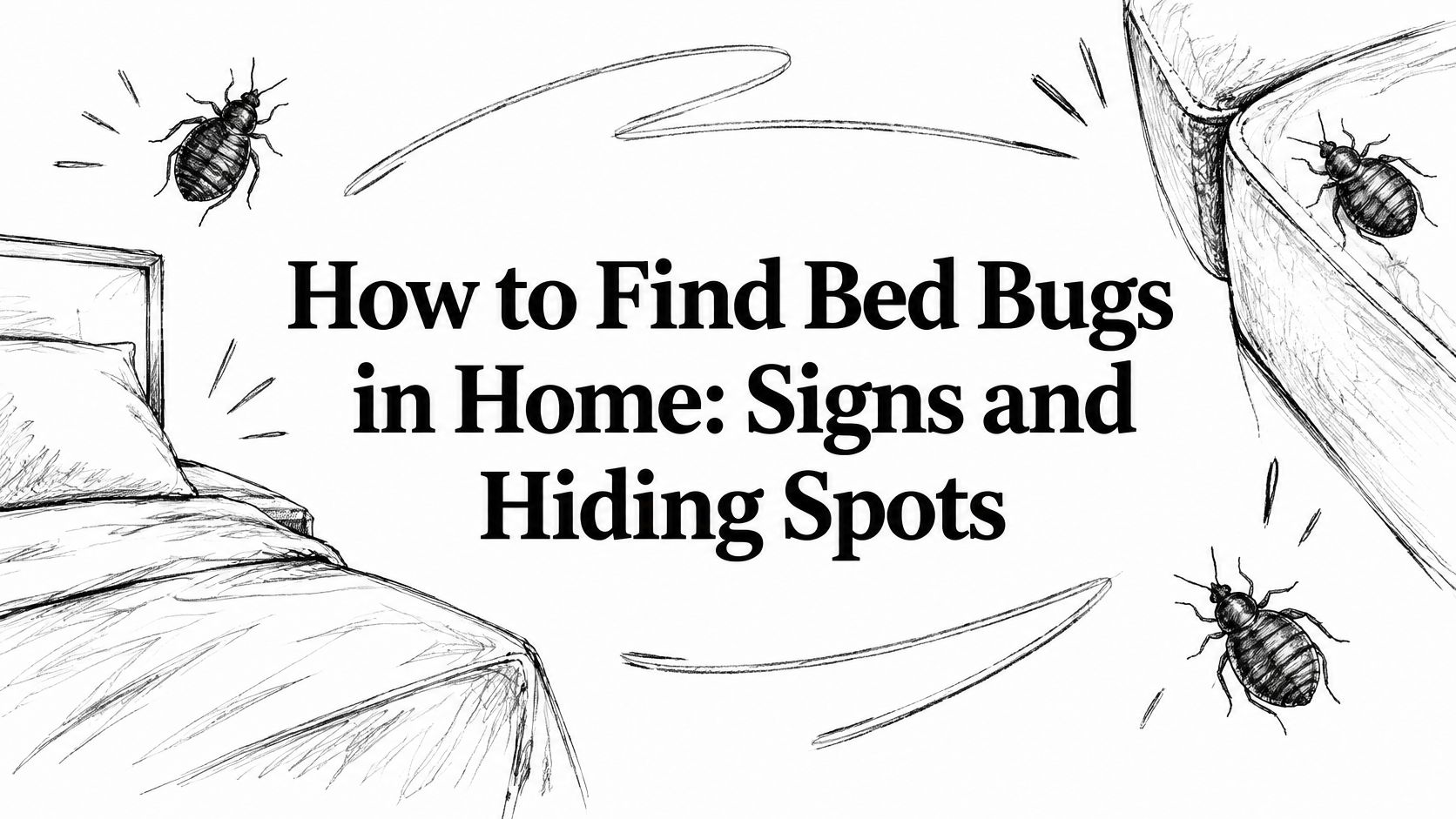
A spotless mattress does not clear a room of bed bugs. Checking the sheets for blood spots and watching for bites can leave you searching the exposed surfaces while insects remain tucked into hiding places. Bites alone are a weak reason to decide what pest you have.
Look where a bug can stay concealed. Mattress seams, screw holes and the thin fabric beneath a box spring deserve closer attention than a quick glance across the mattress top. Extend the search to the nightstand, sofa and baseboards rather than assuming clean sheets mean the problem stops at the bed.
Finding bed bugs means weighing evidence and following a fixed inspection order from the mattress outward. A numbered bed-to-room search helps you keep track of what you have checked. Identify the insect you find and separate it from lookalikes before choosing treatment, spraying a baseboard or dragging a mattress to the curb.
Table of Contents
- Signs That Prove Bed Bugs Are Present
- How to Inspect the Bed in Order
- Telling Bed Bugs Apart From Lookalikes
- Checking Rooms and Furniture Beyond the Bed
- Placing Monitors to Catch Hidden Bugs
- Decide Whether to Call a Bed Bug Pro
Signs That Prove Bed Bugs Are Present
One bite proves little. A single rust-colored fleck proves even less. The useful question is whether several physical signs sit in the same small area at once, because each sign carries different weight. A dark dot on a sheet can be dirt. A pale casing in a seam is harder to explain away.
The U.S. Environmental Protection Agency's guidance on finding bed bugs puts physical indicators ahead of everything else on the list. Rank them before you act on any of them.
| Sign | What it looks like | Evidence strength |
|---|---|---|
| Live bugs | Oval, flat, reddish-brown insects with six legs and no wings; nymphs paler and smaller | Strong once identified by an expert |
| Shed skins | Pale, translucent casings left as nymphs grow | Strong, shows a breeding population |
| Eggs and eggshells | Pale-yellow, about 1 mm, glued into seams and crevices | Strong, shows active breeding |
| Fecal spotting | Dark dots that smear like marker ink | Moderate, can resemble other insect droppings |
| Rusty blood stains | Small rust-colored spots on sheets or mattress | Moderate, can come from crushed bugs |
| Sweet, musty odor | Faint smell in heavy infestations | Weak alone, supports other signs |
| Bite marks | Itchy welts, sometimes delayed up to 14 days, according to the CDC guidance on bed bug inspection | Weak, often mistaken for other skin reactions |
The two strongest entries both point to a breeding population. A shed skin means a nymph grew to the next stage somewhere in that room. Pale eggs fixed into a seam mean the same thing, only more so. Live bugs matter most when they are identified correctly, because several small insects can be mistaken for bed bugs before anyone gets close enough to check the body shape, legs and wings.
Fecal spots are the sign people often misread. They cluster near a seam or a frame crack, look like ink dots, and smear brown-red on a damp tissue. Dust and dirt tend to flake or brush away. A sweet, musty smell is real, but it shows up in heavy infestations, which makes it a late signal rather than an early one.
Bites come last, and they should never be the only reason you act. Reactions vary from person to person. Some people develop itchy welts, while others show little visible response, and the marks can resemble mosquito or flea bites closely enough that no doctor can confirm a cause from skin alone. That is why a bite diary, by itself, gives you a weak case.
The one finding that ends the debate: a live adult or nymph collected from a sheltered spot near the bed, taped to a card or sealed in a small container, and identified by someone who does this for a living.
For a regional walkthrough of these same field marks, this guide to identifying bed bugs in Northwest Indiana covers the physical signs from a local inspector's angle.
How to Inspect the Bed in Order
Timing changes what you see. Bed bugs feed after dark and retreat into cracks by morning, so a bed that looks empty at noon can show activity at nine or ten at night. Start with the hours when the insects are more likely to be outside their hiding spots.
The CDC guidance on bed bug inspection sets out a structured visual pass and warns against using bites as the trigger, since bites can take up to 14 days to appear. That delay sends many people searching the wrong room at the wrong time.
Having an order at all is the bigger advantage. A 2025 Harris Poll for the National Pest Management Association found that 73% of Americans did not know how to inspect for bed bugs, according to the Professional Pest Management Alliance. A fixed sequence keeps you from glamorizing the mattress top while the frame, seams, and underside stay unchecked.
Here is the sequence to follow, from the sheets down to the frame.
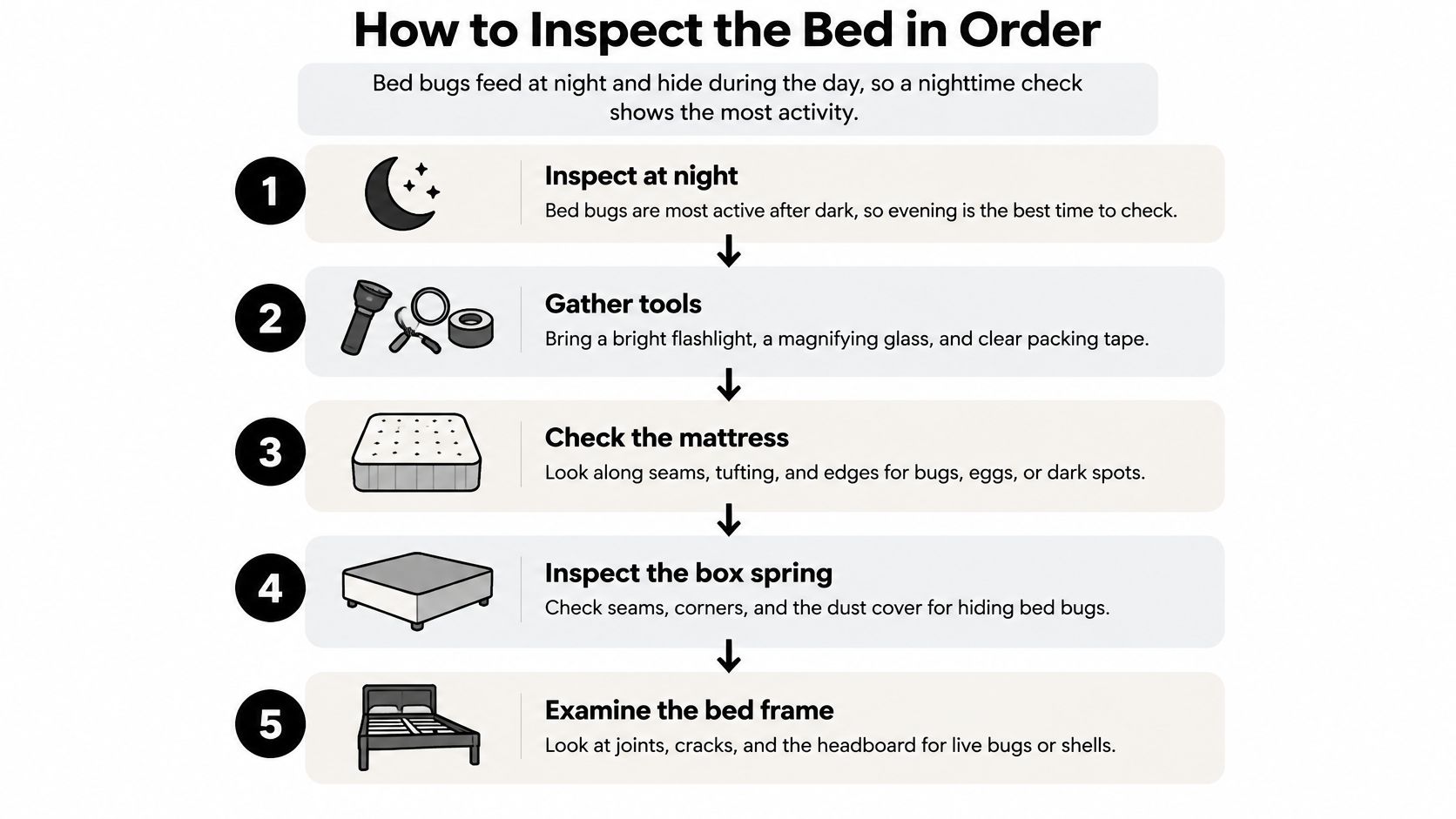
Inspect at night. Bed bugs are most active after dark, so an evening check catches insects a midday glance would miss. The common slip is searching at the wrong hour and concluding the bed is clear.
Gather four tools. A bright flashlight, a magnifying glass, clear packing tape and a sealed bag or jar. A phone light spreads too much glare across seams. Anything you find goes on tape or into the bag, because an unidentified smudge proves nothing.
Strip the bed and read the sheets. Check seams and corners for dark spotting, rust-colored stains and shed skins, then look at the mattress label. One faint mark should send you back to the same seam with the flashlight, not straight to a treatment decision.
Lift the mattress and work the underside. Run the light along the piping, labels, handles and the flat bottom surface. Those underside edges give bugs narrow seams, folds and contact points close to the sleeping area. Stopping at the mattress top skips the places where a bed is most likely to hold a hidden population.
Flip the box spring. Examine the seams, the corners and the thin dust cover on the underside, plus the frame where the box rests. This step is productive because the box spring stays undisturbed for long stretches and offers protected folds that a quick sheet check never touches.
Finish on the frame and headboard. Go through joints, screw holes, cracks in unfinished wood and the gap between the headboard and the wall, then the nightstand and the baseboard behind it. These are fixed structures, so bugs can remain close to the bed even after bedding is stripped and laundered.
What a clean pass looks like
Six clean steps in one night do not clear the room. Eggs and young nymphs are small enough to survive any single pass, so repeat the same order over three or four nights before you accept a negative result. Use the same route each time, because a second pass often catches what glare, bedding folds or a rushed first look concealed.
Two errors undo the inspection. The first is moving items before the check is complete, because carrying a pillow, backpack or blanket to another room can relocate live bugs and eggs with it. If an item must move, seal it first. The second is reaching for a fogger before the insect is identified, which turns an inspection problem into a wider treatment problem.
Never fog a room before you know what you're treating. A fogger pushes bugs deeper into wall voids and frame cracks, leaves the eggs untouched, and spends money a proper inspection would have saved.
Telling Bed Bugs Apart From Lookalikes
The most useful check in the whole search costs nothing: confirm what you're holding before anyone treats anything. Identification is where most false alarms start and most real infestations get missed.
Only 29% of 2,099 U.S. adults could correctly identify bed bugs, according to the 2025 Harris Poll commissioned by the National Pest Management Association. A confident guess fails often enough that a taped specimen is worth more than a memory.
Four traits settle a true bed bug. It has six legs, no wings, an oval body flattened from top to bottom, and a shield-like plate behind the head that widens at the sides. Nymphs stay pale yellow-white until they feed, then turn red-brown.
| Found insect | What gives it away | What it means |
|---|---|---|
| Bed bug | Six legs, no wings, oval flat body, plate behind the head widening at the sides | Confirm with an expert and treat the room as infested |
| Bat bug | Nearly identical to a bed bug; only a microscope shows the longer hairs on the plate behind the head | Check the attic and roofline for bats before treating the bedroom |
| Carpet beetle | Small, mottled white and brown, with slow hairy larvae on windowsills | A false alarm; no bed bug treatment needed |
| Spider beetle | Round body on long spider-like legs, reddish-brown | A false alarm; no bed bug treatment needed |
| Flea | Flattened side to side, jumps, lives on pets | Different pest and different treatment |
| Tick | Eight legs, cannot jump, attaches and stays put | Different pest and different treatment |
Bat bugs are the trap. They look so close to bed bugs that the difference lives in the length of hairs on that plate behind the head, which means a microscope and a trained eye. Finding one points at bats in the attic or roofline, and treating the bedroom for bed bugs won't touch that source.
Carpet beetles account for a large share of panicked calls. The adults are mottled white and brown rather than uniformly reddish-brown, and the larvae are slow, hairy and usually found near windowsills and wool. If you're staring at something small and patterned, this comparison of beetles that look like bed bugs walks through the differences before you spend a dollar.
The capture routine takes a minute. Trap the bug on clear tape or seal it in a bag, photograph it next to a coin for scale, write the date and room on the tape, and send it out for identification.
Checking Rooms and Furniture Beyond the Bed
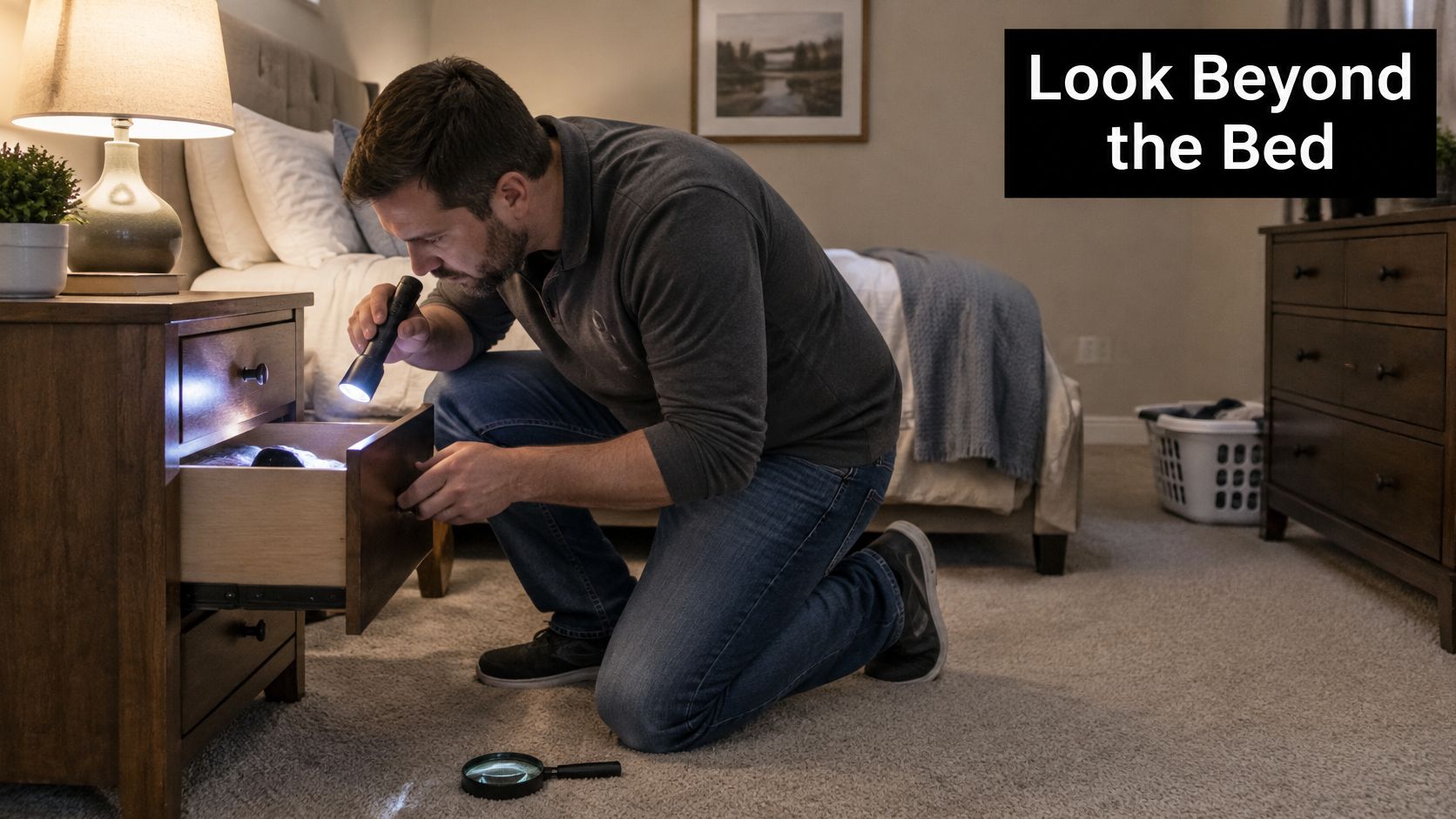
The bed is the start of the search. A flashlight and magnifier carried through the rest of the room find what a mattress check never will.
A clean bed tells you almost nothing on its own. CDC materials on bed bugs note that adult females lay about five eggs a day throughout their adult lives, tucked into sheltered spots such as mattress seams, box springs and crevices, including spaces beneath baseboards. Fresh bedding every week changes nothing about the population living a few inches away.
Moving outward from the mattress
Work in a widening ring. Start with the nightstand and dresser drawers, checking the joints and the underside of the top panel. Open drawer joints and look at the guides. Move to upholstered sofas and chairs, especially any piece where someone naps, and check the seams, the skirt and the deck under the cushions.
Then check the vertical surfaces. Curtain folds, the backs of picture frames, baseboards, the joint where wall meets ceiling, electrical outlets and utility penetrations all give bugs tight places to rest. Loose wallpaper edges deserve the same attention. In a heavy infestation, spread can reach appliances, sofa seams and even screw heads, so a room that looks untouched near the bed can still hold bugs at the far wall.
Bags are the other half of the search. Luggage, backpacks and totes that came home from a trip need their seams and lining checked before the contents go into a closet. Travel is the usual way they arrive in the first place, and this guide to whether bed bugs travel on clothes covers what to do with a suitcase before it comes inside.
A single bug on a couch arm usually points back to the bedroom rather than the couch. The full bed check still matters because bugs often spread out from a bed that was never inspected properly. Log each area as you finish it. Mark every location checked, clear or suspicious, with the date. A written map of where evidence appeared saves the next inspection, gives a landlord a record, and stops you rechecking the same drawer three nights running.
Placing Monitors to Catch Hidden Bugs
A pitfall-style interceptor under each bed and sofa leg works while your eyes are off duty. Bugs climbing toward a meal fall into a smooth-sided well and stay there until you check with a flashlight. That matters because a clean-looking mattress proves nothing about what is moving after lights out.
The evidence for monitors is strongest when you separate detection tools from ordinary glue traps. Independent apartment research collected by Ohio State University's bed bug program found detection in 88% of apartments using ClimbUp interceptors and 79% using BlackOut detectors, against 39% for a sticky detection system. Adding more monitors per apartment produced no significant improvement. In practice, placement beats quantity: put devices where bugs must climb, then log what each one catches.
| Monitor or method | Reported detection rate | Notes |
|---|---|---|
| ClimbUp interceptor | 88% of apartments | Independent apartment study summarized by Ohio State |
| BlackOut detector | 79% of apartments | Same study, one or more monitors per apartment |
| Sticky detection system | 39% of apartments | Weakest system in the same study |
Treat those figures as benchmarks, not promises. A clean monitor doesn't rule out a low-level infestation, so keep monitoring and repeat the room-by-room search instead of trusting a single empty trap. Monitors are strongest as confirmation tools and as a way to track whether activity continues after furniture has been pulled, seams have been checked, and luggage has been handled.
The comparison that settles the argument comes from 2025 Penn State Extension guidance: visual inspection alone found 72% of infestations, while visual inspection combined with interceptors reached 99%. A visual pass with no monitors leaves roughly a quarter of infestations undetected. That gap is why I would rather have both evidence streams than rely on a fast look at the mattress and call it clear.
Set the traps correctly and they'll earn their price. Put one under every bed and sofa leg, pull furniture an inch away from the walls, keep bedding off the floor, and check each trap at least once a week. Write the date, the location, any specimens and any fecal evidence in the trap. This turns a vague worry into a usable record: which leg, which room, which night, and whether the find is a bug, a shed skin, or a stain that needs a second look.
Interceptors mainly catch bugs that walk. They will not solve eggs tucked into a seam or hidden harborages that never feed on that schedule. When the search does confirm bugs, Bed Bug Treatment is built to eliminate every life stage, bugs, eggs and all, which matters because monitors can show activity without reaching the places where the next generation sits.
Decide Whether to Call a Bed Bug Pro
Evidence decides the next move, and each level of evidence has one sensible response. Match what you found to the row below rather than to how anxious you feel at two in the morning.
| Evidence found | What it means | Next step |
|---|---|---|
| Live bug or egg confirmed by an expert | Infestation confirmed | Call a licensed pro now and stop moving items between rooms |
| Two or more physical signs, such as shed skins and fecal spots | Likely infestation | Call a pro, or monitor for two weeks while you prepare |
| One stain, one bite or one unidentified bug | Not enough to confirm | Continue monitoring and repeat the inspection |
| Carpet beetle or lint suspected | Probably a different insect | Send the specimen for identification before treating |
A confirmed bug or egg ends the debate. Call a licensed professional the same day and keep the furniture where it stands.
Two or more physical signs in the same seam indicate a breeding population. Book the visit. If you want monitors running first, cap that at two weeks with a dated log, and don't let data collection become an excuse to delay treatment you already know you need. The monitor placement and trap-checking routine from the previous section applies here unchanged.
A single stain, a single bite or one unidentified insect isn't enough. Go back through the numbered bed-to-room order from the inspection section, since one pass often misses what a second look catches. Acting on one mark produces the two most expensive mistakes in this trade: spraying a room that had no bugs, and discarding a mattress that was never the source.
What the first visit should cover
When the answer is to call, Pestless matches a homeowner with a licensed bed bug professional serving their Miami neighborhood, based on the specific address submitted in the form. The first visit is an inspection: the technician confirms the insect, identifies harborage points and assesses how far the infestation has spread. The date you first noticed something, which rooms show signs, photos, taped specimens and the monitor log all let the matched provider prepare before arriving, so have them ready. If you want to know what happens after that inspection, this breakdown of what exterminators do for bed bugs covers the treatment side.
Rental owners have more at stake, since one unit can seed the next. Fitting a bed bug check into a preventive maintenance guide for rental investors schedule keeps the same problem from cycling through three tenants and three sets of belongings.
Today's step is small and it starts the paper trail: tape one specimen, photograph it beside a coin, and set interceptors under every bed leg.
Pestless Inc. connects Miami-Dade homeowners with licensed, insured bed bug professionals by neighborhood, from Brickell and Coconut Grove to Doral, Hialeah and Kendall, at no cost and no obligation. If your search turned up a taped bug, a seam full of spotting or a monitor that keeps filling, tell us the address and what you found so the right local pro can pick it up. Visit Pestless Inc. to submit the details and get a licensed inspection scheduled.
Dealing with this pest right now?
Pestless connects you with a licensed, insured Miami pest control provider for a free, no-obligation quote.