The text arrives at 7:40 on a Saturday morning. A photo of dark pellets lined up along the baseboard behind a refrigerator in a Brickell condo, plus one line. The place sat empty for five weeks, and the tenant wants to know if this is bad.
Maybe your version looks different. A Kendall attic you finally crawled into to check a soffit. A Hialeah garage with a smell you can't place. A short-term rental in Edgewater where the cleaner found a nest in the linen closet and the next guest checks in Friday.
The instinct in all three cases is identical. Get a vacuum, get a trash bag, get it gone before anyone sees it. That instinct is the most common way Miami homeowners turn a manageable contamination problem into an exposure event, and it's why the cheapest result you find for rodent clean up services near me can leave a room worse than it started. Below is how to tell which jobs you can handle, what a safe cleanup involves, and what should be printed on the quote before anyone walks through the door.
Table of Contents
- When a Miami Mess Needs a Crew
- How a Safe Rodent Cleanup Runs and What to Avoid
- What a Miami Quote Must List
- Cleanup After Bait and Hidden Carcasses
- Book a Licensed Miami Cleanup
When a Miami Mess Needs a Crew
Start with the room, not the number of pellets. Volume tells you how long the problem has been running. The room tells you whether the material will stay put when you touch it. South Florida makes that second question harder than most markets. An attic in July is an oven, a garage in August holds humidity like a sponge, and a unit that sits vacant through the rainy season gives droppings time to dry into dust that lifts the moment air moves.
| Situation | Who should clean | Why this line |
|---|---|---|
| A few droppings on a hard floor in one ventilated room | Resident, wet method only | Small volume, easy to isolate and air out |
| Urine stains, nests, or a carcass in a closet or garage | Professional if the space is enclosed | Dry disturbance can aerosolize dust |
| Attic, crawlspace, or wall void | Professional | Poor ventilation and hidden porous material |
| Rodents in heating or cooling ducts | Professional | CDC recommends pros for HVAC contamination |
| Multiple rooms or a heavy infestation | Professional with respirator-level PPE | Household gloves are not enough |
| Unit closed for weeks or a vacant rental | Professional | Household exposure is the common pathway, not only outdoor work |
Match your property to a row before you read any further. If you land in the first row, a careful wet cleanup by you is reasonable, and the next section walks through exactly how. If you land anywhere below it, the job belongs to a crew, and not because the mess is unpleasant to look at. It belongs to a crew because of what happens when dry material goes airborne in a space you can't ventilate.
Why the Line Sits at the Attic Door
The U.S. hantavirus surveillance record is the bluntest evidence on this point. CDC researchers reviewed 662 laboratory-confirmed hantavirus pulmonary syndrome case-patients reported from 1993 through 2015 and found that 71 percent were exposed at home, while 17 percent reported exposure while cleaning an area containing rodents, according to the CDC's two-decade hantavirus review. Put that in Miami terms. The dangerous exposure wasn't a hike through the Everglades. It was a living room, a garage, a storage closet, and someone holding a broom.
Bacteria add a second reason to slow down. The World Health Organization identifies rodents as major reservoirs of Leptospira, the organism behind leptospirosis, and its guidance cites a systematic-review estimate of more than 1,000,000 human cases and more than 58,000 deaths globally each year, with roughly 73 percent of cases and deaths occurring in tropical climates, per the WHO leptospirosis guidance. Miami is a tropical climate with heavy rainfall. Transmission runs through infected urine and the water and soil it contaminates, not through a bite, which is why soaked insulation and wet cardboard in a garage deserve more caution than three dry pellets on tile.
What Counts as Contamination Even When Pellets Look Sparse
The visible dropping is the least of it. Treat every item below as contaminated material, not as debris to be tidied:
- Urine staining on wood or concrete: dried urine leaves a residue that reactivates into dust when scrubbed.
- Nesting material: shredded paper, insulation fibers, and cardboard hold both urine and fine fecal dust.
- A single carcass: a dead rodent in a trap or a wall carries fleas and its own waste load.
- Soaked porous material: the bottom layer of attic insulation, drywall edges, and duct liner that touched the nest.
Practical rule: if you can't shut the door, open a window, and keep everyone else out for half an hour, you don't have a cleanup. You have a dust event with a trash bag attached.
Three quick verdicts. A Brickell condo with pellets on tile in one closed bathroom is a resident job. A single-family home with a nest in the attic insulation is a professional job, no exceptions. A property manager with units in Doral and Hialeah should treat every vacancy longer than two weeks as a professional inspection, because the unit that sat empty is the one where the exposure pathway formed. And the moment insulation, ductwork, or a wall cavity is involved, stop. That's the edge of the map for DIY.
How a Safe Rodent Cleanup Runs and What to Avoid
When contamination sits in one ventilated room, on a hard surface, and you can keep kids and pets out of it, you can handle it with a spray bottle, disposable towels, and a bag. When it sits in an attic, a crawlspace, a wall void, or anything connected to the air handler, stop and call. The dividing line isn't squeamishness. It's airflow.
The six-step version of the workflow, with the mistakes that cause the most harm, looks like this.
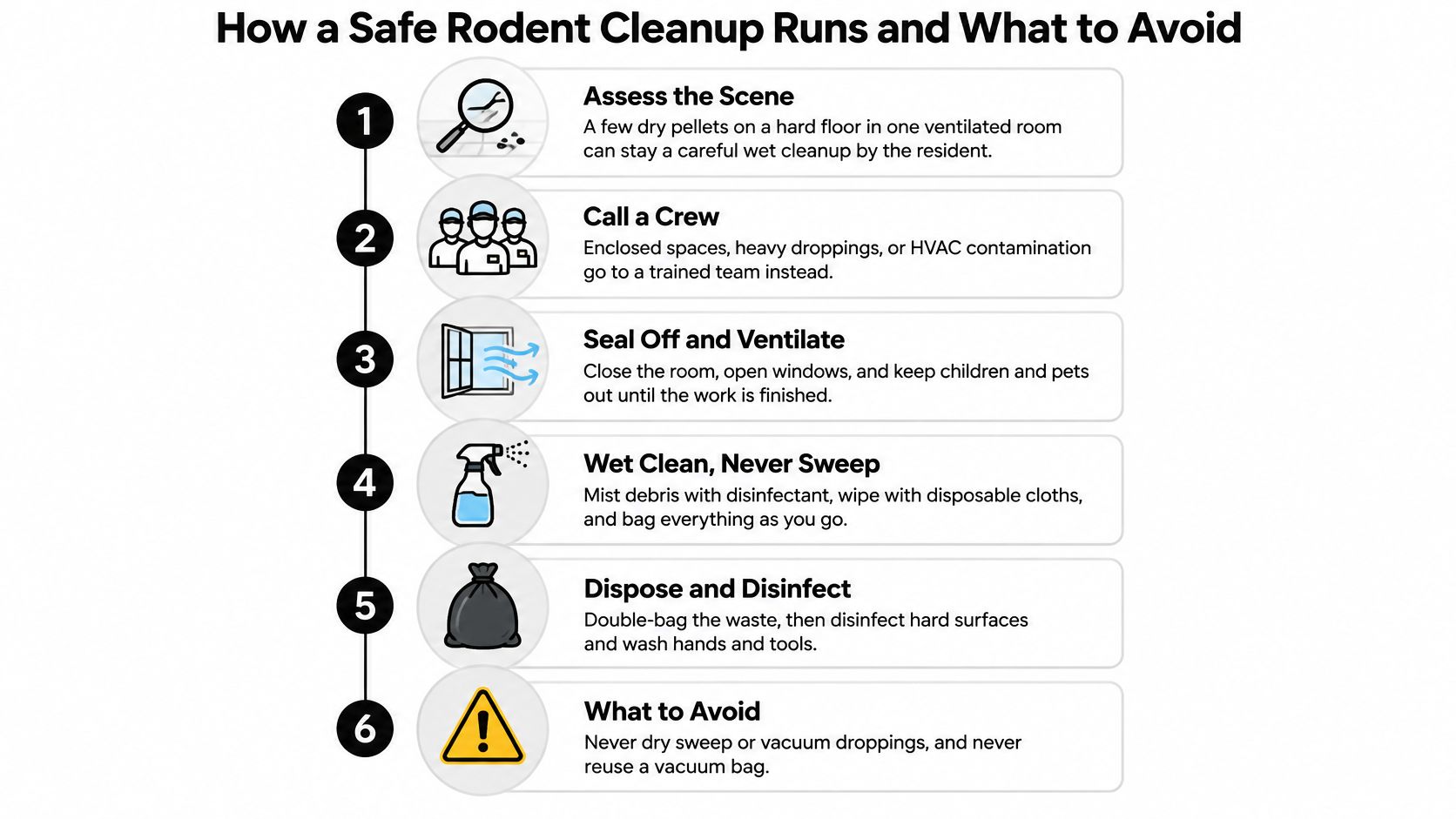
- Isolate and ventilate. Close the room to everyone else, open doors and windows, and leave the space alone for at least 30 minutes before you walk in. The CDC rodent cleanup guidance sets that minimum, and it's the step people skip because it feels like wasted time.
- Never sweep, vacuum, or blow. Dry droppings, urine patches, nesting, and carcasses all release contaminated particles when mechanically disturbed. One pass with a shop vac is worse than leaving the mess for another day.
- Wet everything down. Gloves and eye protection on, then saturate the material with an EPA-registered disinfectant or a freshly mixed 10 percent bleach solution, and let it sit for at least 5 minutes or the contact time on the label, whichever is longer, per the same CDC cleanup protocol.
- Wipe, bag, and wash. Lift the soaked material with disposable towels, double-bag it, dispose of it per local requirements, then wash your hands. Gloves come off last, not first.
- Identify and inspect. Note whether you're dealing with rats or mice, since the droppings differ in size and shape and the response differs too, then find the nests and walk the perimeter looking for every entry. This comparison of rat droppings versus mouse droppings is a fast way to sort out which rodent you have.
- Trap, then seal. Remove the rodents still inside, then close the gaps, vents, rooflines, and utility penetrations they used. Cleaning without exclusion means you'll be doing this again in eight weeks.
- Document it. Photograph the before and after, including the sealed entry points. That record is what protects a landlord in a deposit dispute and what proves a job to a condo board.
When Household Gloves Aren't Enough
Substantial contamination needs a different layer of protection. National Park Service guidance for hantavirus work recommends coveralls, boots or shoe covers, gloves, goggles, and respiratory protection, and for heavily infested areas or handling dead rodents it identifies a NIOSH-approved tight-fitting respirator with N100 or P100 filters, or a PAPR, as the appropriate equipment, per the NPS hantavirus health and safety update. The method stays wet throughout: soak droppings, nests, carcasses, and traps, leave the disinfectant undisturbed for at least 10 minutes where that protocol applies, and treat roughly a 2 foot radius around each contaminated object.
The Three Failures That Show Up on Almost Every Bad Job
The dry sweep. Someone in a mask broom-sweeps an attic in the morning and the family sleeps under it that night. Nothing about the room looks worse afterward, which is exactly the problem.
The old bleach bottle. Diluted bleach loses strength as it sits, so a spray bottle mixed last month is mostly water and scent. Mix it fresh, every time, and use it the same day.
Odor as the finish line. A treated attic that smells fine can still have soaked insulation, contaminated drywall, and a duct liner holding the source. Porous materials often need removal and replacement, not a spray. Outside the house, the same wet-down logic applies to other animal waste, and if you're also dealing with soften and wash away bird droppings on a lanai or balcony rail, the sequence is the same: wet it, disinfect it, bag it, don't dry-scrape it.
The acceptance test for any paid job is documentation: ventilation time, the chemical name and EPA registration number, contact time, PPE level, waste handling, and a post-cleaning inspection with photos. A crew that shows you a bag of visible pellets and a bill has done the easy third of the work. Our Rodent Control service is scoped around the full version: an inspection that identifies the species, the nesting areas, and every likely entry point, cleanup of droppings and contaminated material with insulation remediation where it's needed, and sealing of gaps, vents, rooflines, and utility penetrations so the rodents don't come back.
What a Miami Quote Must List
A quote is a scope document or it's a number someone said on the phone. Those are not the same product, and the difference shows up three weeks later when the smell returns and the crew says the insulation was never included.
Print the table below, or screenshot it. When a provider can't answer a row, that's your answer.
| Scope item | Ask for | Red flag |
|---|---|---|
| Inspection | Species, nests, and every entry point in writing | A spray visit with no look in the attic or along the roofline |
| Disinfection | EPA-registered product or fresh bleach, contact time, no dry sweeping | Vacuuming or sweeping pellets |
| Protection | Gloves and eye protection, respirator for heavy or enclosed messes | Bare-hand cleanup of an attic or crawlspace |
| Waste | Double-bagged droppings, nests, and carcasses | Loose debris left in an open bin |
| Porous material | Insulation or duct-liner removal when contaminated | Odor spray over soaked insulation |
| Exclusion | Sealing of gaps, vents, rooflines, and utility holes | Bait with the same holes left open |
| Proof | Photos plus license and insurance | A verbal price and no paperwork |
Red Flags, Translated Into Miami Properties
The vacuum-only price. Picture a Coral Way duplex where the quote covers "dropping removal" and nothing else. A vacuum pass over dry pellets in a closed utility room pushes fine dust into the air and onto every surface in the room. You paid to spread it. The cheapest number on the list is rarely the safest metric, and never the cheapest overall once a second visit is needed.
The bait-only visit. A Hialeah fourplex gets stations dropped in the laundry room and a handshake. No exclusion, no carcass plan, no inspection of the roofline the rats are using. Bait without sealing is a subscription, not a fix.
The unlicensed crew. A van, a cash price, no certificate of insurance. If a worker is injured in your attic or a tenant later reports illness, you own that exposure. Ask for the Florida license number and an active insurance certificate, then verify both before the truck arrives.
The odor spray over wet insulation. An Edgewater short-term rental gets fogged and photographed. The source is still in the ceiling. Guests notice within a week, and the review is permanent.
What You Can Verify the Same Day
License and active insurance, for starters. A neighborhood match rather than a call center three states away, which matters when someone has to come back and check a trap line. A written, no-obligation quote before work begins, and a commitment to a return inspection if activity continues after treatment. Those four items separate a real local operator from a lead broker.
For landlords and hosts, add one line to the scope: which rooms guests or tenants must stay out of, and for how long the disinfectant has to sit before the space is usable again. A host with a Friday check-in needs that written down, not estimated at the door. Reject any quote that can't itemize source removal, exclusion, disposal, disinfection, and photos. Every time.
Cleanup After Bait and Hidden Carcasses
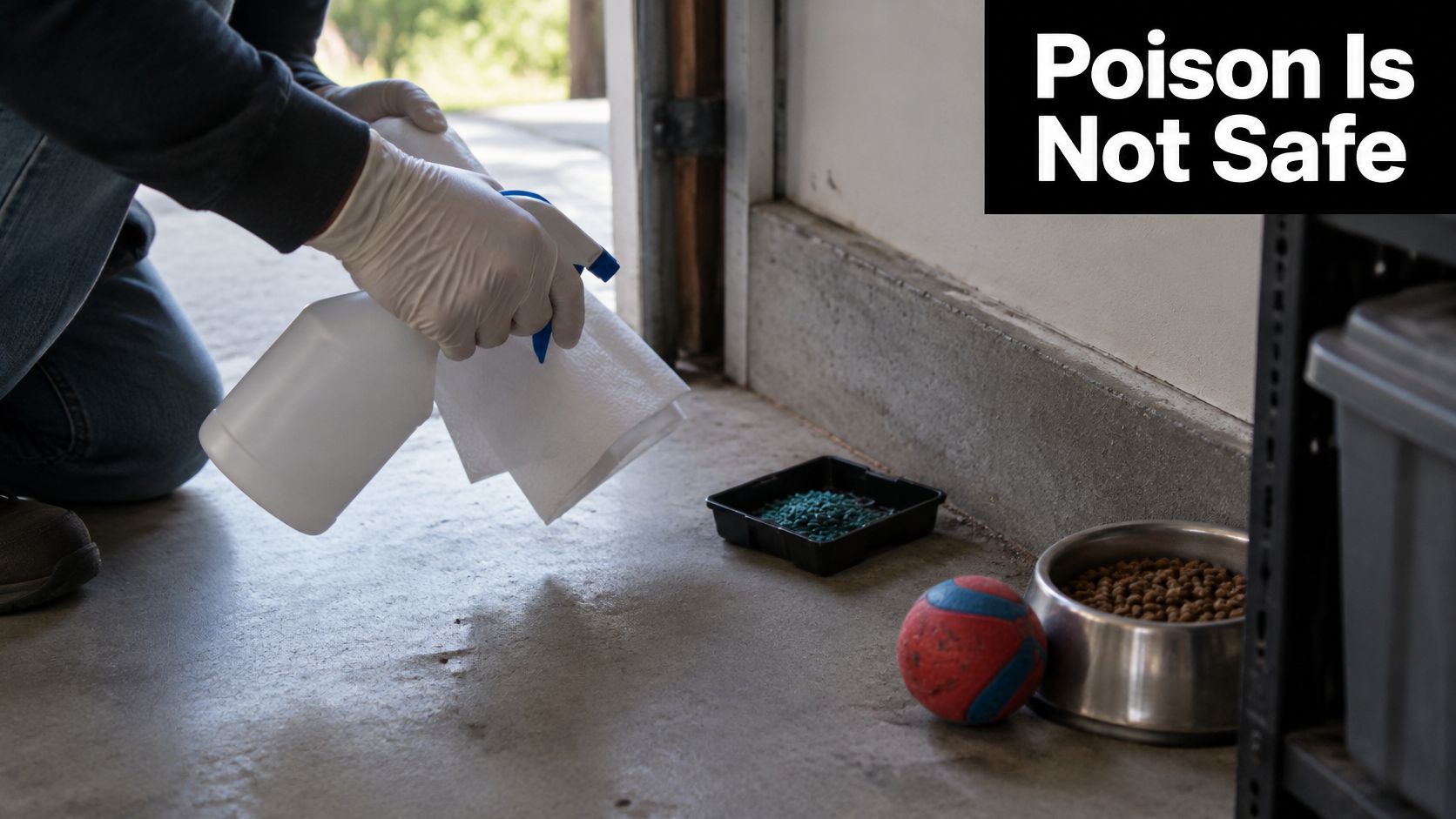
More poison is not a finished job. That's the assumption worth challenging, because a property that's been baited for two weeks is often dirtier than one that hasn't, with rodents dying in places you can't reach and the survivors still using the same gap in the soffit.
The U.S. Environmental Protection Agency is direct about the risk: rodenticides can harm children and pets when misused, and non-target wildlife and pets can also be poisoned by eating baited rodents, per the EPA guidance on safe rodent bait use. The same standards require consumer products to use bait stations that securely contain the poison, with more protective tamper-resistant stations in settings involving children, pets, or outdoor exposure.
The Post-Treatment Conversation You Should Have
Ask the provider to walk through four things before they leave the property, and get them in writing where possible:
- Station placement. Where each station sits, how many there are, and whether they're tamper-resistant and locked.
- Carcass retrieval. How dead rodents will be located and removed, including a plan for wall voids and ceiling cavities, not just the floor.
- Surface disinfection. Which surfaces the animals crossed and how those get disinfected, since a dying rodent leaves a trail.
- Product disclosure. The active ingredient and a written record, so you know what's in a house with a dog or a toddler.
A bait station is a container, not a solution. The job ends when the bodies are out, the surfaces are clean, and the entry points are sealed.
Consider a Miami condo where a rat dies inside a shared wall between two units. The smell reaches the neighbor in four days, the board gets a complaint, and nobody can say which side of the wall the animal is on. That's not a pest problem at that point, it's a building problem: a small section of drywall may need to be opened, the void treated, and the cavity closed again. Masking it with fragrance only buys a week.
A Kendall home with a labrador is the second scenario. The dog finds a dying rodent in the shrub line before you do. That's the secondary poisoning pathway the EPA warns about, and it's why treated zones stay off limits to pets and children until carcasses are retrieved and every station is accounted for. If you manage short-term rentals and the odor has already reached the unit next door, the same professional-grade work that hotels use for professional odor elimination for hotels is the right comparison, because a sealed room with treated air is a different product from a plug-in.
Compare providers on the retrieval plan and the follow-up inspection, not the price of the bait. Exclusion and carcass removal are the job. They're not add-ons you negotiate after the poison is gone, and a company that treats them that way is telling you what the second invoice will look like.
Book a Licensed Miami Cleanup
Before you dial anyone, write down three facts. Which rooms are affected, and whether that includes an attic, crawlspace, or wall void. Whether insulation, drywall, or ductwork is involved. And whether bait was already used or a smell suggests a carcass you can't see. Those three lines turn a vague phone call into a scoped request, and they stop a crew from quoting a generic spray price for a job that needs a containment plan.
Why Those Three Facts Change the Price
Rooms tell a provider how much ventilation and isolation the job needs. Insulation and ducts tell them whether porous material has to come out, which is the single biggest variable in scope. Bait and odor tell them whether they're doing retrieval and void treatment in addition to cleanup. Give those details up front and the quote you get back is comparable to the next one you request. Leave them out and you'll be comparing three different jobs that happen to share a number.
The One-Minute Route to a Local Provider
Pestless is a free referral service for Miami and Miami-Dade, and we don't perform the cleanup ourselves. You describe the rodent problem in a form that takes about a minute, or you call, and the request goes to a licensed, insured local provider who typically contacts you within one business hour, Monday to Saturday, 7am to 9pm ET, with a no-obligation quote. Your details are shared with that provider, who may follow up by phone, text, or email. For an urgent mess, call (786) 305-7867.
Matching runs by neighborhood, from Brickell and Coconut Grove through Doral, Hialeah, and Kendall, so a condo board, a landlord, or a vacation host isn't guessing from ads. That also means the person who shows up works this market and has seen what a Miami attic does to insulation in August.
What to Ask on the Call
Verify the license and active insurance first, and read this guide to choosing a licensed pest control professional if you want the specifics of what a Florida license lookup should show you. Then walk the quote table from earlier: wet disinfection with a named product and contact time, exclusion of the entry points they found, insulation removal if it's contaminated, carcass retrieval if bait was used, and photos at the end.
One last thing. If someone in the household has already swept a heavy area without protection or develops respiratory symptoms afterward, get medical advice. Hantavirus is uncommon in Florida and it's also potentially severe, and no cleanup schedule is worth waiting out a fever to keep.
You don't need to guess which Miami provider will treat rodent waste as hazardous material instead of yard debris. Pestless Inc. matches homeowners, landlords, and rental hosts across Miami-Dade with licensed, insured local pros who quote the job in writing, free and with no obligation, usually within one business hour. Describe the rooms, the insulation, and any bait that's already down, and let a vetted local crew put a real scope in front of you. Start at Pestless Inc. or call (786) 305-7867.
Dealing with this pest right now?
Pestless connects you with a licensed, insured Miami pest control provider for a free, no-obligation quote.