A tenant texts you a photo of a roach behind the microwave on Tuesday afternoon. You call your licensed exterminator, grab the first open Thursday slot, and start typing a quick message to post on the door. That's the exact moment most property managers create a headache they won't see until next week.
A vague two-line note announcing that "pest control will spray Thursday" leaves tenants guessing about pets, dishes, locks, and whether they can sleep in the apartment that night. When a technician arrives to an unprepared kitchen or a deadbolted door, the visit fails, the infestation spreads to the unit next door, and you're left paying for a return trip with no paper trail to show you handled the report properly.
A well-built pest control notice to tenants isn't a courtesy memo. It's two tools in one document: a compliance record that proves you met statutory timelines and rent-adjustment duties, and a field-ready treatment plan that tells residents exactly how to prepare so the treatment works on the first visit.
Table of Contents
- What Every Pest Control Notice Must Contain
- Florida Notice Timelines and a Miami-Dade Worked Example
- How to Write and Deliver the Notice Step by Step
- Sample Pest Control Notice Template
- Who Pays and Who Is Responsible When Pests Are Disputed
- Before You Send and Where to Get Help
What Every Pest Control Notice Must Contain
A short note taped to apartment doors can fail before the technician reaches the property. It says the building will be sprayed Thursday morning, but a parent in unit 2A still does not know whether the work is crack-and-crevice gel or an aerosol application, how long to keep a newborn out of the kitchen, or whether open cereal boxes must be bagged. By Wednesday night, the manager is answering repeated questions. By Thursday morning, several units are still not prepared for entry.
That breakdown happens when a notice is treated as a scheduling alert instead of an operational record. A useful pest control notice to tenants does two jobs at once. It creates a compliance record showing that the owner handled the report through proper notice and preparation steps. It also gives residents a field-ready treatment plan they can follow without guessing.
Timing rules vary by location, so the notice has to match the jurisdiction where the dwelling sits. Under the Massachusetts Department of Public Health pest control guidance, owners must provide at least 48 hours' notice before extermination and give clear safety-preparation instructions. The same guidance points to the practical reality behind those rules: tenants need to know what to move, what to empty, and how to avoid exposure before treatment begins.
California adds its own documentation duties. California Civil Code §1940.8.5 and §§1954.600–1954.605 require at least 24 hours' advance written notice before pesticide is applied inside a dwelling unit. The statute also requires written bed-bug information before new tenancies created on or after July 1, 2017, and delivery of a pest operator's inspection findings to inspected tenants within two business days of receiving them. Those deadlines are not paperwork for its own sake. They shape when the notice goes out, what records the manager keeps, and how soon follow-up information reaches the resident.
A notice that skips preparation tasks, re-entry rules, or adjacent common areas protects nobody. It just pushes the treatment back by two weeks.
Essential Fields for Your Portfolio Template
In multifamily buildings, treating one unit often fails when pests move through wall voids, pipe chases, laundry rooms, and shared corridors. The notice should name the affected unit along with any adjacent walkways or service areas included in the scope. That matches the building-wide approach shown in practical integrated pest management plan examples. If the work touches a trash room or hallway, say so, because residents who prepare only their kitchen may still block the treatment route.
Order the details the way a resident needs to act on them: where the work happens, what pest is targeted, when the crew arrives, what method they are using, and what the household must do before and after. Keep the language direct. "Bag food and empty cupboards" is more useful than "prepare as needed." The contacts line should include a direct management email and an after-hours number. A property manager who uses 24/7 call answering for pest companies can route urgent questions about locked entries or chemical precautions instead of letting them sit in voicemail overnight.
| Notice element | What to write | Example entry |
|---|---|---|
| Affected unit or common area | Unit number plus shared hallways, laundry or stairs | Units 3B and 3C, third-floor hallway, and trash room |
| Pest and target location | Pest name and the rooms or areas treated | German cockroaches in the kitchen and bathroom |
| Date, start time and duration | Scheduled window and expected length | Thursday 9am to 12pm, about three hours |
| Method and precautions | Chemical or nonchemical method with label warnings | Gel bait; keep children and pets away until dry |
| Preparation tasks | Items tenants must do before the visit | Empty cupboards, move furniture, bag food |
| Access and entry | Who will enter and how access is arranged | Licensed technician with tenant present or lockbox |
| Vacancy, rent and re-entry | Days tenant must leave, rent abatement and re-entry rules | Vacate 2 days; rent abated for days not occupied |
| Accommodation process | How to request changes for disability, work or childcare | Submit request by email 48 hours ahead |
| Contacts | Emergency line and follow-up contact | Property manager phone and email |
| Follow-up inspection | Date of the recheck visit | Recheck two weeks after treatment |
Build these ten rows into one master template for the portfolio, then lock the headings so site staff fill out every line before printing or emailing a notice. The blank fields are where disputes start. A missing re-entry rule becomes a dispute about whether the unit was safe to occupy. A missing access line becomes a locked door. A missing preparation task becomes a technician who cannot reach the harborage. I would treat the template as part of the treatment file, not as a message to be rewritten from scratch each time.
Florida Notice Timelines and a Miami-Dade Worked Example
If you manage apartments or condo rentals in Miami-Dade County, your timeline starts with property classification. Under Florida Statutes §83.51, landlords of dwelling units other than single-family homes or duplexes must make reasonable provisions for exterminating rats, mice, cockroaches, ants, wood-destroying organisms, and bedbugs throughout the tenancy, unless the lease states otherwise in writing. When rodents show up in a multifamily building, meeting that duty takes more than tossing bait blocks behind a dumpster; effective Rodent Control has to remove the rodents and seal the way back in.
The visual below outlines the core legal flow for handling a Florida multifamily pest report from initial statute check through reinspection.
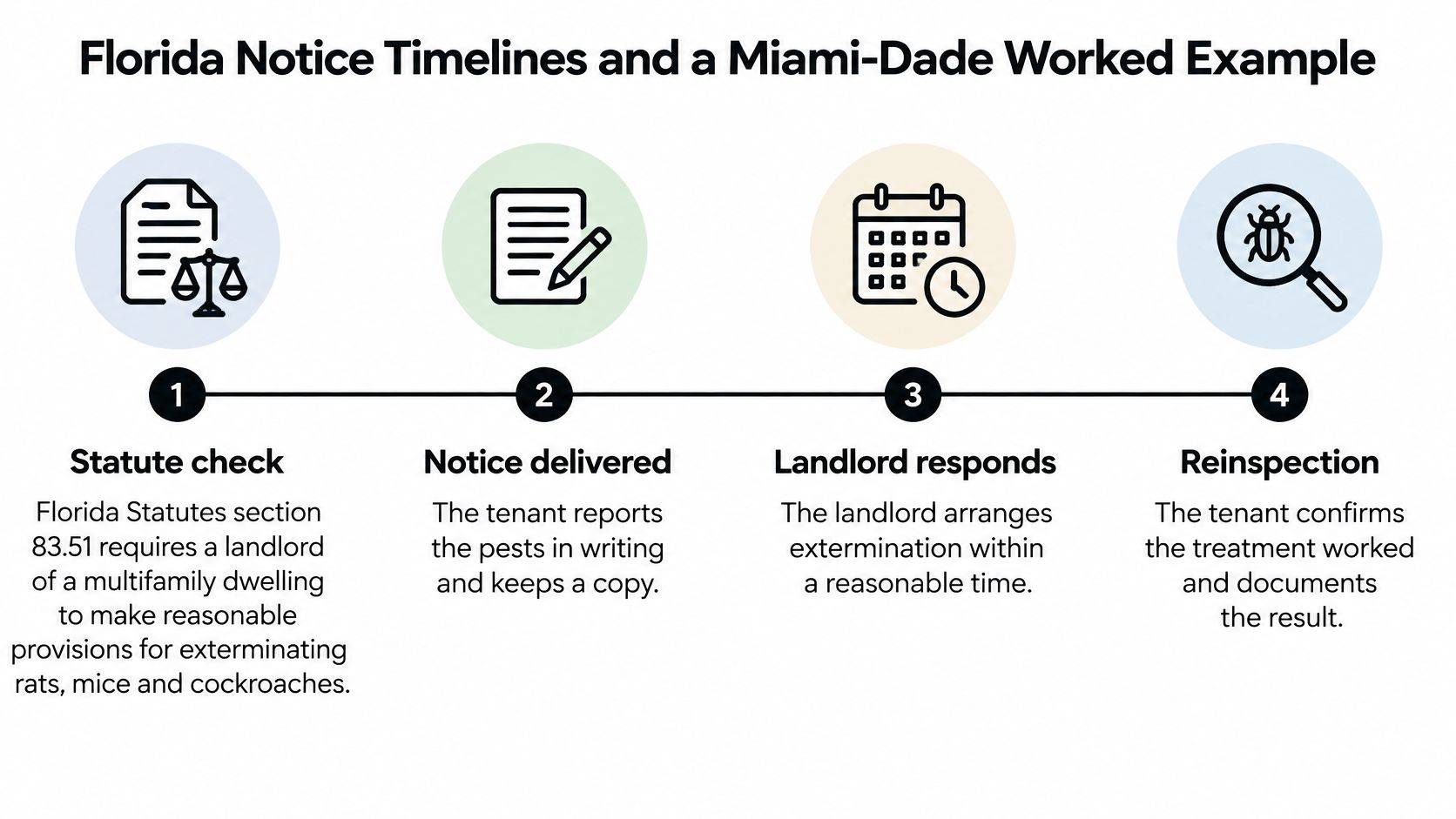
When an extermination requires residents to leave the apartment temporarily, the Florida Legislature's statutory text for §83.51 requires at least 7 days' written notice, delivered in person, by mail, or by email when Florida's electronic-notice requirements are satisfied. The landlord isn't liable for damages caused solely by the temporary vacancy, but must abate the rent for the days the tenant can't occupy the unit. Single-family homes and duplexes sit outside this multifamily mandate, so I always pull the signed lease before assuming a standard building template applies.
| Jurisdiction | Situation | Minimum notice |
|---|---|---|
| Florida (multifamily) | Tenants must temporarily leave for extermination | At least 7 days written notice |
| Florida (multifamily) | Rent during required vacancy | Rent abated for the days tenant cannot occupy |
| Florida (single-family or duplex) | Routine treatment without vacancy | Set by the written lease and local entry rules |
| Massachusetts (comparison) | Extermination with safety preparation | At least 48 hours |
Walking Through a 24-Unit Miami-Dade Building
Picture a typical 24-unit apartment building in Miami-Dade where tenants in units 3B and 3C report roaches near the kitchen plumbing wall, and maintenance spots droppings inside the third-floor trash chute room. Sending a notice early enough to absorb a missed entry or a technician delay saves you from restarting the clock.
- Verify multifamily status and lease language. Because a 24-unit building isn't a single-family home or duplex, check the leases for 3B and 3C to confirm no written clause shifts pest duties, and note that common areas always remain management's responsibility.
- Expand the treatment scope beyond two kitchens. Schedule the applicator to inspect and treat units 3B, 3C, the third-floor corridor, and the trash chute room together so displaced roaches don't retreat into the hallway wall and migrate back.
- Check whether vacancy is triggered. If the licensed operator recommends a fumigation-style or heavy residual treatment requiring residents to stay out for two days, deliver written notice at least 7 days before the vacate date, aiming for 9 or 10 days ahead so any accommodation request can be resolved without pushing back the crew.
- Draft the unit-specific notice. Name units 3B and 3C plus the hallway and trash room, list the exact prep tasks from the applicator's sheet, state the two-day vacancy window and matching rent abatement, and include the two-week follow-up inspection date.
- Tie delivery proof to your rent ledger. Save the signed hand-delivery receipt, mail proof, or compliant email timestamp alongside the actual dates residents were out of the units. If the notice says Tuesday through Wednesday but ventilation delays re-entry until Thursday afternoon, your accounting ledger needs to reflect the actual days unpaid so you don't end up arguing over prorated rent credits at month's end.
For a quick walkthrough of how property managers structure tenant entry and communication around treatment visits, watch the short overview below.
One portfolio template works well across multiple Miami-Dade buildings, but only after you verify property type, lease terms, and whether shared corridors belong in the treatment plan.
How to Write and Deliver the Notice Step by Step
A strong notice does more than announce a spray date. In HUD's integrated pest management guidance, IPM combines sanitation, waste control, restricting food and water, mechanical traps, physical barriers, structural maintenance, and conservative pesticide use only when necessary. HUD also advises defining resident duties in the lease, including prompt reporting of pests, leaks, and mold, and requiring management permission before tenants buy or apply their own pesticides, because unauthorized store-bought sprays and foggers often scatter insects into neighboring walls and undo professional Cockroach Control designed to break the breeding cycle, not just the roaches you can see.
Because HUD recommends urgent responses to infestation reports with documented follow-up rather than a one-and-done notice, every step from drafting to recheck needs a clear trail. The graphic below maps the core five-stage workflow before we break down the full eight-step execution checklist.
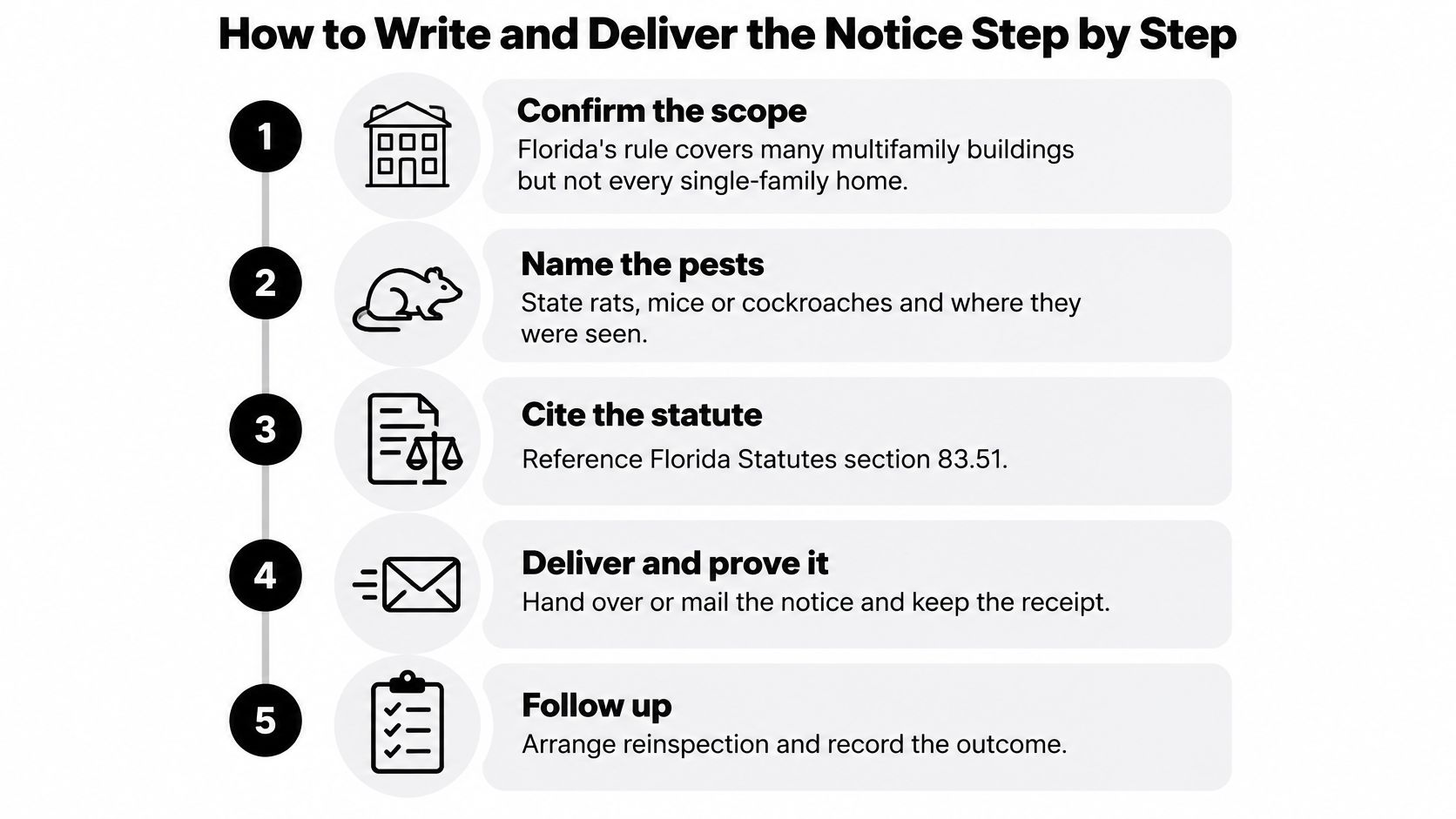
- Confirm the treatment scope and building type first. Verify whether the unit sits inside a covered multifamily property or a lease-governed single-family rental, and check adjacent rooms or utility rooms that need service. Usual slip: copying last month's single-unit notice for a multi-unit hallway issue and forgetting to notify the neighbor across the plumbing stack.
- Collect the applicator's prep sheet and label precautions in writing. Ask the licensed operator for the exact product label safety warnings (such as pet removal, aquarium covers, and drying times) and any room-clearing checklist before you write a word. Usual slip: guessing at prep instructions over the phone, which leaves tenants emptying closets they didn't need to touch while leaving under-sink cabinets full.
- Draft every required field cleanly. Fill in the unit number, named pest, target rooms, arrival window, vacancy dates if applicable, and direct management contact. If you're dealing with recurring apartment roaches, align the preparation instructions with proven sanitation steps for roach control in apartments. Usual slip: writing "Thursday afternoon" instead of a defined window, causing residents to miss the crew.
- Keep the wording neutral and factual. State what the technician will do and what the tenant needs to prepare without accusing anyone of poor housekeeping. Usual slip: slipping frustrated remarks about clutter into a treatment notice, which puts residents on the defensive and makes them less likely to report future sightings.
- Deliver through a provable method. Hand-deliver the notice and ask for a signed acknowledgment, send it by mail, or use email only when the lease and statutory electronic-notice rules allow it. Post visible pesticide-use warning signs in treated common areas as well. Usual slip: sliding an undated flyer under the door with no photo, log, or receipt.
- Log the delivery record immediately. Enter the send date, delivery method, staff member's initials, and any resident replies into the unit file the same day. Usual slip: waiting until a dispute pops up two weeks later to hunt through text threads for proof of delivery.
- Confirm the appointment one day ahead. Send a short written reminder 24 hours before arrival to catch schedule changes, pet boarding issues, or lockbox updates early. Usual slip: assuming silence means readiness, then paying a technician trip fee for a locked unit.
- Send post-treatment re-entry and recheck details. Once the applicator finishes, confirm ventilation or drying clearance in writing and lock in the follow-up inspection date so small surviving egg cases don't restart the problem. Usual slip: treating the initial visit as the finish line and skipping the two-week verification check.
What to Do When a Tenant Cannot Prepare or Grant Access
Sometimes a resident is recovering from surgery, working an overnight hospital shift, or didn't have time to clear the kitchen cabinets. Don't mark the visit as "refused" and walk away without building a clean record.
- Re-offer a date in writing inside your notice window: Send an immediate email or printed letter proposing the next available treatment slot along with the exact prep checklist again.
- Log every outreach attempt: Record the date, time, contact channel, and the tenant's exact response in the property management software or unit binder.
- Send a day-before confirmation: Put a written reminder in front of the resident 24 hours prior to the rescheduled slot so the appointment stays top of mind.
- Update the licensed applicator right away: Let the pest control company know the unit was rescheduled so they adjust the follow-up inspection calendar for the whole stack, not just one apartment.
The most common mistake here is handling the reschedule on a quick phone call with no follow-up message. If access later turns into a lease-compliance issue, an unrecorded phone conversation won't protect you.
Sample Pest Control Notice Template
Copy the template below into your property management software and replace each bracketed prompt with your building's specifics. The lines follow the exact order a resident reads them: who is coming, what they're using, what needs to move, and who to call if something doesn't fit their schedule.
Subject: Pest treatment notice for [unit or common area], [property address]
- Dear [tenant name], we will treat [pest] in [rooms or areas] on [date] between [start time] and [end time], with an expected visit length of [hours].
- Method and safety precautions: The licensed applicator will use [chemical or nonchemical method]. Per the product label, please keep [children and pets away until dry, and ensure all food, dishes, and toothbrushes are covered or removed].
- Preparation required before the visit: Please [empty lower and upper kitchen cupboards, pull furniture 18 inches away from walls, and seal open dry food and pet bowls in plastic bags].
- Access and entry: [Technician name and company] will enter with you present, or using [management key or lockbox arrangement] if you are away during the window.
- Temporary vacancy, rent abatement, and re-entry: If treatment requires you to leave the unit, you must vacate from [start date and time] to [end date and time]. Rent will be abated for every day you cannot occupy the unit. You may re-enter after [re-entry time and ventilation or clearance condition].
- Accommodations: To request an adjustment for a disability, medical need, work schedule, or childcare conflict, email [management email address] by [date, at least 48 hours ahead].
- Questions or adverse reactions: For urgent questions during treatment, after-hours concerns, or any reaction following service, call [emergency phone number] or email [follow-up contact].
- Follow-up inspection: The technician will return on [recheck date] to verify the treatment worked and check for remaining activity.
Signed by [name, role] | Date sent: [date] | Delivered by: [in person with signed acknowledgment, mail, or email]
File-keeping rule: Staple the delivery receipt, signed acknowledgment, or timestamped email confirmation directly behind your copy of the sent notice before filing it in the unit ledger.
Adapting the Form for Structural Treatments
Routine kitchen baiting rarely forces anyone out overnight, so line 5 stays brief ("No temporary vacancy is required"). That changes completely when an inspection uncovers drywood termites or other wood-destroying organisms, where thorough Termite Control to stop silent structural damage before it spreads may involve structural fumigation or multi-day tenting.
For structural work, expand line 3 to attach the fumigator's official bagging and gas shut-off sheet verbatim, never paraphrased. Double-check that line 5 matches the fumigator's clearance certification requirement rather than a rough guess at hours, and note clearly how tenants will receive the "all clear" call before returning.
Who Pays and Who Is Responsible When Pests Are Disputed
Two shortcuts stall pest disputes between landlords and residents: "the landlord always pays" and "the tenant brought them in." Both fail in practice because treatment duty and cost causation are separate questions, especially in multifamily housing where an active infestation spreads through shared walls while the fault argument drags on.
In a covered Florida multifamily building, management's duty to make reasonable extermination provisions runs throughout the tenancy unless a written lease shifts it, so waiting for a blame ruling before calling an exterminator is a bad trade. Other jurisdictions draw the same line with different details. NSW Fair Trading guidance generally assigns landlords responsibility for infestations already present when a tenancy begins, while tenants may become responsible when pests stem from their own activities or poor cleanliness; Manitoba similarly tasks landlords with investigating, eliminating pests, and sealing structural entry points while requiring tenants to report issues promptly and cooperate with treatment.
Delayed reporting is where these disputes get expensive. New York City enforcement data cited in NSW Fair Trading's guidance on pests and vermin in rental properties reports 65,977 pest complaints in FY2025: tenants flagged pests during 29% of inspections opened for unrelated reasons, and 52% of those inspections ended in a pest violation. When residents stay quiet because they fear being blamed or billed, a small kitchen problem turns into a multi-unit violation, and your notice file becomes the only record showing when you learned of it and what you did next.
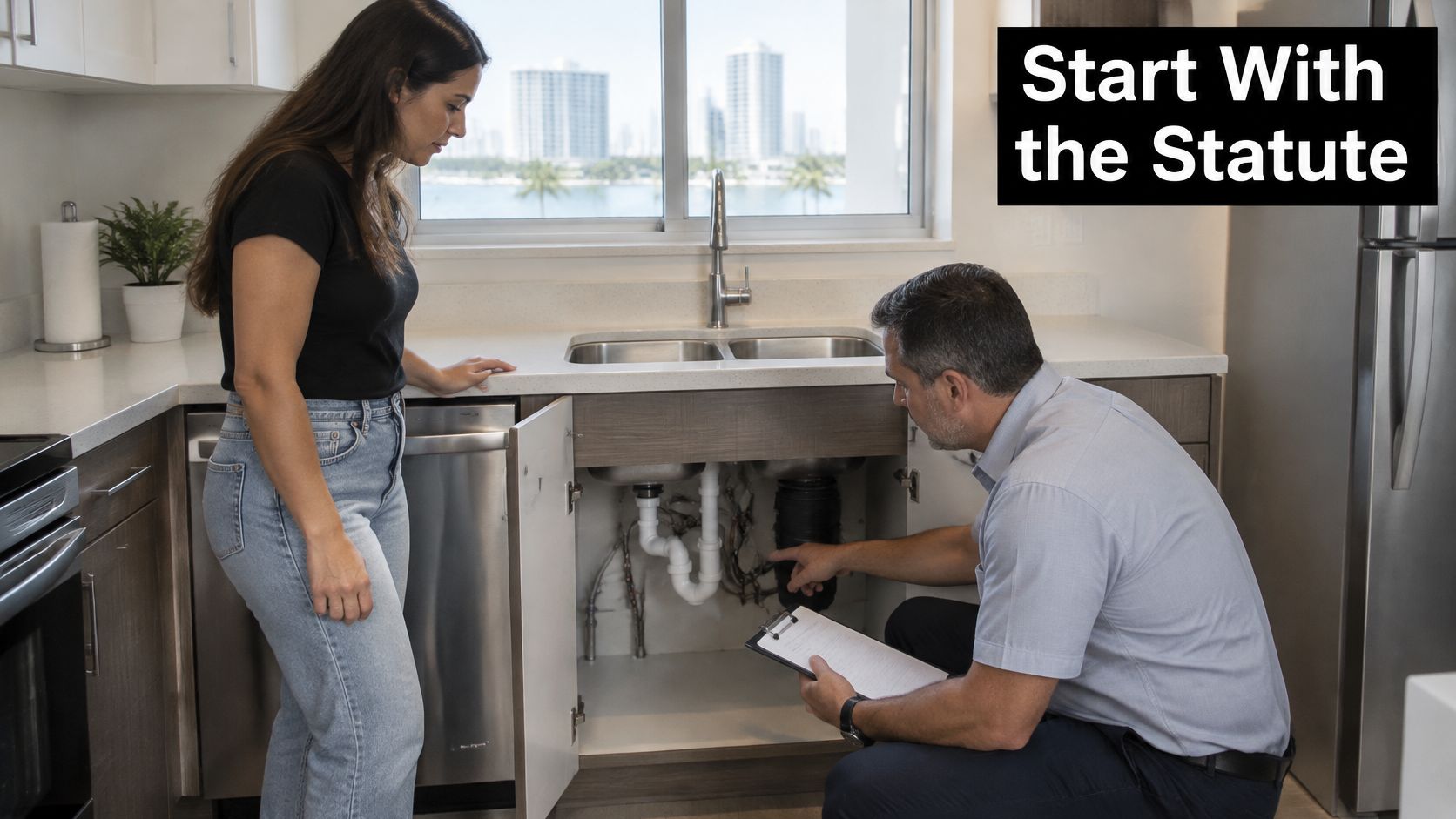
The inspection photo below captures what separates guesswork from real evidence: checking physical building components like under-sink plumbing lines alongside a tenant before drawing any conclusions about cause.
Building a Neutral File While Causation Is Checked
Bed bug claims and recurring roach complaints are especially contentious because insects hitchhike on luggage, secondhand furniture, and shared hallways alike. Mediation perspectives like M&N on landlord bed bug duties from Mediation & Negotiation Services (M&N), read alongside state-specific rules on landlord pest control responsibility, point the same direction: calm, timestamped records resolve disputes faster than accusatory emails. This is the point in the process where the notice doubles as a compliance record, so build the file as if a mediator will read it later.
- Encourage prompt, blame-free written reports: Tell residents in your welcome packet and notices that reporting a sighting early isn't an admission of fault. Early reports keep remediation bills small and give you a dated starting point for the paper trail.
- Separate structural defects from housekeeping: Have the technician note moisture leaks under sinks, unsealed pipe penetrations, and worn door sweeps separately from overflowing trash or uncovered food. Structural entry points belong to the owner; sanitation habits belong to the occupant.
- Preserve visual and third-party evidence: Save dated photographs, exact room locations, copies of every sent notice, logged access attempts, and the licensed operator's written findings before discussing reimbursement.
- Keep retaliation and DIY chemicals strictly separate: Never link a pest report to rent hikes, lease non-renewals, or reduced services, and address unauthorized tenant-bought foggers or sprays as a safety and lease-compliance issue rather than a personal dispute.
Document what the technician found, what repairs you completed, and when access was offered. Facts settle deposit and billing disputes; assumptions escalate them.
Before You Send and Where to Get Help
A notice that leaves before the scope is clear creates avoidable problems. It can name the wrong unit, set an access date the household cannot meet, or promise prep steps that do not match the treatment. Treat the document as both a compliance record and a treatment plan, not a courtesy note saying a technician is coming.
Run the draft through four gates before you print, mail, or send it.
- Property type and lease terms: Confirm whether the property is multifamily or a single-family or duplex rental, and check that no written lease clause changes who arranges or pays for treatment.
- Scope and named pests: Match every affected unit, adjacent hallway, trash room, and target pest to the inspection notes. A vague notice invites an equally vague response.
- Vacancy lead time and rent math: If residents must leave temporarily, check that the send date meets the required lead time and that any rent abatement lines up with the exact vacancy window.
- Delivery proof and recheck date: Use a delivery channel that leaves a record, log the send date immediately, and calendar the follow-up inspection before the notice goes out.
Condominiums and managed communities need one extra check. If the rental sits inside one, review the association's governing documents before assigning work involving shared walls, balconies, or exterior eaves. A guide to understanding homeowners association rules in Florida can help clarify where an individual owner's duties end and association common-element maintenance begins.
When you need a licensed technician on site before finalizing prep instructions and notice dates, Pestless connects Miami and Miami-Dade homeowners with licensed and insured local pest control pros. Pestless is a free referral service and does not perform treatments. The matched third-party provider performs the inspection and treatment, then contacts the homeowner by phone, text, or email using the details submitted. Details such as when the pest was first noticed and how widespread the activity seems help that provider prepare. For urgent requests, call (786) 305-7867, Monday to Saturday, 7am to 9pm ET.
Need a licensed, insured Miami-Dade technician to inspect a property and provide exact preparation instructions before the next tenant notice? Pestless Inc. matches Miami-Dade homeowners with local providers for cockroaches, rodents, termites, ants, mosquitoes, and bed bugs. Submit property details in under a minute at Pestless Inc. to get matched with a licensed local provider quickly.
Dealing with this pest right now?
Pestless connects you with a licensed, insured Miami pest control provider for a free, no-obligation quote.