A termite bond is worth it only when the contract pays for structural repairs you couldn't absorb from savings and the renewal fee stays small against what the house would cost to fix. In Florida that agreement starts as a one-year warranty, carries automatic annual renewals for up to four additional years, and the inexpensive versions pay for retreatment only, never for the wood.
The advice you'll hear most often says termites cause billions in damage every year, so every homeowner should carry a bond. That advice skips the only part that decides the money. A damage total describes a country; a contract describes your house, your species, your repair cap and your renewal date. Plenty of Miami homeowners pay every year for a document that would treat a reinfestation and hand them the repair bill anyway.
The verdict depends on three things you can check in about ten minutes with the paperwork in front of you: what the contract pays for, whether the fee is trivial next to that payout, and how long you'll own the property. Get those three right and a bond is a reasonable purchase. Get them wrong and you're paying for the word on the cover letter.
Table of Contents
- Quick Verdict on Whether a Termite Bond Is Worth It
- What a Termite Bond Is and How It Differs From Insurance
- Retreatment-Only Versus Repair-Inclusive Contracts
- Renewal Terms and Florida Warranty Rules
- What a Termite Bond Costs and the Break-Even Test
- Who Gets Value From a Termite Bond and Who Does Not
- Contract Terms to Verify Before You Sign
- Confirm the Contract Before You Buy a Termite Bond
Quick Verdict on Whether a Termite Bond Is Worth It
A termite bond earns its cost only when its contract addresses the loss you cannot comfortably pay for yourself. The word “bond” guarantees nothing about a home's condition or the company's obligations. The U.S. Forest Service reports commonly cited annual termite damage in the United States at about $1 billion, with some estimates reaching $7 billion; those totals may include treatment, prevention, building repairs, lost property value and damage never formally attributed to termites.
Start with the contract's payout. If it covers retreatment only, it pays for renewed termite treatment while leaving you responsible for framing, flooring and trim. That is a monitoring service, and it pays nothing toward the wood.
Next, compare the annual fee with both the repair cap and your available savings. A low fee can make limited protection worthwhile, but years of payments against a small cap may leave you carrying most of the risk. Then consider how long you expect to own, rent out or hold the property. Buyers, landlords and long-term owners may value a documented response more than someone planning to sell soon.
The recommendation changes with the house and your finances. An older wood-framed home with heavy landscaping and hard-to-inspect crawl spaces points toward repair-inclusive coverage. A newer home with no termite history, paired with an owner able to pay for repairs without borrowing, points toward periodic inspections and self-insurance.
Read the contract type before weighing the price. Florida requires termite treatment contracts to state prominently whether they provide retreatment only, repair and retreatment, or no warranty. Providers cannot call a limited contract a “full” or “unlimited” warranty.
Identify which category the contract belongs to, then judge the fee against its stated coverage and your ability to absorb repairs. If the contract excludes structural repairs, do not value it as though it protects the house from that expense.
What a Termite Bond Is and How It Differs From Insurance
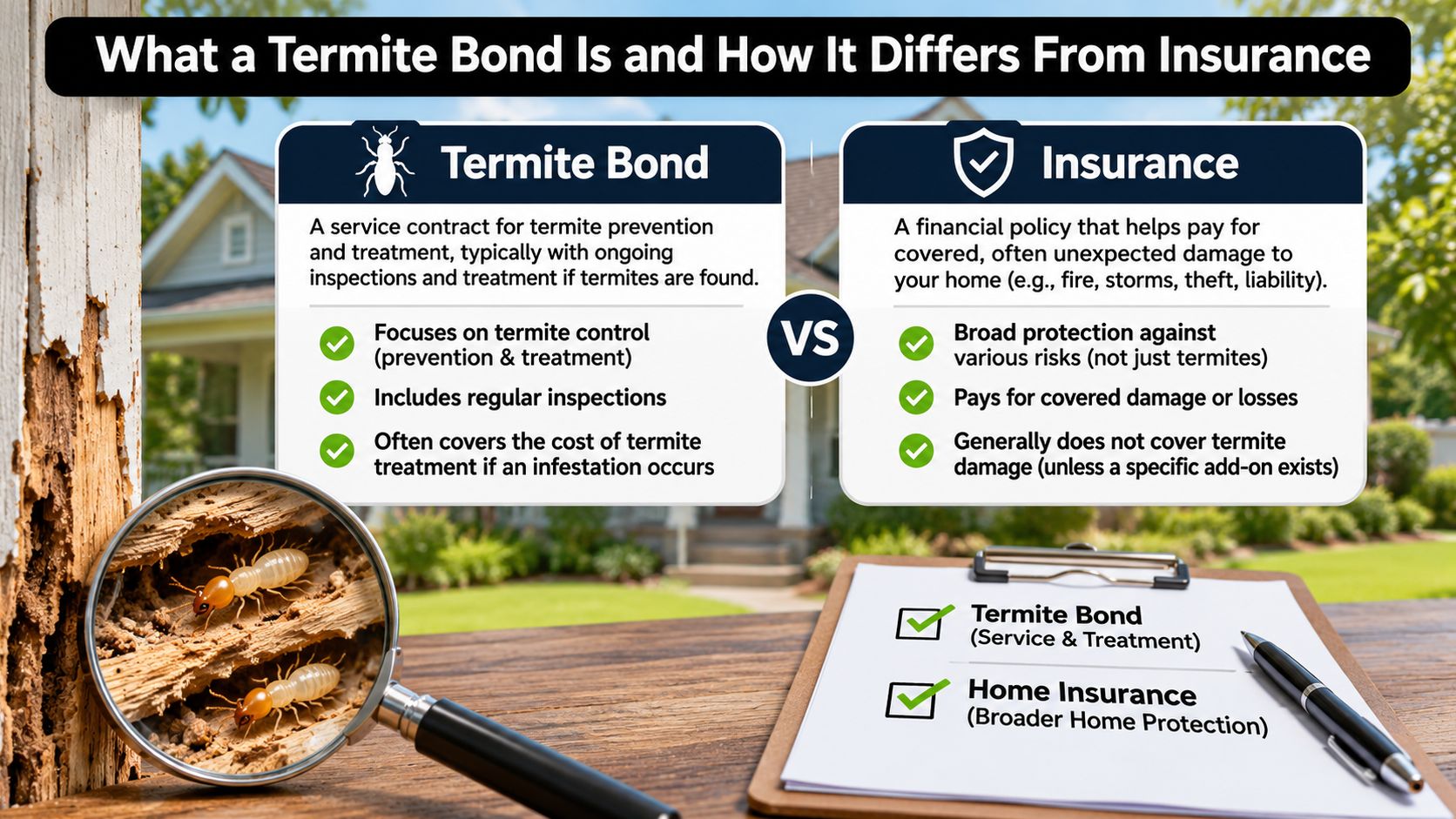
A termite bond is a service agreement with a pest control company. Its value depends on the work and coverage promised in the contract: scheduled inspections, retreatment if termites return, and, in some agreements, payment toward repairs within stated limits. Homeowners insurance generally excludes gradual termite damage, so it does not replace a bond. Before deciding how to budget for either product, compare what homeowners insurance and service agreements cover in this guide to home warranty vs homeowners insurance.
A report, a bond and a policy are three different documents
These documents address different questions. A wood-destroying-organism inspection report records conditions visible on the inspection date. A bond defines what the pest control company must do if activity returns. A homeowners policy covers specified causes of loss, while gradual termite damage is generally outside its scope.
| Document | What it tells you | What it leaves open |
|---|---|---|
| WDO inspection report | Conditions visible on the inspection date | What happens after the inspection |
| Termite bond | What the company must do if activity returns | Whether repairs are covered |
| Homeowners policy | Which causes of loss are covered, such as fire, wind or theft | Gradual termite damage in most policies |
The inspection report is a snapshot, not ongoing protection. Florida Statutes Chapter 482 says a wood-destroying-organism report does not guarantee the absence of termites or future damage unless the report itself defines that guarantee. The statute also requires qualifying inspection providers to carry at least $500,000 aggregate and $250,000 per-occurrence professional liability coverage. That coverage addresses negligent inspections, not future termite damage.
A buyer could receive a report stating that no visible evidence of wood-destroying organisms was found, then mistake that finding for continuing protection. The report describes what was visible on the inspection date. It does not establish what will happen later. Ongoing protection depends on a separate agreement, and the homeowner should know its renewal terms and obligations.
After treatment, protection depends on continued monitoring. Ongoing bait-station checks or annual re-inspections help keep protection active, so check whether the contract specifies them and who is responsible for scheduling them. A termite control program that includes scheduled monitoring can provide that continuing service.
Keep the distinction clear: the inspection describes observed conditions, the bond sets out the provider's service obligations, and the homeowners policy defines covered losses. Read the document you hold, then identify which termite-related costs it leaves for you to handle.
Retreatment-Only Versus Repair-Inclusive Contracts
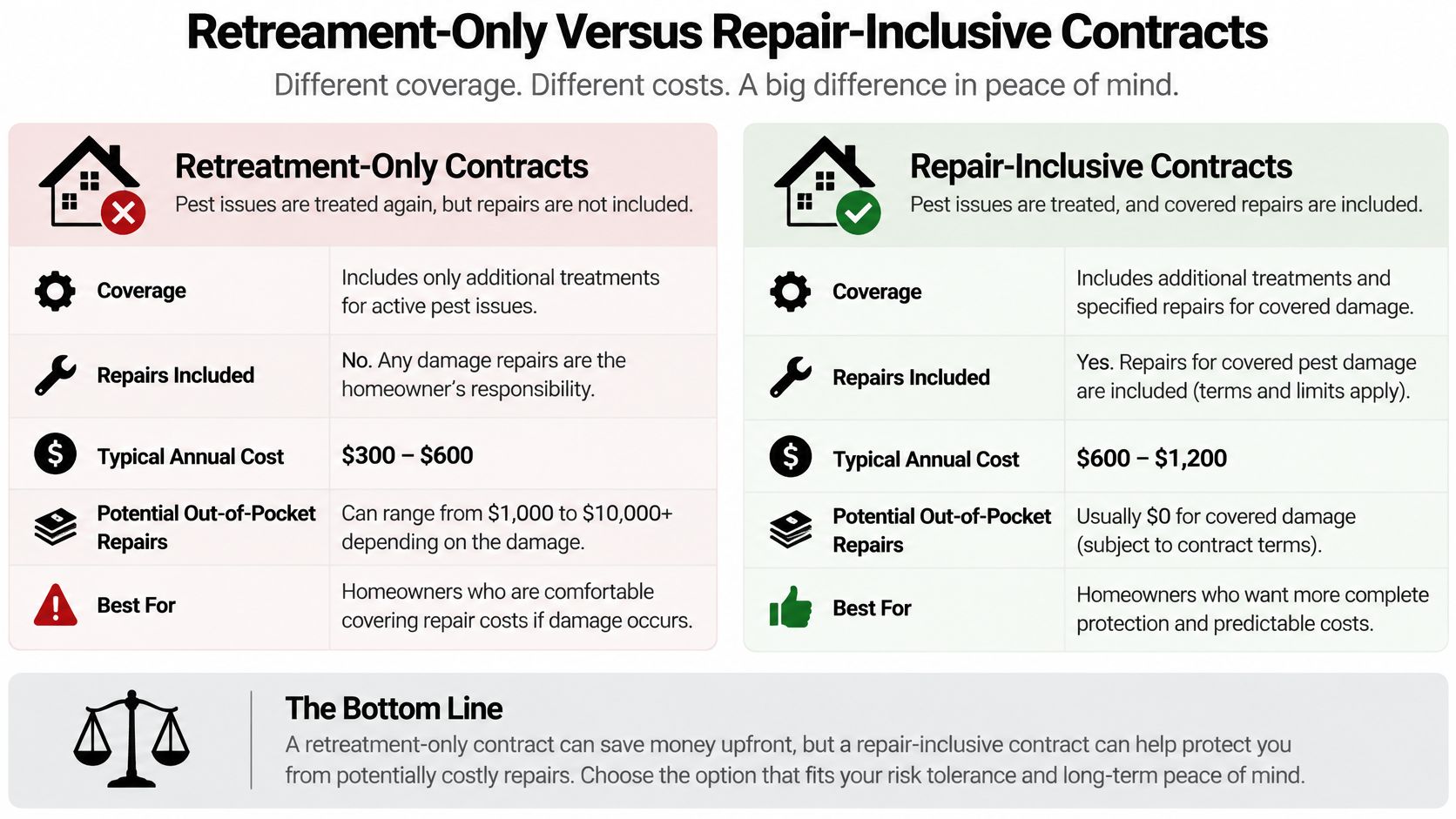
Florida consumer guidance identifies retreatment-only, retreatment-and-repair, and spot or no-warranty agreements. The Florida Department of Agriculture and Consumer Services says contracts must identify the type of coverage, name the species covered, state treatment costs, and explain when the provider may refuse service. Check those terms before signing.
What each contract type pays for
| Contract type | Retreatment of new activity | Structural repair | Best fit |
|---|---|---|---|
| Retreatment-only | Yes, addresses renewed activity | No, does not pay for structural damage | Low structural exposure, owners willing to self-insure damage |
| Retreatment and repair | Yes | Yes, within stated limits, exclusions and dollar caps | Older wood-framed homes, hard-to-inspect areas, repair cap large relative to rebuilding cost |
| Spot or no-warranty | None stated | No | One-time treatment with no continuing obligation |
For a concrete-block home with little wood and no termite history, a fairly priced retreatment-only bond can make sense. You are paying for inspections and renewed treatment if activity returns, while accepting responsibility for damage. For an older wood-framed cottage, the same contract offers little protection against the costly outcome: replacing damaged framing or flooring.
Repair-inclusive coverage is worth considering only when its cap can cover a meaningful share of repairs. If opening a wall and rebuilding framing would cost far more than the maximum payout, the bond then works like a deductible, paying only up to a cap you may not reach. Compare that cap with the contract's exclusions and with what repairs could involve. This is a different decision from home warranty vs homeowners insurance.
Moisture and construction-change exclusions can rule out plausible damage scenarios. Check whether the agreement covers only damage that occurs after its effective date, since hidden, pre-existing damage is generally outside the new contract's coverage, as the Florida guidance explains. Ask the provider to disclose any prior termite activity recorded for the property.
The rule that matters: the repair cap, not the annual fee, sets what the bond is worth.
Renewal Terms and Florida Warranty Rules
Protection is renewable and time-limited by design. Florida Building Code guidance explains that Chapter 482 requires licensed providers issuing preventive treatment contracts to offer either retreatment-only coverage or retreatment plus damage repair, with an initial warranty of one year and automatic annual renewal for up to four additional years when the fee is paid. The first four renewal fees can't increase unless the contract itself permits an increase.
What happens after year one
That clause about permitted increases is where budgets get tested. Read it before you sign, not at renewal. A contract that allows the provider to raise the fee without a stated ceiling turns a modest annual cost into an open-ended one, and you won't discover the new number until the invoice arrives.
| Rule | Duration or limit | Practical effect |
|---|---|---|
| Initial warranty | One year from the stated treatment date | Coverage starts from the date printed in the contract |
| Automatic renewals | Up to four additional years, paid each year | A lapse ends protection exactly when it may be needed |
| Renewal fee increases | First four renewal fees cannot rise unless the contract permits it | Check whether your contract allows increases |
| New construction, subterranean termites | Additional treatment during warranty, at least one year, annual extensions for at least four years | Confirm the treatment date and extension terms in the contract |
| Contract type disclosure | Retreatment only, repair and retreatment, or no warranty stated prominently | Read the first page before comparing prices |
The lapse risk deserves blunt treatment. Coverage dies when the payment stops, and it tends to stop in the year you're traveling, refinancing or renovating. That's the same year an inspection would have caught a mud tube before it became a repair.
A missed renewal is the most ordinary way a bond disappears. Nobody at the office is chasing you.
Four habits keep it alive. Put the renewal date in your phone calendar with a two-week warning. Request the written fee schedule rather than a verbal range. Confirm in writing whether the renewal transfers to a buyer at closing. Keep every inspection and treatment record in one folder, because claims get decided on documentation. Florida also requires a written contract for each wood-destroying-organism treatment, and any bond obligation has to be stated specifically and match that contract language, so the paperwork is the protection. If you're unsure whether annual is enough, this guide to how often a termite inspection should happen covers the schedule question in plain terms.
What a Termite Bond Costs and the Break-Even Test
A bond is worth paying for only if its likely payout justifies its total cost and the contract covers the damage you could not comfortably pay for yourself. Compare the written fee, renewal terms, and repair cap against your own budget. A headline price cannot answer that question.
Running the numbers
Calculate your total outlay by multiplying the annual renewal fee by the years you expect to own the home, then add any initial treatment charge. Compare that sum with the contract's repair cap, while accounting for how likely you think a claim is on your property. Then compare the potential repair bill with savings you could use without financial strain. If the likely bill is manageable and the bond's cumulative fees are higher than the protection it offers, skip the bond or choose a lower-cost inspection and treatment option.
For example, if the annual fee is $300 and you keep the home for five years, renewal fees alone total $1,500. If the contract's repair cap is $10,000, the fee total is below the cap, but that does not make the bond a good deal by itself. Check whether the cap applies per claim or in total, what damage qualifies, and whether the contract covers repairs at all. A retreatment-only bond does not pay for repairs, so its repair cap is effectively irrelevant.
| Input | Where to find it |
|---|---|
| Initial treatment price | Written treatment quote |
| Annual renewal fee | Written fee schedule |
| Repair cap per claim and in total | Contract limits section |
| Years you expect to keep the home | Your ownership plan |
| Savings you can spend on repairs without strain | Your budget |
A low fee paired with a small cap may offer little meaningful protection. A higher fee can make sense when the contract provides a substantial repair cap and the potential bill would strain your finances. Compare treatment quotes carefully: termite treatment cost in Florida depends on the termite species, home size, and treatment approach, so the initial charge can vary.
Before signing, get every input in writing. If the provider cannot state the fee, cap, or covered repairs clearly, do not count that promise as protection. Run the comparison using the contract you will sign, not a verbal estimate.
Who Gets Value From a Termite Bond and Who Does Not
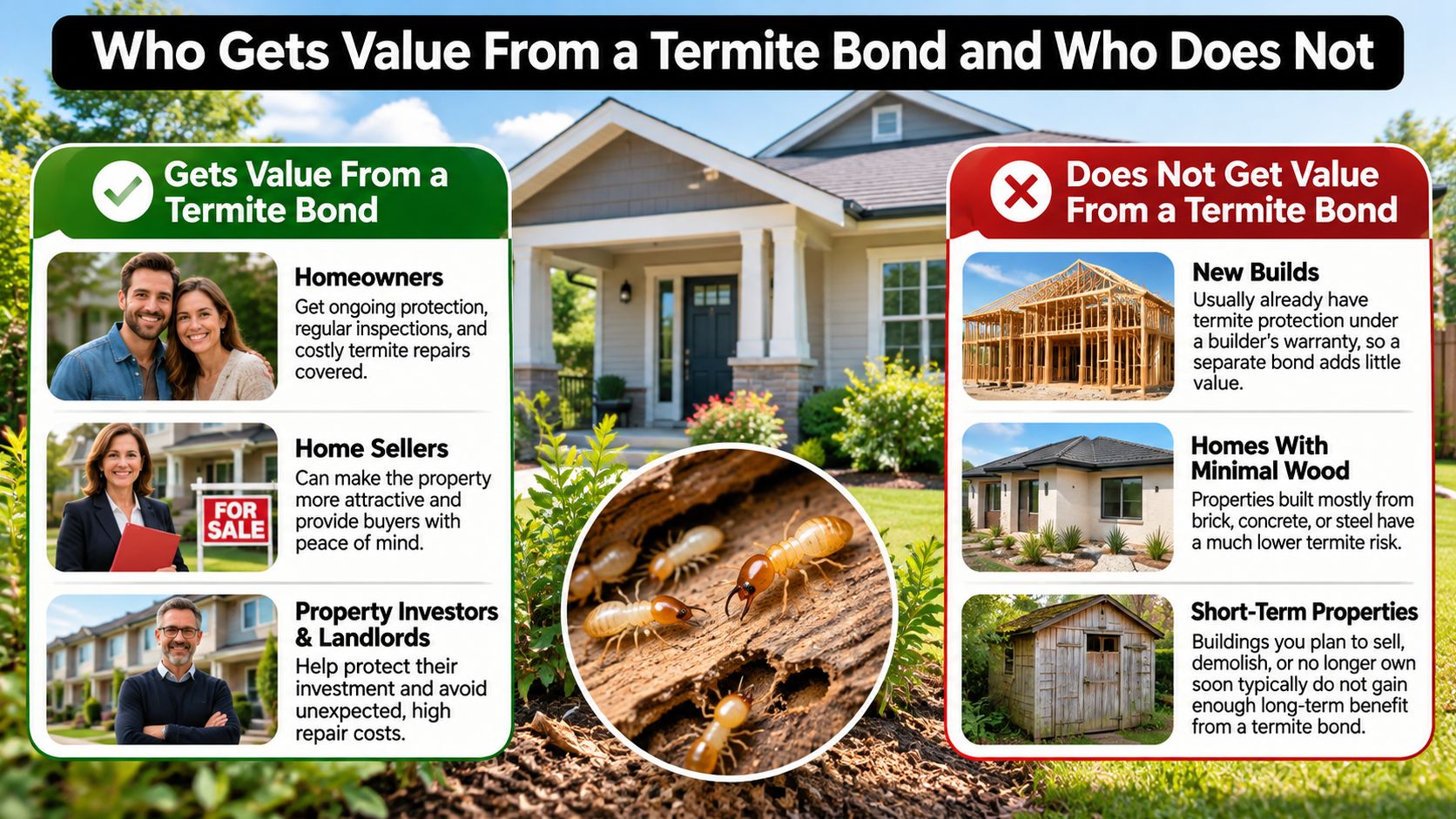
Termite pressure alone doesn't settle the question, and a summary of coverage comparisons from The Pest Control Brief makes the point that some owners in high-risk states can rationally skip broad coverage while others gain value for reasons unrelated to expected repair costs. A newer home with no termite history and a healthy emergency fund is the clearest case for inspections only. Many agreements are retreatment-only anyway, so the household paying for one is buying monitoring rather than damage protection.
Four owners, four different answers
The cash-rich owner of a 2015 build. Periodic inspections and prompt treatment when something shows up is the rational spend. Broad repair coverage duplicates an emergency fund that already exists.
The owner of a wood-framed 1960s house with heavy landscaping. Repair-inclusive coverage with a substantial cap earns its fee here, because the worst case is structural and the inspection schedule catches activity the owner would never spot.
The landlord or short-term rental host. Documented inspections, continuity and a fast response when a tenant reports swarmers are worth more than the expected payout. A gap in coverage during a guest turnover is a scheduling problem you don't want.
The seller closing within two years. Transferability and a clean record matter to buyers, and an active transferable contract can preserve continuity for the purchaser, provided the buyer verifies the contract instead of assuming prior treatment records carry over. If you're weighing a coastal move, listings such as these Miramar Beach homes for sale show how often termite documentation and transfer terms enter the negotiation.
Ownership horizon changes the math more than termite pressure does. Five years of fees against a repair cap tells you more than any damage statistic.
Condo and HOA boards are a fifth case, weighing vetted coverage across many units where one shared structure means one shared exposure. Run the holding-period test on your own figures: annual fee against the cap, probability of needing treatment, emergency savings, ownership horizon and any resale requirement. Treat these as patterns to test, not rules to obey.
Contract Terms to Verify Before You Sign
The contract determines what protection you buy. Read the full document, then use this table to identify terms that could change the value of the bond.
| Item | What to confirm | Red flag |
|---|---|---|
| Covered organisms | Which termite species are covered, including Formosan termites if relevant | Vague wording that does not identify covered species |
| Repair limit | Maximum payout per claim and in total | A cap too low to cover likely framing or flooring repairs |
| Exclusions | Which conditions or circumstances are excluded | Broad language that could leave realistic damage uncovered |
| Inspection schedule | How often inspections occur, access requirements and reporting deadlines | You must request each inspection yourself, with no clear schedule |
| Renewal price | Written fee schedule and rules for increases | The contract permits increases without stating a limit |
| Transferability | Whether a buyer can assume coverage at sale | Coverage ends when ownership changes |
| Documentation | Records you must keep and reporting deadlines | Requirements you cannot realistically meet |
Species matters. A licensed inspector checks the structure, attic and crawl spaces and identifies the termite species. Ask for the findings in writing and confirm that the contract covers the identified species. Drywood termites in a window frame and subterranean termites in a planter bed call for different treatments. Coverage written for one may not protect you against the other. Before signing, you can check how to verify a pest control license in Florida.
If a provider describes a limited agreement as full or unlimited, ask them to identify the coverage in the contract. Confirm the specific repair obligations and limits in writing. Florida restricts misleading descriptions of limited contracts, so rely on the actual terms, not a sales label.
Practical rule: If a contract term cannot be explained in writing, do not sign until it can.
Request the complete contract, not just a summary. Mark the repair cap and exclusions, then compare the renewal fees with your budget for the period you expect to own the property. Get written confirmation of whether coverage transfers at sale. Keep those answers with the contract so you can find them when renewal or a sale comes up.
Confirm the Contract Before You Buy a Termite Bond
You should finish with a clear choice, comparable quotes, and the contract terms in writing. A bond only makes sense if its coverage fits the risk and its renewal cost fits your budget.
- Choose the contract type that matches your risk and check whether it still makes financial sense for the time you expect to own the home.
- Compare the contract against the audit checklist above. If a key term is missing or unclear, get it clarified in writing before signing.
- Arrange a licensed inspection to document the termite species and affected areas before comparing coverage.
- Get written quotes and compare each one using the same break-even inputs.
- Submit a quote request for your address to be matched with a licensed, insured provider serving your Miami neighborhood. Most providers in the network can schedule an inspection within a day or two, and the referral and quote cost you nothing.
Treatment quotes depend on the termite species, home size, and whether the proposed method is a liquid barrier or baiting system. Confirm which method each quote includes before comparing prices. If you see active swarmers, say so when requesting a quote so the provider can prioritize a faster response.
Keep the comparison with the signed contract. Mark the renewal date and repair cap where you can find them quickly. The decision rule is direct: buy a bond when its coverage addresses a risk you cannot absorb and the renewal cost remains worthwhile for as long as you expect to keep it.
Pestless connects Miami and Miami-Dade homeowners with licensed, insured local pest control professionals. Share your address and what you have seen to request a free, no-obligation quote. Pestless does not perform treatments; it connects you with a local provider who can inspect, identify the species, and discuss a suitable plan. Start a quote request through Pestless Inc..
Dealing with this pest right now?
Pestless connects you with a licensed, insured Miami pest control provider for a free, no-obligation quote.