Why does a spotless kitchen suddenly sprout an ant trail the morning after a storm? Heavy rain floods the shallow tunnels and chambers where many ants nest, so workers head for drier ground and slip inside through gaps you'd never spot from the yard. Researchers tracking red harvester ant colonies found that colonies sometimes attempt a full nest relocation when conditions turn bad, and only some of those attempts end in a completed move.
Flooding explains the timing. It doesn't explain why the trail ends at the sink in a house that was spotless the night before. Many homeowners answer that question by spraying what they can see, then spraying again after the next storm, because the first round never asked why the ants chose that door, that week. Ants in house after rain is usually treated as a cleaning problem when it's a diagnostic one. The trail is evidence before it's a nuisance: it shows where the gap is, what resource is pulling workers through it, and which species is doing the walking.
Table of Contents
- Why Heavy Rain Pushes Ants Indoors
- Post-Rain Ant Signs, Their Causes and First Moves
- Tracing Entry Points and Moisture Sources
- Identifying the Ant Before You Treat
- Cleaning, Sealing, Bait Timing and Prevention
- When a Licensed Pro Should Take Over
Why Heavy Rain Pushes Ants Indoors
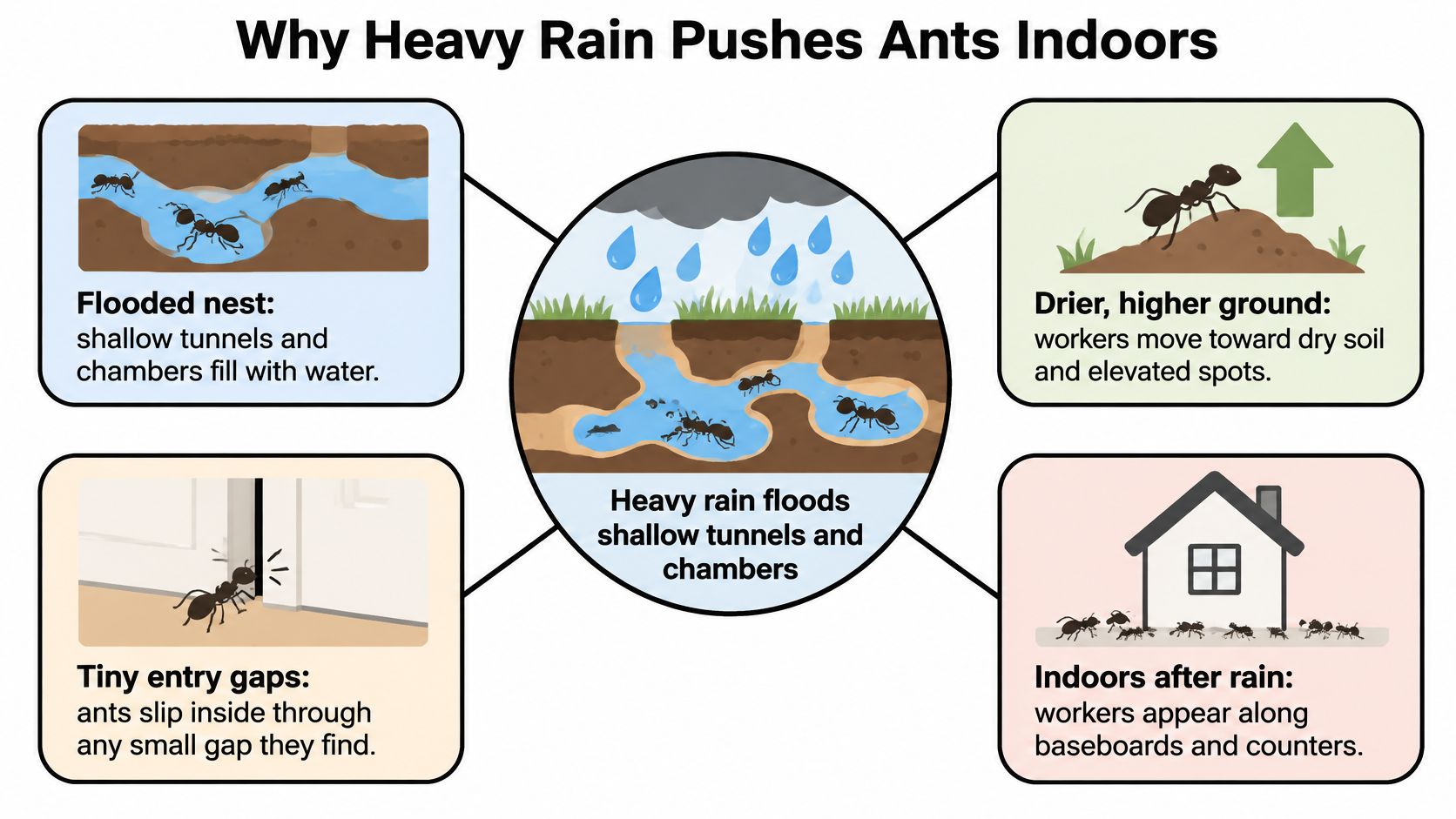
Rain doesn't draw ants toward your kitchen. It pushes them out of the ground. The Pacific Northwest insect management handbook led by Oregon State University names pavement ants as a particular nuisance after heavy rain, precisely because their subterranean colonies can flood. Water fills the tunnels workers travel and the chambers where the brood sits, and the colony's response is to move up and out.
Think about a street during a flash flood. Residents don't pick the nearest dry building because they like the decor. They pick it because it's dry and the door is standing open. Ants behave the same way: saturated soil turns a nest into a bad address, and any crack in a foundation, gap under a door, or hole where a pipe enters the wall becomes an open door. Mississippi State University Extension, in the same handbook, lists extreme weather, including heavy rains, among the conditions that drive ants indoors while they search for food, water, and shelter.
What the trail actually tells you
An indoor trail that appears hours after a storm usually points to a nest outside the house, not a colony living in your walls. The routes workers used before the rain are gone or unreliable, so they scout new ones, and a few scouts end up inside. That difference decides everything that follows. A trail that arrives from outdoors is an entry-point problem. A trail that starts at a baseboard is a nesting problem.
Why intensity beats the fact of rain
A passing drizzle rarely moves a colony. Prolonged or intense rainfall is what saturates shallow soil, and the outcome depends on species, nest depth, drainage, and how long the water sits. Miami-Dade stacks the odds against the homeowner: flat ground where water pools, heavy seasonal rain, irrigation that keeps beds damp through the dry months, and a building stock full of penetrations for pipes, vents, and cable.
Pavement ants, ghost ants, carpenter ants, and red imported fire ants respond differently to the same storm because they nest at different depths and in different materials. That's why the sign you're looking at matters more than the weather report. Each sign points to a specific cause, and each cause has a first move.
Post-Rain Ant Signs, Their Causes and First Moves
Readers want to know what to do before they want to know why. Here's the sort: sign first, cause second, first move third.
| Sign | Likely cause | First move | Timing |
|---|---|---|---|
| Single trail along a door threshold or window frame | Gap at an entry point that rain runoff exposed or pushed workers toward | Trace the trail outdoors and seal the gap once dry | Act today |
| Trail from a sink, dishwasher, or pet bowl | Food residue, standing water, or condensation | Remove the resource, wipe the trail with soapy water, store food sealed | Act today |
| Ants emerging from a baseboard, wall, or drywall seam | Nest in a damp wall void or saturated soil beside the wall | Check for moisture and plumbing leaks, then call a licensed pro if it repeats | Act within a week |
| New mounds in the lawn or along the foundation after rain | Rebuilt or displaced colony, including red imported fire ants | Mark the mounds, avoid flooding or raking them toward the house, treat when dry | Monitor, then treat |
| Winged ants inside after a storm | Reproductive dispersal from a nearby colony | Identify the species, close window and door gaps, check for light leaks | Monitor for a few days |
| Ants plus hollow, soft, or stained wood | Carpenter ants in moist or decayed wood from a leak or poor airflow | Stop the water source and schedule an inspection | Act promptly |
Read the trail's direction before you act on any row
Two directions, two different answers. If the line runs from a threshold toward a pet bowl, the entry is solved and the resource is the problem. If it runs from the middle of a baseboard toward nothing in particular, you're probably watching workers leave a nest inside the wall.
A wiped trail that rebuilds within the hour tells you more than a sprayed one. Wiping removes the scent markers, so fresh workers have to find their own way back. If they do it fast, the nest is close and the resource is still there.
Oregon State University Extension lists flooded conditions, extreme weather, food, water, warmth, and shelter among the reasons ants enter buildings, and Cornell IPM notes that the ants you see indoors are often foragers whose colony sits somewhere outdoors, as detailed in this Pacific Northwest ant guide. Killing visible workers lowers the count on the counter and leaves the colony running, which is why the same line reappears two days later.
Sort the rows by urgency rather than by fear. Threshold gaps and sink trails are today's work. Ants from a wall void get a moisture check within the week. New mounds and stray winged ants get watched for a few days before anyone spends money. The row that changes the plan is the last one: ants plus wood that's soft, hollow, or stained means you stop self-treating and go looking for the leak behind it.
Tracing Entry Points and Moisture Sources
A post-storm trail is evidence, and evidence only helps if you read it in the right order. The line of workers tells you where the ants are going. The gap they came through tells you where to act. Saturated soil and damp wood tell you why the colony is on the move at all. Read all three and what looked like a random invasion becomes a fixable problem.
A twenty minute walk with a flashlight
- Follow the line in both directions. Tape a small mark where it crosses the threshold with painter's tape so you can compare against the next storm. Direction separates an entry problem from a nest problem.
- Check thresholds, sweeps, and window frames. Look for daylight under the door or cracked caulk along the sill. A worn sweep is a half-inch gap with a doormat over it.
- Inspect utility penetrations. AC line sets, dryer and bath fan vents, cable, gas, and water entries. These are drilled holes in your wall that nobody caulked.
- Walk the foundation and the roofline. Stucco cracks, the joint where wall meets soffit, and the bottom plate hidden behind mulch. Each one is a covered highway.
- Audit drainage. Downspouts discharging against the slab, clogged gutters, and sprinkler heads that spray the wall. Chronically wet soil against a foundation invites exactly the species you don't want. If you suspect water is getting in where you can't see it, this guide to leak detection advice for Sylacauga homeowners covers the signals of a hidden leak, and the same checks apply to any slab-on-grade home.
- Look for damp material indoors. Under sinks, around the water heater, behind the refrigerator, and any trim that's soft or stained.
- Log the findings. Date, rainfall amount, where the trail ran, what the ants looked like. Two entries turn a mystery into a pattern.
The point of the map is aim. Seal the right gap and the trail ends. Seal an arbitrary one and you've spent a Saturday with a caulk gun for nothing. Moisture is what turns a temporary detour into a permanent address, so a dry gap gets a bead of caulk while a wet gap gets fixed at the pipe feeding it. The full list of routes is longer than expected, and how ants get into a house covers it in detail. Most of those gaps are the same ones you'd hunt for when chasing heat loss, which means sealing them pays twice.
Identifying the Ant Before You Treat
A name changes the plan. Baits are formulated around feeding preferences, and two species on the same counter may need two different products. Use this as a lookup, not a diagnosis.
| Species | Typical nest site | Post-rain sign | Key ID clue |
|---|---|---|---|
| Pavement ant | Under slabs, pavers, sidewalk cracks | Small soil piles along slab edges | Dark brown to black |
| Ghost ant | Wall voids, near plumbing and warm appliances | Trails to sweets and moisture, reappears after spraying | Tiny, pale body with dark abdomen |
| Carpenter ant | Moist, decayed, or soft wood near leaks | Fine sawdust-like frass near wood | Large, black or red-black |
| Red imported fire ant | Loose soil mounds in lawns and beds | New mounds appear after rain | Reddish-brown, painful stings |
Ghost ants are the ones that make homeowners feel like they're losing. They nest in wall voids near plumbing and warm appliances, trail toward sweets and moisture, and shrug off a surface spray because the nest keeps sending replacements. Carpenter ants carry a different message: large, black or red-black, nesting in moist or decayed wood from a leak, condensation, or poor airflow, and leaving fine sawdust-like frass. See that frass and you have a water problem with ants living in it.
Fire ants are separate in biology and in risk. University of Minnesota Extension cautions that flooding nests with water isn't an effective control method, and fire ant workers push loose soil upward after underground tunnels saturate, so fresh mounds commonly appear after rainfall, as the University of Minnesota household ants guide explains. In warm Florida soil that pattern can run for much of the year.
Four species is a short list for South Florida, though. Ants in Florida runs through the rest of the cast, including the ones that look identical to a ghost ant until you're close enough to see the abdomen.
Cleaning, Sealing, Bait Timing and Prevention
Order matters. Cleaning fixes the resource, sealing fixes the route, bait handles the colony. Get the sequence wrong and you waste the bait, which is the most expensive part.
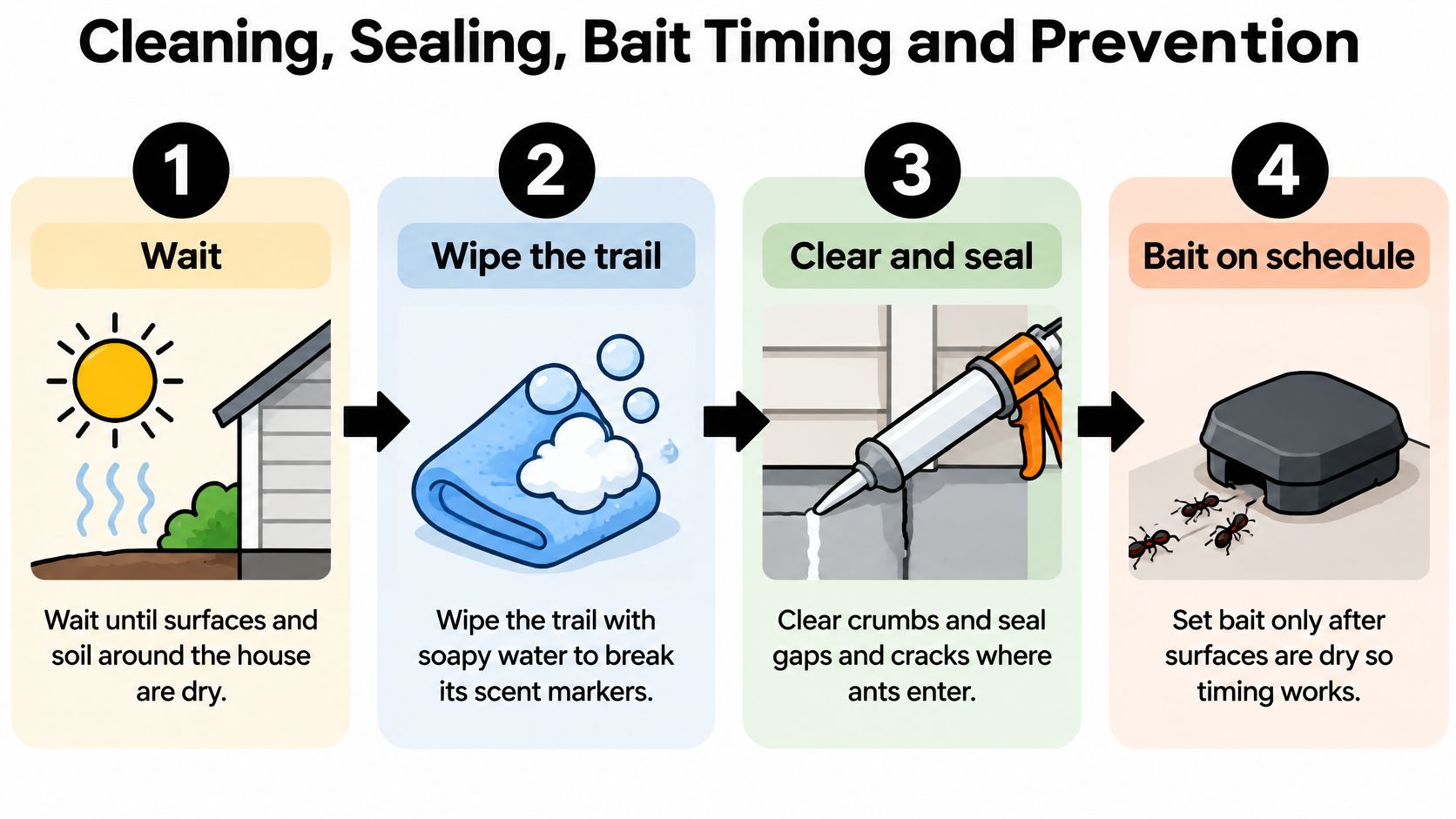
- Wait for dry surfaces and dry soil. This is the step people skip. Bait that has been rained on is bait the colony won't take.
- Wipe the trail with soapy water. It breaks the pheromone line, forcing the next workers to find their own way, which also tells you whether the nest is inside.
- Clear the resources. Crumbs, the grease film on the range hood, sweet residue on counters, pet bowls left down overnight, water in plant saucers.
- Cut the moisture. Fix dripping faucets and supply lines, insulate sweating pipes, and dry the condensate pan under the refrigerator.
- Seal the gaps. Caulk at the foundation line, around doors and windows, and at every utility penetration. Replace worn door sweeps and add weatherstripping where daylight shows through.
- Move water away from the wall. Clear the gutters, extend downspouts several feet from the foundation with splash blocks, and aim sprinklers at the lawn instead of the stucco.
- Bait on schedule, not on impulse. The UF/IFAS baiting guidance recommends baiting when conditions are roughly 70 to 90°F and not immediately before or after a drenching rain, because rain or dew can ruin many baits.
The timing rule most people never hear. Bait set before a storm, or on ground still wet from one, is money in the water. Spraying the trail first can also teach workers to avoid bait entirely. Keep cleaning chemicals away from anything you want the colony to eat.
Slow-acting bait fails in three predictable ways: the ants were sprayed first, the bait sits where irrigation or runoff reaches it, or the colony is a species with different feeding preferences. Cleaning and sealing handle the cause. Bait handles the colony. You need both, in that order.
Prevention between storms
- Trim the bridge. Shrubs and vines touching the wall give ants a covered route that bypasses any ground treatment.
- Watch the condensate line. AC drains keep a strip of soil permanently damp right where the wall meets the slab.
- Walk the perimeter within a day of every heavy storm. Five minutes, same route, same order, so changes stand out.
- Keep the log going. Date, rainfall, where you saw them, what you did. Two storms of data beat any guess.
If the same entry point produces ants after two storms, treat it as a repair job or an inspection rather than another round of spray. Professional ant control ends with exterior barriers and entry-point sealing to reduce the chance of re-invasion, which is the same logic applied more thoroughly. That's the reasoning behind Ant Control: treat the colony, not just the trail on the counter.
Here's a short walkthrough of the same sequence in video form, useful for seeing how workers behave along a sealed versus unsealed edge.
When a Licensed Pro Should Take Over
Some trails resolve with a caulk tube and a dry afternoon. Others point to a problem a homeowner cannot easily fix, and the difference decides whether this is a caulk job or a service call.
- Two weeks on and still trailing after cleaning, sealing, and a dry baiting window.
- Ants coming from a wall void or baseboard rather than a threshold or utility gap.
- The same trail after every heavy storm, which points to a colony that is not going anywhere.
- Carpenter ants, or wood that is soft, hollow, or stained, because the moisture source matters more than the insects.
- Fire ant mounds near a play area, or anyone in the household already stung.
A professional inspection looks at what you cannot reach. Providers inspect indoor voids, exterior mounds, and moisture sources to find the colony, because the workers on your counter rarely mark where the nest sits. Ant control covers carpenter ants and red imported fire ants among the species it handles, and licensed providers treat fire ant mounds directly, with the option of a broadcast yard program to keep new mounds from establishing.
Gather a few details before you call: the date you first noticed the ants, how wide the trail is and where it runs, any leaks or wood damage you spotted, and photos if you can get them. Sharing when the pest was first noticed and how widespread it seems helps the matched provider arrive prepared rather than guessing. Pestless connects Miami-Dade homeowners with licensed, insured local professionals and does not perform treatments itself, so the visit is with the company doing the work.
Then compare quotes on three things: what the inspection covers, whether exterior barriers and entry sealing are included or billed separately, and how many follow-up visits come with the price. A matched provider typically contacts you within one business hour during business hours to discuss the situation and give a no-obligation quote. If you want a sense of what a good visit looks like before you book, this guide to finding an ant control service near me walks through the questions worth asking.
When the same trail keeps reappearing, the diagnosis is done and the fix is no longer DIY. Visit Pestless Inc. to describe what you saw and get a licensed local pro on it.
Dealing with this pest right now?
Pestless connects you with a licensed, insured Miami pest control provider for a free, no-obligation quote.