You wake up on a Tuesday with three itchy bumps in a line across your forearm. By Thursday there are two more near your shoulder, and your partner, who sleeps in the same bed, has nothing at all. The marks itch harder at night. You strip the mattress, spot something dark near a seam, and start searching your phone at 11pm for an answer.
Bed bugs are so confusing because the marks on your skin and the insects in your room are two separate problems, and they need two separate answers. Soothing a bite tells you nothing about whether the room is clear. A neat row of bumps that fades by the weekend doesn't prove anything was ever living in your mattress. And a household with zero bites can still be feeding a colony under a box spring every night.
That split is the whole key. People looking for bed bug treatment bites usually assume one solution covers both, and that assumption is where money gets wasted and infestations get a six-week head start. What follows separates the skin question from the building question, in the order you'll face them.
Table of Contents
- Telling Bed Bug Bites From Other Bites
- Proof of an Infestation When Bites Are Not Enough
- First Aid and Self-Care for Bed Bug Bites
- When Bite Symptoms Need a Doctor
- Choose a Licensed Miami Pro Before You Book
- How to Prepare Your Home for Professional Treatment
- Why Bites Continue After Treatment
Telling Bed Bug Bites From Other Bites
Bite appearance is the weakest clue available, and the clinical record is blunt about it. In a systematic review of 84 clinically documented patients, researchers found reactions so varied that no single mark could be called typical. Papular eruptions (small raised bumps) were the most frequent presentation, but nearly half of the same patients threw a completely different pattern.
| Reaction pattern | Share of reported cases |
|---|---|
| Papular skin eruptions | 76.2% |
| Macular lesions | 53.6% |
| Lesions in a linear pattern | 45.2% |
| Arms affected | 71.4% |
| Legs affected | 59.5% |
| Trunk affected | 34.5% |
| Skin necrosis | 1 reported case |
Read that table the way a clinician would. Papular bumps appear in roughly three of four cases, so about one in four patients never produce them. Flat red patches show up in just over half. The famous "breakfast, lunch and dinner" line only showed up in 45.2% of cases, which means the most quoted sign in the entire bed bug world is absent more often than it's present.
Why the pattern appears where it does
Bed bugs feed on skin left uncovered while you sleep. That's why the arms (71.4%) and legs (59.5%) carry most lesions, with the trunk affected in 34.5% of cases. A row forms because an insect walks a short distance and probes again, not because it's executing a plan. You'll see the line along a forearm, a shoulder, a calf, an ankle.
Severe outcomes were rare in the review. A single case of skin necrosis was recorded, and systemic symptoms were uncommon overall. For many, it's an annoyance, not a medical emergency.
Mosquitoes, fleas, hives and everything else
Mosquito bites usually arrive as random single bumps after you've been outdoors. Flea bites cluster low, on ankles and lower legs, often in small groups where socks end. Hives move around, change shape within hours, and don't respect the boundary of clothing. Bed bug marks are different in timing more than in appearance. They often appear after sleep, on skin your pajamas didn't cover, and keep arriving on consecutive nights. A comparison of bed bug bites versus flea bites helps sort those two apart.
There's one more wrinkle. Some people mount no visible reaction at all, and others don't react until days later. Bites may not itch or hurt right away, so absence of marks is not absence of bugs.
Practical rule: A bite pattern is a reason to search a bedroom, not a diagnosis. Only physical evidence settles it.
Run a quick three-part check. Did the marks appear after a night's sleep? Are they on skin left uncovered? Are new bumps still arriving several nights later? Three yeses move bed bugs toward the top of the list, and still prove nothing.
Proof of an Infestation When Bites Are Not Enough
Inspecting for the insect is more reliable than reading your own skin, and it takes about fifteen minutes per room once you know the route.
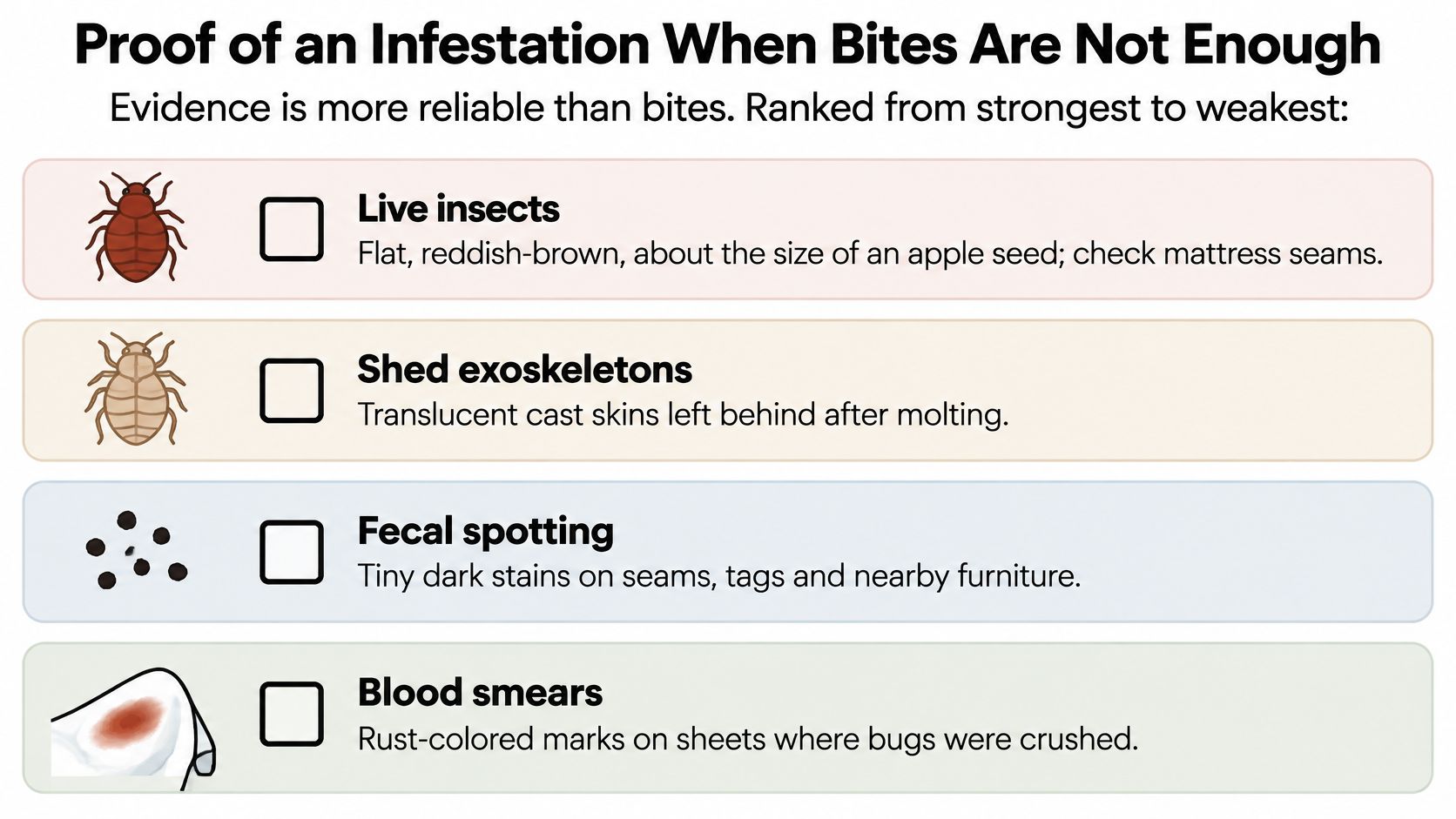
Rank the signs in this order of strength. Live insects beat everything: flat, reddish-brown, roughly the size of an apple seed, tucked into mattress seams, tag edges and frame joints. Next, shed exoskeletons, the translucent cast skins left behind as nymphs grow. Then fecal spotting, small dark ink-like dots or smears on seams and nearby furniture. Blood smears on sheets, rust-colored, where bugs were crushed during the night, come last because a dozen things can stain a sheet.
That ranking matters because bites lie in both directions. A study of 2,372 low-income apartments across 43 buildings in four New Jersey cities found that among 475 residents who had experienced infestations, only 68% reported symptoms after being bitten (EPA research record). Nearly a third of affected households had no itch to warn them. Building-level infestation rates in the same study ranged from 3.8% to 29.5%, with an overall rate of 12.3%.
The fifteen-minute search route
- Strip the bed and work the seams. Run a fingernail or a credit card along every seam, the tag edge and the piping, then check the corners.
- Lift the box spring. Inspect the frame joints, the underside and the fabric dust cover for spotting and cast skins.
- Work outward. Headboard, nightstand drawers, outlet plates, baseboard gaps, the gap where carpet meets wall.
- Finish with the furniture. Behind picture frames, inside couch seams, along recliner mechanisms, in luggage left unpacked.
Here's a short walkthrough of the same inspection done properly, if you'd rather watch it than read it.
Photograph anything you find with a coin beside it for scale. Bag suspected items without shaking them, because shaking launches bugs across the room. If evidence turns up in two or more rooms, stop and call a licensed professional rather than buying a can. The CDC and EPA note in a joint statement that some populations are resistant to almost all pesticides registered for bed bug control, which limits what a casual do-it-yourself application can achieve. The same study recorded that 59% of 539 affected residents applied insecticides themselves.
Our bed bug inspection checklist breaks the search into room-by-room steps you can print. Landlords and property managers who want a mattress-focused routine will find this walkthrough of bed bug checks for UK landlords useful for training staff, since mattresses hide more bugs than any other single object in the room.
First Aid and Self-Care for Bed Bug Bites
Start with the skin, because the itch is what's keeping you awake. The routine below handles most reactions, and it takes about five minutes.
- Wash gently with soap and water. Pat dry instead of rubbing. This clears the area and lowers the chance of infection at any spot you've already scratched open.
- Apply a cold compress for 10 to 15 minutes. Wrap the pack in a cloth, never place ice directly on skin, and repeat as needed through the evening. Cold dulls the itch signal and reduces swelling.
- Keep nails short and cover the spot. A light bandage or soft cotton sleeve breaks the scratch-and-scratch-again loop, especially at night.
- Use an over-the-counter antihistamine or hydrocortisone cream for itch. Follow the label, and don't apply cream to broken or weeping skin unless a clinician tells you to.
Why scratching matters more than the bite
Scratching is the usual route to a real problem. It opens tiny breaks in the skin, bacteria move in, and a simple itchy bump turns into something that needs antibiotics. The CDC clinical guidance on bed bug bites keeps the advice equally plain: clean the skin, maintain hygiene, avoid scratching, and use an antiseptic or antipruritic product when needed. Antibiotics are not routine and are reserved for clinically suspected secondary infection.
| Reaction | What helps | Expected course |
|---|---|---|
| Mild itching, small bumps | Wash, cold compress, over-the-counter antihistamine | Usually resolves within about one week |
| Extensive itching | Topical corticosteroid, with or without oral antihistamine | Itch relief; trials have not shown faster healing |
| Spreading, painful or pus-filled skin | Medical assessment, not repeated self-treatment | Needs clinician review |
Most bites need minimal treatment and settle without intervention. For widespread inflammation, a topical corticosteroid with or without a systemic H1 antihistamine may reduce itching. That's the ceiling of home care.
One limit deserves honesty. Treatments for bite reactions have not been evaluated in controlled clinical trials, and the CDC notes no demonstrated significant outcome difference between treated and untreated cases. In other words, the cream makes you comfortable, not cured faster. Keep self-care simple and consistent rather than stacking products.
Treating the skin does not treat the room. New bites keep arriving until the source is found and controlled.
When Bite Symptoms Need a Doctor
Most itchy spots need soap, a cold pack and a few days. A smaller group needs a clinician, and a very small group needs emergency care. Sorting them takes ten seconds.
Book a medical appointment for any of these:
- Spreading redness or warmth around a bite, especially if the red area grows over hours
- Pus, drainage or yellow crust, which point to bacterial infection
- Red streaks running away from the bite toward the limb
- Fever or chills alongside a skin reaction
- Pain instead of itch, or a bite that becomes tender and hot
- Reactions still worsening beyond 7 to 10 days rather than fading
Call emergency services for trouble breathing, swelling of the face, lips or throat, dizziness or fainting, or hives spreading across the body. Those are signs of a systemic allergic reaction and they don't wait. Bed bug bites alone rarely cause any of this. The usual culprit behind the serious-looking cases is a secondary infection from scratching, which is why the list above separates skin infection from allergy.
Bring useful information to the appointment. Dated phone photos of the bites at their worst, a note of when each new mark appeared, the medicines and creams you've already tried, and where in the home the bites showed up. A clinician can then judge whether this looks like bites, hives, eczema or infection.
What you shouldn't do is keep rotating creams and antibiotics on your own while the skin gets worse. Persistent, spreading, painful, purulent or systemic reactions warrant assessment rather than another round of self-treatment. The reassurance is that the overwhelming majority of bed bug bites fall nowhere near this list.
Choose a Licensed Miami Pro Before You Book
Treatment isn't one product. It's a set of methods chosen for your building, and the differences decide whether the job holds.
| Treatment type | Best suited for | Question to ask |
|---|---|---|
| Whole-room heat | Infestations spread across a room or unit | How will you confirm lethal temperatures reach wall voids and furniture? |
| Targeted conventional products | Smaller activity in cracks, frames and harborages | Which labeled products will you use, and how will resistance be handled? |
| Heat plus conventional products | Larger or resistant infestations | What is the follow-up and retreatment schedule? |
Heat sounds like the clean answer until you learn its condition. It only works when lethal temperatures are reached throughout the affected area, and a 2025 review notes it can fail when that doesn't happen (Journal of Travel Medicine review). Cool spots hide in wall voids, inside upholstered furniture and deep in mattress seams. Physical methods aren't automatic either. The same review summarizes laboratory evidence that steam killed directly exposed and crack-hidden bugs almost instantly, but efficacy fell to about 89% when insects were protected under fabric, because heat penetration dropped.
Chemistry has its own ceiling. Bed bugs have developed resistance to several major insecticide classes, including organophosphates, carbamates, pyrethroids and neonicotinoids, so a single spray applied by rote is unreliable. The EPA favors integrated pest management, which combines inspection, containment, laundering, vacuuming, targeted products and monitoring rather than leaning on one tactic.
Four questions that separate a pro from a pitch
- Are you licensed and actively insured? Ask for the license number and the insurer, then verify both. A provider who hesitates here is finished.
- How will you confirm temperature coverage in wall voids, mattress seams and furniture, and what happens if a cold spot is found on the day?
- Will you inspect adjacent units? In a Miami condo or duplex, an untreated neighbor re-infests a treated wall in weeks.
- How are eggs handled, and what's the retreatment schedule? Eggs survive many initial visits, so a plan without follow-up isn't a plan.
Ask specifically whether the technician has worked in multi-unit buildings like yours. A single-family approach applied to a Brickell high-rise or a Hialeah fourplex misses shared walls, stacked plumbing and common-area furniture. Get two or three quotes, ask every provider the same four questions, and compare answers rather than prices alone. Treat any promise of one-time elimination with open suspicion.
We match each request to a licensed bed bug pro serving your specific Miami neighborhood, based on the address you submit, so the quote comes from someone who knows your building type.
How to Prepare Your Home for Professional Treatment
Control follows a staged workflow, and skipping a stage wastes the one before it. Inspection confirms the pest, preparation opens access, treatment reaches the insects, and follow-up proves the job worked.
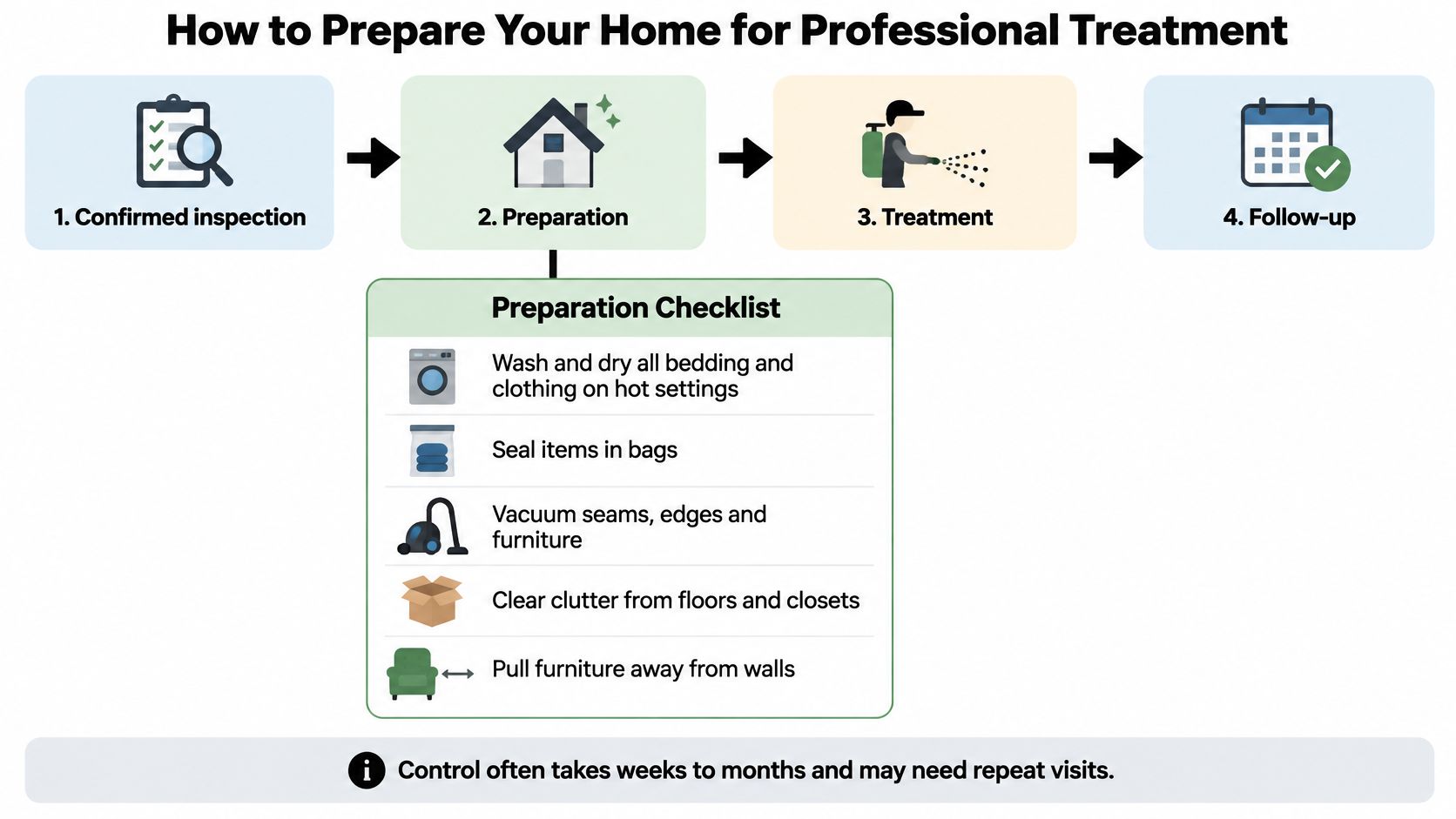
The first visit from any competent provider includes an inspection: the technician confirms bed bugs, identifies harborage points, and assesses how far they've spread. You then get a clear prep checklist so the treatment can reach every hiding place, which is where most residents underestimate the work.
Six prep steps and why each one counts
- Follow the provider's checklist exactly. It lists the specific hiding places the treatment must reach in your home, in your layout.
- Declutter without relocating. Move items out of the way, not into the next room. Bagging clutter and carrying it to a bedroom spreads the infestation and empties the treatment zone.
- Bag clothing and linens, then wash and dry hot. Use the hottest setting the fabric allows. Heat in the dryer does real work on eggs and adults.
- Vacuum seams, cracks, bed frames and floor edges, then seal and bin the contents. A vacuum bag left in a closet releases everything you just collected. Carry it outside.
- Install encasements and interceptors. Mattress and box-spring encasements trap bugs inside and starve them out; interceptor monitors under each bed leg tell you whether activity continues.
- Pull beds and furniture away from walls. Clear access to outlets, baseboards and wall voids so the applicator can treat the places bugs use.
The failure points that waste a treatment
Foggers top the list. They scatter insects into walls and force them deeper, and they leave eggs untouched. Pesticide-only programs fail for the same reason. So do residents who skip prep, neighboring units nobody treated, heavy clutter that blocks access, and quitting early because bites declined.
Prep rule: if an item doesn't need to move, don't move it. Every bag you carry across the apartment is a possible delivery.
On treatment day, follow the technician's instructions on how long to stay out, keep clear access to beds, couches and outlets, and don't move treated items back until you're told it's safe. Whole-room heat, targeted conventional products, or a combination of both can all be part of a Bed Bug Treatment plan, matched to what the inspection found, and the aim is to eliminate every life stage including eggs.
Expect a follow-up inspection. Eggs and hidden insects can survive the first visit, and the EPA states plainly that treatment may take weeks to months and may need to be repeated (EPA IPM guidance). Don't stop laundering, vacuuming or checking monitors just because the first week felt quiet. Our bed bug treatment preparation checklist turns this into a task list you can work through the night before.
Why Bites Continue After Treatment
Fourteen days after a single spray, a renter in Kendall is still finding itchy marks and assumes the treatment failed. The honest answer depends on facts the marks alone don't carry.
New exposure doesn't produce an instant reaction in everyone. Previously unexposed people may show no immediate visible response, and reactions are sometimes delayed by approximately 8 to 10 days (StatPearls clinical overview). That delay scrambles the timeline. Marks appearing a week after service can reflect a feeding that happened before the technician arrived.
Reactions are generally self-limited once exposure ends. So fading itch is a better sign than no itch at all, and a cluster that's shrinking on day ten tells you more than any single new spot.
The test that actually settles it
Ask whether the marks are old or new, and answer with evidence rather than memory.
- Old and fading means the exposure likely ended. Keep monitoring.
- New bites on nights after service, appearing in a fresh location on the body, mean something is still feeding.
- Live insects, fresh fecal spotting or new eggs mean the source was never reached. That isn't a reason to wait.
A follow-up inspection confirms eradication and treats any surviving pockets. That's the step that converts a guess into an answer, and it's the reason a credible provider schedules it before you ask.
Don't reapply steroid cream for weeks or take leftover antibiotics for marks that are already healing. Comfort care is fine; guessing at infection treatment isn't.
The habit that ends the argument is a simple log. Write the date, the time, and where on your body each new bite appeared, and share it at the follow-up. Two weeks of a dated log tells a technician far more than a description of "bites everywhere," and it stops delayed hypersensitivity or a scratched spot from being mistaken for ongoing activity.
Bed bugs are a building problem, not a skin problem, and Pestless Inc. exists to close that gap for Miami homeowners, renters and property managers. One short form tells us your address and what you're seeing, and we connect you with a licensed, insured bed bug professional serving your neighborhood, at no cost and with no obligation to book. Visit Pestless Inc. this week, compare two or three quotes using the four questions above, and choose the provider whose answers hold up.
Dealing with this pest right now?
Pestless connects you with a licensed, insured Miami pest control provider for a free, no-obligation quote.