Florida has more than 60 state-approved mosquito-control programs, according to the Florida Department of Agriculture and Consumer Services. That public-health network puts backyard biting into perspective: mosquito control in Florida isn't a matter of buying a stronger spray.
For Miami homeowners, the useful questions are more specific. What's producing mosquitoes, which life stage needs attention, and does local disease activity call for extra precautions? Effective prevention starts with those answers, not a preset spraying calendar.
Table of Contents
- Florida Mosquito Seasons and Peak Biting Months
- Find the Breeding Sites Around Your Home
- Larvicide and Adulticide Methods Compared
- Why Sprays Fail and How to Diagnose the Problem
- Disease Alerts and When to Change Your Routine
- When a Licensed Professional Is Worth Calling
- Confirm the Program Before You Sign
Florida Mosquito Seasons and Peak Biting Months
South Florida doesn't have a dependable mosquito off-season. Rain and heat often matter more than the month because warm conditions and water-filled containers can keep mosquitoes developing when residents expect a break.
Use the calendar to prepare, then adjust your routine to actual conditions. A warm spell after rain deserves attention even during the cooler season. Irrigation can also keep plant trays and neglected containers wet through otherwise dry weather.
Florida mosquito seasons and what to do in each
| Season | Months | Activity in South Florida | Priority action |
|---|---|---|---|
| Cooler dry season | December to February | Lower, but containers can support breeding after warm spells | Check gutters and drains monthly, and after rain |
| Spring rain build-up | March to May | Rising as rain returns | Empty containers before the rains start |
| Wet summer peak | June to September | Highest biting pressure and rapid breeding under warm, wet conditions | Make weekly source checks; consider targeted barrier treatment when warranted |
| Early fall | October to November | Tapering, but storms still refill containers | Inspect after every major storm |
Storms create aquatic habitat, while warmth helps immature mosquitoes develop more quickly. The result isn't always an immediate swarm. Water can collect unnoticed first, then produce adults after the yard looks dry again.
North Florida and the Panhandle generally have a clearer summer peak and a stronger winter slowdown. Miami residents shouldn't use that northern pattern as permission to stop checking their property.
Weather isn't a disease forecast
The Florida Department of Health's arbovirus surveillance program recorded 93 locally acquired human mosquito-borne disease cases in 2024, compared with 199 in 2023. Those statewide totals show year-to-year fluctuation, not the risk at a particular address.
Locally acquired infections also differ from travel-associated infections. A diagnosis reported in Florida doesn't automatically mean someone acquired it from mosquitoes in their neighborhood.
Practical rule: Use weather to guide property inspections and local health notices to guide disease precautions. Neither replaces the other.
Inspect before the wet season begins, then return after major storms. If rain refills something you've already emptied, change how it's stored or drained rather than repeatedly treating the same avoidable source.
Find the Breeding Sites Around Your Home
Start with gutters and downspouts, not the most visible puddle. Leaves can trap water above eye level, so a tidy lawn doesn't prove the property is free of breeding sites.
Mosquito larvae and pupae need water. Some mosquitoes lay eggs on container surfaces near the waterline, which is why dumping water without cleaning the container may leave part of the problem behind.
Use this checklist to establish a consistent inspection route.
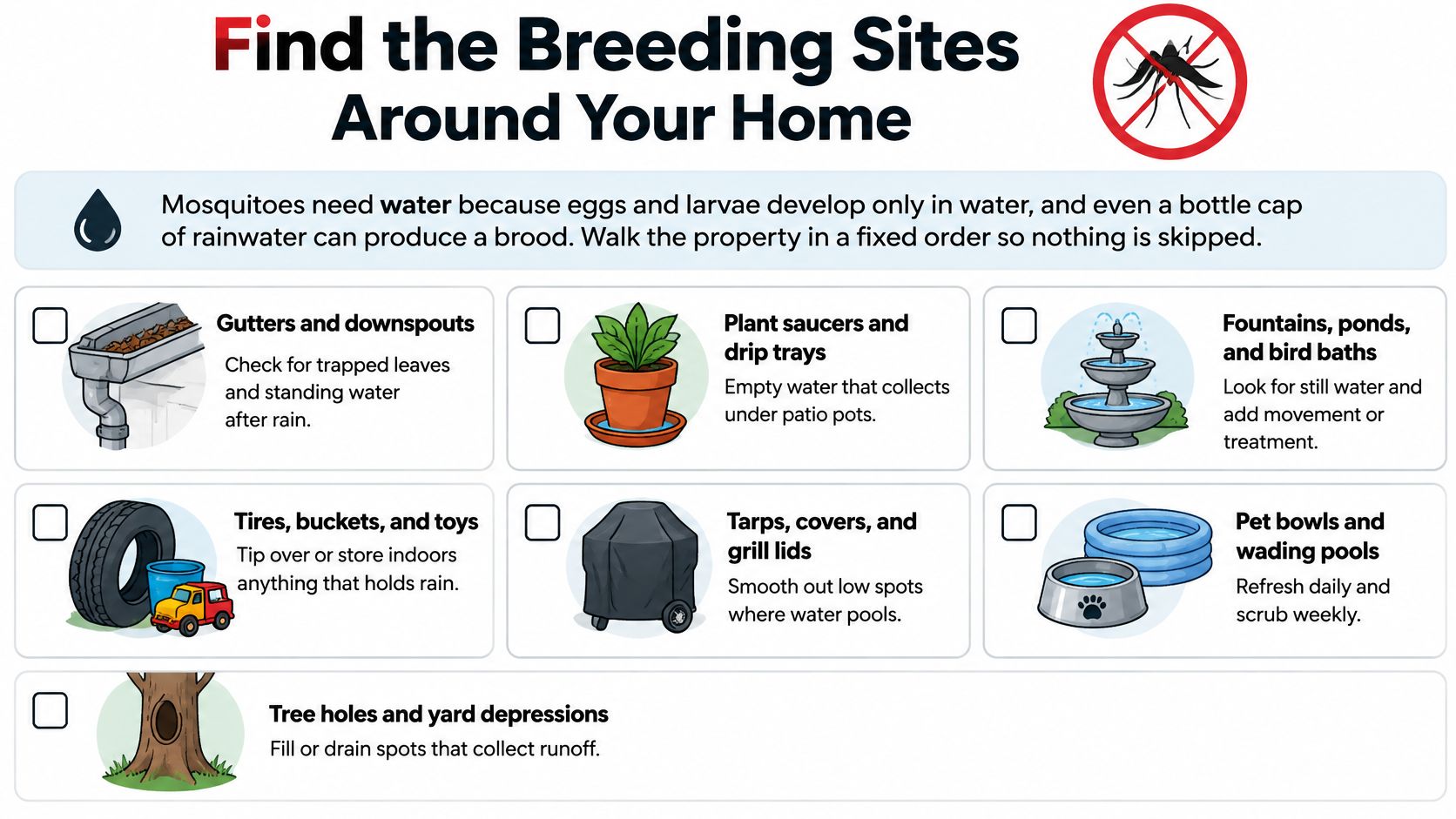
Work from the roofline to the ground
Inspect gutters safely from the ground where possible, then walk around pots, furniture, stored equipment, drains, irrigation devices, and pool covers. Use a flashlight beneath decks and in shaded corners. Don't climb onto a wet roof to investigate.
| Breeding site | Why it holds water | Fix |
|---|---|---|
| Gutters and downspouts | Leaves trap rainwater | Clear debris and flush so water drains |
| Bromeliad leaf axils | Cupped leaves hold water | Flush trapped water or use a larvicide labeled for that site |
| Plant saucers and pot trays | Water sits after watering | Empty them or remove unnecessary saucers |
| Pool covers and tarps | Sagging areas collect rainwater | Pull taut and drain low spots |
| Clogged drains and storm inlets | Blocked flow leaves standing water | Clear accessible debris and report unresolved drainage to the owner |
| Discarded containers, buckets and tires | Cups and hollows retain rain | Remove them or store them dry and covered |
| Pet bowls and outdoor toys | Water is topped up rather than fully replaced | Empty and scrub regularly; refill drinking bowls with fresh water |
| Irrigation drip trays and fountains | Irrigation or still water maintains wet habitat | Repair excess watering, clean regularly, and treat suitable undrainable water |
Tip out every movable container, including items tucked behind sheds. Don't assume a decorative fountain is protected merely because it has a pump; inspect quiet edges and disconnected basins.
For additional examples of overlooked containers, use our guide to mosquito breeding grounds. Households coordinating prevention with children or caregivers can also consult VirusFAQ.com's resource on family safety during mosquito season.
Include shared and neighboring spaces
Property managers should inspect common areas, dumpster pads, vacant-unit patios, and stored maintenance equipment. Ask neighboring owners or the HOA to check their own sources rather than entering another property.
Record where and when biting occurs, including daytime activity, not just dawn and dusk. That information helps identify places that need closer inspection, although it doesn't prove where mosquitoes developed.
This video provides another way to review the inspection task.
Keep a written list of water you can't empty or safely reach. Those locations need a specific drainage, maintenance, or treatment decision.
Larvicide and Adulticide Methods Compared
Larvicides and adulticides solve different problems. Larvicides act during aquatic development before mosquitoes emerge as flying adults. Adulticides target adults already present, but leave the breeding habitat behind.
The Florida resident guide to mosquito control recommends surveillance before insecticide application, with source reduction as the starting point. It identifies Bacillus thuringiensis israelensis (Bti), methoprene, and spinosad as larvicide options for appropriate water-holding sites that can't be emptied or modified.
A pond illustrates the difference between methods and habitats.
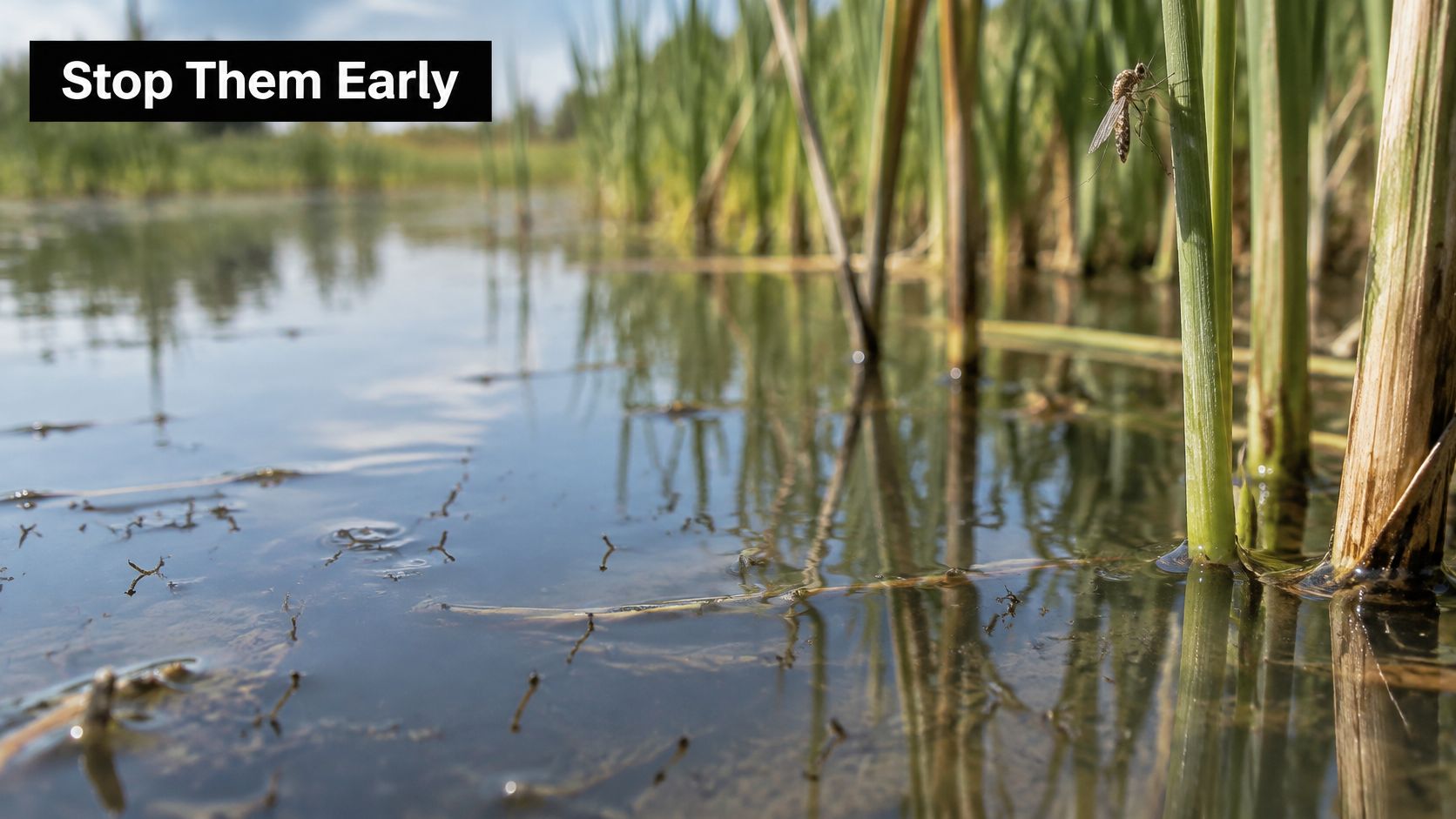
Match the method to the problem
Integrated pest management, or IPM, means inspecting first and combining suitable interventions. It doesn't mean applying every available product.
| Method | Life stage targeted | How long it lasts | Main limit |
|---|---|---|---|
| Source reduction | Aquatic habitat supporting immature mosquitoes | As long as water stays removed | Can't address hidden or inaccessible water |
| Larvicide, including Bti, methoprene and spinosad | Immature mosquitoes before adult emergence | Product-label interval, adjusted for water conditions | Requires a product labeled for the site and intended use |
| Adulticide barrier spray | Adults resting in foliage and shade | Typically about three to four weeks | Doesn't remove the breeding source |
| Personal repellent | Adults approaching the person wearing it | Reapply according to the product label | Protects the person treated, not the whole yard |
A barrier treatment's typical duration isn't a guarantee for every property. A follow-up plan still needs to account for weather, nearby sources, and what inspections reveal.
Larvicides aren't interchangeable household additives. Choose a formulation specifically labeled for the water feature and intended use. Never put a yard-treatment product into drinking water, a pet bowl, or another site unless that use is expressly permitted.
What a treatment record should show
A documented inspection should identify:
- Breeding sites found, including water that couldn't be accessed.
- The target stage, so you know whether the work addresses immature mosquitoes, adults, or both.
- The active ingredient and application site, rather than only a brand name.
- Application restrictions and reinspection arrangements, including when people and pets may return.
Outdoor fogging alone isn't a complete plan. A useful plan explains why treatment is needed, what it targets, and how someone will check the result.
Personal repellent remains a separate protective layer. Don't treat reduced yard activity as evidence that you no longer need protection during an alert or an outdoor outing.
Why Sprays Fail and How to Diagnose the Problem
A stronger or more frequent spray isn't automatically better. Repeat biting can mean the insecticide isn't working as intended, but it can also mean new adults keep emerging from water that nobody addressed.
A Florida insecticide-resistance study found that 95% of pyrethroid bioassays for Aedes aegypti produced resistant results across populations from 30 counties. That finding concerns tested mosquito populations and laboratory assays, not a prediction that the same proportion of residential treatments will fail.
Separate treatment failure from replenishment
Adulticide failure means the application hasn't adequately controlled the adults being targeted. Possible explanations include resistance, unsuitable placement, or poor coverage of resting areas.
Breeding-site reinfestation means adults continue arriving or emerging after treatment. Say a patio becomes more comfortable after service, but biting returns while a blocked drain remains wet. Repeating the same spray without investigating that drain leaves an obvious question unanswered.
Homeowners can't reliably diagnose resistance by bite counts alone. A provider needs the application record, an inspection, and meaningful before-and-after observations to distinguish likely explanations.
Follow a diagnostic sequence
- Log the pattern. Record the location, time of day, weather, and whether activity changed after treatment. Include the patio, entryway, shaded side yard, and shared grounds.
- Inspect before another application. Check containers and drainage, then document unresolved sources with photographs.
- Identify the target and ingredient. Obtain the service record showing what was applied and whether the provider targeted adults or immature mosquitoes.
- Review the strategy. Discuss whether monitoring supports a different approach, including product rotation where appropriate and legally permitted. Changing brand names doesn't necessarily change the active ingredient.
- Compare written plans. Evaluate inspection quality, monitoring, and follow-up rather than choosing solely by spray frequency.
Don't respond to possible resistance by increasing a pesticide dose yourself. Application rates and intervals must stay within the label, and more product doesn't repair poor diagnosis.
A better service question: What evidence will tell us whether the next visit worked?
Resistance doesn't make control impossible. Combining source reduction and barrier treatment can make a noticeable difference, although mosquito control cannot eliminate every mosquito.
The useful endpoint is a documented change in conditions and mosquito activity. Diagnosis determines whether the next visit addresses the actual problem, while a calendar alone only tells you when another visit is due.
Disease Alerts and When to Change Your Routine
Nuisance biting and disease risk aren't the same decision. Persistent biting may justify a property inspection and routine service. An official disease alert can justify changing household behavior immediately, even if you haven't noticed more mosquitoes.
Florida monitors diseases including West Nile virus, Eastern equine encephalitis, St. Louis encephalitis, dengue, chikungunya, Zika, and malaria. The Florida Department of Health's week-six 2026 arbovirus report listed Miami-Dade County under a mosquito-borne illness alert; that report is a dated surveillance snapshot, not confirmation of today's alert status.
Use current county and state notices when making present-day decisions.
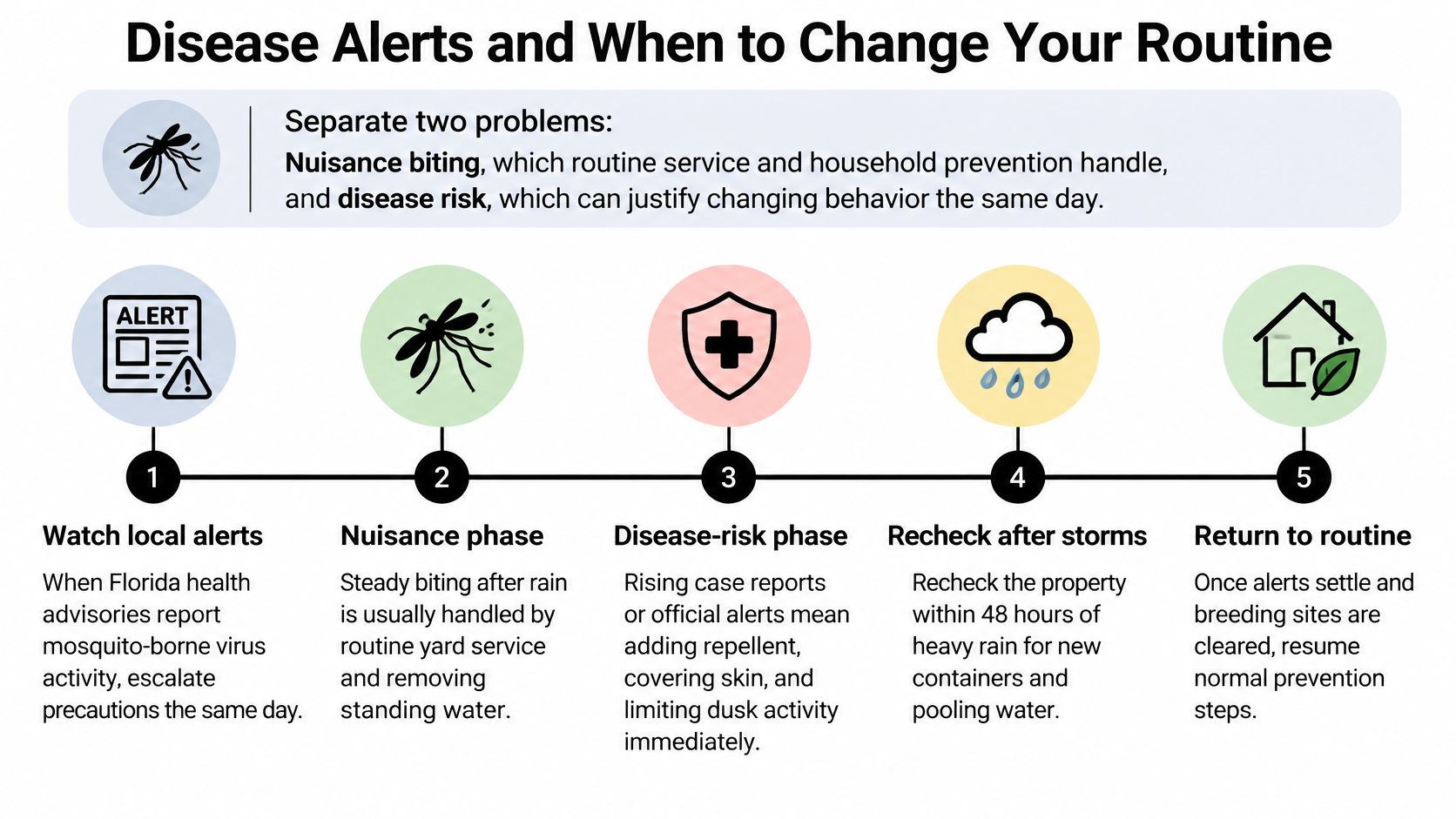
Respond to an alert in a practical order
- Notify the household promptly. Check the alert's location and instructions, inspect accessible water sources, and make repellent available.
- Coordinate beyond your fence. Contact the property owner, landlord, or HOA about inaccessible containers and shared drainage. Don't wait for your next routine service appointment to report them.
- Adjust outdoor plans. Limit exposure when mosquitoes are active, cover exposed skin, and repair window and door screens. Don't assume daytime is risk-free.
- Plan protection for vulnerable residents. Help infants, older adults, and people with weakened immune systems use appropriate barriers and age-appropriate products.
- Escalate health concerns appropriately. Contact a healthcare professional about illness and mention relevant travel or mosquito exposure. Report concentrated mosquito activity to local mosquito control.
Match precautions to the outing and property
Different mosquitoes have different biting habits. Our guide to mosquito species in Florida can help you understand why dusk-only precautions leave gaps.
Before leaving home, include repellent and suitable clothing when you prepare for beach and spring outings with PADL's outdoor-safety resource. Yard treatment doesn't protect you at another location or replace public-health guidance.
Inspection responsibilities also differ by property. Pool covers need attention after rain, irrigation needs maintenance checks, and rental properties need a handover routine so outdoor containers aren't overlooked between occupants.
When a Licensed Professional Is Worth Calling
Professional help becomes worthwhile when biting persists despite sustained source checks, or when the property is too complex for household maintenance alone. Multifamily buildings, HOA grounds, frequently changing rentals, and yards with difficult drainage require coordination that a homeowner may not be able to provide.
An active disease alert is another reason to seek timely advice. It doesn't mean every yard automatically needs spraying; it means treatment decisions deserve prompt, informed attention.
Use the process below to evaluate what a provider proposes.
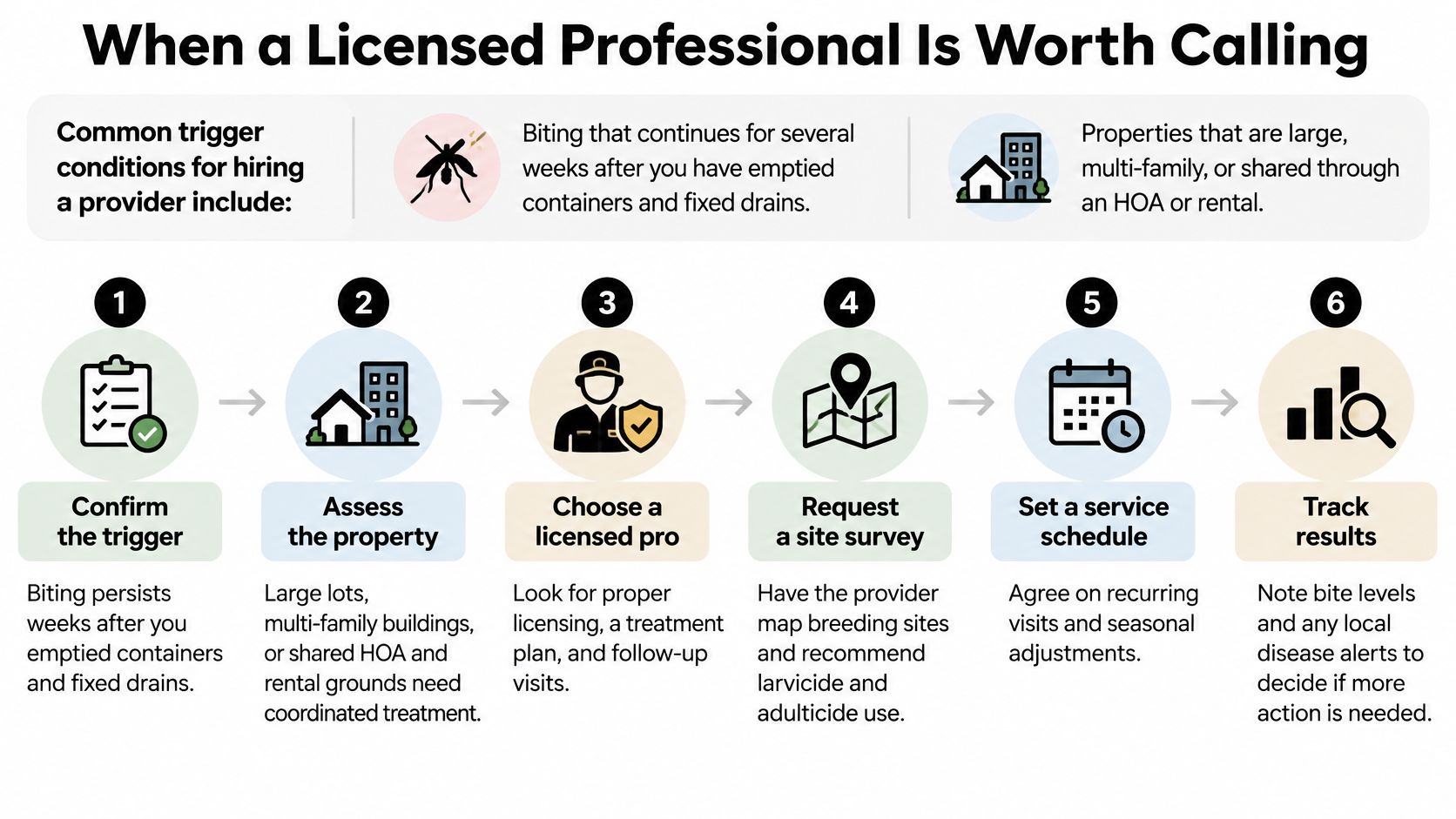
Expect a complete property program
Our matching process connects homeowners with providers whose mosquito-control work follows these stages:
- Property survey. Map breeding sources and adult resting areas across the yard, including access limitations and shared boundaries.
- Source reduction. Remove standing water where practical and select suitable larvicide treatment for water that must remain.
- Barrier treatment. Target foliage and resting zones where adult control is warranted, rather than treating every surface indiscriminately.
- Recurring program. Schedule re-treatments through the season, with adjustments based on inspections and results.
The schedule should support control, not substitute for checking whether the original plan is working.
Monitoring should guide additional treatment
For public-health response after identification of a locally acquired case or positive mosquito pool, the Florida mosquito-control toolbox recommends weekly follow-up inspection or surveillance for 45 days. That's a disease-response protocol, not a standard requirement for every residential service agreement.
The underlying decision rule is useful for any property: persistent adult abundance supports reassessing adult control, while increasing larval activity calls for renewed attention to aquatic sources. A statement that the yard looks better isn't equivalent to measured observations.
Confirm credentials and responsibilities
Florida pest-control services are regulated by FDACS under Chapter 482, Florida Statutes. Every provider we match holds the required Florida pest-control license and carries active insurance. Keep the license information and insurance documentation with the written proposal.
The proposal should record survey findings, active ingredients, application locations, relevant label restrictions, before-and-after observations, and a reinspection schedule. It should also distinguish work the provider will perform from maintenance the owner must arrange.
Check your county's public mosquito-control service-request option for roadside ditches, storm drains, and other public sources. Confirm local coverage and any charges rather than assuming private-yard treatment is included. Public response and a licensed property's provider can address different parts of the same neighborhood problem.
Confirm the Program Before You Sign
A useful agreement explains what someone will inspect, what they'll treat, and how they'll evaluate the outcome. A promise to visit regularly isn't enough if nobody has identified the sources or recorded the starting conditions.
Start with a short action list:
- Walk after rain. Follow a consistent route and photograph water you can't remove.
- Keep a biting log. Record locations and timing so a provider has more than a general complaint.
- Compare the pattern with conditions. Note whether activity follows storms or continues despite corrected sources.
- Request a written survey when biting persists. Compare the proposed work, monitoring, access requirements, and follow-up terms.
Know who will provide the treatment
We connect Miami homeowners with licensed, insured local pest-control professionals for a free, no-obligation quote. Pestless doesn't perform treatments itself. Information you submit is shared with those vendors, who contact you by phone, text, or email.
Our Florida pest-control license guide helps explain credential checks. You can also review the Mosquito Control service page before requesting an introduction.
Before signing, make sure the written scope addresses your actual property, including shared spaces or inaccessible drainage. Clarify what happens if activity persists, rather than assuming every return visit includes a new diagnosis.
Begin the checklist this week. If biting doesn't decline after sustained source checks, request a survey instead of increasing spray frequency.
Pestless Inc. connects Miami homeowners with licensed, insured local professionals for a free, no-obligation mosquito-control quote. Visit Pestless Inc. to describe your property's conditions and request an introduction to a provider who can assess the problem before proposing treatment.
Dealing with this pest right now?
Pestless connects you with a licensed, insured Miami pest control provider for a free, no-obligation quote.