A scratch-and-roll above your bedroom ceiling wakes you in the middle of the night. Then everything goes quiet. By morning, you're wondering whether you heard a rodent in the attic, a loose duct, or something moving across the roof. Before you climb through the hatch or buy bait, start with a safer question: what evidence can you document without disturbing the space?
Table of Contents
- Why a Rodent in the Attic Is a Building Problem
- The Signs That a Rodent Is Living in Your Attic
- How Rodents Get Into an Attic and What the Gaps Reveal
- The Damage and Health Risks an Attic Rodent Leaves Behind
- How to Clean an Attic After Rodents Safely
- Prevention and Exclusion That Actually Holds
- When to Call a Licensed Professional
- Book a Licensed Inspection Before You Seal Anything
Why a Rodent in the Attic Is a Building Problem
Say the noise returns the following night, this time above the hallway. You haven't seen an animal, but the sound seems to follow the ceiling toward an air-conditioning vent. That's enough reason to investigate, not enough to identify the species or start closing holes.
Nationally, nearly 12% of approximately 128,000 surveyed households reported signs of mice or rats inside their homes during the previous year in the 2021 American Housing Survey, conducted by the Census Bureau with HUD, according to the Census Bureau's housing analysis. Those reports concern homes generally, not attic-only infestations, but they show that this isn't an unusual homeowner problem.
Attics offer darkness, undisturbed nesting material, and shelter. They also sit beneath a complicated roof envelope containing vents, soffits, flashing, and utility openings. An animal can exploit a defect that's invisible from your driveway.
An attic rodent is an entry-and-sanitation problem with a possible wiring risk, not simply an animal to catch.
The building perspective helps connect the sound overhead with the openings outside.
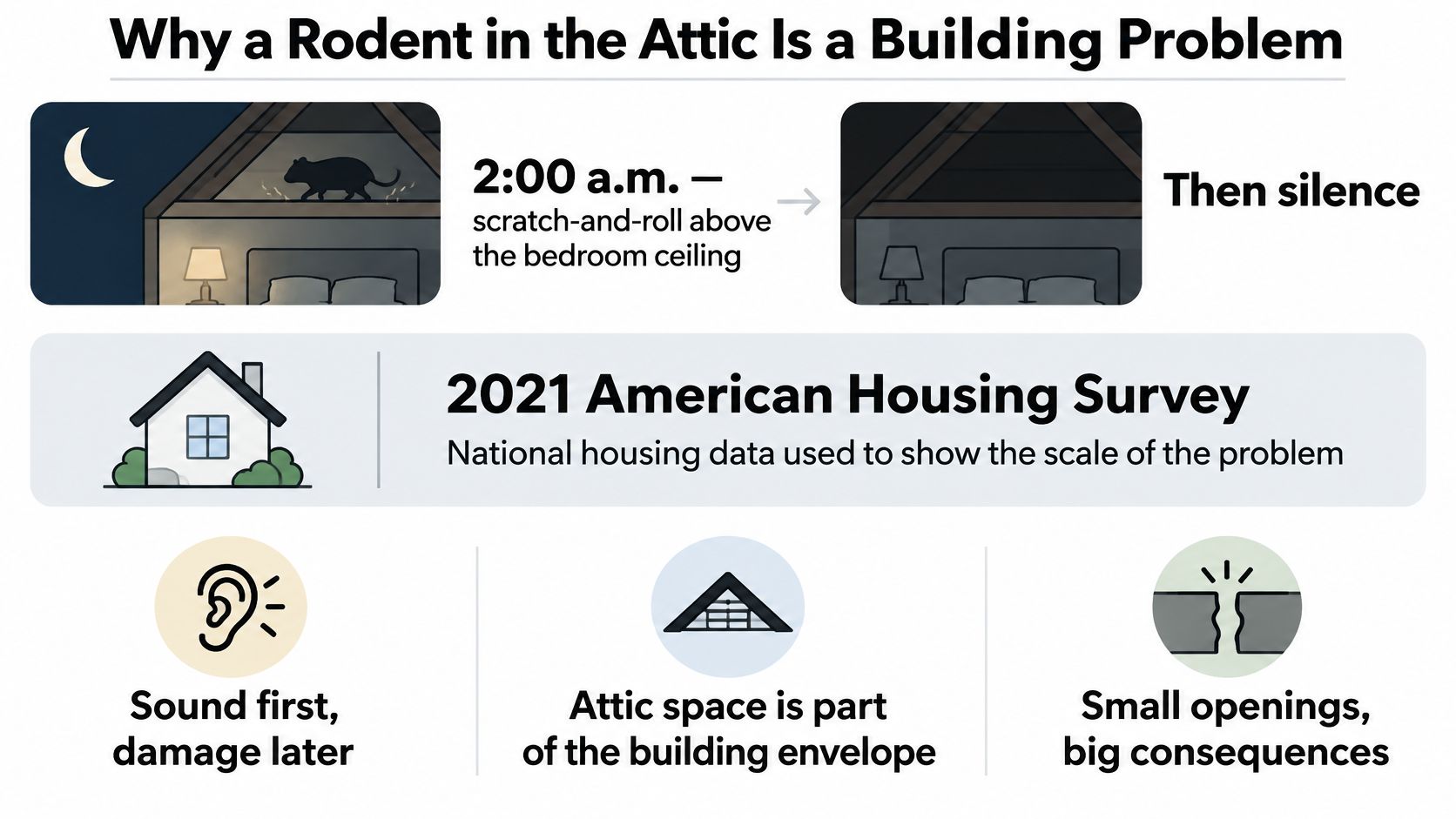
Don't seal suspected active entrances blindly. Animals left inside may move into wall cavities or die in inaccessible places, creating odor and attracting flies. A coordinated inspection establishes where rodents are traveling, how they'll be removed, and when permanent closure is appropriate.
For Miami properties, that inspection should connect interior evidence to roof defects, sanitation conditions, and whoever controls the affected building elements. Catching an animal without assigning those repairs leaves the next entry opportunity untouched.
The Signs That a Rodent Is Living in Your Attic
Use several signs together. Scratching alone doesn't identify a rodent, and droppings alone don't establish that animals are still present. Location, fresh damage, repeated sounds, and newly appearing evidence make a stronger case than any isolated clue.
Start from the hatch with a bright flashlight and your phone camera. Don't crawl across insulation to follow a sound. Ceiling drywall won't support you, and insulation can conceal framing, wiring, and damaged ducts.
Signs of a rodent in the attic and what each one tells you
| Sign | What to Check | What It Usually Means | Urgency |
|---|---|---|---|
| Scratching or rolling at night | Listen after dark and before dawn; record the room below | Possible animal movement; heavier sounds aren't reliable species identification | Arrange inspection soon |
| Droppings on joists or insulation | Illuminate joists, insulation surfaces, vents, and the hatch perimeter | Rodents have used the area; size and shape need careful interpretation | Prompt inspection; never sweep dry |
| Gnaw marks on wiring, PVC, or rafters | Look for pale exposed wood and fresh plastic shavings | Recent chewing; wiring may be damaged | Urgent if wiring is involved |
| Rub marks and grease trails | Check beam edges, pipe runs, and hatch framing | Repeated travel along the same surfaces | Book an inspection |
| Ammonia or urine odor | Note odor near the hatch, ceiling fixtures, and HVAC returns | Possible accumulated urine or contaminated materials | Urgent if ducts or occupied rooms are affected |
| Nesting material piles | Look for shredded insulation, paper, cardboard, palm fronds, or leaves | Possible nest, potentially containing young | Prompt inspection |
| Tracks and flattened runways | Look across insulation for compressed paths and drag marks | Movement routes that help focus the inspection | Book an inspection |
| Brown stains on ceiling drywall | Examine the ceiling below the suspected activity | Possible contamination or a separate roof or plumbing leak | Prompt assessment; moisture repair may be needed |
| Pets staring or pawing at the ceiling | Note repeated evening behavior in the same room | A supporting clue, not proof of rodents | Confirm through inspection |
| Daytime sightings | Record the location and behavior without approaching | Active rodent presence requiring assessment | Urgent |
Don't handle droppings to judge their texture. Fresh-looking pellets can appear darker or shinier, while older material may look dull or weathered, but attic heat and moisture make visual aging unreliable. A lone dropping could remain from an earlier infestation.
For a closer comparison of appearance, use the rat-droppings-versus-mouse-droppings guide, then let the inspector confirm the identification. Don't select traps or repairs from pellet appearance alone.
Verify safely without rearranging the attic
Photograph evidence from a stable position and describe its location in ordinary terms, such as above the hallway return or beside the water-heater pipe chase. Keep a simple activity log showing when you heard movement and which room was underneath it. Repeated concentration in one area helps a technician prioritize the search.
Storage can hide travel routes and make inspection harder. Premier Builders' Dublin attic conversion storage tips offer useful planning context for keeping attic storage organized, though a converted attic and a Miami service attic have different access and construction requirements.
- Keep evidence undisturbed. Don't sweep a path, move a suspected nest, or pull contaminated boxes through living areas.
- Keep access controlled. Close the hatch after observation and keep children and pets away.
- Escalate hazardous signs. Chewing near energized wiring, daytime sightings, or odor entering occupied rooms calls for prompt professional attention.
A quiet night doesn't cancel the evidence you found. Rodents may change routes, remain still while you're listening, or occupy a part of the roof space you can't hear clearly.
How Rodents Get Into an Attic and What the Gaps Reveal
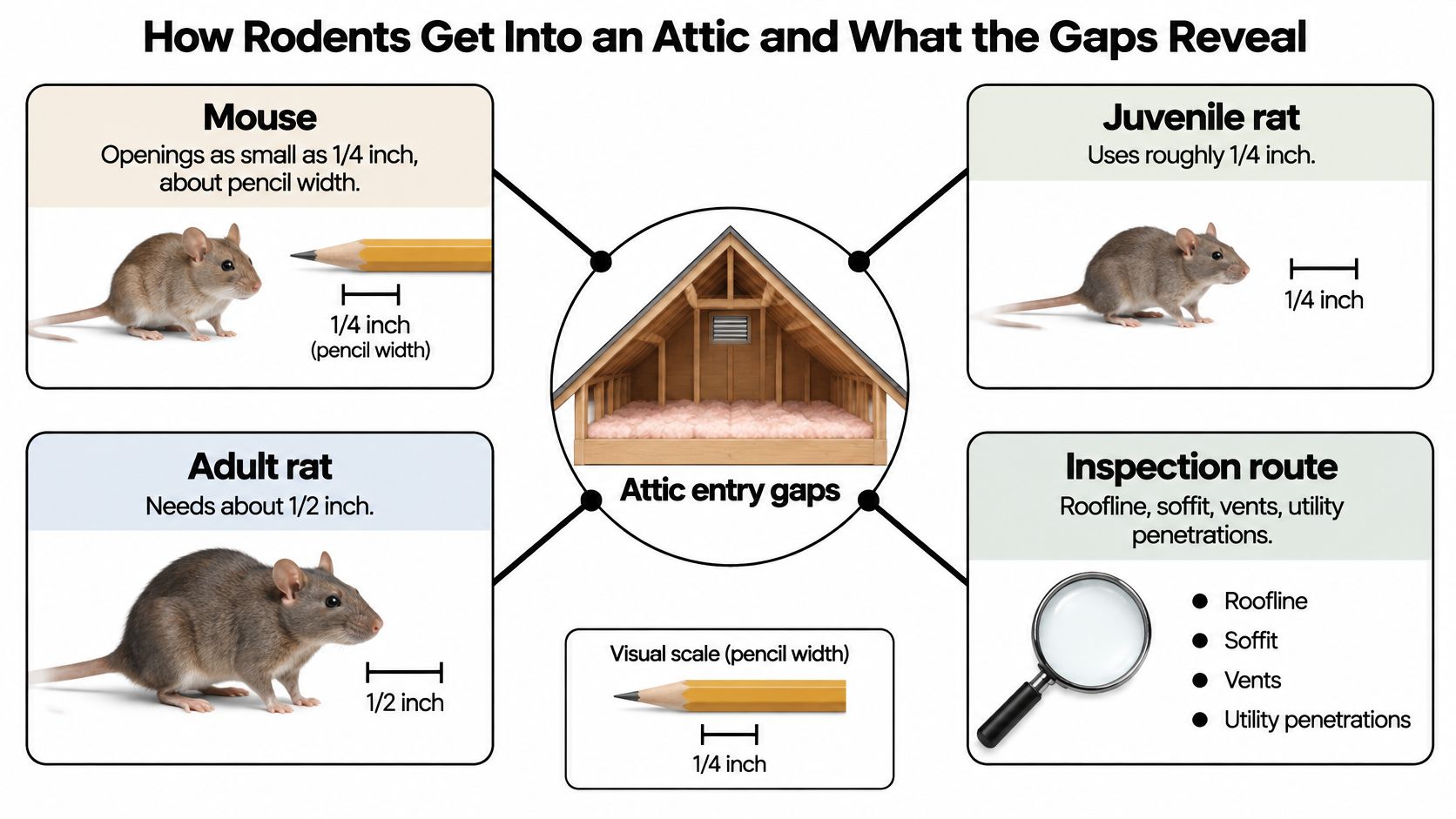
Inspect for small openings, not just obvious holes. The EPA pest-entry-prevention technical bulletin describes mice passing through openings as small as 1/4 inch, roughly pencil width; juvenile rats may use roughly 1/4-inch gaps, while adult rats may enter openings around 1/2 inch.
Those dimensions explain why a roof can look sound from the ground while still admitting rodents. A separated panel corner or an oversized opening around a cable can matter more than a conspicuous but securely screened vent.
The entry diagram shows where a small-gap inspection begins.
Follow the roof envelope rather than the noise
A professional should work systematically across roofline and fascia joints, soffit corners, eaves, roof vents, and gable vents. Torn screening, loose vent frames, rotted wood, and separated panels all deserve examination. The inspection then follows utility penetrations, refrigerant lines, chimney flashing, pipe collars, and interior plumbing chases.
In Miami, vegetation deserves equal attention. Palm and citrus branches near the roof can provide access to an opening, while dense planting can conceal defects lower down. HVAC penetrations need inspection on both sides of the assembly, not just a bead of sealant around the visible exterior opening.
The hatch also matters. Four Seasons Roofing's attic access guide for WA homeowners is useful background on access planning, but don't treat another region's guidance as a substitute for evaluating your own hatch, framing, and safe working clearance.
Species identification changes where the technician looks. House mice may nest within insulation and use interior voids; climbing roof rats direct attention toward high routes. Norway rats warrant attention to lower-level access and connected chases rather than an assumption that every attic animal entered directly through the roof.
Match the repair to the opening
Foam alone isn't a durable rodent barrier. It can fill a void visually without preventing an animal from chewing through it. Use corrosion-resistant copper or stainless-steel mesh secured with compatible sealant and structural patching where appropriate.
The repair must also suit the assembly:
- Vent openings: Use a properly secured guard that preserves required airflow.
- Rotted fascia: Replace unsound material rather than attaching mesh to crumbling wood.
- Utility penetrations: Protect the opening without crushing cables, damaging refrigerant insulation, or defeating required clearances.
- Flashing defects: Have a qualified roofing professional restore water shedding as well as pest resistance.
A repair isn't finished because daylight disappears. It must resist gnawing, remain attached, and preserve the roof's drainage and ventilation.
The practical sequence is inspect, manage the animals inside, then complete exclusion with confirmation and monitoring. A professional may stage closures during trapping, but blocking every opening without knowing where animals remain can turn an exterior-entry problem into an interior-removal problem.
The Damage and Health Risks an Attic Rodent Leaves Behind
The exposure homeowners underestimate is often the cleanup. Brushing dry droppings from a joist or vacuuming a nest can lift contaminated particles into the air. Someone who never touched a rodent can still disturb material it left behind.
The EPA's rodent-infestation guidance identifies direct disease transmission through bites, saliva, urine, and feces, along with indirect transmission through fleas, ticks, and mites that fed on infected rodents. Rodent-associated diseases include hantavirus, leptospirosis, salmonellosis, and plague; listing these hazards doesn't mean every attic rodent carries them.
Contaminated nesting material can also aggravate allergies and asthma when disturbed. For a household with respiratory vulnerability, the cleaning method and containment plan deserve as much attention as the trapping plan.
Separate electrical hazards from material loss
Gnawed cable insulation requires an electrician's assessment. A pest technician can identify suspicious damage, but shouldn't declare a damaged electrical circuit safe merely because the rodents have been removed. A burning smell, heat, smoke, or sparking changes the response from pest scheduling to an electrical emergency.
Other damage is less dramatic but can require substantial work:
- Insulation: Nesting, compression, and urine contamination may make affected sections unsuitable to retain.
- Ducts: Chewed or displaced material can compromise the system and require HVAC assessment.
- PVC and stored belongings: Gnawing and contamination can affect pipes, containers, fabrics, and paper goods.
- Drywall and framing: Staining needs investigation to distinguish animal contamination from an independent moisture problem.
Consider a hypothetical South Florida house where attic noise is ignored for months. By the time the owner requests trapping, nests and soiled insulation extend beyond the original entry corner. Catching the animals addresses occupancy, but it doesn't make contaminated insulation clean or restore damaged ductwork.
Poison adds a separate management problem
Loose bait blocks aren't a substitute for identifying access routes. Any rodenticide use must follow its label and account for children, pets, and non-target animals. An animal that dies inside an inaccessible void may also leave an odor source that's difficult to retrieve.
Immediate priorities are electrical safety, occupant exposure, and keeping contamination out of living areas. Insulation loss, repeated soiling, and damage to stored goods may develop less visibly, but they still belong in the written scope. Don't accept a quote that treats every consequence as solved once trap activity stops.
How to Clean an Attic After Rodents Safely
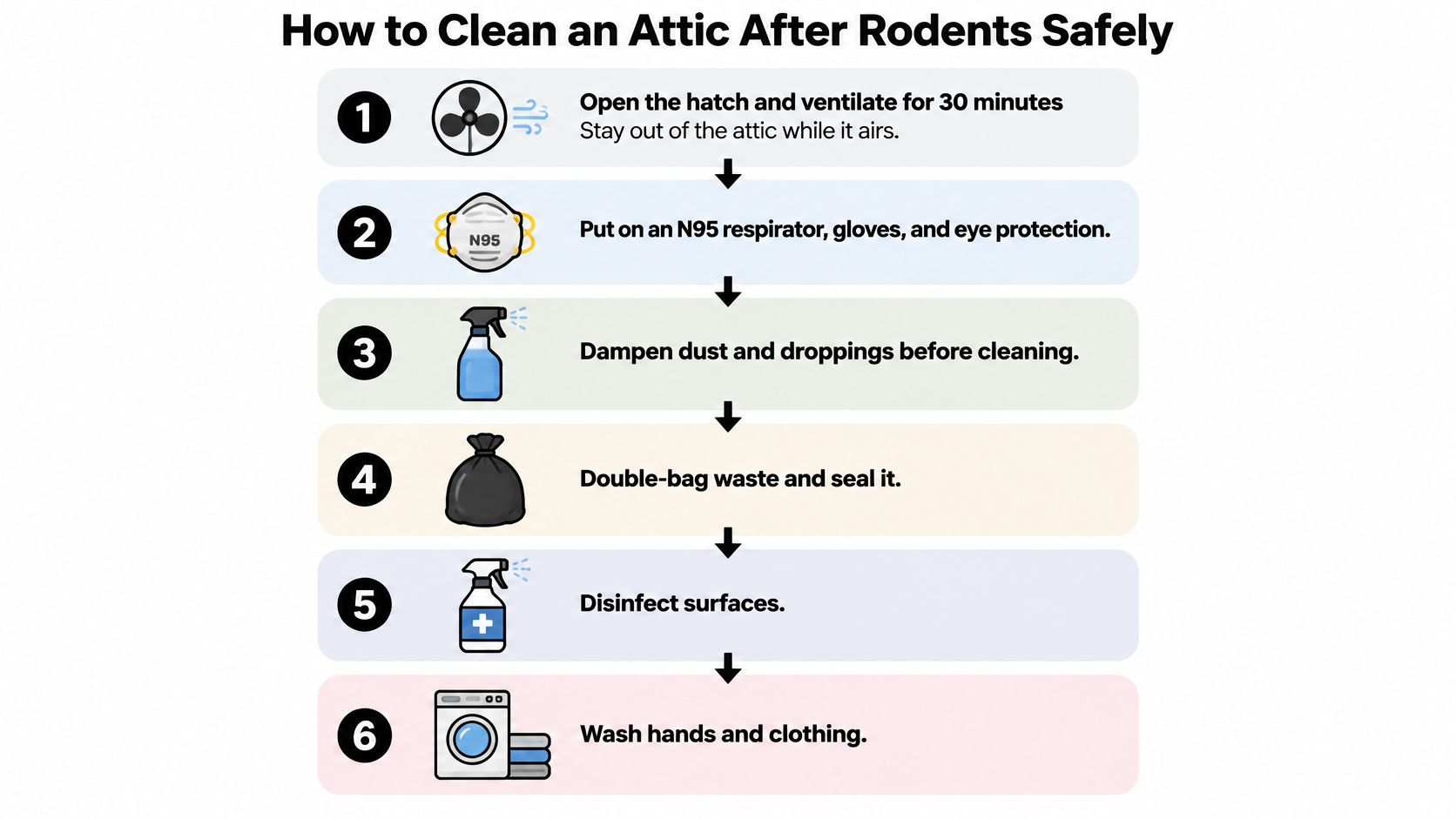
Never dry-sweep or vacuum rodent droppings, urine residue, or nests. Wet removal is the starting point, and extensive contamination is professional remediation work rather than a routine weekend cleanup.
This visual summarizes the basic sequence, but protective equipment must match the actual contamination and work.
Use controlled wet removal
The CDC's rodent-control guidance calls for 30 minutes of ventilation while you remain outside the area, then wetting waste with disinfectant or a 1:9 bleach-to-water solution and allowing at least 5 minutes of contact time, or following the product label.
Ventilate safely. Use available exterior ventilation without directing contaminated air into occupied rooms. If opening or ventilating the attic requires unsafe entry, stop and arrange professional help.
Put on suitable protection. Wear rubber or plastic gloves, eye protection, boots, and protective clothing. A disposable particle mask doesn't make heavy-contamination cleanup safe; substantial jobs need professional assessment of respiratory protection.
Keep dust down. Don't brush, shake, or kick contaminated material. Keep household vacuums and ordinary shop vacuums out of the cleanup.
Saturate the waste. Apply an EPA-registered disinfectant appropriate for the surface, or the CDC bleach solution described above, and keep the material wet for the specified contact period. Never mix bleach with ammonia, acids, or other cleaning products.
Pick up and contain. Use disposable towels to collect wetted waste, then bag and seal it without squeezing air toward your face. Double-bag contaminated waste and follow local disposal requirements.
Remove affected porous materials appropriately. Don't reuse nesting material or visibly contaminated insulation. Large-scale insulation removal requires containment and equipment beyond hand cleanup.
Clean yourself and your equipment. Wash gloved hands before removing gloves, then wash bare hands thoroughly. Launder contaminated clothing separately and clean reusable equipment appropriately.
Assess connected systems. Have affected ducts, vents, and ceiling penetrations evaluated before restoring normal use. Don't spray disinfectant into HVAC equipment as a substitute for that assessment.
Stop when the scope exceeds safe homeowner work
Extensive droppings, carcasses, inaccessible nests, or contaminated ventilation equipment justify professional remediation. Even HEPA equipment isn't permission to vacuum untreated waste casually.
If roof leakage is also present, AMPM Restoration Services' guidance on drying a wet attic within 48 hours provides related moisture-restoration context. Treat moisture repair separately from disinfection, and don't cover damp framing with replacement insulation.
For a visual companion to the wet-cleaning process, use this demonstration.
Prevention and Exclusion That Actually Holds
A homeowner can repair an attic opening while a shared dumpster continues feeding rodents nearby. A condo resident can keep an immaculate unit while an association-controlled roof vent remains damaged. Durable prevention needs both a physical barrier and someone responsible for maintaining it.
A 2025 analysis of urban rat populations found significant increases in 11 of 16 cities, or 69%, with larger increases associated with warming temperatures, urbanization, and population density. That isn't a Miami infestation estimate. It supports the broader management principle that waste control, exclusion, monitoring, and neighborhood conditions matter alongside lethal control.
Prevention and exclusion matrix by building element
The responsibility column identifies the practical coordinator, not a legal allocation. Condo documents, leases, ownership boundaries, and the actual repair scope determine who authorizes and pays for work.
| Area or Element | What to Inspect or Do | Rodent-Resistant Fix | Who Handles It |
|---|---|---|---|
| Roofline and fascia | Check storm damage, open joints, and rotted wood | Replace failed material; secure corrosion-resistant mesh and appropriate patching | Licensed professional; owner or HOA authorizes |
| Soffits and eaves | Look for separated panels and corner openings | Refit panels and install secured rodent-resistant screening | Licensed professional |
| Roof and gable vents | Inspect screens, frames, and attachment points | Fit compatible commercial vent guards without obstructing ventilation | Licensed professional |
| Attic hatch or door | Check frame fit and latch engagement | Repair the frame, weather-strip, and fit a secure latch | Homeowner or landlord |
| Utility and AC line penetrations | Trace pipes, cables, and refrigerant lines | Secure mesh with compatible sealant; protect services and required clearances | Qualified licensed professional |
| Chimney flashing and pipe collars | Look for corrosion, separation, and failed seals | Repair flashing and collars using appropriate roofing details | Qualified roofing professional |
| Gutters and downspouts | Remove debris and check drainage | Restore flow and direct runoff away from the building | Homeowner or maintenance contractor |
| Trees and vegetation | Identify roof contact and climbing routes | Trim branches clear and remove vines from walls | Homeowner or qualified tree contractor |
| Garbage and dumpster areas | Check lids, overflow, and spills | Use rodent-resistant lidded containers and reliable collection | HOA, landlord, or waste-area manager |
| Food and water sources | Check fallen fruit, pet bowls, seed, and leaks | Remove accessible food and repair leaks | Residents, homeowner, or landscape manager |
| Attic storage | Inspect cardboard, paper, and fabrics | Use sealed durable bins and keep inspection routes accessible | Homeowner or occupant |
| Monthly monitoring | Observe from safe access points and review prior photos | Log new evidence and arrange inspection after damage-producing storms | Homeowner, landlord, or building maintenance |
Material selection should suit the opening rather than follow a single shopping list. The rodent exclusion materials guide helps distinguish barriers, fillers, and supporting sealants. None substitutes for sound attachment to the building.
Assign the whole route to an owner
A Kendall house with fruit trees. Say branches overhang the roof and fallen citrus collects beside the fence. The homeowner handles fruit pickup and arranges trimming, while the pest and roofing professionals coordinate entry repair. Repairing the soffit without changing the outside conditions leaves rodents nearby testing the building again.
A Brickell condo with a shared roofline. A resident hears activity above a top-floor bedroom, but the suspected vent belongs to the association. The resident documents the evidence and notifies management; the association coordinates roof access, adjoining-unit inspection, and common-area repairs. A unit-only trap service can't resolve a common-envelope defect.
A short-term rental with a guest complaint. The host should restrict attic access, document the report, and arrange assessment rather than sending a cleaner to sweep up evidence. The property manager then coordinates pest work, any electrical or HVAC repairs, and guest-space cleaning before normal use resumes.
Shared-building rule: Assign a named person to every repair and sanitation task. Unassigned work is unfinished work.
Make a monthly flashlight check part of property maintenance, using safe hatch access rather than walking blindly along joists. After a damaging storm, inspect the exterior again and compare conditions with your photographs. Keep the record with invoices and repair locations so the next technician doesn't start from scratch.
When to Call a Licensed Professional
You don't need to see an animal before requesting help. Odor, repeated scratching, contaminated materials, and suspected wiring damage are enough to justify assessment. The urgency comes from exposure and building conditions, not from how confidently you can name the species.
North Carolina State Extension's structure-invading rat guidance emphasizes the health concerns associated with these rats and the importance of attic openings, tight doors, and screened vents. For Miami owners, waiting for a seasonal change isn't a repair strategy.
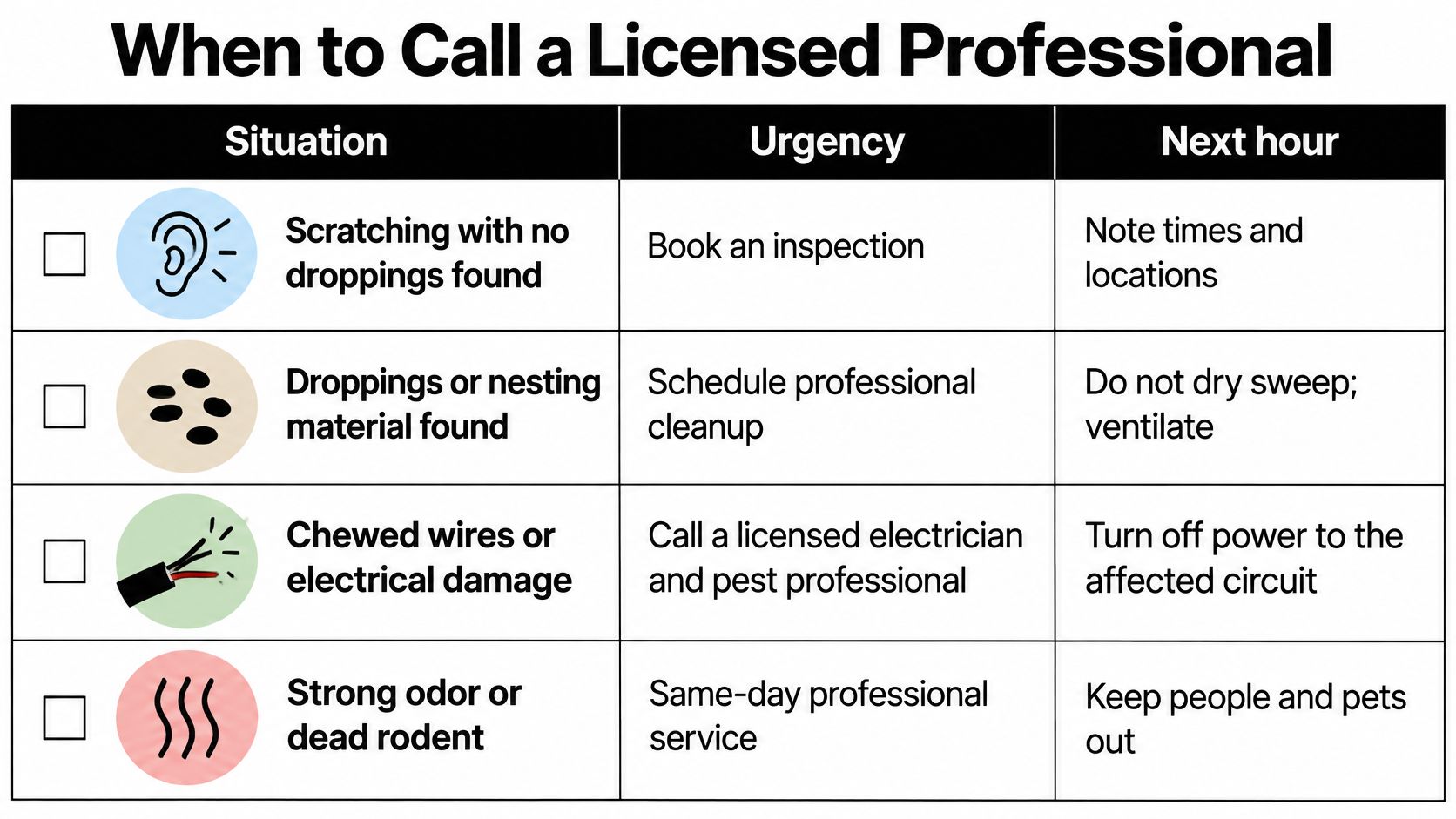
Attic rodent triage by situation and urgency
These are practical response recommendations, not statutory deadlines.
| Situation | Urgency | What to Do Now |
|---|---|---|
| Scratching only, no droppings found | Standard | Book an inspection soon; record sounds and keep access controlled |
| Droppings near the hatch or above living space | Prompt | Keep people away, leave material undisturbed, and arrange inspection and cleanup assessment |
| Chewing sounds near wiring or a hot burnt smell | Emergency | Leave the area; isolate the affected circuit only if safe and call qualified help |
| Strong ammonia odor or damaged ductwork | Urgent; emergency if breathing is affected | Stay out, avoid spreading attic air, and arrange professional remediation and HVAC assessment |
| Pups or an intact nest in the insulation | Prompt | Arrange professional removal that accounts for dependent young |
| Infant, asthma sufferer, or immunocompromised resident in the home | Urgent | Limit exposure and arrange professional assessment and cleanup |
| Shared roofline affecting several units | Prompt | Document activity and notify the landlord or HOA |
| Short-term rental with a guest report | Urgent | Assess affected guest areas and arrange prompt professional inspection |
| Persistent DIY trapping with no change | Standard escalation | Stop repeating the same setup; request entry-point mapping |
| Daytime sightings of rats in the attic | Urgent | Record the location and call promptly; don't infer population size from the sighting alone |
Smoke, sparking, or an active burning smell requires emergency action. Leave the building when appropriate and contact emergency services; don't enter the attic to locate a cable. A pest appointment is not a substitute for an electrician or emergency responder.
The visual below summarizes common escalation points; only turn off a circuit when you can do so safely from the panel.
Read these questions before approving the work
Pestless routes requests to licensed, insured local providers. Our guide to choosing a licensed pest control professional provides additional credential-checking context.
Use these questions to compare written scopes:
- License: What Florida license covers the proposed work, and whose name appears on it?
- Insurance: Is active insurance in place for the provider performing the job?
- Inspection map: Will the report identify suspected entry points, nesting areas, and inaccessible areas?
- Cleanup scope: Which contaminated materials will be removed, and is insulation work included or separately priced?
- Exclusion scope: Are sealing locations and repair materials itemized separately from trapping?
- Follow-up: What inspection or monitoring is scheduled, and how will unresolved activity be handled?
The Rodent Control service description pairs removal with sealing the way back in. Compare proposals against that complete objective, not just the number of traps placed.
Book a Licensed Inspection Before You Seal Anything
Start with evidence you can gather safely, then request a coordinated plan. There's no benefit in turning a manageable inspection into a fall, an electrical exposure, or a contaminated cleanup.
Use this action sequence:
- Observe from safe access. Shine a flashlight from the hatch at dusk and photograph visible signs without touching them.
- Record the pattern. Note the sound, room, approximate time, odor, and any change since the previous observation.
- Leave hazardous work alone. Don't seal active routes blindly, scatter poison bait, or sweep droppings.
- Request a complete scope. Have the inspection identify the species, nesting areas, and likely entry points, then coordinate removal, cleanup, repairs, and exclusion.
A complete visit should distinguish pest work from roofing, electrical, and HVAC work that needs another qualified trade. The written plan should also identify which tasks belong to the homeowner, landlord, or association.
Pestless is a Miami-Dade matching service, not a pest control company, and doesn't perform treatments. A 60-second form or phone call routes your request to a licensed, insured provider serving your area. Typical responses arrive within one business hour during Monday through Saturday, 7am to 9pm ET, and quotes are free with no obligation.
Choose a scope that accounts for the whole route, from outside food sources to the damaged roof detail. The goal isn't one dead rodent. It's a sealed envelope.
Pestless Inc. connects Miami and Miami-Dade residents with licensed, insured local professionals who can assess attic rodent activity and quote the necessary work. Visit Pestless Inc. to describe the noises, droppings, or damage you've found and request a free, no-obligation quote before you seal anything.
Dealing with this pest right now?
Pestless connects you with a licensed, insured Miami pest control provider for a free, no-obligation quote.