You're on the patio in Miami-Dade after an afternoon storm. The lights are on, the chairs are damp, and the first mosquito finds your ankle before you've finished your drink. You empty the obvious saucer near the back door, but the biting continues because the source may be a bromeliad, clogged gutter, drainage easement, shared courtyard, or neglected lot nearby.
That's why mosquito control services shouldn't be treated as a single spray appointment. In Miami, effective control depends on matching the treatment to the mosquito's life stage, checking conditions beyond your property line, and keeping someone responsible for follow-up. A good provider reduces breeding opportunities, monitors activity, treats adults when appropriate, and tells you when the county, HOA, landlord, or neighboring property needs to get involved.
Table of Contents
- What Mosquito Control Services Do in Miami
- The Five Service Types Explained in Plain Language
- What Miami-Dade's County Program Tells You About Private Service
- Costs and Service Frequency You Should Plan For
- Integrated Mosquito Management and What Good Service Looks Like
- Why Your Yard May Not Be the Whole Problem
- How to Choose a Vetted Mosquito Control Contractor in Miami
- Seasonal Timing and Habits That Keep Mosquito Service Working
What Mosquito Control Services Do in Miami
A fogging truck may clear adult mosquitoes from a patio for a short time, creating the appearance of a finished job. It does not remove the water where the next generation develops. Ask the provider what it will inspect, which areas it will treat, and how it will confirm that the response is working.
A useful mosquito control service combines several methods:
- Barrier sprays treat foliage and shaded resting areas used by adult mosquitoes.
- Larviciding treats standing water before immature mosquitoes emerge as biting adults.
- Misting systems release insecticide through installed equipment on a programmed schedule.
- Source reduction drains, covers, removes, or corrects places where water collects.
- Trapping and monitoring reveal activity and help target recurring hotspots.
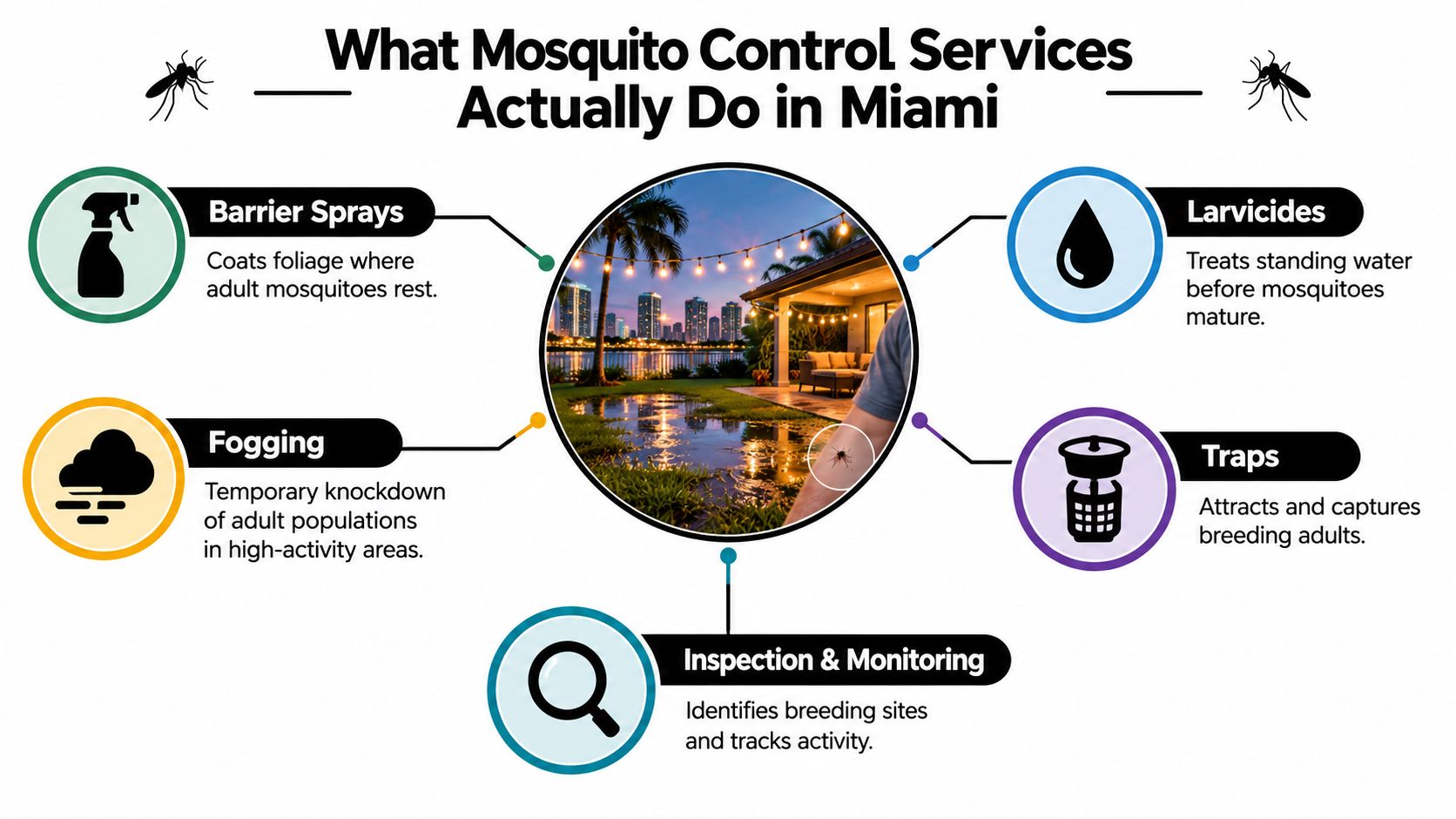
Miami weather makes coordination part of the job. Heavy rain can refill containers, dense landscaping can conceal breeding sites, and tidal or drainage conditions can create sources outside a homeowner's control. The history of mosquito management in the United States supports this layered approach. During the twentieth century, public-health programs combined habitat management with insecticide-based suppression, and federal and state agencies drained larval habitats beginning in 1930. The CDC's historical account shows why surveillance and continued response remain important after disease transmission has declined.
Responsibility must be clear. Homeowners should remove containers, correct drainage they control, and follow treatment instructions. HOAs should address shared courtyards, retention areas, and common landscaping. County agencies handle public drainage and mosquito sources beyond private property. A contractor should identify which party needs to act instead of treating only the easiest yard.
Practical rule: If a company discusses spraying but never asks about standing water, drainage, foliage, or neighboring sources, it is selling an appointment rather than a control program.
Buy a recurring plan with inspection and adjustment, not a promise that one visit will end mosquito activity. The provider should explain which method targets adults, which targets larvae, and which property conditions you must correct.
The Five Service Types Explained in Plain Language
Think of mosquito control as interrupting a production line. Water supports eggs and immature stages, while vegetation and shade give adult mosquitoes places to rest. Each service type interrupts a different part of that process.
Barrier sprays
A barrier treatment applies product to foliage, shaded edges, ornamental plants, and other areas where adult mosquitoes rest. A pergola covered with vines, a dense hedge beside the patio, or a damp side yard can all deserve attention.
Barrier sprays are useful for reducing adult activity around outdoor living areas, but they don't remove the breeding site. If rain creates new standing water, the next wave of adults can appear after the treated surface loses effectiveness.
Larvicides
Larvicides target immature mosquitoes in water before they become flying adults. A technician may inspect drain structures, plant saucers, neglected containers, catch basins, or a drainage easement that can't be emptied easily.
This is often the more intelligent choice when water is present but eliminating it isn't practical. The provider should identify the water source, explain why it needs treatment, and return to check whether the condition remains.
Misting systems
A misting system automates scheduled applications through fixed nozzles around a property. It can provide consistent coverage in selected areas, but installation doesn't solve poor drainage, missed habitats, or excessive application.
Treat the equipment as one tool, not the entire program. A system that runs on a timer without inspection can repeatedly treat the symptom while water continues producing mosquitoes.
Source reduction
Source reduction means removing the habitat itself. Emptying water from a plant saucer, clearing a roof gutter, correcting a low spot, turning over unused containers, or managing water held by bromeliads can reduce future emergence.
This is the step homeowners control most directly, and it's often the one providers underemphasize. If a technician doesn't point out specific sources, you won't know what to change between visits.
Trapping and monitoring
Traps attract or capture mosquitoes and help reveal where activity is concentrated. They're especially valuable for recurring hotspots, larger properties, and situations where residents keep reporting bites despite treatment.
A service such as Mosquito Control should be judged by whether it connects treatment to inspection and monitoring, not by the equipment name alone.
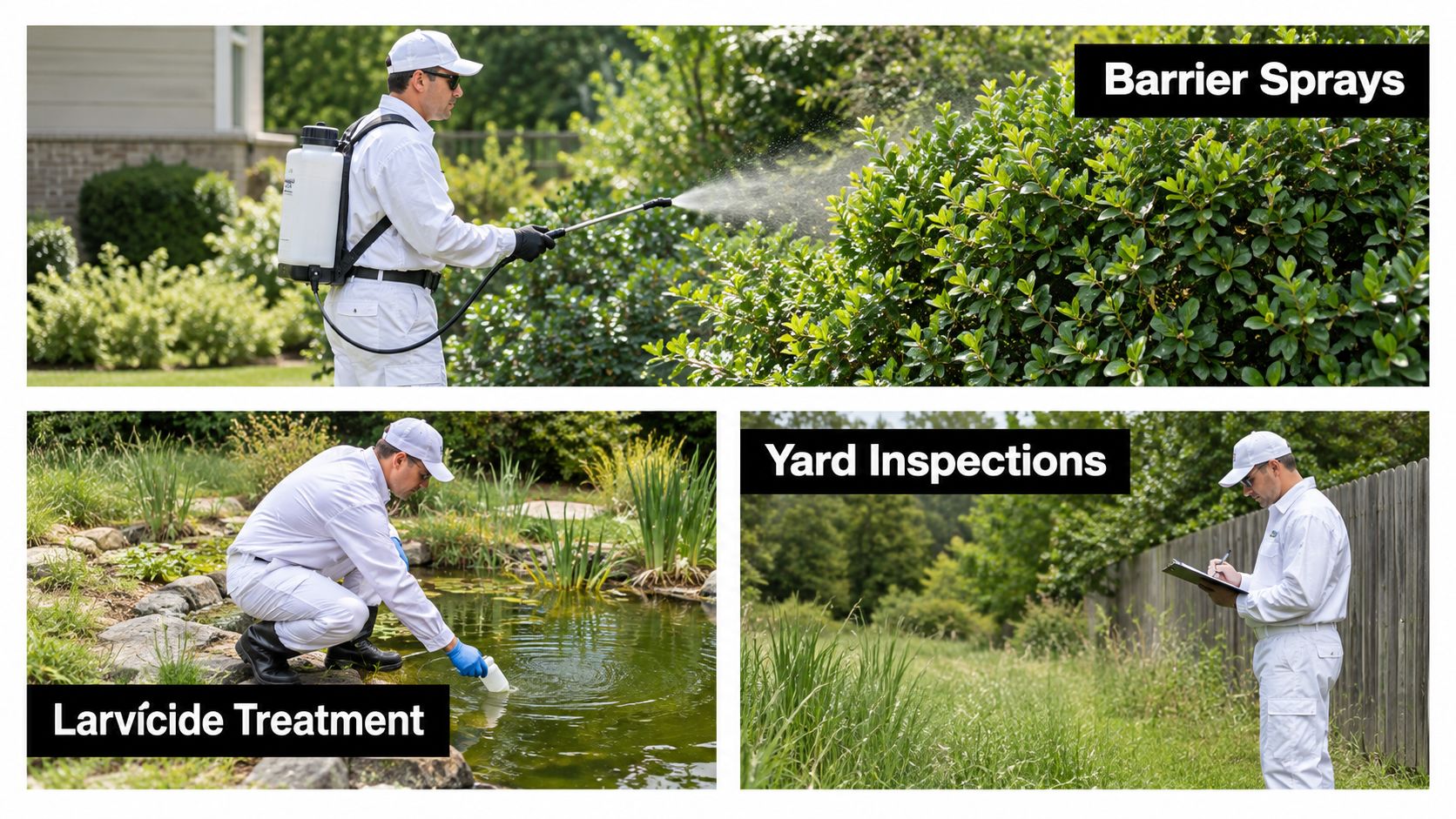
The right combination depends on the property. A small yard with dense foliage may need inspection, source correction, and targeted barrier treatment. A condo community may need shared-drainage work, resident reporting, and coordination with the association.
What Miami-Dade's County Program Tells You About Private Service
Private mosquito control should borrow its operating habits from public programs. Miami-Dade's county program uses more than 320 mosquito traps and combines trap information with resident service requests to guide inspections and surveillance, as described on the Miami-Dade mosquito inspections and surveillance page.
That model matters because it treats resident complaints as useful location data, not as vague inconvenience. If several people report activity near the same drainage feature, the response should focus there rather than sending every household the same generic spray.
A 2025 analysis found 66 mosquito-control programs operating across 67 Florida counties in 2023. The same analysis identified Miami-Dade, Palm Beach, and Broward as populous counties where mosquito control is managed by county governments. The point for private customers is straightforward: dense urban mosquito management requires organization, geographic targeting, reporting, and repeated field work.
A practical comparison
| Standard | County Program | Vetted Private Provider |
|---|---|---|
| Surveillance | Uses traps, service requests, and field inspections | Records mosquito activity, recurring complaints, and inspection findings |
| Geographic targeting | Prioritizes locations based on data | Adjusts treatment to property layout and known hotspots |
| Source management | Addresses public or shared breeding conditions where applicable | Identifies private sources and assigns correction steps |
| Documentation | Maintains operational and program records | Provides treatment details, dates, target areas, and follow-up notes |
| Escalation | Coordinates with public agencies and residents | Tells the customer when an HOA, landlord, county, or neighbor must act |
Ask a private provider whether it records where mosquitoes are found, what life stage is present, and what changed after treatment. A company that can't answer those questions is working without the feedback loop that makes county-scale programs effective.
A professional visit should leave you with information, not just a wet driveway and a new appointment date.
Homeowners should also report persistent public-area problems through the appropriate Miami-Dade channel. Private treatment can protect a yard, but it can't repair a blocked public drain or compel an abandoned property owner to remove water-holding debris.
Costs and Service Frequency You Should Plan For
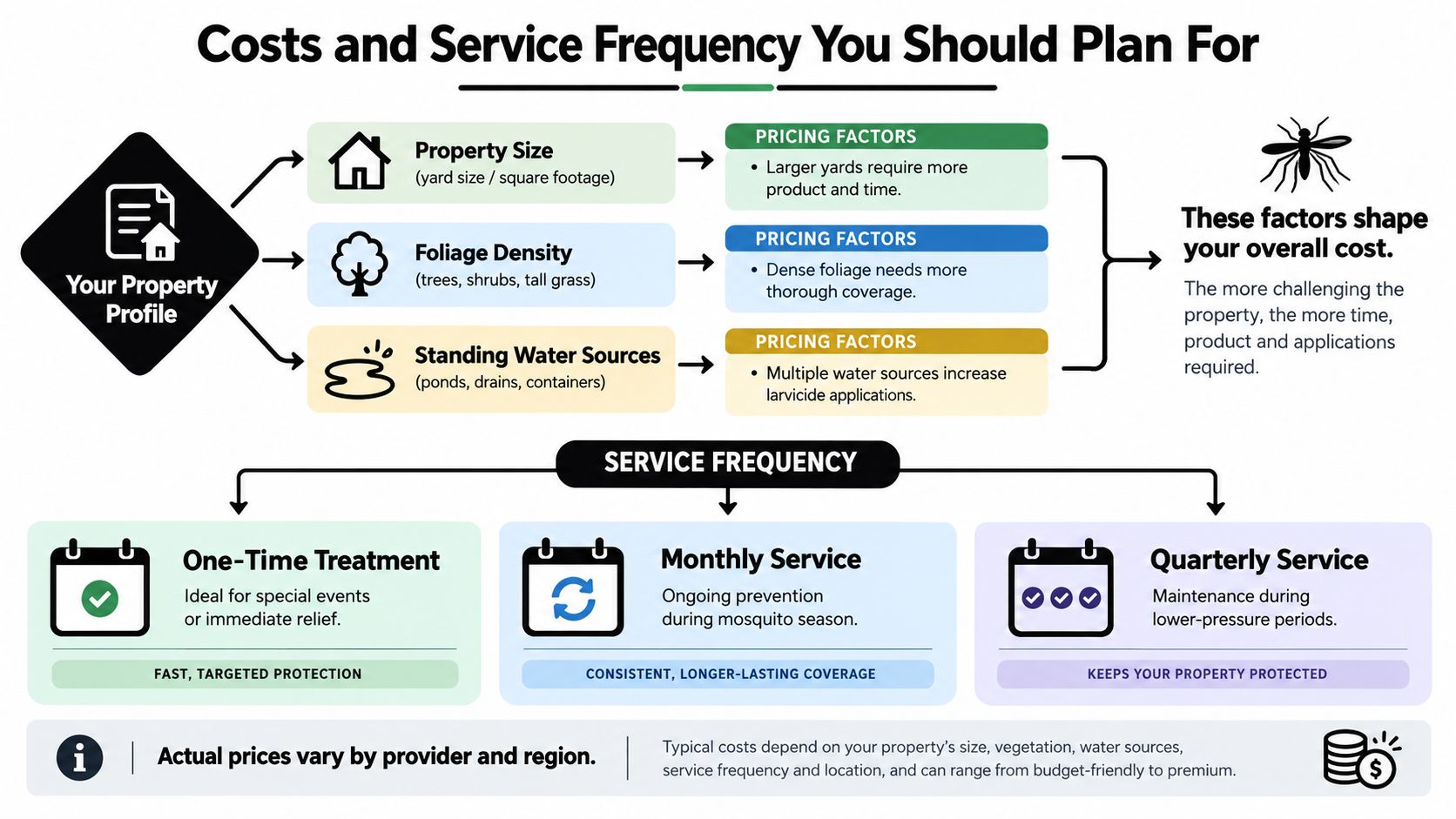
A Miami homeowner planning a backyard gathering may need one treatment for short-term relief. A property manager overseeing shaded common areas, drains, pools, and multiple structures needs a recurring program with inspections. Mosquito control is a continuing maintenance expense, and the price depends on site conditions, treatment methods, and the amount of work each visit requires.
A compact, open yard takes less time to inspect and treat than a large property with dense planting, shaded corridors, water-holding plants, pools, drains, and several structures. Ask contractors to price the actual service area, inspection work, target zones, and follow-up responsibilities rather than quoting only by lot size.
Barrier spraying often runs on a recurring schedule during periods of heavy outdoor use. Yard size, foliage density, obstacles, and the amount of edge coverage affect labor. A one-time treatment can help before an event, but it does not provide lasting prevention when breeding sources remain.
Larval treatment follows a different schedule. Technicians may need to return after rain, inspect persistent water sources, or replace treatment in areas that cannot be drained. Visit frequency depends on the number of breeding sites and whether the owner corrects drainage, container, or maintenance problems.
Match the service to the property
- One-time treatment: Good for a gathering or immediate relief, with limited value if breeding sites remain.
- Recurring barrier service: Suited to yards used regularly when adult mosquito pressure returns between visits.
- Targeted larval service: Useful where persistent water sources cannot be removed immediately.
- Installed misting equipment: A larger equipment commitment that still requires inspection and responsible servicing.
- Monitoring and trapping: Helpful when activity is localized, persistent, or difficult to explain.
Property managers and HOA boards should separate treatment costs from infrastructure costs. Clogged gutters, poor grading, standing water in shared areas, and unmanaged drainage can create a repeating service bill. Assign those corrections to the homeowner, HOA, property manager, or county agency with authority over the source.
Site complexity drives labor, inspection time, and visit frequency for any outdoor service, and mosquito control is no exception. Prestonwood's commercial maintenance pricing guide provides useful context for matching service requirements to site scope.
Use this mosquito control service cost guide to organize questions before accepting a recurring proposal. Confirm whether follow-up inspections, water-source treatment, documentation, and callbacks are included or billed separately.
South Florida's warm conditions can support mosquito activity through much of the year. Plan for continuing service, then reduce unnecessary visits by correcting water sources and requiring targeted treatment.
Integrated Mosquito Management and What Good Service Looks Like
Integrated Mosquito Management, or IMM, is the standard I'd expect from a credible provider. It combines surveillance, mapping, source reduction, larval and adult treatment, resistance testing, public education, and post-treatment evaluation. The CDC's IMM guidance supports this approach instead of routine adulticide spraying by itself.
The biology explains why. Eggs, larvae, and pupae develop in water, while adult mosquitoes emerge and seek resting areas and hosts. Removing water interrupts the cycle early. Larviciding addresses immature mosquitoes where the habitat remains, and adulticide treatment addresses mosquitoes that have already emerged.
Questions to ask before treatment
- Where did you find breeding habitat? The technician should identify containers, drains, gutters, plant structures, or other water sources.
- Which life stage are you targeting? The answer should connect the product and method to larvae or adults.
- What active ingredient and formulation will you use? You should receive a clear treatment record.
- How will you check efficacy? Follow-up surveillance is more meaningful than a fixed calendar promise.
- What should I correct? A provider should give specific property instructions, not general reminders.
Good documentation includes the target area, equipment, treatment timing, weather, observed mosquito stage, and the product used. You can also use this mosquito control equipment guide to understand why tools such as traps, sprayers, and larvicide applicators serve different purposes.
Resistance changes the treatment decision. Repeated exposure can reduce mosquito susceptibility to an insecticide, but poor dilution, calibration, timing, coverage, weather, or untreated habitat can produce the same apparent failure. The CDC resistance guidance recommends routine resistance and efficacy testing, including testing at least annually and before the next mosquito season, with attention to insecticides used during the previous five years.
A fixed-duration guarantee is a warning sign. Weather, flooding, tides, inaccessible habitat, and missed breeding sites can all change the result.
When mosquitoes return, the provider should inspect and diagnose the recurrence. Repeating the same spray without checking the cause is not IMM.
Why Your Yard May Not Be the Whole Problem
You can empty every container on your property and still get bitten. Mosquitoes cross property lines, so a clean yard may sit beside an unmanaged lot, shared drain, construction area, roof gutter, or stormwater structure that keeps producing adults.
A 2025 review connects mosquito abundance with temperature, rainfall, humidity, water quality, pollutants, artificial light, urbanization, inadequate housing, socioeconomic vulnerability, and irregular water supply. Separate 2025 research reported an 87.5% increase in urban Aedes aegypti density over two decades, with warmer conditions associated with roughly 50% longer mosquito lifespan and 50% greater egg production. The review and related research record reports these findings.
Assign responsibility instead of guessing
- Homeowner: Empty containers, manage plant saucers and bromeliads, clear private gutters, correct small drainage issues, and provide inspection access. For a closer look at common containers and plants, use this guide to mosquito breeding grounds.
- Landlord or property manager: Coordinate treatment across rental units, shared grounds, vacant spaces, and maintenance vendors.
- HOA or condo board: Address common grounds, shared drains, courtyards, roof systems, and resident communication.
- County or public-health program: Report unusually high populations or suspected sources in public spaces, drainage infrastructure, abandoned properties, or areas outside private control.
- Neighboring owner or contractor: Correct a source beyond your boundary that continues affecting your property.
Recurring flooding requires a water-management fix before another spray. A practical guide on fix yard drainage to protect your home can help you frame the issue for a drainage contractor. Mosquito companies can treat some conditions, but pesticide will not correct failed grading or stormwater infrastructure.
Keep a simple log before requesting help:
- Date and location of bites or visible activity
- Recent rain, flooding, or high-tide conditions
- Time of day when mosquitoes are most noticeable
- Repeating hotspots, such as one hedge, drain, or courtyard
- Service dates, products, and areas treated
- Photos of standing water or inaccessible sources
Give the record to the provider, HOA, landlord, or county program. Precise location details show whether the source belongs to your property, a shared area, a neighboring parcel, or public infrastructure. That assignment determines who must act and prevents repeated treatment of the wrong place.
How to Choose a Vetted Mosquito Control Contractor in Miami
Start with licensing and insurance. Ask for the Florida pest-control license information, current proof of insurance, and the name of the person responsible for the inspection. Don't accept “our technician is trained” as a substitute for documentation.
Next, ask for the service plan in writing. It should describe inspection, source reduction recommendations, larval and adult treatment decisions, follow-up, callback handling, and the records you'll receive. A provider that promises a fixed result without discussing weather, water, or neighboring sources is not setting realistic expectations.
Use this hiring checklist
- Inspection: Will the technician walk the property and identify specific breeding locations?
- Treatment logic: How does the company choose between source reduction, larvicide, barrier treatment, and adulticide?
- Product records: Will the report identify the active ingredient, formulation, application area, and timing?
- Resistance awareness: Does the company use local efficacy information and avoid blindly repeating one product?
- Follow-up: What happens if activity returns, and will the next visit include diagnosis?
- Coordination: Will the provider tell you when the HOA, county, landlord, or neighbor must act?
- Safety: What instructions will residents, pets, and workers receive before re-entering treated areas?
CDC guidance recommends routine resistance and efficacy testing, including testing at least annually and before the next mosquito season, while considering insecticides used during the previous five years. That doesn't mean every residential customer needs a laboratory report at the door. It does mean a serious contractor should understand resistance and application quality rather than treating every failure as a reason to spray more.
For broader contractor-screening habits, these tips for choosing a contractor offer a useful reminder to verify credentials, scope, insurance, and written expectations.
| Situation | Best first move |
|---|---|
| A few containers or plant saucers | DIY source reduction and monitoring |
| Persistent activity around your private yard | Licensed, insured mosquito provider |
| Shared drains, common landscaping, or condo courtyards | HOA or property manager coordination |
| Public land, drainage infrastructure, or unusually high neighborhood activity | County mosquito-control or health authority report |
Pestless Inc. connects Miami and Miami-Dade residents with licensed, insured pest-control professionals, but it doesn't perform treatments itself. That distinction matters. You're still responsible for comparing the provider's inspection method, documentation, and follow-up plan.
Seasonal Timing and Habits That Keep Mosquito Service Working
Miami doesn't offer a dependable long winter break from mosquito planning. Rain can create fresh breeding sites quickly, warm conditions can keep activity moving, and king tides or flooding can introduce water problems that weren't present during the last visit.
Use a simple maintenance rhythm:
- Empty plant saucers, toys, buckets, and other containers after rain.
- Inspect bromeliads and similar plants regularly for trapped water.
- Clear roof gutters and downspouts before they become breeding sites.
- Walk shared landscaping with the property manager or HOA.
- Recheck drainage after heavy rain, flooding, or king tides.
- Keep a service log with dates, treatment areas, observations, and callbacks.
- Report recurring public or neighboring sources instead of treating only your own yard.
The most useful seasonal question isn't “When does mosquito season start?” It's “What changed since the last inspection?” A storm, landscaping project, clogged drain, vacant property, or new construction area can change the risk faster than a calendar can.
Choose a provider that inspects, documents, and adjusts. Your job is to remove the sources you control, preserve useful records, and escalate problems that belong to shared property or public infrastructure. That's how mosquito control becomes a durable property-management habit instead of an endless sequence of emergency sprays.
Pestless Inc. connects Miami and Miami-Dade homeowners, landlords, and property managers with licensed, insured pest-control professionals for mosquito concerns and other household pest problems. Visit Pestless Inc. to describe your situation, compare a local service option, and request a no-obligation introduction.
Dealing with this pest right now?
Pestless connects you with a licensed, insured Miami pest control provider for a free, no-obligation quote.