Most Miami homeowners first notice a bug on a wall late at night, then spend far too long trying to name it. A roach near a drain, ants following a baseboard, or a mosquito resting beside a window can look similar at first glance, but the correct fix may involve bait, sealing, moisture repair, or a professional inspection. This guide sorts eight common insects on walls by identity, health concerns, structural risk, and urgency, so you can decide whether sanitation, a caulk gun, or a licensed pro is the right next step.
The wall itself provides useful evidence. Note the insect's size and color, whether it's moving in a trail or appearing alone, the room where you found it, nearby water or food, and whether sightings increase after rain or during cooler weather. For broader home planning, homeowners can also use landscape software for homeowners to identify vegetation, drainage, and outdoor conditions that may be contributing to pest pressure.
Table of Contents
- 1. American Cockroach “Palmetto Bug” Identification and Control
- 2. German Cockroach Identification and Control
- 3. Formosan Subterranean Termite Identification and Control
- 4. West Indian Drywood Termite Identification and Control
- 5. Ghost Ant Identification and Control
- 6. Mosquitoes Including Aedes aegypti and Culex Species
- 7. Bed Bug Identification and Control
- 8. Florida Carpenter Ant Identification and Control
- Identification & Control: 8 Wall Insects Compared
- Turning a Wall Sighting Into a Clear Action Plan
1. American Cockroach “Palmetto Bug” Identification and Control
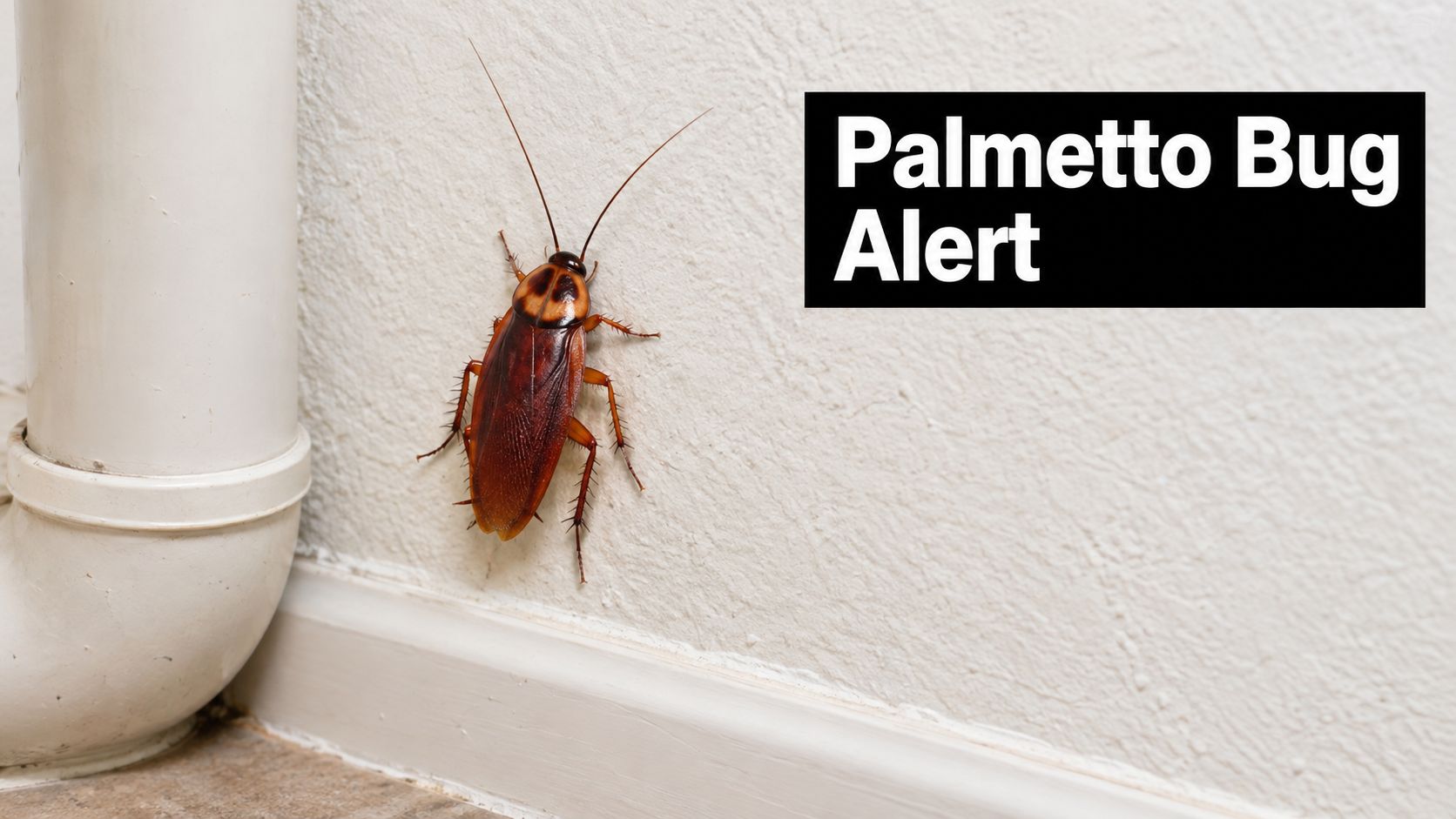
A large, reddish-brown roach moving across a Miami wall is often the palmetto bug, the common name for an American cockroach. It may enter through a drain, garage, utility opening, or gap near a bathroom or kitchen. One visitor is usually an access problem. Repeated sightings raise the urgency because they can point to damp voids, plumbing gaps, or shared building chases.
The wall route provides useful evidence. American cockroaches usually follow corners, baseboards, pipes, appliances, and thresholds instead of crossing open rooms. Place numbered, dated sticky traps near food, water, heat-producing appliances, plumbing, and suspected hiding places. Replace them when they become wet, dusty, or covered, according to its monitoring guidance.
What to fix first
Start with moisture and entry routes. A room-wide spray may kill visible insects while leaving the source untouched.
- Use targeted bait: Apply small gel-bait dots behind appliances, under sinks, beside baseboards, and near drains. Keep bait away from surfaces washed frequently.
- Remove water sources: Repair leaking pipes, AC condensate lines, and damp cabinet floors. Persistent moisture supports continued activity.
- Seal movement routes: Caulk gaps around pipes, outlets, door thresholds, and wall penetrations.
- Reduce sewer access: Run water through rarely used drains and keep drain covers in place when practical.
- Improve sanitation: Seal trash, remove food debris, and avoid leaving standing water overnight.
These steps address nuisance visitors and reduce conditions that support breeding. A licensed provider may still need to inspect wall voids or plumbing chases that homeowners cannot reach. Cockroach Control focuses on breaking the breeding cycle, not only removing visible roaches. For identification and treatment considerations, review this guide to palmetto bug control.
2. German Cockroach Identification and Control
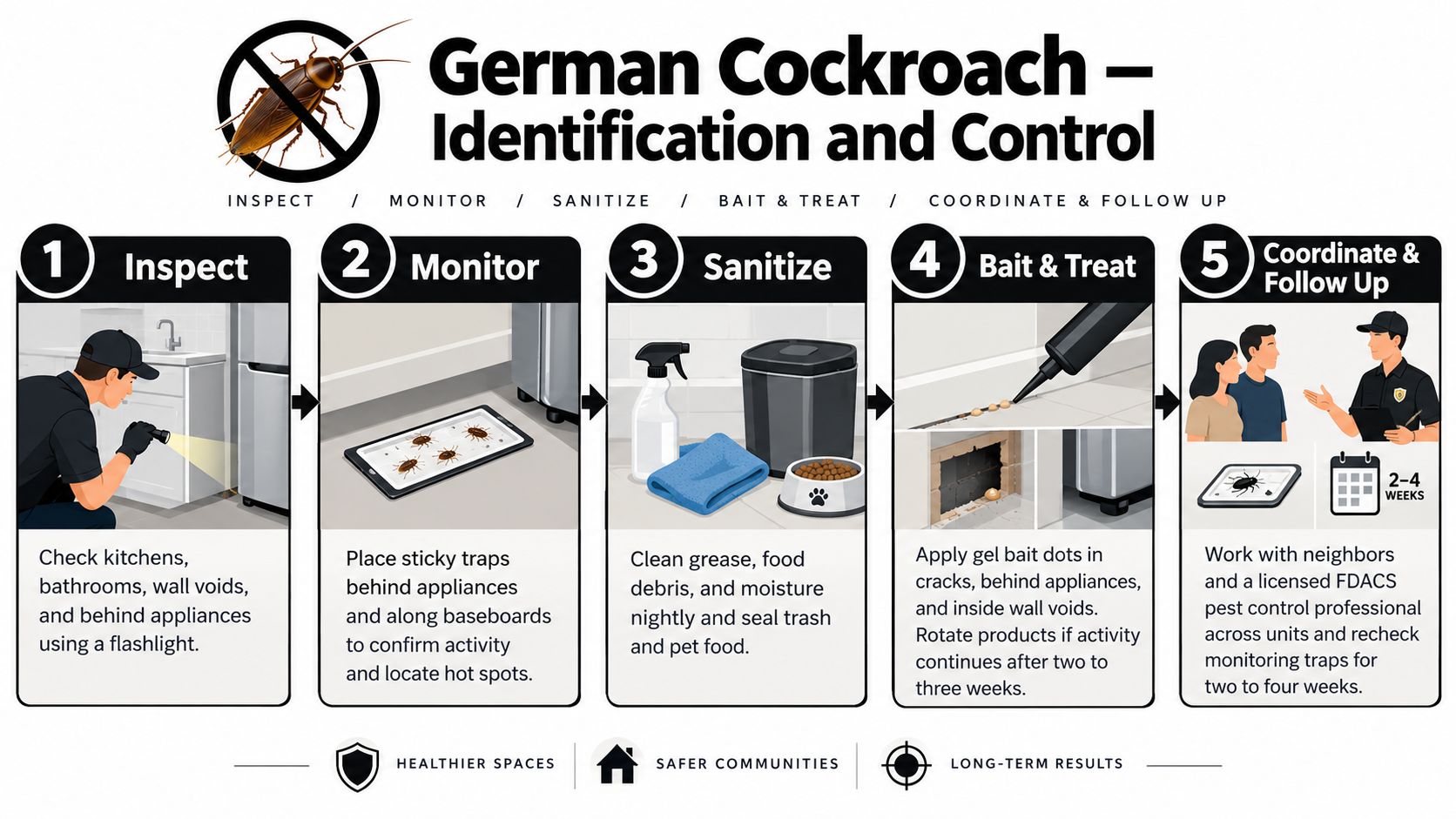
German cockroaches are smaller and lighter than palmetto bugs, with two dark stripes behind the head. In Miami homes, they're most often associated with kitchens, bathrooms, appliance motors, cabinets, and wall voids. Unlike many large outdoor-invading roaches, German cockroaches usually establish indoors, so a sighting behind a refrigerator deserves more attention than one near an open patio door.
Use monitoring to determine whether the wall sighting is isolated. Place sticky traps behind the refrigerator, beneath the sink, beside the stove, and near utility penetrations. A Florida field study found that pheromone sticky traps captured an average of 19.2 cockroaches per trap, compared with 7.2 for baited glass-jar traps, and sticky traps accounted for 73% of total captures in that study published monitoring research. Capture counts don't measure the full infestation, but they can show which room and edge are active.
Why apartment treatment can fail
Treating one kitchen while an adjoining unit remains untreated often produces temporary relief. German cockroaches can move through shared walls, plumbing penetrations, appliance spaces, and service openings. Property managers should document activity by unit and coordinate inspections where repeated sightings continue.
At home, remove grease from stovetops, cabinet edges, and appliance sides. Inspect secondhand appliances and furniture before bringing them inside. Don't spray repellent insecticide across an active trail if a technician plans to use bait, because contamination can make the bait less attractive and push insects into less accessible voids.
Practical rule: Two or three weeks of continuing activity after baiting calls for a treatment review, not an automatic increase in spray.
The same inspection discipline matters when other biting pests are present. A mosquito service such as Mosquito Control addresses a different pest and shouldn't be substituted for German cockroach monitoring. If activity persists, a licensed professional can rotate appropriate products, inspect neighboring areas, and check whether sanitation or building conditions are undermining the treatment.
3. Formosan Subterranean Termite Identification and Control
Small winged insects emerging from a wall, window frame, or light fixture can signal a termite problem rather than a harmless flying ant. Formosan subterranean termites are especially concerning because they can remain hidden in wall cavities and structural wood. Swarmers, discarded wings, mud tubes, or repeated activity around framing justify a licensed inspection.
The first response shouldn't be a household aerosol. Collect a few insects or photograph them beside a ruler, then note exactly where they emerged. A professional needs to distinguish termites from winged ants and determine whether the colony is associated with soil, plumbing moisture, wall voids, or damaged structural wood.
Protecting the building
Correcting moisture improves the building but won't replace termite treatment. Repair leaks, improve drainage, and keep wood debris and firewood away from the foundation. Avoid allowing mulch or soil to contact vulnerable wood components, and maintain visible access for future inspections.
Treatment choices depend on construction, access, moisture, and the distribution of activity. Ask whether a bait system or liquid barrier is appropriate, and confirm that the provider holds the required Florida termite credentials. Homebuyers and sellers should request a licensed Wood-Destroying Organism inspection before closing so hidden activity and damage can be documented.
For a broader species comparison, review this explanation of types of termites in Florida.
A wall emergence is more urgent when you also find wings on a sill, hollow-sounding wood, mud tubes, or repeated swarmers in more than one room. Don't open walls or disturb suspected galleries before an inspection. Preserving the evidence can help the technician trace the route and choose a treatment that reaches the colony rather than only the insects visible on the surface.
4. West Indian Drywood Termite Identification and Control
Drywood termites create a different pattern from subterranean termites. They live inside dry wood and don't need a soil connection, so activity may appear in a window frame, door trim, attic member, piece of furniture, or wall stud. The most recognizable clue is often a small pile of hard, pellet-like droppings beneath a tiny kick-out hole.
Check window sills, baseboards, door frames, and trim where pellets collect. Brush the material away and photograph the location, but don't assume the problem is limited to the spot you can see. Drywood colonies can occupy wood elsewhere in the structure, and pellets may fall through concealed gaps before appearing on a sill.
Local treatment versus broader treatment
Localized treatment may make sense when an inspection identifies a confined piece of trim or furniture. A widespread problem can require a broader plan, such as whole-structure treatment or monitored heat treatment. The trade-off is straightforward: a narrow treatment may reduce disruption when the infestation is strictly limited, while a broader approach may be necessary when multiple areas contain activity.
Don't bring untreated used furniture or reclaimed wood indoors without a careful inspection. Look for pellets, kick-out holes, blistered finishes, and small swarming insects. Seal cracks and damaged wood where practical, but don't caulk over active evidence before the source is identified.
Sunlight and ventilation may make some exposed wood less favorable, but they won't eliminate termites inside enclosed framing. A licensed professional should inspect the attic, wall edges, frames, and connected wood before you choose between localized treatment and a structure-wide option.
5. Ghost Ant Identification and Control
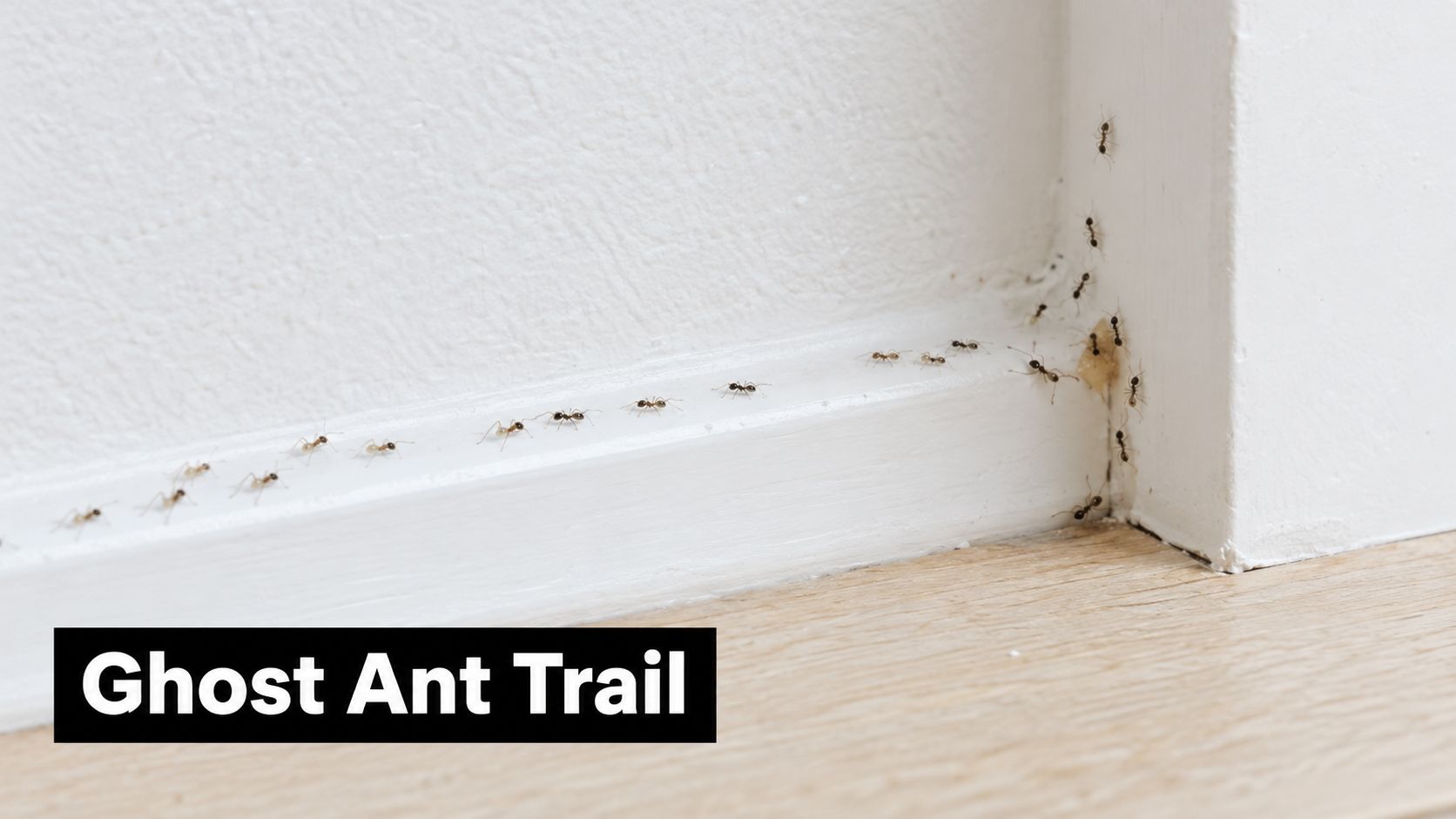
Ghost ants are tiny, with dark heads and pale, almost translucent bodies. In Miami homes, they commonly form visible trails along walls, baseboards, counters, window edges, and cabinet seams. Their small size lets them use gaps around pipes, outlets, window frames, appliances, and wall finishes that larger insects can't easily access.
A steady trail matters more than a single ant. Repeated workers moving along the same edge suggest a food route and may indicate a nest in a wall void, appliance, insulation, or nearby sheltered space. Extension guidance distinguishes accidental entry through cracks from ants repeatedly traveling along wall edges, which is more suggestive of indoor nesting or an established route in its ant guidance.
Bait works better than chasing trails
Repellent spray often creates a frustrating result. It can kill exposed workers while disturbing the trail and causing the colony to split or relocate. Bait gives workers something they can carry back to hidden nest members, but it requires patience and careful placement.
- Match the bait: Try sugar-based or protein-based bait according to what the ants are accepting.
- Leave trails undisturbed: Don't spray or scrub directly over an active bait route.
- Remove competing food: Clean syrup, pet food, grease, and sticky residues promptly.
- Seal after activity falls: Close gaps around windows, pipes, outlets, and baseboards once the route is understood.
- Protect the bait: Keep it away from cleaning products and areas where children or pets can reach it.
If activity keeps shifting from room to room, inspect moisture and exterior vegetation as well as indoor food sources. A practical guide to the sequence is how to get rid of ghost ants. The goal isn't to kill every visible ant immediately. It's to let the colony encounter the treatment while removing the conditions that keep drawing workers inside.
6. Mosquitoes Including Aedes aegypti and Culex Species
A mosquito resting on an interior wall usually came from a nearby entry point or breeding source. Check screens, doors, shaded patios, garages, bathrooms, and areas near indoor plants. The wall is a resting surface, not usually the breeding site.
Aedes aegypti is a daytime-active mosquito associated with transmission of dengue, Zika, chikungunya, and yellow fever. That makes repeated biting a health concern, particularly when activity persists around the home. Culex species can follow different resting and breeding patterns, so identification helps determine which outdoor sources deserve attention.
Remove the water before treating the wall
Spraying an adult mosquito may provide short-lived relief, but it won't solve a breeding container outside. Walk the property after rain and inspect:
- Plant saucers and buckets: Empty and scrub them regularly.
- Pet bowls and bird baths: Replace water and clean the surfaces.
- Gutters and drains: Remove debris that holds water.
- Pool covers and tarps: Tighten or drain sagging areas.
- Screens and vents: Repair tears and close gaps around frames.
Miami-Dade County's Mosquito Control Division conducts source-reduction inspections and larviciding in neighborhoods with identified breeding sites. Homeowners can contact the division for guidance on local programs and suspected breeding locations. Use EPA-registered repellent and protective clothing when biting continues, especially during periods of high outdoor activity.
A single mosquito on a wall isn't proof of a household infestation. A pattern of bites, repeated indoor sightings, and standing water nearby deserves a source inspection before relying on interior chemical treatment.
7. Bed Bug Identification and Control
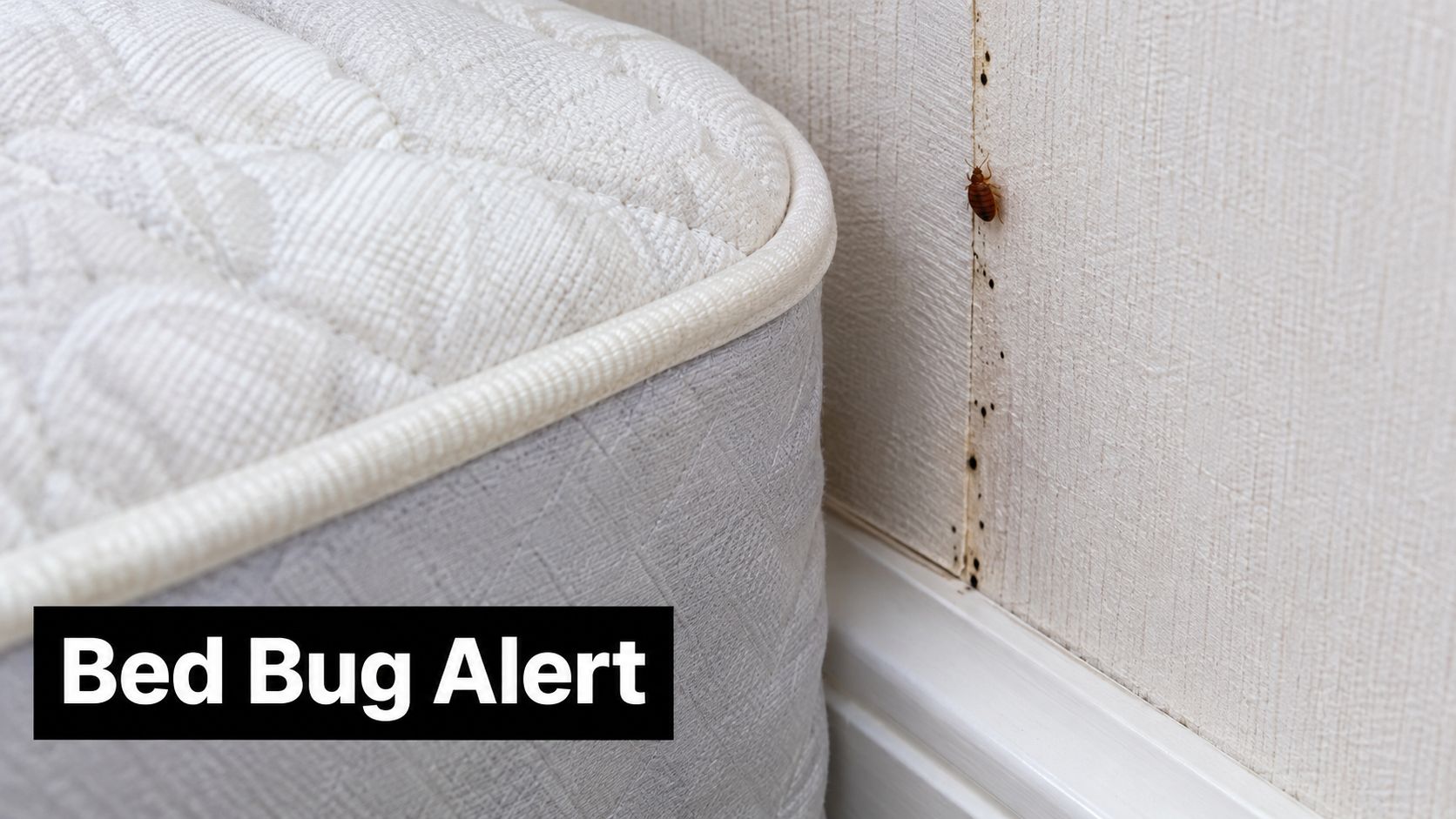
Bed bugs are small, wingless insects that hide in seams, cracks, baseboards, picture frames, outlet areas, and wall gaps. They emerge at night to feed, so a wall sighting near a bed, sofa, headboard, or sleeping area deserves a careful inspection even if the mattress looks clean.
Look for live insects, dark spotting, pale shed skins, eggs, and cast skins around mattress seams, bed frames, headboards, baseboards, and outlet covers. Bites alone don't identify bed bugs, because skin reactions vary and can resemble other causes. Capture a specimen with clear tape or a container when possible instead of crushing it and losing the evidence.
Containment matters
Wash bedding and clothing in hot water when suitable for the fabric, then use high heat in the dryer. Vacuum seams, cracks, and baseboards, and empty the vacuum outdoors. Mattress and box-spring encasements can help isolate hiding places, while interceptor traps can provide useful monitoring around bed legs.
Avoid foggers. They may disperse bed bugs into new hiding areas and rarely reach the protected cracks where the insects remain. In apartments, condominiums, hotels, and short-term rentals, nearby units may need inspection because treating one room without addressing connected spaces can allow reinfestation.
Do not move infested furniture to another room. That often spreads the problem before treatment begins.
Professional treatment commonly requires inspection, preparation, an appropriate treatment method, and follow-up visits. If you're comparing protection options, review this guidance on encasement pairing advice. A licensed provider can also determine whether the insect is a bed bug rather than a carpet beetle, bat bug, or another look-alike.
8. Florida Carpenter Ant Identification and Control
Florida carpenter ants are large ants that excavate galleries in damp or damaged wood. They don't eat wood like termites, but their nesting can weaken already compromised areas. In Miami homes, wall sightings deserve extra attention near window frames, eaves, roof leaks, plumbing penetrations, and AC condensate lines.
Follow the trail rather than killing the first worker. Look for sawdust-like debris, soft wood, faint rustling, and entry points where branches or vines touch the structure. Ants emerging near a damp window frame may be using a moisture-damaged void, while ants appearing around a dry interior wall may be traveling from a nest elsewhere.
Moisture repair comes first
A bait-only approach often fails if the nest remains protected and the moisture source continues. Repair roof and plumbing leaks, correct AC condensate drainage, replace damaged wood, and improve drainage around the affected wall. Trim branches and shrubs that touch the house, and keep firewood away from the structure.
- Trace activity: Follow trails during active periods and mark the route.
- Inspect wood: Check frames, eaves, trim, and wall edges for damage.
- Correct moisture: Repair leaks before sealing the suspected route.
- Use targeted control: Baiting and exclusion can work together when the nest location is uncertain.
- Escalate hidden activity: A professional may need to inspect cavities without opening unnecessary sections of wall.
Carpenter ants found indoors during colder periods can be more concerning because they may indicate a nest inside the building rather than an outdoor visitor as extension guidance explains. For visual identification details, see these nesting signs of carpenter ants. Fixing the leak is essential, but it isn't a substitute for locating and treating an established colony.
Identification & Control: 8 Wall Insects Compared
| Pest | Implementation Complexity 🔄 | Resource Requirements ⚡ | Expected Effectiveness ⭐ | Typical Outcomes 📊 | Ideal Use Cases & Key Advantages 💡 |
|---|---|---|---|---|---|
| American Cockroach ("Palmetto Bug") | Medium, requires baiting, exclusion, plumbing access; sewer sources complicate control 🔄 | Moderate, gel baits, IGRs, sanitation, moisture repair; pro inspection for wall voids ⚡ | ⭐⭐⭐, effective with combined baiting + exclusion but recolonization risk | Reduced indoor sightings within weeks; may need repeated or coordinated treatments due to sewer/drain recolonization 📊 | Best for wall/drain-associated infestations; low-odor gel baits and moisture correction are practical advantages 💡 |
| German Cockroach | High, rapid reproduction and indoor persistence; needs coordinated IPM across units 🔄 | Moderate–High, gel baits, monitoring traps, IGRs, thorough sanitation; professional coordination often required ⚡ | ⭐⭐⭐⭐, very responsive to proper baiting/monitoring but insecticide resistance possible | Fast population drops if treated correctly; untreated neighboring units often cause reinfestation 📊 | Ideal for kitchens/bathrooms in multifamily settings; monitoring traps enable early hotspot detection 💡 |
| Formosan Subterranean Termite | High, large, hidden colonies; requires licensed termite inspection and complex treatments 🔄 | High, bait systems or liquid termiticide barriers, structural repairs, licensed professionals; WDO inspections ⚡ | ⭐⭐⭐⭐, effective when detected early; elimination challenging for large, extensive colonies | Early detection prevents major structural damage; delayed discovery often leads to costly repairs 📊 | Critical for structural protection and real-estate inspections; professional bait/barrier systems offer long-term control 💡 |
| West Indian Drywood Termite | Medium–High, infestations can be localized but detection is difficult; whole-structure treatment disruptive 🔄 | High, spot injections possible; heat or structural fumigation may be needed; professional thermal monitoring ⚡ | ⭐⭐⭐⭐, targeted treatments effective for localized infestations; fumigation/heat reliably eradicates whole-structure infestations | Localized elimination common; whole-structure treatments are disruptive but can be curative 📊 | Suited for furniture/trim infestations; heat/fumigation useful when infestation is widespread within a structure 💡 |
| Ghost Ant | Medium, trail tracking and baiting required; repellents can worsen spread due to colony splitting 🔄 | Low–Moderate, sugar/protein baits, sealing entry points, monitoring; pro help if nests in wall voids ⚡ | ⭐⭐⭐, baits effective but colonies can relocate or split, requiring patience (weeks) | Activity typically declines over 1–3 weeks with baits; improper sprays may cause dispersion 📊 | Effective with bait stations and exclusion; early baiting prevents colony expansion and spread between units 💡 |
| Mosquitoes (Aedes aegypti, Culex spp.) | Low–Medium, source reduction simple; adulticide spraying gives short-term relief 🔄 | Low, remove standing water, Bti larvicides, screens, repellents; public vector control support helpful ⚡ | ⭐⭐⭐⭐, source reduction + larviciding highly effective; neighbors' sites limit complete control | Significant biting reduction when breeding sites are removed; continuous maintenance required 📊 | Best for public-health prevention; inexpensive source reduction and targeted larvicides reduce disease risk 💡 |
| Bed Bugs | High, cryptic hiding, requires multi-session IPM and often professional heat treatments 🔄 | High, heat treatment, encasements, repeated inspections, vacuuming, professional services ⚡ | ⭐⭐⭐⭐, very effective with coordinated professional heat/IPM; resistance and hiding complicate DIY attempts | Multiple treatments usually required; early intervention prevents spread to adjacent units 📊 | Ideal for multifamily, hotels, rentals; heat and encasements provide rapid, reliable elimination when applied correctly 💡 |
| Florida Carpenter Ant | Medium, locating nests in wall voids is difficult; moisture correction essential 🔄 | Moderate, baits, moisture/wood repair, exclusion; pros may be needed to find hidden nests ⚡ | ⭐⭐⭐, effective if nests found and moisture sources fixed; satellite nests may persist | Foraging reduced and structural risk lowered after moisture remediation; follow-up often needed 📊 | Best addressed by combining moisture repair with baiting; prevents long-term wood damage when detected early 💡 |
Turning a Wall Sighting Into a Clear Action Plan
Start with the pattern, not the insect alone. A single mosquito near a screened door or one large roach beside a drain may reflect incidental entry. Repeated ants along a baseboard, multiple roaches around plumbing, or insects emerging from a wall suggests the building is providing a route, food source, moisture source, or protected harborage.
For health-related concerns, prioritize mosquitoes and bed bugs differently. Mosquito control begins outside with standing-water removal, screens, and source reduction. Bed bug control depends on containment, careful inspection, laundering, monitoring, and coordinated treatment. Don't rely on bite appearance alone to identify either pest.
For structural concerns, termites and carpenter ants deserve the fastest escalation. Termite swarmers, discarded wings, mud tubes, pellet piles, soft wood, and recurring ants near damp framing should prompt a licensed inspection. Moisture correction protects the building, but it won't by itself eliminate termites or a concealed carpenter-ant colony.
For nuisance and recurring indoor activity, roaches and ghost ants usually require a combination of sanitation, exclusion, monitoring, and targeted baiting. The EPA estimates that approximately 20% of American households, about 16 million homes, had interiors commercially treated for pests such as cockroaches, ants, or fleas, and reports that 75% of U.S. households used at least one pesticide product inside the home in its national home-and-garden survey. Those figures show how common household pest management is, but they don't mean every wall sighting requires immediate chemical treatment.
Season changes the interpretation. Boxelder bugs may gather on sun-warmed exterior walls while seeking sheltered overwintering locations, while foreign grain beetles can emerge from moist wall voids in newer construction and appear around baseboards, sockets, and ceiling fixtures according to Oregon State and University of Minnesota Extension guidance. The wall may be where you notice the insect, not where the problem began.
Use a simple escalation rule:
- One insect near a window or door: Photograph it, check screens and seals, and monitor.
- A repeated trail or recurring sightings: Deploy location-specific monitors and inspect moisture, food, plumbing, and wall openings.
- Swarmers, frass, mud tubes, or damaged wood: Arrange a licensed termite or structural pest inspection.
- Bites or insects near sleeping areas: Contain fabrics and furniture, avoid foggers, and seek professional identification.
- Activity in a shared building: Notify the landlord, property manager, or association so connected units and wall chases can be considered.
If you want a quote without pressure, Pestless connects Miami-Dade homeowners with licensed, insured pest professionals for free, no-obligation quotes. Pestless doesn't perform treatments itself. It facilitates introductions so homeowners, landlords, property managers, and buyers can compare local options and choose a provider suited to the pest and building.
Pestless Inc. connects Miami and Miami-Dade homeowners with licensed, insured pest professionals for issues including wall roaches, termites, ants, mosquitoes, and bed bugs. Describe the sighting through the Pestless Inc. form or by phone to request a free, no-obligation quote and get matched with a local provider.
Dealing with this pest right now?
Pestless connects you with a licensed, insured Miami pest control provider for a free, no-obligation quote.