After a Miami-Dade rainstorm, the soft ground beside a canal, pool, fence, or trash enclosure can look like a page from a wildlife notebook. Then you notice a row of small, hand-shaped impressions and start wondering whether a raccoon crossed the yard, an opossum wandered through, or a neighborhood dog left the evidence.
That distinction matters, but not because every muddy print signals a pest problem. A track can show that an animal passed through without proving that it lives in your attic, crawl space, or walls. By the end of this guide, you'll be able to identify the print, document it properly, judge whether the trail is harmless or actionable, and know when a licensed professional should inspect the property.
Table of Contents
- You Spotted Something in the Mud, Now What
- What a Raccoon Track Actually Looks Like
- Raccoon Versus Opossum, Skunk, and Dog
- Photographing and Documenting the Evidence
- Setting Up a Tracking Surface for a Second Look
- From Track to Decision: What the Evidence Means
- When to Call a Pro and What to Ask Them
You Spotted Something in the Mud, Now What
The ground is soft after an afternoon downpour. Near the side gate, several impressions run from the drainage swale toward the garbage area. Each one has narrow toes, but the first print is partly collapsed and the next is crossed by a human shoe. At a glance, it looks like a tiny hand. That's enough to raise suspicion, not enough to make a reliable identification.
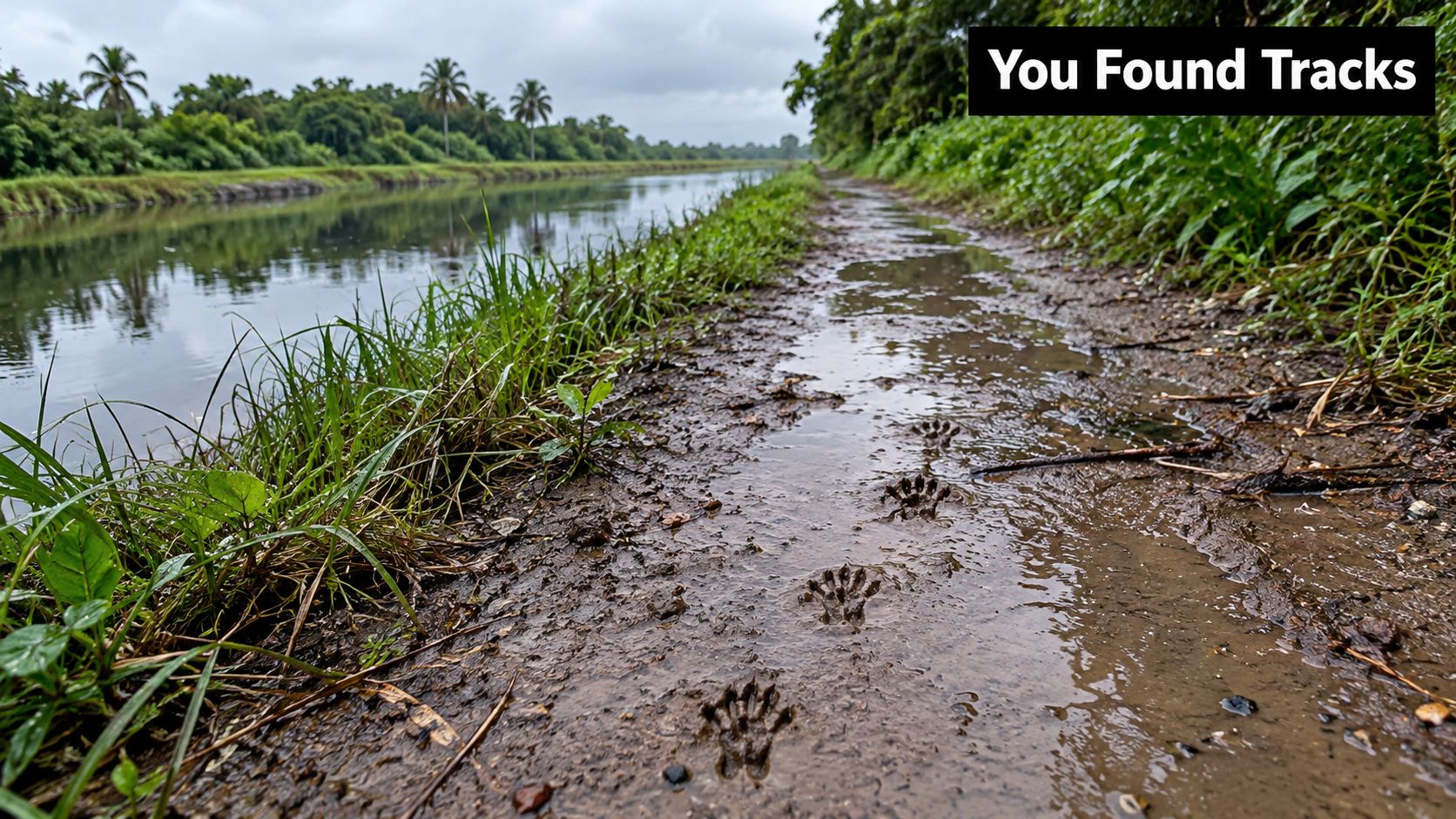
Miami yards create plenty of opportunities for confusion. Raccoons, opossums, domestic dogs, and other urban wildlife use the same wet edges, fence gaps, drainage routes, and food sources. A single distorted impression can resemble several species, especially when mud spreads the toes or hides the central pad. The same caution applies when you're investigating what is digging holes in your yard, because the damage pattern and surrounding sign often matter as much as the hole itself.
Start with the evidence rather than the animal you expect to find. Look for repeated prints, count the toes, compare front and hind impressions, and check whether the trail has a recognizable walking pattern. Then record where the animal traveled and whether the route points toward a structure or just follows a wet corridor.
Field rule: A likely raccoon track tells you that a raccoon was probably present. It doesn't tell you whether the animal entered the home, occupies the property, or poses a health risk.
That distinction keeps the response proportionate. A trail beside a canal may call for observation and improved trash control. Repeated prints aimed at a crawl-space opening, roof gap, or pet-food station deserve closer inspection. The practical goal is not to win a guessing game. It's to turn muddy evidence into a sensible next step.
What a Raccoon Track Actually Looks Like
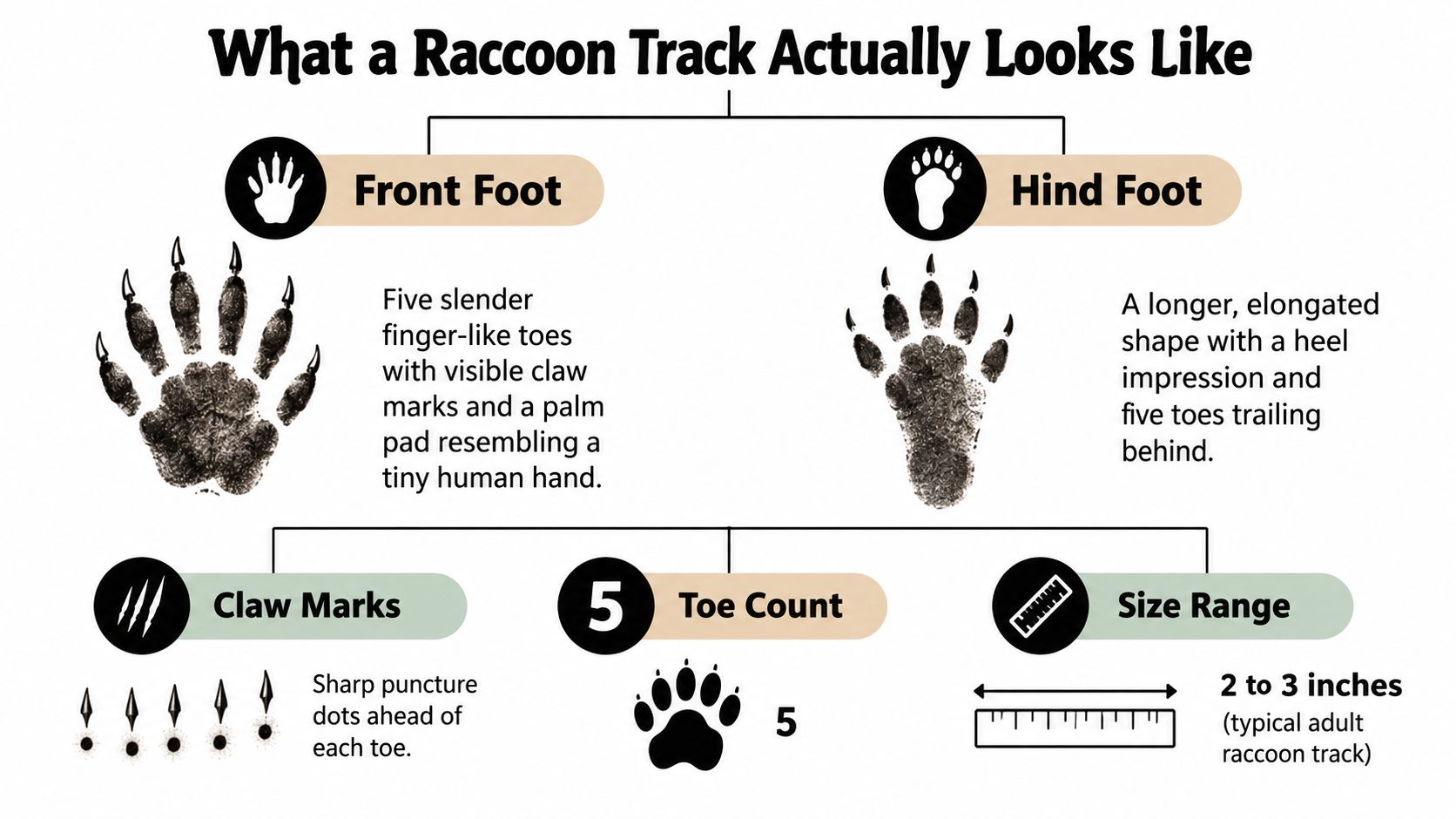
A raccoon print has a recognizable combination of five toes, a hand-like forefoot, and a longer hindfoot. Count the toes on both ends of the trail, not just on the clearest impression. Raccoons normally show five toes on each front and hind foot, and small claw marks may extend beyond the toe tips. The Missouri Department of Conservation describes the front track as typically about 2.5 to 3 inches long, with a width approximately equal to its length, while the hind track is generally 3.75 to 4 inches and noticeably narrower (raccoon track characteristics).
Read the print as a group of clues
The foreprint usually looks compact and palm-like. The hindprint is longer, more elongated, and can resemble a small human footprint with stretched toes. Those proportions help, but they're screening clues rather than a measurement test. Deep mud can enlarge a print, wet edges can collapse, and a moving animal can splay its toes or elongate the impression.
A walking sequence adds another layer. Wildlife-management guidance reports an average distance of about 14 inches between successive prints, with the left hind foot often landing nearly beside the right forefoot (walking raccoon track pattern). That offset pairing is more useful than a neat row of isolated paw marks. It shows how the animal moved, not just how one foot looked after the mud shifted.
Use a repeatable field check
- Photograph the cleanest impressions first. Avoid stepping into the trail or brushing away loose soil.
- Count the toes. Look for five forward-pointing digits on both front and hind prints.
- Inspect the pad and claws. Raccoon claws may leave small marks beyond the toe tips, but their absence on a poor impression doesn't rule the animal out.
- Measure more than one print. Compare a compact foreprint with a longer hindprint, and note the mud's condition.
- Follow the gait. Look for recurring offset pairs rather than relying on one mark.
- Record the surrounding sign. Disturbed soil, repeated travel routes, food waste, or damage at a structure can change the decision.
A careful property inspection also depends on separating wildlife sign from unrelated building problems. For example, Termite Control addresses silent structural damage, while muddy tracks answer a different question about animal movement. Don't use one type of evidence as a substitute for the other.
Raccoon Versus Opossum, Skunk, and Dog
South Florida homeowners often make the same mistake: they see several long toes and call every print a raccoon track. The better approach is comparative. Examine toe arrangement, pad shape, claws, dimensions, and the way consecutive prints are placed.
Raccoon foreprints are compact and hand-like, with five toes. Their hindprints are longer and narrower, and a walking trail may show the hind foot landing close beside the opposite forefoot. Opossums also have five toes, but the rear foot can show a distinctive thumb-like toe set apart from the other digits. That separated rear toe is often more informative than overall size.
Dogs usually leave four primary toes, a central triangular or rounded pad, and visible nail impressions. Their tracks tend to look more compact and symmetrical than the spread, finger-like arrangement of a raccoon. A dog's stride can vary widely, so don't identify a print from spacing alone.
Skunks are a useful size comparison. Reported skunk hindprints measure about 1.25 to 2 inches, while foreprints measure about 1 to 1.75 inches, making them smaller than the typical raccoon ranges (wildlife track comparison guidance). Otters near freshwater canals can create confusion too, particularly where wet soil softens the edges. If the impression is partial, smeared, or mixed with water disturbance, treat an otter identification as tentative and rely on a sequence plus surrounding sign rather than a single footprint.
| Animal | Front track | Hind track | Toes | Gait clue |
|---|---|---|---|---|
| Raccoon | Compact, hand-like, commonly about 3 inches | Longer and narrower, commonly about 3.25 to 4.5 inches in walking-track guidance | Five | Hind foot often lands beside the opposite forefoot, with offset paired impressions |
| Opossum | Five-toed, often less hand-like | Rear toe may sit apart like a thumb | Five | Rear-foot arrangement can look more splayed and asymmetrical |
| Skunk | About 1 to 1.75 inches | About 1.25 to 2 inches | Five | Shorter, smaller sequence than a typical raccoon trail |
| Domestic dog | Compact pad with toe impressions and nails | Similar overall structure | Usually four primary toes | More direct, varied stride with a central pad shape |
Don't let a nearby hole or mound settle the question either. A guide to moles or voles may help with lawn damage, but it won't identify a muddy paw print. Keep the track evidence and digging evidence separate until the pattern connects them.
Photographing and Documenting the Evidence
The best time to document raccoon tracks in mud is before anyone walks through the area or the sun hardens the edges. Photograph the clearest print from directly above, then place a ruler beside it without touching the impression. A coin can provide rough scale, but a ruler gives a professional a more useful record of length and width.
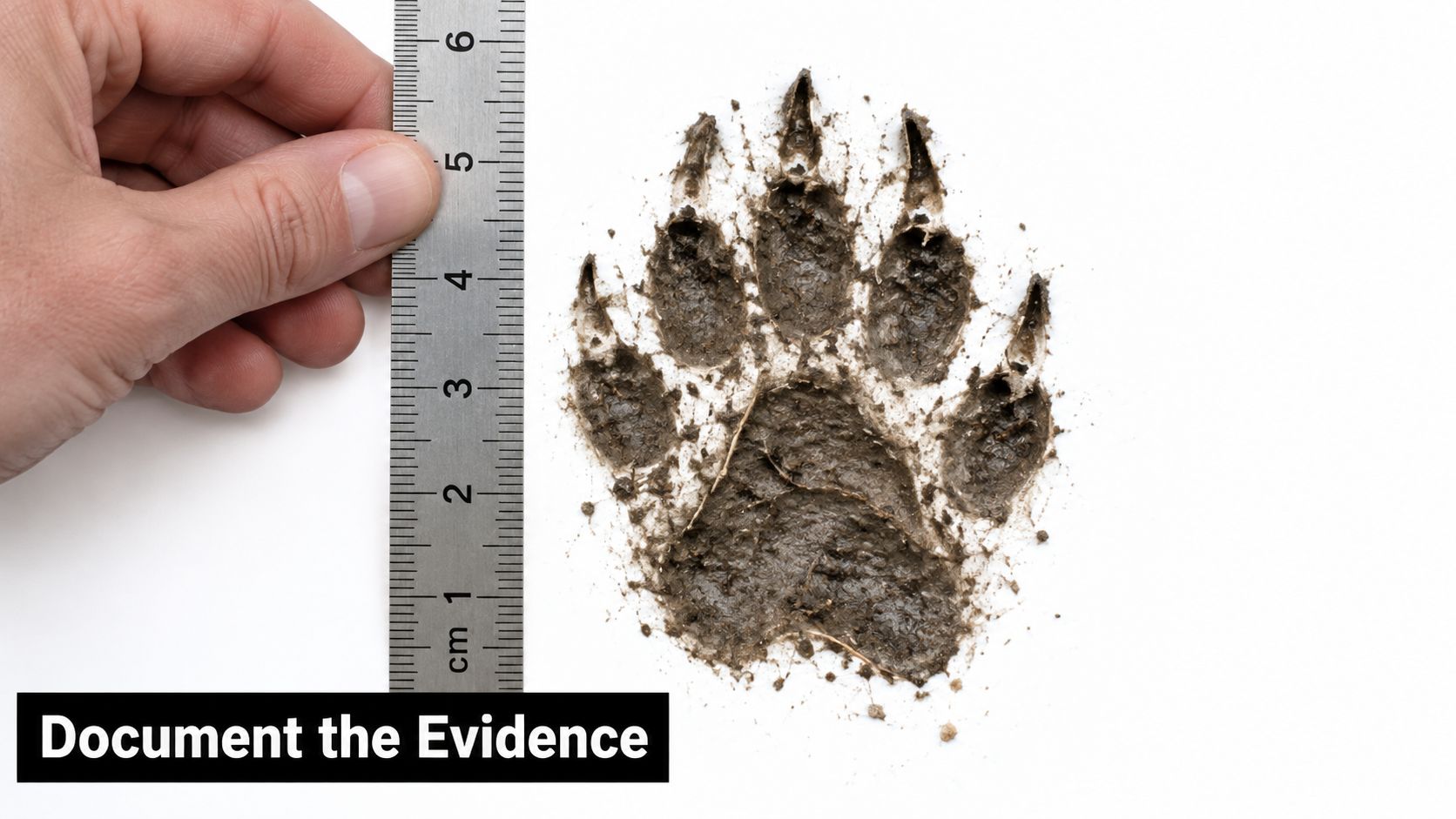
Take three kinds of photographs:
- Detail view: One clean print with the ruler aligned alongside it.
- Sequence view: Several consecutive impressions showing direction and gait.
- Context view: The trail's location relative to a canal, trash enclosure, fence gap, pool, crawl-space entrance, or building edge.
Write down the date, recent weather, substrate condition, direction of travel, and the measurements you took. Note whether the mud was shallow, saturated, drying, or mixed with sand and leaves. Those details explain why two prints from the same animal might not look identical.
Build a small evidence file
A technician can do more with a short, organized record than with a gallery of unlabelled close-ups. Name the photos in sequence, keep the original files, and include a brief note about whether the prints were near food waste, pet bowls, damaged screening, or a roofline. If you later need to compare tracks after another rain, the notes give you a baseline.
The same principle applies to security documentation around a property. If you're researching how to monitor a side gate or trash enclosure, you can find Malvern CCTV installers for general camera-placement ideas, but wildlife identification still depends on clear track morphology and context.
A short video can also preserve the route and surrounding conditions when photographs miss the scale of the trail. Use it as supporting evidence, not as a replacement for measured still images.
Never put your hand in the mud to test depth, and don't handle feces or visibly contaminated material. Your job is to preserve the scene, not to collect wildlife evidence at personal risk.
Setting Up a Tracking Surface for a Second Look
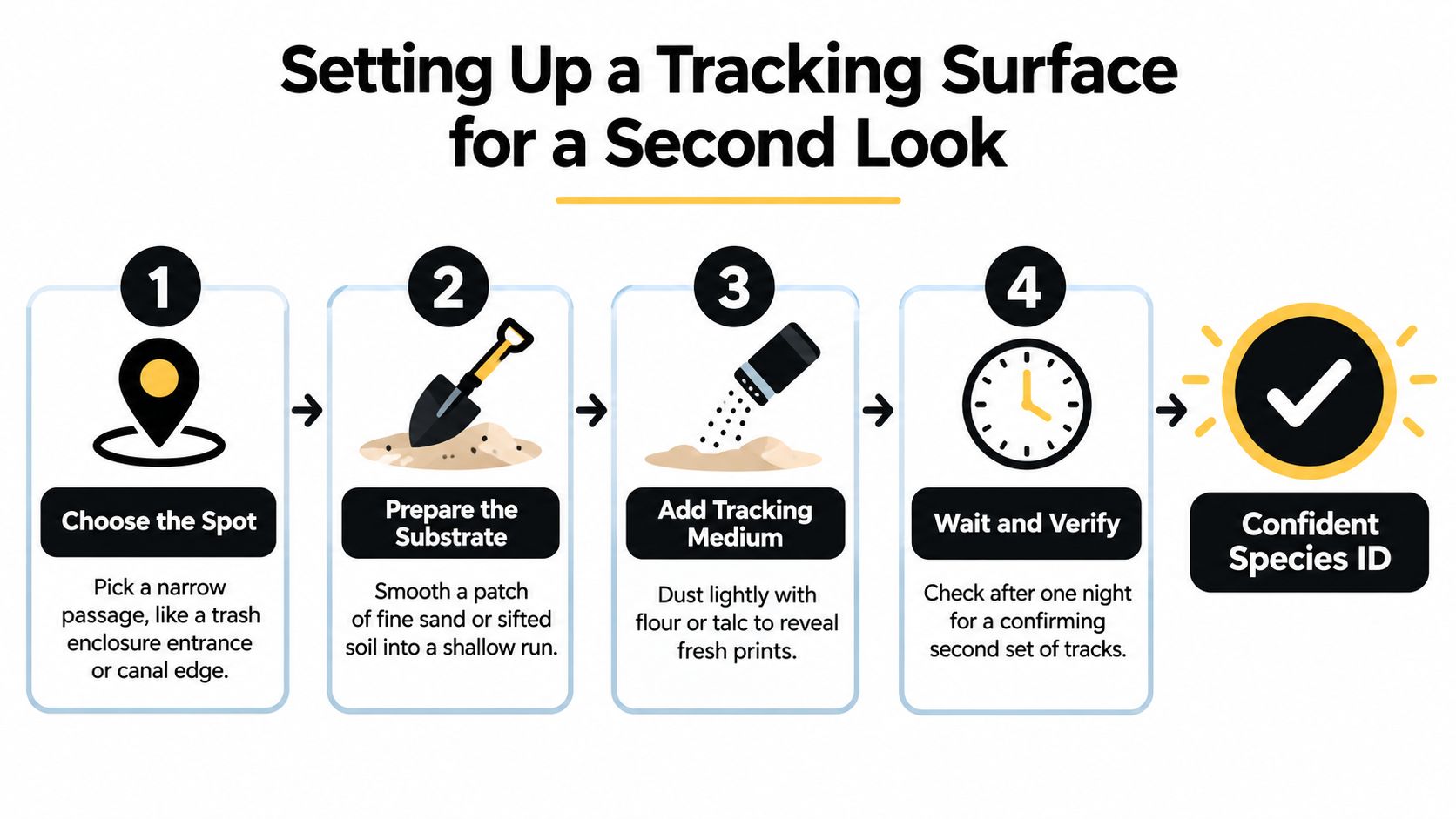
A controlled tracking surface can resolve uncertainty when natural mud produces only one usable print. Choose a narrow passage the animal is likely to use, such as the entrance to a trash enclosure, a pond edge, a fence gap, or the route beside a crawl-space access point. The narrower the corridor, the easier it is to obtain a sequence instead of scattered marks.
Smooth a patch of damp soil or fine sand with a hand tool, then step away without leaving your own prints. Photograph the prepared area and note its location. If the surface sits beside a building, keep it away from children and pets, and don't block an emergency route or trap an animal.
Choose the medium carefully
Utah wildlife guidance notes that flour can be spread at damage sites to reveal nocturnal tracks, but a thin, localized application works better than covering a broad area (guidance on revealing nocturnal tracks). A heavy layer can create its own problems by clumping, blowing away, or producing overlapping impressions that are hard to interpret.
Use the setup to answer one question: does a repeated animal route produce a consistent track pattern? Don't treat flour as bait, and don't add food to make an animal approach the house. The aim is observation, not attraction.
In daylight, inspect the surface without disturbing it. Look for at least three consecutive print groups, then compare toe count, foreprint shape, hindprint length, claw marks, and recurring placement. Record the distance between successive prints when the sequence is clear.
Practical standard: Call the species only when morphology, dimensions, and gait support the same conclusion. A deep single print doesn't meet that standard.
A controlled surface works best when it's paired with ordinary property observations. Check whether the route leads to garbage, a pond, pet food, an opening under a deck, or a damaged screen. The track can identify likely passage, while the destination helps determine whether the passage deserves action.
From Track to Decision: What the Evidence Means
A muddy footprint shows that an animal passed through one spot. The decision depends on what surrounds it: damage, access points, food, shelter, and repeated activity.
A single print beside a fence, drain, pool, or canal commonly marks a travel route. South Florida's drainage corridors can offer cover and foraging opportunities, so a track there does not by itself show that a raccoon is denning inside the house. A trail near garbage carries the same limited meaning when it stays away from the building.
Separate travel from property use
Start with the destination rather than counting toes again. Does the route end at a crawl-space door, damaged screen, roof opening, loose soffit, trash container, pet-food station, or gap beneath a raised structure? Does the same access point show fresh disturbance after later rain?
A repeated route toward a structure deserves inspection, not an occupancy verdict. Raccoons may cross a property regularly without establishing a den there. Conversely, a short trail that ends at a damaged opening can matter more than several clear prints along a fence.
A homeowner in Miami found one clear print beside a canal after rain. The next storm erased it, but fresh mud showed a route turning toward the garbage enclosure. After another rain, prints appeared near a loose crawl-space screen, alongside disturbed soil. The sequence changed the response from simple observation to checking the screen and waste area. The evidence accumulated through location and repetition, not through one impressive impression.
Match the response to the evidence
Use three practical levels. Curiosity means an isolated, weathered print in a wet travel area with no damage or recurring sign. Maintenance means a route that returns near waste, food, fencing, or a building edge. Secure containers, remove outdoor food, and repair obvious gaps while recording new evidence.
Professional inspection fits when tracks accompany damaged soffits, displaced screening, droppings, scratching sounds, a trapped animal, or repeated daytime activity. Those combinations justify checking for entry and exclusion needs.
Other pests require separate reasoning. Ant Control addresses the colony rather than the visible trail, but ant activity does not explain raccoon tracks. Keep each observation tied to the problem it can support.
When to Call a Pro and What to Ask Them
A clear trail becomes a professional-inspection issue when it leads toward damaged screening, a soffit gap, displaced crawl-space material, or another possible entry point. Repeated access attempts, daytime activity, or an animal cornered by pets also warrant help from a licensed wildlife professional. The technician should assess both the animal's route and the exclusion work needed to prevent reentry.
A muddy print by itself is not a rabies exposure. Public-health concern follows a bite, scratch, saliva contact, or other direct exposure, not ordinary contact with soil. Keep people and pets away from an abnormal, trapped, or unusually tame animal, and contact the appropriate public-health office after an exposure. Raccoon rabies surveillance context supports caution without treating every raccoon track as an emergency.
Document an attic or crawl-space opening before anyone closes it. The animal in the attic guide can help organize photos, timing, and entry signs. If an animal is still inside, humane removal should come before sealing the opening.
Ask these questions before hiring
- Licensing: Can you provide proof of the relevant Florida license?
- Insurance: Can you document current liability coverage?
- Scope: Does the written estimate separate inspection, removal, exclusion, cleanup, and other services?
- Evidence: Which track, opening, or damage supports the recommendation?
- Follow-up: How will you confirm the route is closed without trapping an animal inside?
Photograph the trail tonight and keep pets away from it. This week, secure garbage, remove outdoor food, and inspect screens, soffits, and crawl-space access points. Choose an inspection when the evidence suggests entry, not merely travel.
For a local comparison, Pestless Inc. connects Miami-Dade homeowners with licensed, insured pest professionals. Upload your track photos and notes through its form, then request an evidence-based review and advice on whether an on-site inspection is warranted.
Dealing with this pest right now?
Pestless connects you with a licensed, insured Miami pest control provider for a free, no-obligation quote.