You're under contract on a Coconut Grove bungalow, the general home inspection is complete, and everyone is talking about paint, wiring, and the aging air conditioner. Then a lender asks for a wood-destroying-organism report, or you notice soft trim near the patio and realize nobody has inspected the places termites favor. Closing is suddenly at risk, and the "clean" home inspection doesn't answer the question you need answered.
For a Miami-Dade buyer, a pest inspection for home purchase isn't a ceremonial checkbox. It's a separate risk decision involving different expertise, different documentation, and potentially different repair obligations. The sections below focus on the access, forms, licensing, and negotiations that matter in South Florida.
Table of Contents
- Why a Pre-Purchase Inspection Is a Separate Decision
- What a WDO Inspection Actually Covers
- What Happens During the Inspection
- Finding and Verifying a Licensed Miami-Dade Inspector
- Reading the Report as Risk Evidence
- Timing the Inspection for Closing
- Negotiating Repairs, Treatment, and Credits
Why a Pre-Purchase Inspection Is a Separate Decision
The buyer in that Coconut Grove bungalow has two reports, but they answer different questions. A general home inspector may identify visible moisture, structural concerns, drainage problems, or areas that couldn't be accessed. A qualified wood-destroying-organism inspector looks specifically for evidence of termites and other organisms that damage wood, along with conditions that invite them.
That distinction matters in Miami-Dade because humid conditions, slab-on-grade construction, concealed framing, patios, garages, and roof voids can hide evidence from a casual walkthrough. A standard inspection can flag a damp wall or deteriorated trim without determining whether termites, beetles, carpenter ants, or wood-rot fungi caused the condition.
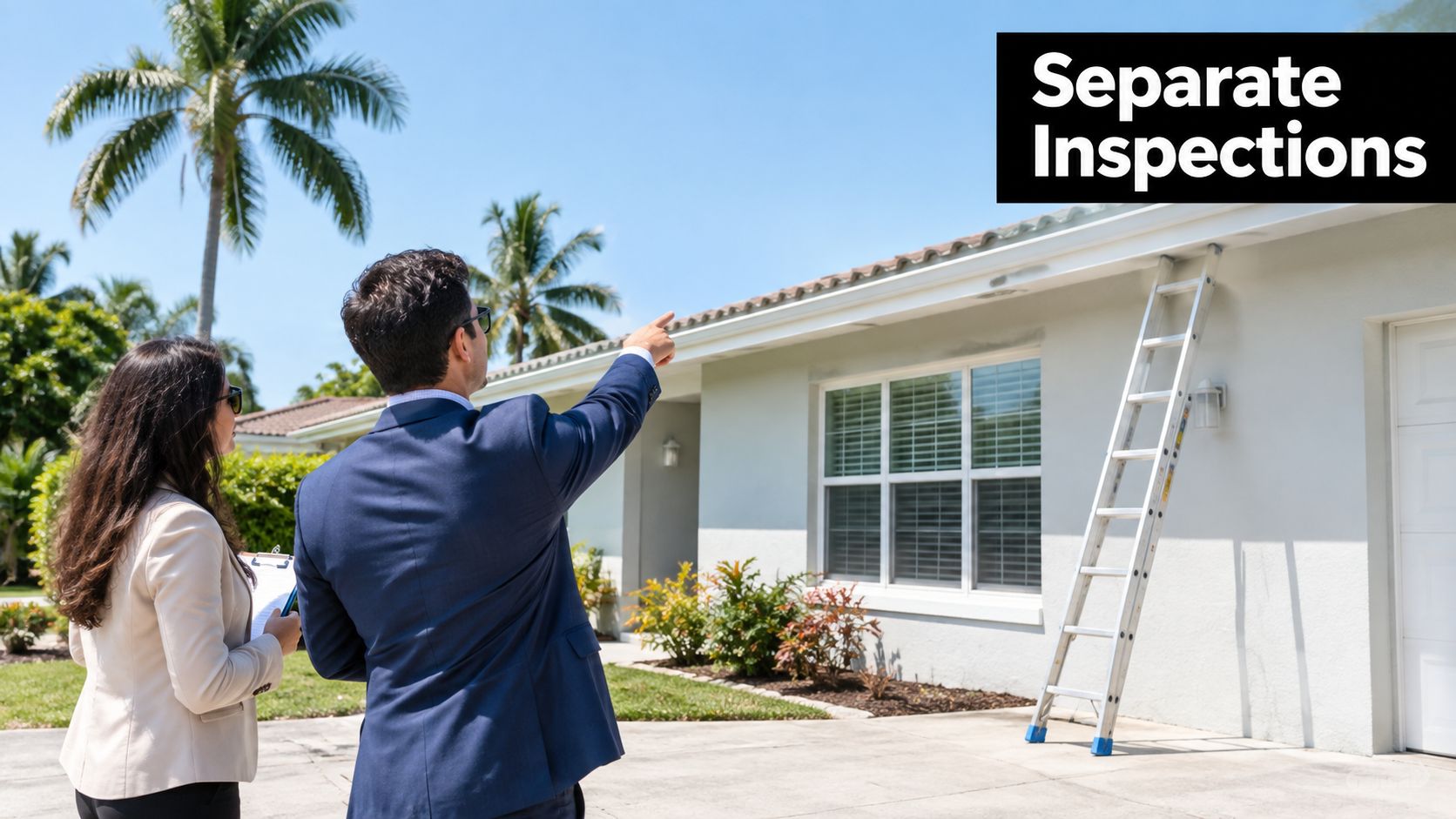
The financial exposure is substantial. The National Pest Management Association estimates that termites cause approximately $5 billion in U.S. property damage each year, while a 2015 estimate from the U.S. Department of Agriculture's Agricultural Research Service found that termites destroy parts of more than 600,000 American homes annually. These figures are reported in this consumer overview of termite risk for homebuyers.
Homeowners insurance typically excludes termite damage, so a buyer who skips the WDO step may inherit treatment expenses and concealed repair work without assuming the policy will pay. A general home inspection may be valuable, but it doesn't replace this specialized assessment.
Miami buyer rule: If your lender, contract, or closing attorney expects WDO documentation, order it independently and make sure the inspector can reach the property's vulnerable zones.
More than half of Americans, 52%, reported that they'd never had their homes inspected for termites, according to the same cited consumer source. That helps explain why buyers sometimes treat the inspection as optional until a lender or visible clue forces the issue. Use a broader real estate due diligence checklist to coordinate the WDO report with the other inspections, documents, and contingency deadlines in your contract.
What a WDO Inspection Actually Covers
A wood-destroying-organism inspection, usually called a WDO inspection, is a focused evaluation of accessible areas for evidence of organisms that damage wood. Depending on the report and applicable form, that can include subterranean and drywood termites, wood-boring beetles, carpenter ants, and wood-rot fungi. The inspector also records conditions such as moisture, earth-to-wood contact, cellulose debris, poor drainage, and other circumstances that can support infestation.
A general home inspection has a broader property scope. It may assess visible roofing, plumbing, electrical, HVAC, structural, and safety conditions, but it doesn't automatically provide the specialized WDO documentation your lender or transaction may require. Neither report should be treated as a substitute for the other.
The Florida reporting anchor
Florida transactions require attention to the professional's license and the report being delivered. University of Florida guidance states that WDO inspections are commonly performed in real-estate transactions, and Florida Statute 482.266 requires Form 13645 to be issued to the person or agent requesting the inspection. The form documents findings involving termites and other wood-destroying organisms, while oversight remains with the Florida Department of Agriculture and Consumer Services. The regulatory context is summarized in University of Florida's WDO study guidance.
Ask your agent and lender whether they require Form 13645, the NPMA-33 framework, or another accepted deliverable. Those documents aren't interchangeable with a treatment warranty, a full home inspection, or a structural-engineering opinion.
Browse WDO vs General Home Inspection
| Scope | Professional | Decision Impact | |
|---|---|---|---|
| WDO inspection | Accessible evidence of termites and other wood-destroying organisms, prior activity, damage indicators, and conducive conditions | Licensed structural pest control professional | Treatment, repair negotiations, lender approval, reinspection, insurance questions, or a decision to proceed |
| General home inspection | Visible condition of major home systems and accessible building components | Qualified home inspector | Broader repair planning, safety review, maintenance priorities, and contract decisions |
| Structural evaluation | Load-bearing framing, suspected structural failure, and engineering analysis | Structural engineer or appropriately qualified specialist | Determines whether damage affects structural performance and what repair design is required |
The report's boundaries matter as much as its findings. Detached structures, concealed framing, blocked closets, stored belongings, and inaccessible crawlspaces aren't certified pest-free merely because the inspector couldn't reach them.
What Happens During the Inspection
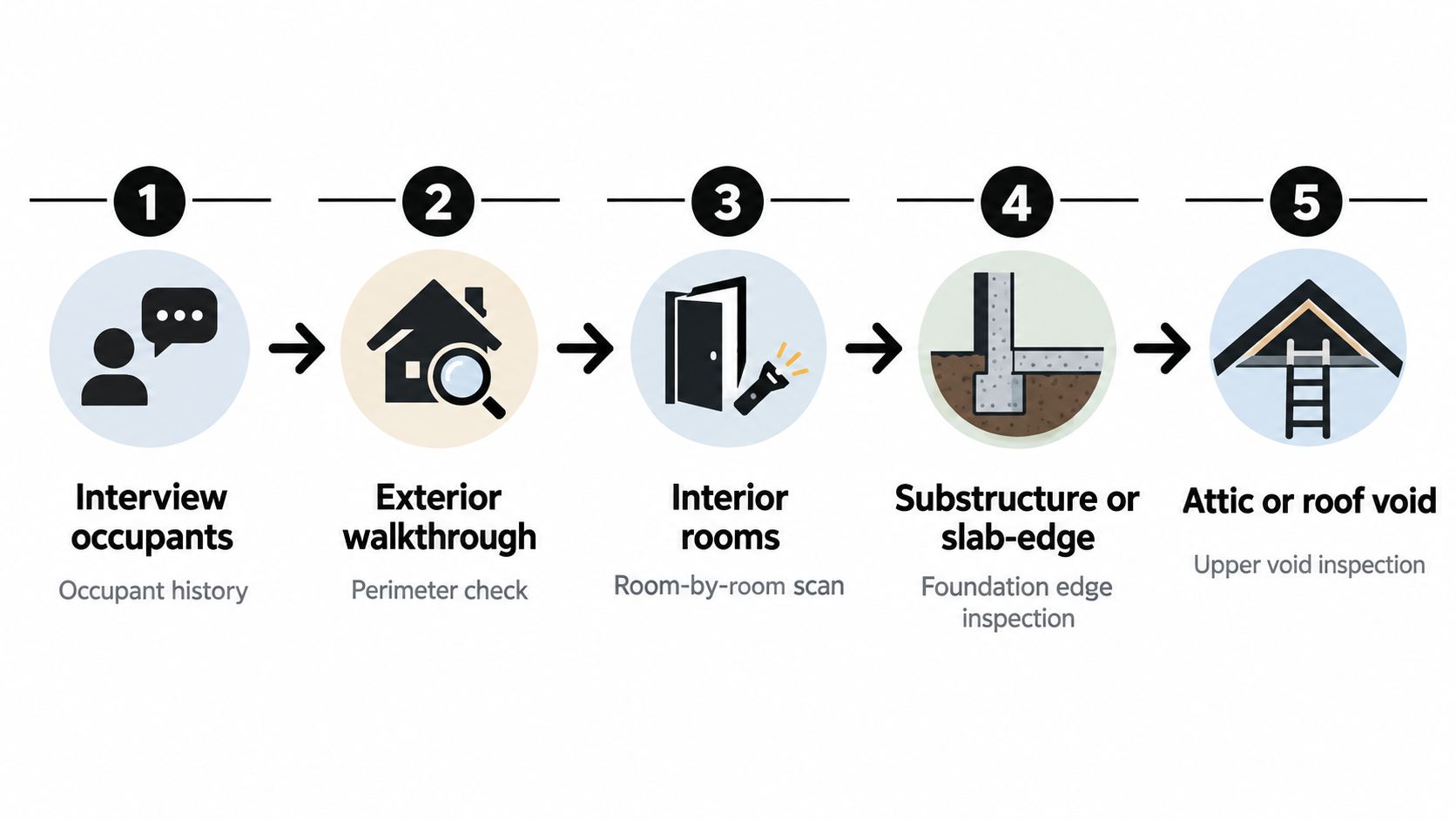
A defensible inspection follows a sequence. It starts with an interview, not a flashlight. The inspector should ask occupants about prior insects, leaks, repairs, treatments, unusual sounds, discarded wings, mud tubes, frass, or recurring moisture.
The physical review then moves through four practical zones: exterior, interior, attic or roof void, and substructure or slab-edge areas. In a Miami-Dade property, that means the inspector should address the perimeter, patios, garages, plumbing chases, closets, roof voids, and accessible foundation edges rather than stopping at the living-room walls.
Tools and documentation that matter
A strong flashlight reveals shelter tubes, frass, exit holes, staining, and damaged trim. Probing and sounding accessible wood can identify softness or hollow areas, while a moisture meter helps map conditions that may support subterranean termites or wood rot.
The report should identify every accessible area inspected and every meaningful limitation. It should distinguish visible live insects, old evidence, damage indicators, and conducive conditions rather than compressing everything into “clear” or “not clear.”
An industry survey cited in the North Carolina guide to wood-destroying insect reports found that, among inspections where WDI evidence was identified, 89% located evidence outdoors, in basements, or in crawlspaces, 10% found it in garages or interiors, and 1% found it in attics. The practical Miami lesson is direct: omitting garages and attics can leave meaningful evidence undiscovered.
Before the appointment, remove stored items from access points and insist that the inspector document anything that remains blocked. For preparation guidance, use this termite inspection preparation guide as a practical reference.
A clear WDO report describes visible evidence within its inspection scope. It doesn't certify hidden framing, inaccessible rooms, or structural capacity.
A WDO inspection also isn't a structural engineering assessment. If probing reveals damaged joists, sagging floors, weakened beams, or suspected load-bearing deterioration, hire a structural engineer or another appropriately qualified specialist.
Finding and Verifying a Licensed Miami-Dade Inspector
Start with credentials, not availability. Florida structural pest control work is regulated through the Florida Department of Agriculture and Consumer Services, so ask for the inspector's Florida license information before scheduling. Verify it independently rather than relying only on a company logo or a salesperson's statement.
Request a sample redacted report. It should show the professional's license details, inspection scope, accessible and inaccessible areas, findings, conducive conditions, and the expected deliverable. If your transaction requires Form 13645, ask the company to confirm that it can issue the form to the requesting party.
Your pre-booking verification
- Confirm the license: Verify the Florida structural pest control license through the appropriate state resources and make sure the named professional matches the company representative.
- Ask for insurance evidence: Request current proof of business insurance before allowing the inspection to proceed.
- Confirm the form: Ask whether the lender or transaction requires Form 13645, NPMA-33, or another specific report.
- Define access: List the garage, attic, roof void, closets, patios, slab edges, plumbing chases, and detached structures that must be examined.
- Clarify limitations: Ask how the inspector records blocked areas and whether moisture readings are included where conditions justify them.
A referral or routing service can save time, but it doesn't eliminate your responsibility to verify the provider. Use Florida license verification guidance to understand the questions to ask, then confirm the answers through official channels.
Walk away from these red flags
An inspector who won't provide a license number, refuses to define the scope, or treats a WDO report as a quick visual glance isn't protecting your transaction. The same applies to a provider who won't document inaccessible areas, won't explain the required form, or pressures you to waive reinspection after treatment.
Miami's slab homes deserve moisture attention. A report that offers no meaningful discussion of moisture, drainage, earth-to-wood contact, or concealed access limitations is incomplete as a decision document, even if it contains a reassuring conclusion.
Reading the Report as Risk Evidence
A WDO report isn't a pass-or-fail certificate. Read every finding as evidence that leads to a specific next action. “No live insects observed” may be useful, but it doesn't answer whether old evidence exists, whether a prior treatment was documented, or whether moisture and access conditions could support a future problem.
The most useful classification is practical:
- Active infestation: Live insects, fresh frass, active mud tubes, or other current indicators. Treat the condition, identify affected areas, and determine whether repairs are also necessary.
- Old or inactive evidence: Exit holes, galleries, staining, or other signs without current activity. Verify the history, inspect the surrounding wood, and determine whether monitoring or further evaluation is appropriate.
- Prior treatment: A record of past chemical or other treatment. Request the treatment date, scope, warranty, exclusions, and transfer terms rather than assuming the issue is resolved.
- Conducive condition: Moisture, earth-to-wood contact, cellulose debris, faulty grading, or poor ventilation. Correct the condition because treatment alone won't remove the pathway that supports recurrence.
- Indeterminate finding: A blocked area, concealed framing, suspicious damage, or condition the inspector can't conclusively classify. Obtain access, open the area through an appropriate professional, or commission a structural assessment.
Moisture deserves special attention
A North Carolina regulatory guide identifies 20% or greater wood moisture content in crawlspaces and similar areas as a reportable condition conducive to subterranean termites. That threshold comes from a different state's guidance, so it shouldn't be treated as a universal Florida rule, but it illustrates why moisture measurements are more useful than vague comments about dampness. The same guide also clarifies that a WDI report may identify evidence without determining the full extent of structural damage.
In South Florida, ask where moisture readings were taken and what conditions produced them. Slab edges, stucco transitions, plumbing penetrations, patios, and poorly drained perimeter areas can tell a more useful story than a single “dry” reading in an accessible room.
Browse Common WDO Findings to Buyer Action
| Finding Type | Buyer Action |
|---|---|
| Live insects or fresh activity | Require a licensed treatment proposal, identify the affected locations, and schedule a clearance reinspection |
| Old evidence with no current activity | Request treatment history, inspect adjacent wood, and decide whether monitoring or additional evaluation is warranted |
| Prior treatment without records | Obtain dated documentation, warranty terms, exclusions, and transferability before relying on it |
| Moisture or earth-to-wood contact | Negotiate correction, document the source, and verify that the condition was resolved |
| Suspected structural damage | Commission a structural evaluation instead of treating the WDO report as a damage estimate |
| Blocked or inaccessible zone | Require access or accept the limitation only after understanding the unresolved risk |
Other pest categories need separate handling. For example, Bed Bug Treatment addresses the elimination of bugs, eggs, and all life stages, but that service doesn't replace a WDO inspection or structural review.
Timing the Inspection for Closing
Order the WDO inspection as soon as the contract is signed. Don't wait for the lender to chase you, because the inspection contingency window, seller response period, treatment scheduling, and possible reinspection all compete for the same calendar.
A practical Miami-Dade sequence looks like this:
- Order on day one: Confirm the lender's required report, accepted form, scope, and validity expectations.
- Schedule within the opening inspection period: Give the inspector enough time to access the property and document limitations.
- Review before the contingency expires: Separate active evidence, repairs, conducive conditions, and unresolved access issues.
- Negotiate promptly: Put treatment, repairs, credits, records, and access obligations in writing.
- Reinspect before funding: Require evidence that treatment or corrective work was completed and that the relevant areas were rechecked.
- Collect the handoff documents: Obtain the final report, treatment records, warranty terms, exclusions, and transfer paperwork.
Florida doesn't impose one universal WDO inspection requirement on every residential purchase, but lender and contract requirements can make the report practically essential. California's historical experience shows how lender risk management can drive widespread inspection practice even where a statewide legal mandate isn't present. A historical account reported that approximately 1.2 million termite inspections were conducted statewide there in 1998, with about 90% attributed to real-estate transactions, and that most lenders reportedly required the inspection before closing. Those figures and the lender-driven context are discussed in this historical account of California termite inspections.
Don't accept inaccessible areas to keep the deal moving. If a closet, garage, attic, roof void, patio edge, or plumbing chase remains blocked, record that limitation and decide whether you're willing to accept unresolved risk. Once treatment and repairs are complete, coordinate the final inspection with your move-in schedule, including practical Miami-Dade move-in cleaning tips after construction dust and stored belongings are removed.
Negotiating Repairs, Treatment, and Credits
The report only helps when you separate the problem correctly. Active infestation, structural damage, and conducive conditions are not the same negotiation, and a seller-funded treatment doesn't automatically pay for damaged framing.
Start with the treatment proposal. It should identify the organism or suspected organism, treatment method, locations, preparation requirements, follow-up obligations, retreatment warranty, exclusions, and whether coverage transfers to you at closing. An invoice proves that someone was paid. It doesn't prove that the infestation was eliminated, that damaged wood was repaired, or that the warranty protects the new owner.
Choose the remedy that matches the risk
Seller-funded treatment makes sense when the report identifies current activity and the work can be completed before closing. Require a licensed provider, written treatment scope, dated completion records, warranty documents, and a clearance reinspection.
A repair credit can be better when you want to choose the contractor or when the work involves finishes, trim, drywall, drainage, or concealed framing. Don't accept a vague credit based only on a treatment quote if the report suggests structural damage. Obtain a qualified repair estimate first.
A price reduction may not solve the immediate problem. It changes the purchase economics, but you still inherit scheduling, contractor selection, treatment coordination, and the possibility that the damage is larger than the report reveals.
Walking away becomes rational when the seller won't provide access, refuses meaningful remediation, or the evidence points to concealed structural deterioration that can't be evaluated inside the contract timeline. Your exact rights depend on the contract and contingencies, so involve your real-estate attorney or agent before making that decision.
Termite damage is typically excluded from standard homeowners insurance, which is why a post-closing discovery can become your expense. Before waiving contingencies, ask the insurance professional to review the actual policy and exclusions rather than assuming future termite damage will be covered.
Don't confuse treatment with repair
A treatment addresses the organisms. A contractor repairs damaged framing, trim, subflooring, or other building components. A drainage contractor may correct grading or water flow. A structural engineer determines whether suspected deterioration affects load-bearing performance.
The North Carolina regulatory guidance notes that a WDI report may identify evidence without determining the full extent of structural damage. In practice, that means the report can trigger the next professional assessment, but it can't replace one when the framing raises serious questions.
For cost context, review this pest inspection cost guide while remembering that the transaction's real exposure may involve treatment, repairs, access work, engineering, and delayed closing rather than the inspection fee alone.
The buyer's one-page checklist
Before booking
- Confirm the lender: Ask which report and form the lender accepts.
- Verify the license: Check the Florida structural pest control license independently.
- Request a sample: Review a redacted Form 13645 or other accepted deliverable.
- Confirm insurance: Obtain current proof of business insurance.
- Put access in writing: List garages, attics, roof voids, patios, slab edges, plumbing chases, closets, and detached structures.
During the inspection
- Require the four-zone review: Exterior, interior, substructure or slab-edge, and attic or roof void.
- Ask about tools: Confirm the use of a strong flashlight, probing and sounding, and moisture measurements where appropriate.
- Record limitations: Make blocked or concealed areas explicit.
- Classify findings: Ask whether each item is active, inactive, prior treatment, conducive, or indeterminate.
- Separate damage from evidence: Ask whether a structural professional should evaluate any suspect framing.
Before closing
- Review the treatment scope: Check method, locations, exclusions, retreatment terms, and transferability.
- Assign responsibility: Put treatment, repairs, credits, and documentation in the contract or written addendum.
- Reinspect: Don't rely on an invoice alone after treatment.
- Check insurance exclusions: Ask what termite and gradual insect damage the policy excludes.
- Collect the file: Keep the WDO report, treatment records, warranty, reinspection, and repair documentation.
A separate pest issue doesn't belong inside the WDO decision. If mosquitoes are affecting the property after closing, Mosquito Control addresses the practical goal of taking your yard back from biting mosquitoes, but it has no bearing on whether a WDO report clears a home for purchase.
When a failed inspection shows active infestation only, obtain a licensed treatment proposal and insist on reinspection. When probing reveals weakened framing, sagging floors, or suspected load-bearing damage, pause the transaction long enough for a structural engineer to evaluate it. If you need fast local treatment quotes, a routing service can introduce you to providers, but you still need to confirm each provider's license, insurance, scope, and warranty terms.
Pestless Inc. connects Miami and Miami-Dade buyers with licensed, insured pest control professionals for inspection and treatment requests, while the actual work is performed by the selected local provider. Visit Pestless Inc. to submit the property details, request local options, and keep your WDO and treatment decisions moving before the contingency deadline.
Dealing with this pest right now?
Pestless connects you with a licensed, insured Miami pest control provider for a free, no-obligation quote.