Most cockroaches live about 6–18 months under typical household conditions, while American cockroaches can reach 1–2 years across their full life cycle. German cockroaches have shorter adult lives, roughly 20–30 weeks, but their faster reproduction can make an infestation grow quickly.
So, how long can a cockroach live is only part of the question. For a Miami homeowner who spots one near the kitchen sink, the more useful question is: how long can the population persist inside this building?
That answer depends on the species, temperature, humidity, access to water and food, and whether eggs and nymphs are hidden nearby. Warm, humid conditions can support development, while a leaking pipe, damp drain, air-conditioning condensation, or shared condo utility space can keep a population established even after visible adults disappear.
A practical way to interpret the answer
Think of lifespan in three layers:
- Species: A German cockroach follows a much faster cycle than an American cockroach.
- Life stage: Eggs and nymphs may remain concealed after adults are killed.
- Building conditions: Moisture and shelter often matter more than crumbs alone.
A peer-reviewed review reports a broad general range of 6–18 months, while its species table shows German cockroaches completing their life cycle in approximately 120–200 days and Madagascar hissing cockroaches living about 250–530 days. Those figures describe biological ranges, not a guaranteed survival time in every home, but they show why one universal number can mislead readers. The peer-reviewed cockroach lifespan review provides the useful starting point.
Practical rule: One adult tells you what survived long enough to be seen. It doesn't tell you how many eggs, nymphs, or harborages remain out of sight.
Table of Contents
- A practical way to interpret the answer
- The Quick Answer and Why It Depends
- The Cockroach Life Cycle from Egg to Adult
- Lifespan by Species You Are Most Likely to See
- How Long Cockroaches Live Without Food and Water
- What Extends or Shortens a Cockroach Life
- What Cockroach Lifespan Means for Treatment and Prevention
- Key Takeaways and When to Get Professional Help
The Quick Answer and Why It Depends
Most household cockroaches live about 6–18 months, but that range includes very different insects and life histories. American cockroaches may remain part of a population for 1–2 years across the complete life cycle, while German cockroaches mature and reproduce much faster. The right answer therefore changes depending on whether you saw a small tan roach in the kitchen, a large reddish-brown roach near a drain, or a dark roach coming from a damp exterior area.
The distinction between an individual and an infestation matters in Miami. A single cockroach may die naturally, but its population can continue through concealed egg cases and immature nymphs. A treatment that removes adults without addressing moisture, entry points, and hidden stages can appear successful before activity returns.
Three details that change the answer
Species identification comes first. German cockroaches are strongly associated with kitchens and other warm indoor areas, and their short adult lifespan is offset by rapid development and reproduction. Larger species, including American cockroaches, may take much longer to mature but can persist in plumbing spaces, drains, basements, service areas, and other moisture-associated locations.
Moisture is the second major variable. Food matters, but a dripping faucet, wet sink cabinet, condensation, or damp wall void can keep cockroaches alive when a home appears otherwise clean. Humidity can also slow the impact of removing food because insects may continue finding water in small, overlooked sources.
Hidden stages are the third. Cockroaches develop through eggs, nymphs, and adults, without a pupal stage. Each stage can occupy a different hiding place, so killing the adults you see doesn't necessarily remove the next generation.
The short answer is useful only when it leads to the right inspection. Ask where the roach came from, what species it may be, and whether the building provides water and shelter. Those clues reveal how long the population may remain active more accurately than a single lifespan figure.
The Cockroach Life Cycle from Egg to Adult
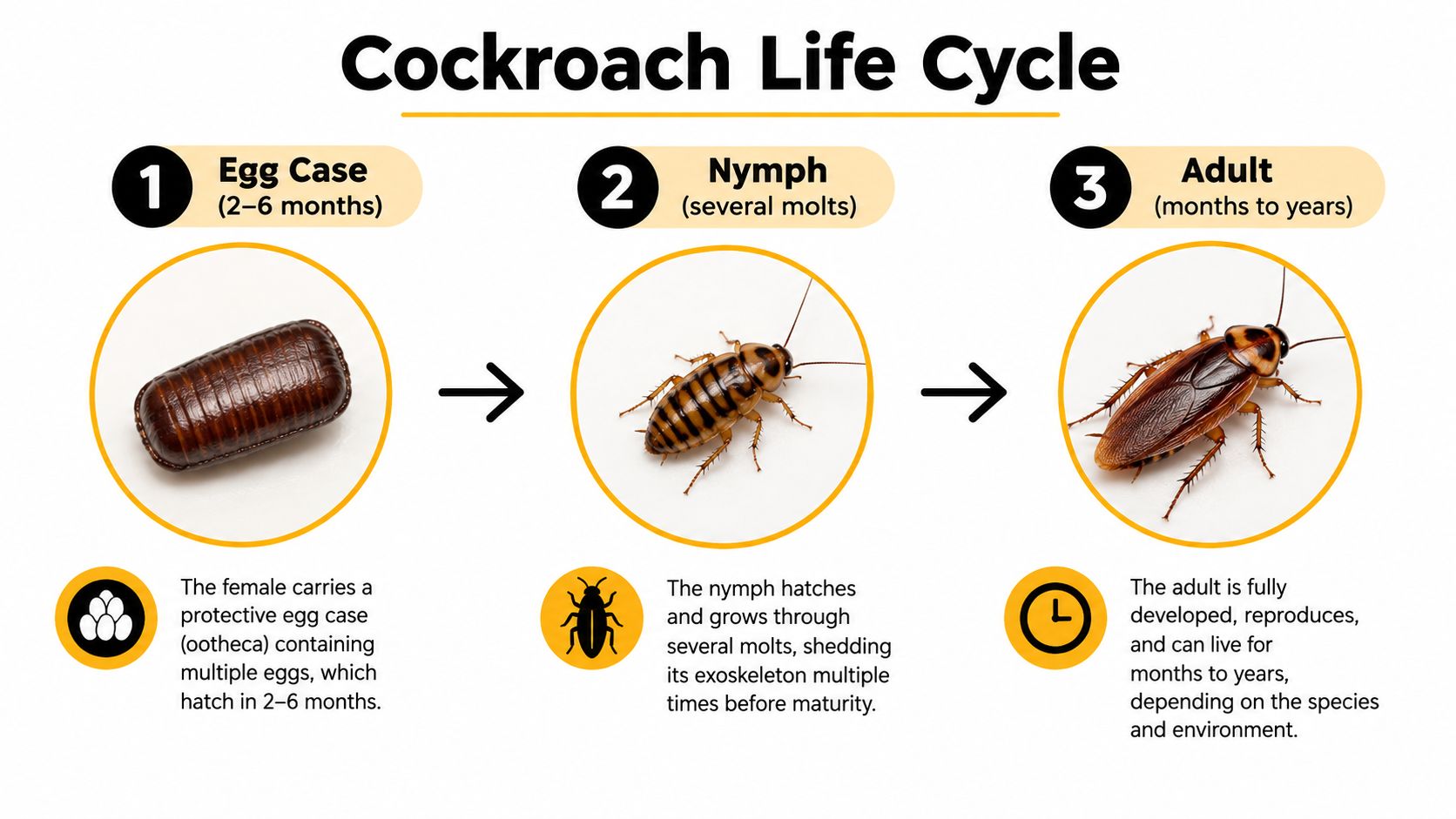
Cockroaches undergo incomplete metamorphosis, which means they pass through three stages: egg, nymph, and adult. They don't form a pupal stage like butterflies or moths. A nymph resembles a small, wingless adult and grows through repeated molts until it reaches reproductive maturity.
Egg cases can outlast visible adults
The egg stage begins inside a protective case called an ootheca. Depending on the species and environmental conditions, eggs commonly hatch after 28–60 days. That case may be tucked behind a baseboard, inside a cabinet void, near plumbing, or in another protected harbor, where a surface spray may not reach it.
American cockroaches illustrate the longer end of development. Their egg capsule requires nearly 2 months before nymphs emerge, according to University of Missouri Extension's American cockroach life-cycle guidance. Removing an adult from a kitchen therefore doesn't prove that reproduction has stopped.
Nymphs grow quietly
After hatching, nymphs feed, hide, and molt. Nymphal development may require 103–360 days, depending on the species and environmental conditions, according to the peer-reviewed review of cockroach biology. American cockroach nymphs can remain in this stage for approximately 6–20 months, depending on conditions, before becoming adults.
That long window explains a common homeowner experience. A kitchen looks quiet after treatment, then smaller roaches appear later. Those insects may not represent a new invasion. They may be nymphs that were already present in protected spaces and continued developing after adult control.
The adult stage completes the cycle
Adults can reproduce, move between harborages, and spread through plumbing or wall gaps. Their visibility makes them the stage homeowners notice, but adults represent only one part of the population.
If you're unsure whether signs point to a breeding site, compare droppings, shed skins, egg cases, and hiding locations with what a cockroach nest looks like. Finding several life stages in one area is more informative than seeing one insect cross the floor.
A missed egg case can turn a “successful” adult treatment into a temporary pause.
Lifespan by Species You Are Most Likely to See
How long can a cockroach population persist in a Miami home? The answer depends on the species, its life cycle, and whether humidity, leaks, drains, or outdoor harborage keep supplying shelter. German cockroaches usually establish indoor populations near kitchens and bathrooms. American, Oriental, and smokybrown cockroaches are more often connected with drains, damp utility areas, exterior hiding places, or gaps around the building.
Species also changes the control problem. German cockroaches can replace adults quickly, while larger species may keep returning from plumbing routes, wall voids, vegetation, or roof spaces. A single sighting does not reveal the full population, so use appearance and habitat together when identifying the insect.
German cockroaches
German cockroaches have a shorter individual lifespan but a fast reproductive cycle. Eggs usually hatch in 14–35 days, nymphs pass through six to seven stages over roughly 6–31 weeks, and adult females generally live 20–30 weeks. Females commonly produce four to eight egg capsules, with approximately 30–48 eggs per capsule, according to Penn State Extension's German cockroach guidance.
That combination allows a small indoor population to keep renewing itself. A tan roach near a refrigerator, cabinet, sink, or bathroom is therefore worth investigating promptly. Removing the adults you see may reduce activity temporarily, while hidden nymphs and egg capsules continue the cycle.
American and Oriental cockroaches
American cockroach timing varies with conditions and the source used. The University of Florida's American cockroach publication summarizes adult lifespan as up to approximately one year, while Texas A&M Extension reports that adults commonly live 1–2 years. The University of Missouri comparison describes egg development at nearly 2 months, nymphal development at approximately 6–20 months, and adult life at another 12–15 months for both American and Oriental cockroaches. These ranges show why a long-lived outdoor or utility-area population can persist even when indoor food storage is tidy.
The practical difference is habitat. American cockroaches often appear around drains, sewers, and service spaces, while Oriental cockroaches favor cool, damp, sheltered areas. Use Florida cockroach identification to compare appearance and likely habitat before choosing a control method. If activity continues, Cockroach Control addresses entry points, moisture, harborages, and the breeding cycle rather than only the insects in view.
Smokybrown cockroaches
Smokybrown cockroaches can spend a long time developing before adulthood, then live about 3–9 months as adults. Their presence may point beyond the kitchen. Check exterior vegetation, roof spaces, garages, attics, doors, and damp areas where they can enter or shelter.
For Miami homeowners, the key question is not only how long one roach lives. It is whether the property keeps providing moisture and protected routes for the next generation. Species-specific identification helps determine whether to focus first on indoor sanitation, plumbing and drains, exterior harborage, or building gaps.
How Long Cockroaches Live Without Food and Water
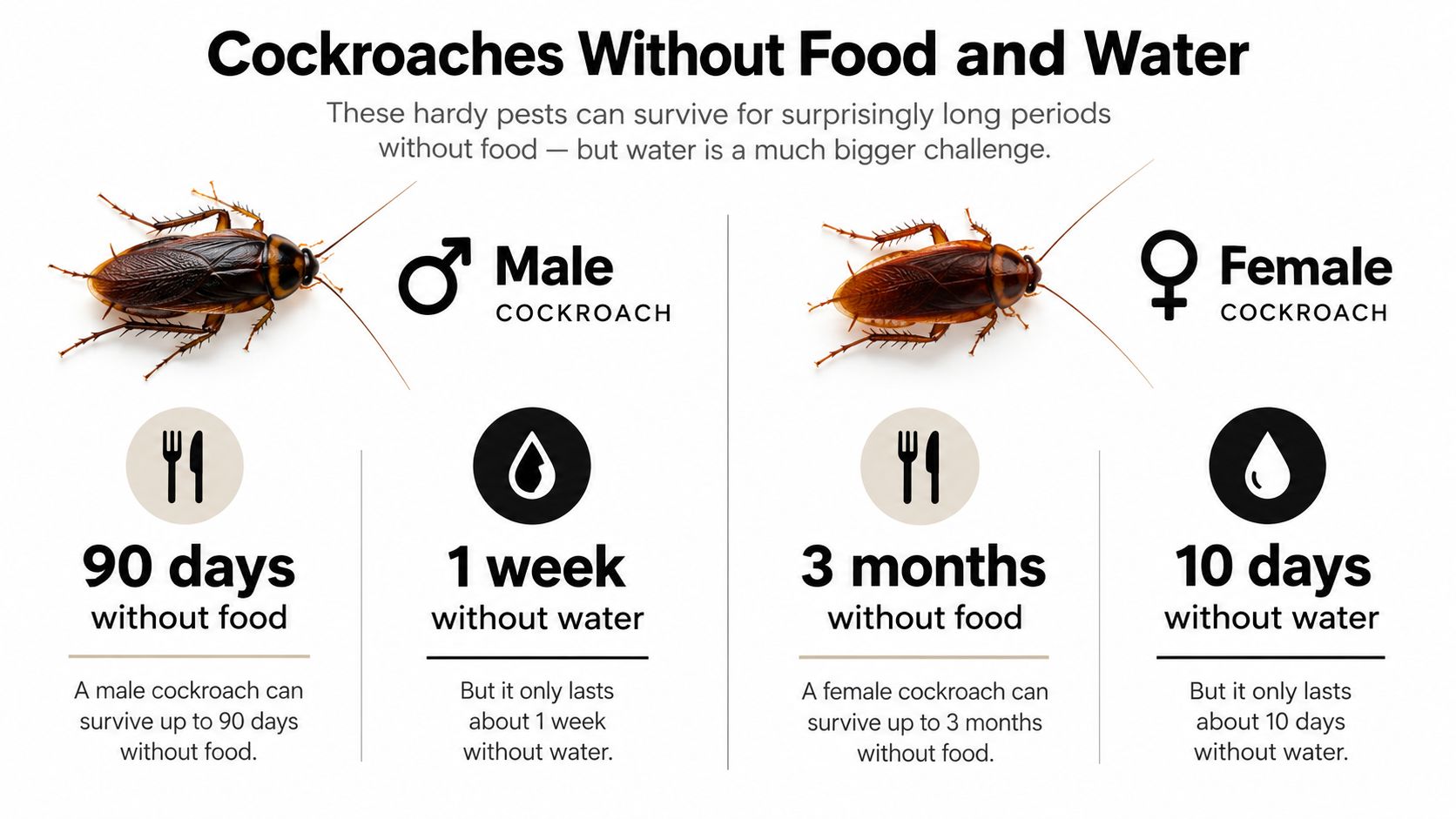
The familiar claim that cockroaches die after about a week without water is too simple for Miami conditions. A controlled study of German cockroaches found that gravid females given only water survived more than five weeks, while adult males and nymphs survived up to about two weeks. When both food and water were withheld, gravid females still survived more than two weeks, as reported in the controlled study of German cockroach survival.
Those findings don't mean a roach is invulnerable. They mean that removing visible crumbs isn't enough if moisture remains available. A kitchen can offer water through a slow faucet leak, a damp sink rim, a wet cabinet floor, or condensation around plumbing. A bathroom may provide moisture through drains, shower edges, toilet supply lines, or a wall cavity that never fully dries.
Water is the useful control lever
Food reduction still matters. Store pantry goods in sealed containers, remove grease, clean crumbs, and avoid leaving pet food exposed. But moisture control often determines whether those sanitation steps produce meaningful pressure on the population.
At higher humidity, survival can extend. In the controlled research, higher relative humidity extended survival, and at 80% humidity, food became the limiting resource rather than water. South Florida homes can therefore support cockroaches through humid air and tiny moisture sources even when residents maintain clean counters.
A short video can help homeowners visualize the survival issue, but the experimental result matters more than folklore:
Treat survival time and controllability as separate questions. A roach that can survive without normal food access may still be controlled by removing water, closing harborages, and applying an appropriate treatment to the correct species and location.
What Extends or Shortens a Cockroach Life
How long can a cockroach live in a Miami home? The more useful question is how long the population can persist. Temperature, humidity, food, water, shelter, and species interact. A clean kitchen may still support cockroaches if a plumbing void stays damp, while abundant food matters less when reliable water is absent.
Temperature changes development speed
Warm conditions generally speed development in many household species. Cooler conditions slow growth and activity, but temperature does not affect every cockroach equally. Species-specific tolerance, shelter, and access to resources determine whether eggs hatch and nymphs mature.
In Miami, seasonal temperature changes may alter where activity is concentrated rather than eliminate it. American cockroaches often remain associated with drains, sewers, and other damp areas. German cockroaches are more likely to persist in warm indoor kitchens, where appliances and cabinets provide stable conditions. A cooler outdoor area may suppress activity, while an indoor harborage continues supporting the population.
Humidity and water keep the system running
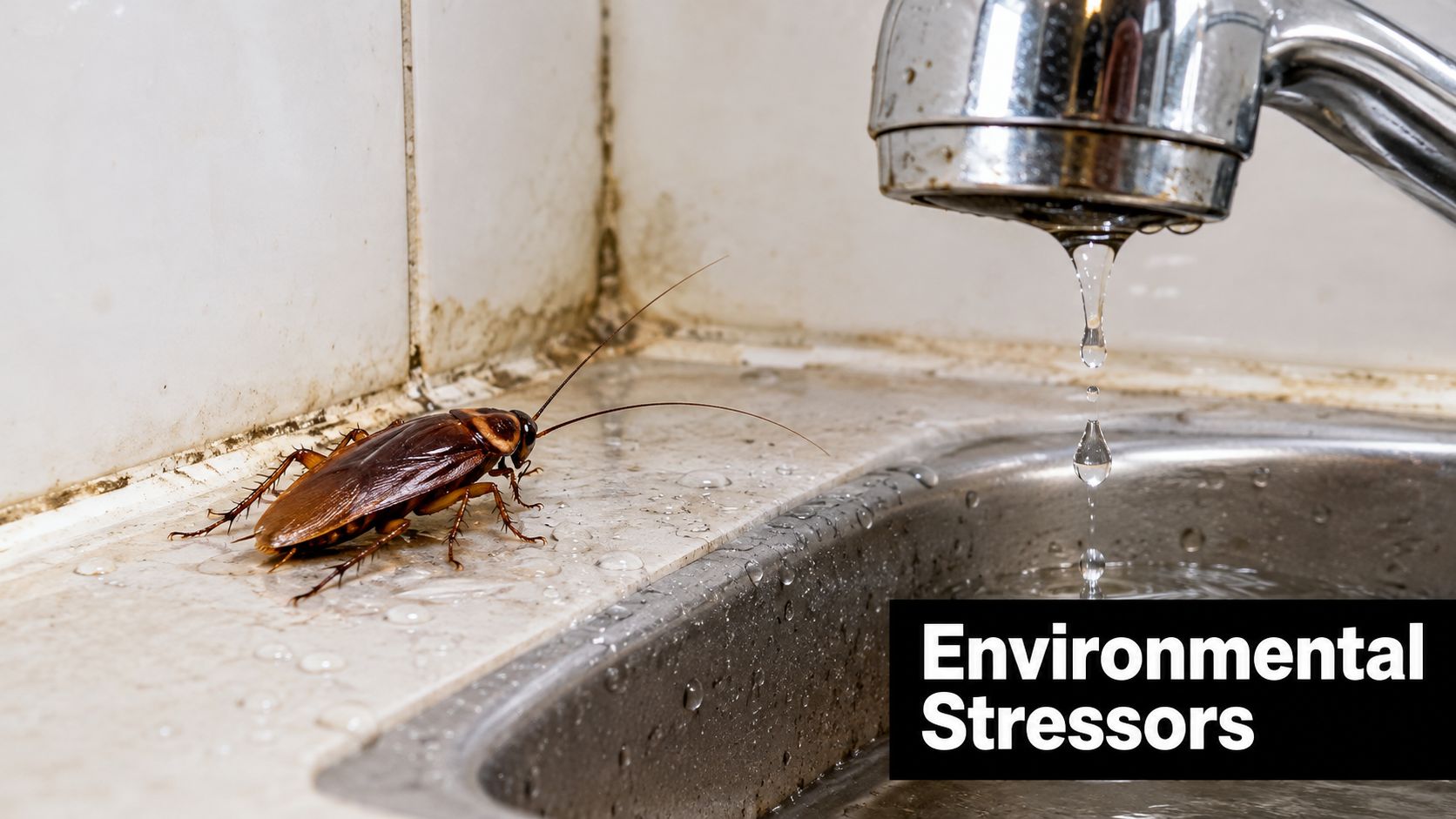
Humidity supports survival, and accessible water can offset limited food. Inspect places residents often overlook:
- Under sinks: Check damp cabinet floors, loose supply connections, and slow drips.
- Around air-conditioning equipment: Condensate and wet insulation can create hidden drinking points.
- Near drains: Floor drains, sink traps, and utility-room plumbing provide moisture and shelter.
- Inside walls: Plumbing penetrations and service chases may remain humid while the room appears dry.
Food affects growth, not just survival
Crumbs, grease, cardboard residue, pet food, and organic debris supply energy for activity and development. Removing them reduces available resources, but sanitation cannot compensate for a hidden water source or protected egg case.
Female adults recorded at room temperatures of 25–30°C showed a wide range of survival times, averaging approximately 450 days in one study. The published lifespan analysis supports a practical conclusion: conditions inside the same species can produce markedly different outcomes. For a Miami homeowner, locating moisture and shelter is therefore as important as removing food.
What Cockroach Lifespan Means for Treatment and Prevention
What should you do after spotting a cockroach? Let the evidence at the site guide the next move. A single large roach near a drain suggests an entry or moisture route. Several small roaches in a cabinet suggest nearby development, so inspect the cabinet, surrounding gaps, and adjoining plumbing before choosing a product.
Record the roach's size, color, location, activity time, and signs such as droppings, shed skins, or egg cases. This record helps distinguish a wandering adult from activity centered in the kitchen. It also gives a professional better information if treatment becomes necessary.
Use a simple decision guide
- One large roach near a drain: Check door thresholds, drain areas, plumbing openings, and outdoor access points. Correct entry routes and monitor for further activity.
- Small roaches or several life stages: Place monitoring traps, inspect nearby cracks and cabinet joints, and consider targeted baiting rather than relying on a surface spray.
- Activity near food storage: Remove residues, seal food, and use these pantry deep cleaning tips to organize cleaning. Sanitation removes accessible food, while repairs and exclusion address shelter and entry.
- Continued sightings after treatment: Recheck bait placement, moisture sources, and hidden gaps. A quiet night does not show that egg cases have hatched or nymphs have stopped developing.
Match treatment to the biology
Baits, monitoring traps, exclusion, and targeted applications can work together, but placement and product choice matter. Protected egg cases may remain unaffected, and nymphs can continue developing after adult activity declines. Follow-up should therefore cover the expected development window, not just the first night without a sighting.
Resistance can also explain poor results. Research on sampled German cockroach populations reported resistance mutations involving common insecticide groups, including a 57.1% frequency for one pyrethroid-resistance mutation and 94.2% frequency for one fipronil-resistance mutation. The same resistance and bait-performance research found at least 80% adult-male mortality after 28 days in tested bait products, with results varying among populations. These figures do not predict performance in one Miami home, but they show why repeated, poorly chosen sprays may fail.
Use these cockroach prevention steps to organize repairs, storage, exclusion, and monitoring. Contact a licensed professional if activity continues, several life stages appear, or cockroaches are using shared walls or utility spaces.
Key Takeaways and When to Get Professional Help
The answer to how long can a cockroach live is a range, not a promise. Many household cockroaches live 6–18 months, American cockroaches may span 1–2 years across their full life cycle, and German cockroaches can move through a much faster cycle. The population can persist longer than the adults you see because eggs and nymphs remain hidden.
Make these checks this week
- Identify the roach: Record its size, color, and location before buying a product.
- Remove moisture: Repair leaks, dry sinks, check condensate, and inspect damp plumbing spaces.
- Clean food sources: Seal pantry goods, remove grease, and avoid exposed pet food.
- Look for reproduction: Search for droppings, shed skins, egg cases, and small nymphs.
- Schedule follow-up: Recheck the area after treatment instead of assuming one application ended the cycle.
- Escalate when needed: Get professional help if sightings continue, multiple stages appear, or the problem involves shared walls, drains, or utility spaces.
A free, no-obligation match with a licensed, insured local provider can help Miami-Dade homeowners compare options without guessing at species or treatment. Pestless connects residents with vetted pest control professionals, but it doesn't perform the treatment itself.
Pestless Inc. connects Miami and Miami-Dade homeowners with licensed, insured pest control professionals for cockroach inspections and related pest problems. Describe what you're seeing through the short request process, then visit Pestless Inc. to get matched with a local provider and compare next steps without an obligation.
Dealing with this pest right now?
Pestless connects you with a licensed, insured Miami pest control provider for a free, no-obligation quote.