Basic rodent exclusion usually costs roughly $200 to $600, while full-home exclusion commonly falls around $500 to $3,000 or more, and exclusion is typically priced separately from trapping and cleanup. The right budget depends less on how many rodents you've seen than on how many entry points a technician must inspect, repair, and seal.
You hear scratching above the ceiling late at night. A few days later, droppings appear near the garage, and the traps catch something without stopping the noise. In Miami homes, that cycle can continue because removing a rodent doesn't close the opening it used to get inside.
Rodent exclusion addresses that structural problem. Think of your home like a boat with small leaks. Trapping removes what's already below deck, and cleanup removes the mess. Exclusion closes the leaks so the next rodent can't follow the same route.
The confusing part is that two homes with similar rodent activity can receive very different estimates. A condo with a few accessible utility gaps may need limited sealing. An older house with roofline openings, damaged vents, and crawlspace access points may require a much broader project.
This guide breaks the rodent exclusion cost question into practical scope tiers, explains what moves a quote higher or lower, and shows how to compare estimates without choosing between overpaying and under-sealing. Treat exclusion like weatherproofing, not like a quick visit for a single pest.
Table of Contents
- Introduction Why Rodent Exclusion Pays for Itself
- What Rodent Exclusion Really Means for Your Home
- How Much Rodent Exclusion Costs Today
- What Drives Your Final Rodent Exclusion Price
- DIY vs Licensed Pro Exclusion and When Each Makes Sense
- Miami Home Scenarios and Sample Estimates
- How to Budget Smart and Compare Zero Cost Quotes Through Pestless
Introduction Why Rodent Exclusion Pays for Itself
A Miami homeowner may start with one small clue, such as scratching in the attic, a musky smell near the garage, or droppings behind stored boxes. The first response is often a trap or bait service. That can address rodents already inside, but it doesn't necessarily stop another animal from entering through the same gap.
The frustration appears when the signs return. You may have paid for removal, cleaned the affected area, and still hear movement because the home's exterior remains open at a vent, pipe penetration, soffit, garage seal, or roofline joint. Exclusion is the part of the job that changes the building, not just the current rodent count.
Practical rule: Ask what will keep rodents out after the current animals are removed. If the answer doesn't include a property inspection and physical sealing, you may be paying for treatment without prevention.
The cost question deserves a clear answer because exclusion is structural work. A basic sealing visit might address a small number of visible openings, while a full-home project can involve several surfaces, access challenges, and repair methods. Market guides place basic residential exclusion around $200 to $600, while more complete sealing packages can reach $600 to $1,400 or $800 to $1,500 or more, depending on scope, as documented by HomeGuide's rodent removal cost guide.
That range isn't a contradiction. It reflects different definitions of “exclusion.” One provider may quote a few spot repairs. Another may inspect the entire exterior, screen vents, reinforce doors, work around the roofline, and include follow-up protection.
For a Miami homeowner, the useful question isn't, “How bad is the infestation?” It's, “How many ways can a rodent enter, and how difficult are those ways to close?” Once you view the project as home maintenance, the investment becomes easier to judge. A sealed home doesn't depend on repeated removal alone, just as a weatherproofed window doesn't need constant attention for the same draft.
What Rodent Exclusion Really Means for Your Home
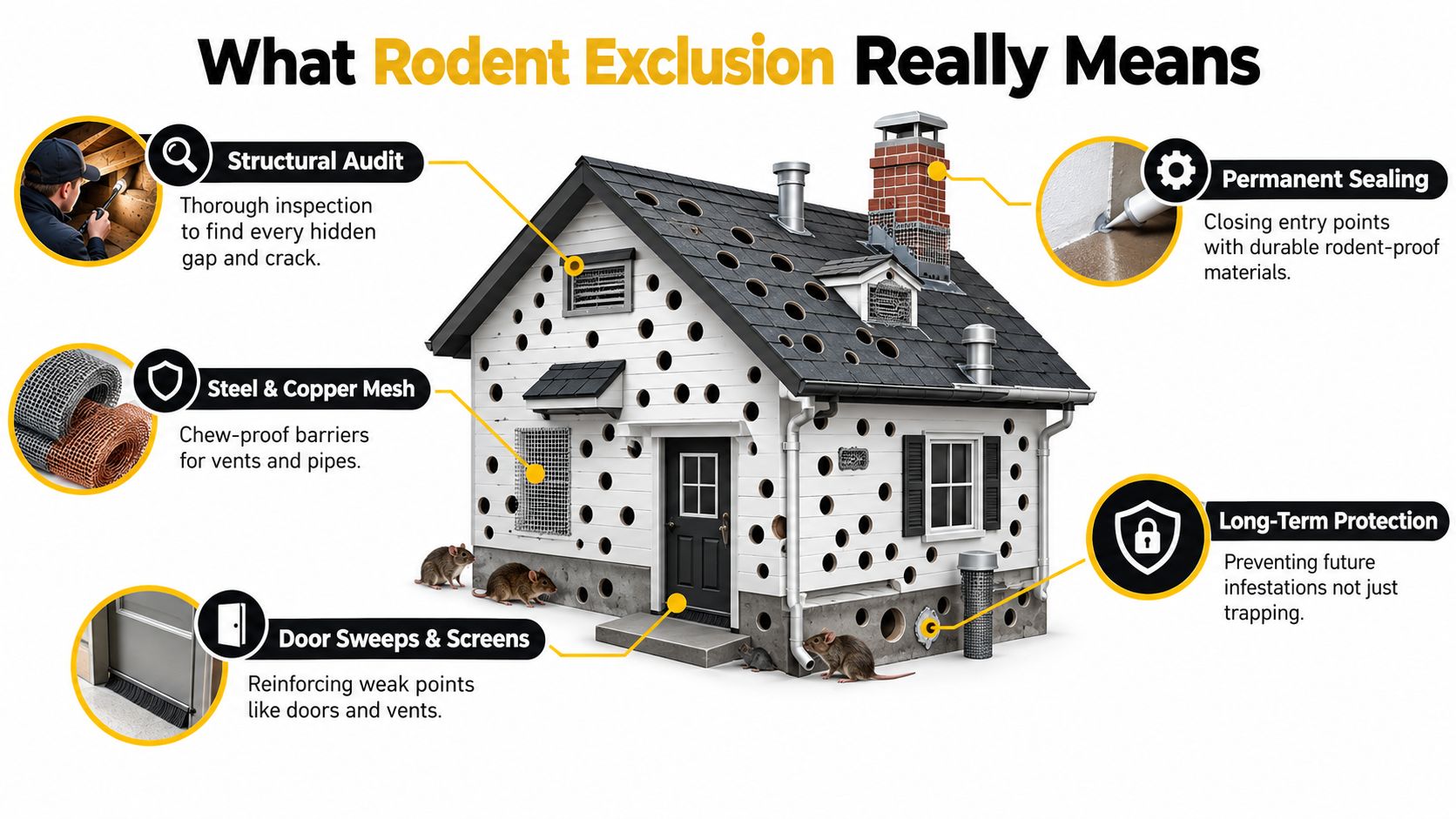
Rodent exclusion is a structural audit followed by permanent sealing. A technician examines the building envelope, identifies openings rodents can use, and matches each opening with a durable repair. The work may involve the foundation, siding, soffits, vents, utility penetrations, doors, roofline, attic, or crawlspace.
The house analogy is simple. Imagine your exterior as a sieve. Trapping empties the sieve, but it doesn't change the holes. Exclusion patches the holes with materials rodents can't easily chew through, then checks whether other weak points remain.
The work has several distinct parts
A thorough service generally follows this logic:
- Inspect the structure. The technician checks the perimeter, roofline, foundation, vents, doors, and places where pipes, wires, or air-conditioning lines pass through walls.
- Identify active routes. Droppings, rub marks, nesting material, and damage can help connect an opening to current activity.
- Choose the repair. A vent may need screening, a pipe gap may need mesh and sealant, and a larger structural opening may require metal flashing or hardware cloth.
- Seal and reinforce. The goal is a durable barrier, not a cosmetic patch that a rodent can pull apart.
- Confirm the scope. Trapping, sanitation, and follow-up may be included, or they may appear as separate line items.
Common materials include steel wool, metal flashing, caulk, hardware cloth, mesh screening, and door sweeps. The product matters, but placement matters just as much. A strong material installed over the wrong opening, or attached poorly to a damaged surface, can still leave a route open.
Exclusion isn't the same as removal
Trapping focuses on rodents already inside. Baiting also targets the current population. Sanitation addresses droppings, urine, nesting material, and damaged areas. Exclusion prevents new animals from entering by changing the structure.
That distinction explains why the work is usually quoted separately. A company must account for inspection time, repair materials, access, and the number and location of openings. Some providers also include a warranty or follow-up assessment because the value comes from preventing reinfestation, not only clearing the present activity.
The number of rodents you saw may help establish urgency, but it doesn't define the labor. One animal can enter through a difficult roofline gap, while several animals may be using an obvious garage opening that is simpler to repair.
How Much Rodent Exclusion Costs Today
The clearest way to understand rodent exclusion cost is to separate the project into scope tiers. The ranges below come from residential pricing guides and should be read as budgeting bands, not guaranteed Miami quotes. A provider still needs to inspect the property before assigning a precise price.
| Scope Level | Typical Price Range | What Is Included | Best For |
|---|---|---|---|
| Basic spot sealing | $200 to $600 | Sealing visible or limited entry points | Homes with a small, accessible repair scope |
| Standard exclusion | $500 to $1,500 | Broader inspection and multiple sealing points, often with durable materials | Typical homes needing more than one isolated patch |
| Comprehensive home sealing | $600 to $1,400 or $800 to $1,500 or more | More complete perimeter work, including several vulnerable areas | Homeowners seeking broader prevention |
| Full or complex-home exclusion | $500 to $3,000 or more | Structural sealing across multiple zones, with difficult access or substantial repairs | Older, larger, or complicated properties |
These ranges overlap because the labels aren't standardized. PestControlPricing's exclusion guide places complete home sealing around $500 to $3,000 or more, with age, construction type, size, and entry-point count affecting the final figure. A basic job might require only caulk, mesh, or a door sweep. A complex project may require metal flashing, hardware cloth, vent screening, and labor in areas that are difficult to reach.
Per-opening work can also change the estimate. One market guide lists exclusion doors at $200 to $400 each, which illustrates why a quote based on several separate openings can climb even when the overall infestation is limited. The issue isn't the pest's severity alone. It's the number of repairs and how much time each repair takes.
Read the quote by scope, not by the headline price
A low estimate may cover trapping and a few visible patches while excluding attic access, roofline inspection, vent screening, or cleanup. A higher estimate may include a more complete audit, durable materials, follow-up, and a prevention warranty.
Check whether the proposal lists:
- Inspection coverage: Does it include the foundation, roofline, vents, garage, attic, and crawlspace?
- Entry-point inventory: Are the identified openings described or photographed?
- Materials: Does the provider name hardware cloth, metal flashing, mesh, sealant, or door sweeps?
- Separate services: Are trapping, baiting, sanitation, insulation work, or repairs outside the exclusion price?
- Follow-up terms: Is a return inspection or warranty included?
The Pestless rodent removal cost guide can help you frame the difference between removal and structural prevention while reviewing estimates. If you need the removal and sealing handled as connected parts of the same problem, Rodent Control is described as removing rodents and sealing the way back in.
What Drives Your Final Rodent Exclusion Price
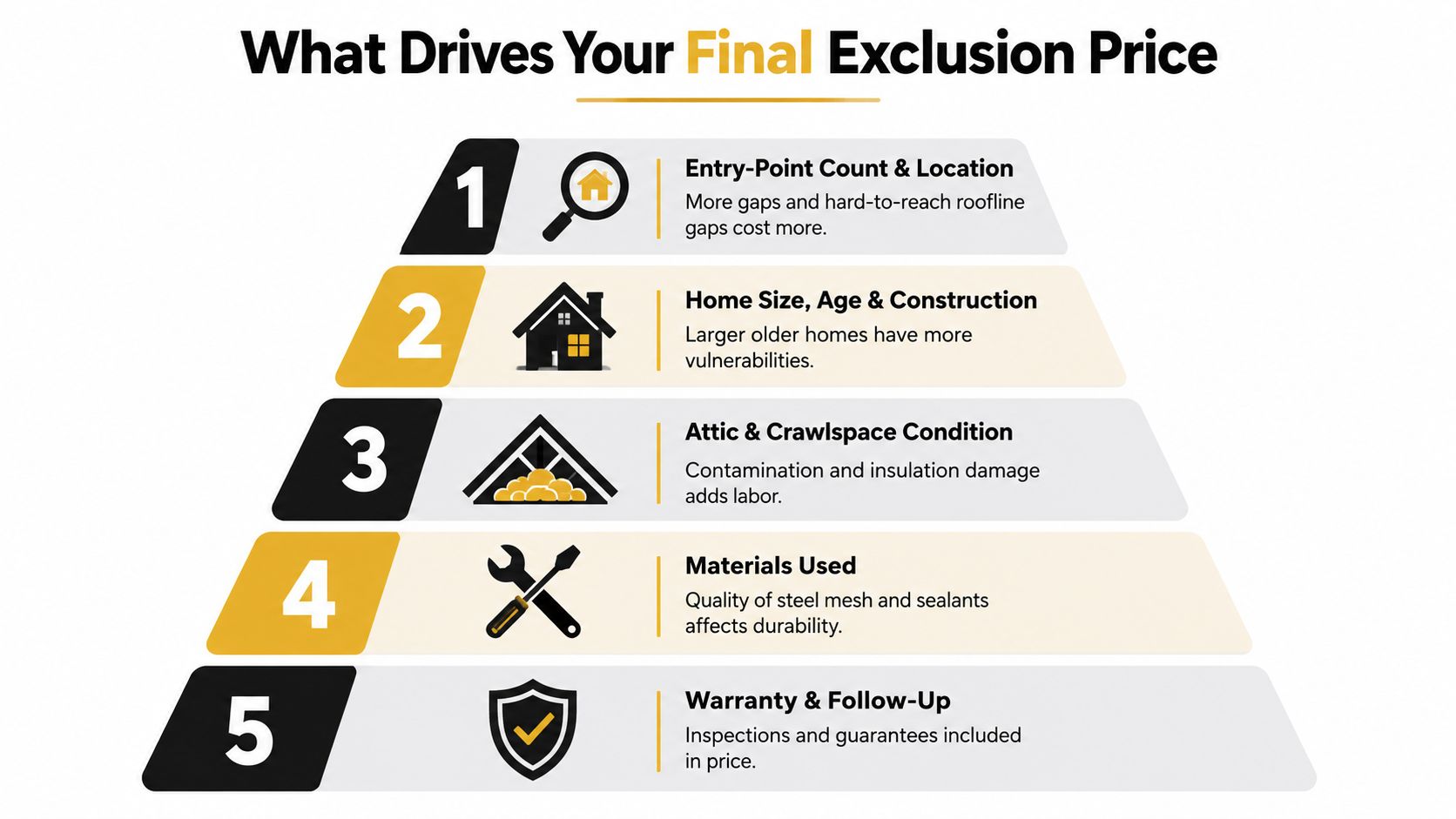
A quote rises when the technician must inspect more surfaces, reach harder locations, make more substantial repairs, or stand behind a broader result. The entry-point count is often more useful than the rodent count because each opening creates its own inspection, material, and installation task.
Entry points and location
Two gaps beside a garage door may be straightforward. Several openings spread across soffits, vents, roof edges, utility penetrations, and foundation transitions require a wider audit. A gap's location matters as much as its size. A technician can reach a low wall opening from the ground more easily than a roofline gap that requires ladder work, roof access, or specialized repair.
Home size, age, and construction
Larger homes offer more perimeter, more transitions between materials, and more possible vulnerabilities. Older construction may include worn screens, settled joints, deteriorated soffits, or previous repairs that no longer hold. Tile roofs, attached garages, complex additions, and mixed exterior materials can make the inspection less predictable.
A compact ranch with two accessible pipe gaps and an older two-story home with roof vents and crawlspace openings may have the same visible rodent activity. Their labor requirements can be completely different.
Attic and crawlspace access
Confined spaces add time and complexity. Technicians may need to inspect insulation, duct interfaces, framing gaps, vents, and signs of travel. If contamination or damaged insulation requires separate cleanup or replacement, those services should appear separately in the estimate rather than being hidden inside a vague exclusion line.
Materials and repair type
A small crack may need sealant. A damaged vent may need a chew-resistant screen. A larger opening may call for metal flashing or hardware cloth secured to the surrounding structure. The Pestless guide to rodent exclusion materials offers useful context for comparing what a provider proposes.
Labor, warranty, and follow-up
Peer-reviewed research involving three New Jersey apartment sites reported exterior exclusion costs of $2,500 in Trenton, $4,000 in Paterson, and $6,160 in New Brunswick, with interior exclusion costing $150 to $180 per apartment and labor-specific costs ranging from $117 to $139 per hour across those sites, according to the study summary on apartment rodent exclusion costs. Those figures concern apartment properties, not a standard Miami house, but they show how building scale and complexity can move exclusion into the thousands.
A warranty can also affect the upfront price. The warranty isn't just paperwork. It represents the provider's willingness to inspect the work again and address covered re-entry through the repaired areas.
DIY vs Licensed Pro Exclusion and When Each Makes Sense
DIY exclusion can make sense when the problem is narrow, visible, and safely accessible. A homeowner may be able to reinforce a small interior crack with caulk and steel wool, attach hardware cloth over a simple opening, or replace a worn door sweep. These repairs can be useful when they address a clearly identified gap rather than serving as a guess about where rodents enter.
The limitation is coverage. Homeowners usually see the opening near the droppings, not every route across the roofline, behind vents, around utility penetrations, or inside a crawlspace. A repair can look complete from the ground while leaving another access point untouched.
A practical comparison
| Consideration | DIY work | Licensed professional work |
|---|---|---|
| Scope | Usually limited to visible, reachable gaps | Can include a systematic exterior and interior audit |
| Materials | Hardware-store caulk, steel wool, and mesh | Metal flashing, chew-resistant mesh, screens, and matched sealants |
| Access | Limited by height, roof condition, and crawlspace safety | Uses appropriate equipment and trained installation methods |
| Warranty | Usually none | May include follow-up or prevention coverage |
| Risk | Missed openings can lead to repeat activity | A documented scope makes omissions easier to identify |
Safety should guide the decision. Roofs, soffits, ladders, tight crawlspaces, and attic insulation can create hazards unrelated to the rodent itself. A homeowner who isn't comfortable accessing those areas shouldn't treat a low material cost as the full price of the project.
A cheap patch isn't a bargain if it leaves the main entry route open.
A licensed professional brings a broader inspection, repair experience, and a defined scope. That doesn't mean every quote is automatically complete. Ask for photographs, materials, excluded work, and warranty terms. Compare the written scope rather than assuming a professional label guarantees identical service.
DIY is most reasonable for a small follow-up repair after the main route has been identified, or for a minor opening that doesn't require height or structural work. A professional is the safer choice when rodents have returned repeatedly, the home has multiple levels, the entry points are unclear, or attic and crawlspace access are involved. For prevention guidance around household openings, you can also review this guide to keeping mice out of a house.
Miami Home Scenarios and Sample Estimates
Miami properties vary sharply in construction, access, and exterior detailing. The examples below are illustrative scope comparisons, not promised quotes. They apply the verified residential pricing bands to common property types without treating square footage or pest severity as the only measure.

Brickell condo with limited exterior access
A condo unit may have a small number of utility penetrations, a door sweep, or a vent interface that needs reinforcement. Exterior walls, roof areas, and shared building components may fall under association management, so the first task is confirming which repairs the unit owner can authorize.
If the scope is limited to accessible openings, the budget may align with basic exclusion around $200 to $600, based on HomeGuide's residential exclusion ranges. Trapping and cleanup may still be separate.
Kendall single-family home with attic vents and garage gaps
A suburban home with garage-door gaps, attic vents, pipe penetrations, and a few foundation openings needs a broader perimeter review. The technician may need to screen vents, reinforce the garage transition, and seal several materials where they meet.
That scope can move toward standard exclusion around $500 to $1,500, depending on the number and accessibility of repairs. The price difference from the condo doesn't necessarily mean more rodents. It reflects more exposed building surfaces and more installation tasks.
Older Coconut Grove home with tile roof and crawlspace vents
An older home with tile roof details, soffit gaps, damaged screens, and crawlspace vents presents a more complex audit. Roofline access and confined-space inspection can add labor, while deteriorated openings may require metal repair rather than simple sealant.
A complete project may fall into the $500 to $3,000 or more full-exclusion band described by PestControlBusinesses' rodent control pricing information. The final figure depends on documented scope, materials, and whether sanitation or structural repair is separate.
How to Budget Smart and Compare Zero Cost Quotes Through Pestless
Start by writing down what you know. Note where you heard scratching, where you found droppings, whether activity has returned after trapping, and which exterior areas seem damaged. Photos of garage seals, vents, pipe openings, soffits, and foundation gaps can make quote conversations more precise.
Ask each provider for the same information:
- Entry-point inventory: Request a written list or photographs of every opening included.
- Material schedule: Confirm whether the work uses hardware cloth, metal flashing, mesh, sealant, screens, or door sweeps.
- Service boundaries: Separate exclusion from trapping, baiting, sanitation, insulation replacement, and structural repairs.
- Access assumptions: Ask whether attic, crawlspace, roofline, garage, and shared condo areas are included.
- Warranty terms: Find out what follow-up covers, how long it applies, and which repairs are excluded.
Compare two or three quotes on equal scope, not just on total price. A cheaper estimate may omit hard-to-reach areas, while a higher estimate may include a broader audit and follow-up. You can reduce unnecessary cost by repairing obvious homeowner-maintenance items before the inspection, asking whether trapping and exclusion can be coordinated, and prioritizing openings that are clearly connected to active travel routes. Don't remove difficult areas from the scope just to make the estimate look smaller.
Pestless Inc. connects Miami and Miami-Dade homeowners with licensed, insured pest professionals through a 60-second form or phone call. Requests can be matched with local providers, and the service offers zero-cost, no-obligation quote requests rather than performing pest treatments itself.
Pestless Inc. can help you request zero-cost, no-obligation quotes from licensed, insured local professionals for a rodent exclusion project. Visit Pestless Inc., describe the entry points and activity you've noticed, and compare the proposed scope before choosing who will seal your Miami home.
Dealing with this pest right now?
Pestless connects you with a licensed, insured Miami pest control provider for a free, no-obligation quote.