You're in your Miami home after a heavy rain, wiping a faint line of dirt from the base of a wall. A door that used to close easily now sticks. Near a window, you notice tiny pellets that look like sawdust. Nothing appears seriously damaged, so it's tempting to clean up and wait.
That's how a termite infestation in a house often begins for homeowners, with clues that seem unrelated and damage that stays out of sight. Termites can hollow wood from the inside, move through foundations and wall cavities, and weaken lower structural components before a homeowner sees obvious evidence. In the United States, termites damage approximately 600,000 homes each year and contribute to about $5 billion in annual control and repair costs, with some estimates exceeding $6.8 billion after inflation adjustments (Science Publishing Group).
This guide follows the practical path a homeowner needs: recognize subtle signs, understand where damage develops, account for Florida's climate and termite species, arrange a proper inspection, compare treatment approaches, and reduce the conditions that invite termites back. You don't need to identify every insect yourself. You do need to know when a small clue deserves a licensed evaluation.
Table of Contents
- Introduction to Termite Infestation in Your House
- How Termite Infestation Damages a House Over Time
- Early Warning Signs of Termite Infestation to Watch For
- Common Florida Termite Species Found in Homes
- How Professional Termite Inspection and Assessment Works
- Treatment Options Timelines and Cost Considerations
- Preventing Future Infestation and Choosing Trusted Local Help
Introduction to Termite Infestation in Your House
A termite problem can develop while your Miami home appears ordinary. A windowsill may hold discarded wings, a foundation may show a thin mud tube, or trim may sound hollow when tapped. These clues can look minor because termites often work behind surfaces rather than across open floors.
That creates a gap between what a homeowner can see and what may be happening inside the structure. A 2026 NPMA/Harris Poll found that only 58% of U.S. homeowners recognized the potential harm termites can cause, meaning 42% did not recognize that risk (NPMA). The figure does not mean every homeowner who missed the risk has active termites. It shows why a quick visual check may provide false reassurance.
Why Miami homes need a local lens
Miami's warmth, humidity, rainfall, irrigation, dense landscaping, and wood near soil or moisture can create favorable conditions for termite activity. These conditions do not prove an infestation. They do mean that a small surface clue deserves more attention when it appears near a foundation, damp area, window, door, or other vulnerable connection.
Florida's risk also extends beyond South Florida. Recent reporting indicates that two highly destructive invasive termite species have spread beyond South Florida, threatening homes and buildings across much of the state (University of Florida). Homeowners should therefore treat termite concerns as a statewide issue, not one limited to a particular coastal neighborhood or property style.
What “early” really means
Early action means saving the evidence, correcting moisture or access conditions, and arranging an inspection before choosing chemicals or repairs. A homeowner who finds termite damage is commonly cited as spending about $3,000 on repairs, illustrating how concealed activity can become costly (Science Publishing Group).
The practical decision is simple: ask whether the evidence or property conditions justify a licensed inspection. You do not need to identify every insect first. You need enough awareness to avoid treating hidden structural risk as a cosmetic problem.
How Termite Infestation Damages a House Over Time
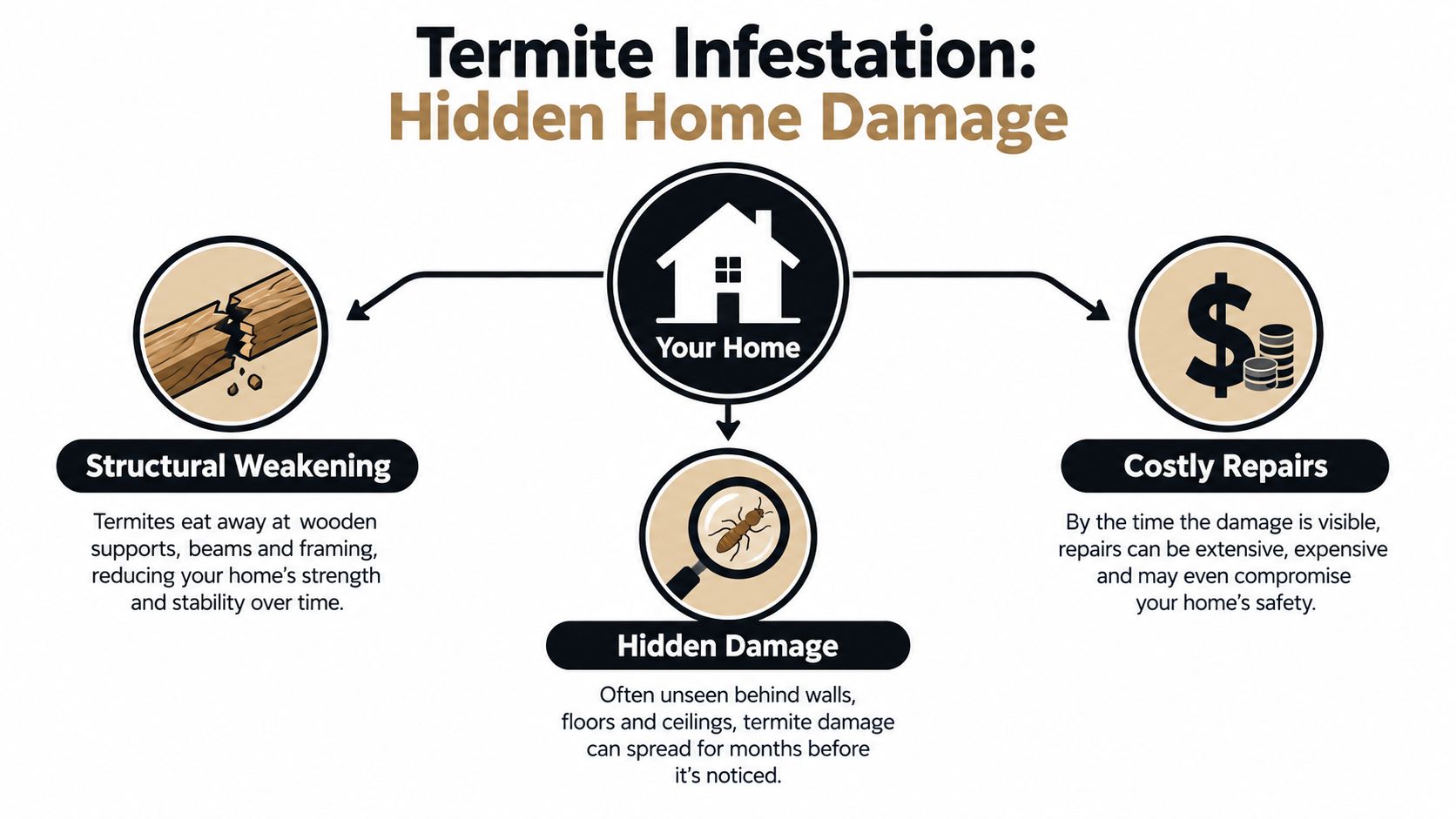
Think of your home as a wooden framework covered by protective layers. Termites behave like concealed carpenters, but they don't remove wood in a neat, visible renovation. They travel through protected routes and consume vulnerable material inside trim, sills, floors, pillars, and framing.
The damage path
Access begins at a vulnerable point. Subterranean termites commonly approach through soil, foundation edges, cracks, damp zones, landscaping, or wood that sits close to the ground. Lower areas are especially important because they connect the soil environment to the house.
Workers feed inside the wood. The exterior surface can remain intact while internal galleries develop. This is why a board may look solid but sound hollow when tapped or feel weak when gently probed.
Moisture helps maintain the route. Damp soil, poor drainage, leaks, condensation, and inadequate ventilation can make lower structural areas more favorable. Moisture doesn't prove termite activity, but it can create conditions that deserve closer inspection.
Strength decreases gradually. Sills, pillars, floors, walls, doors, and windows can lose material over time. When termites attack parts that help transfer or support loads, the concern shifts from cosmetic damage to structural performance.
A field survey of 134 houses in Jakarta found that the worst residential damage occurred in sills, and that building age and condition were linked with infestation intensity. The same study identified four termite species, with Coptotermes curvignathus accounting for 61.14% of cases (Biosaintifika study).
Why lower components fail first
A study of termite-damaged traditional houses found that 51% were infested by Coptotermes gestroi and Nasutitermes matangensis. Lower structural elements, including pillars, floors, walls, doors, and windows, were frequently attacked and severely damaged, reducing the structural integrity of the houses (PMC study).
The practical lesson is simple: don't inspect only the visible center of a room. Pay attention to the places where wood, soil, water, and poor airflow meet. A termite problem can start low and remain hidden while the visible finish above it continues to look normal.
If you're dealing with a different household pest, such as bed bugs, Bed Bug Treatment addresses every life stage, including bugs and eggs. Termite treatment requires a separate inspection and control plan because the target is structural activity rather than an insect population in bedding or furniture.
Early Warning Signs of Termite Infestation to Watch For
The strongest early clues aren't always live termites. In fact, homeowners often find evidence of movement, feeding, or shelter rather than the insects themselves.
Use a room-by-room scan
Start outside, then work upward and inward. Don't scrape away suspicious material before photographing it, because removal can erase the location and appearance of useful evidence.
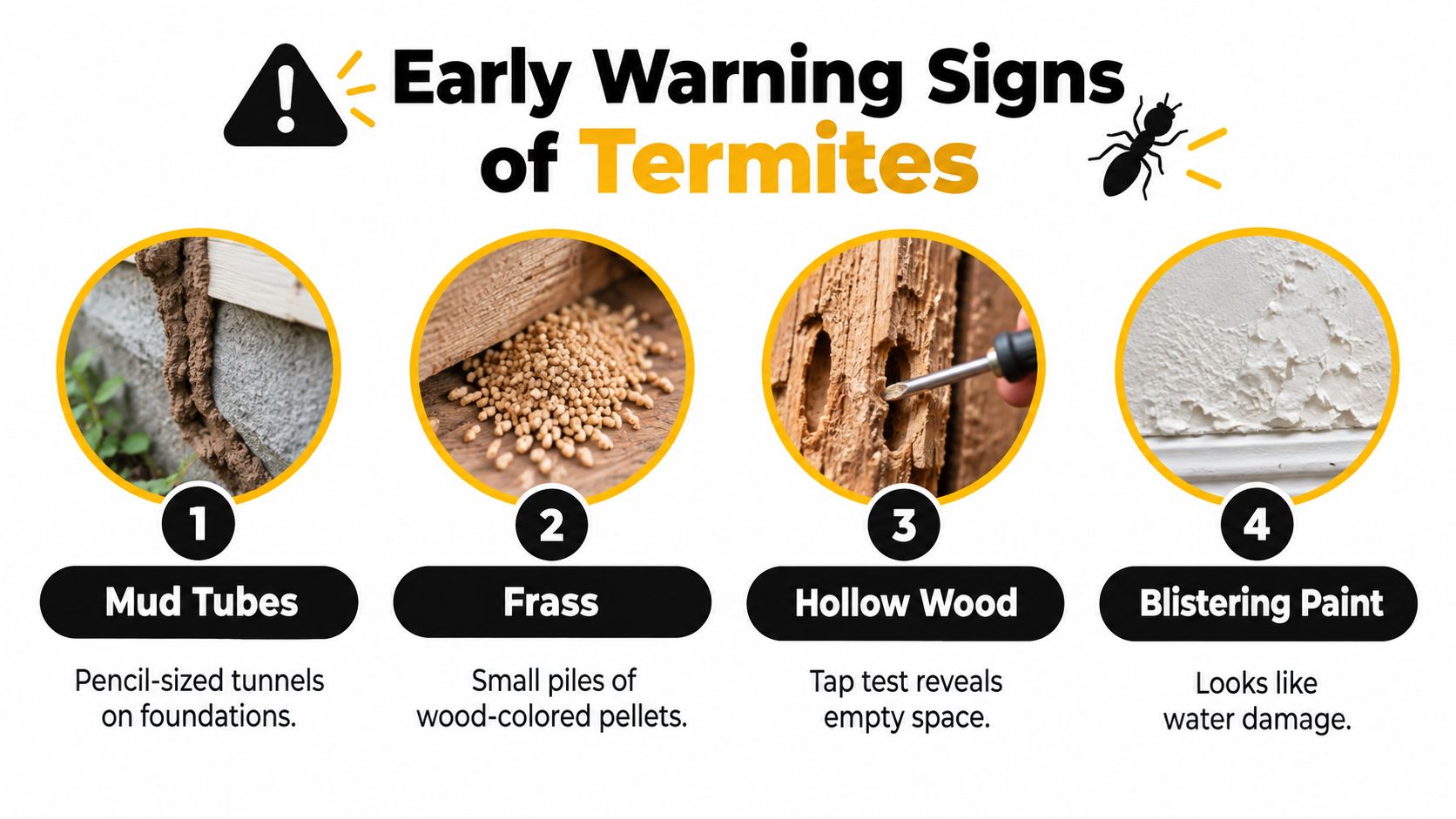
- Mud tubes: Look for narrow earthen pathways on foundation walls, slab edges, porch supports, crawlspace surfaces, or other routes between soil and wood. A tube suggests protected travel, but only an inspection can determine whether it's active.
- Frass: Drywood termite droppings can appear as small, wood-colored pellets beneath trim, furniture, window frames, or other wood. A fresh pile may indicate activity above it, but old pellets can remain after activity stops.
- Hollow wood: Tap trim, baseboards, sills, exposed beams, and frames with the handle of a tool. A hollow sound doesn't prove termites, yet a sudden change in sound deserves attention, especially beside moisture or other signs.
- Blistering paint: Bubbling or blistered paint can resemble water damage. Moisture may be the cause, termites may be involved, or both conditions may exist together.
- Sticking doors and windows: Warped frames can result from humidity, settlement, swelling, or termite-related weakening. Treat this as a clue to investigate, not as a diagnosis.
- Discarded wings: Wings near windows, doors, lights, or other openings can indicate swarmers nearby. Flying ants can look similar, so identification matters.
- Soft or uneven floors: Spongy boards, buckling, sagging, or localized weakness can indicate damage beneath the finished surface. Don't remove flooring or open walls merely to search without professional guidance.
Hidden signs require a different response
A clean wall doesn't rule out termites. Infestations may sit inside wall cavities, behind trim, beneath floors, or near foundations where ordinary cleaning and casual visual checks won't reveal them.
Practical rule: If you find two clues in the same area, such as a mud tube beside damp wood or frass beneath damaged trim, stop treating them as isolated maintenance issues and arrange a licensed inspection.
The awareness gap is especially important in Florida. The fact that many homeowners don't recognize termite harm means waiting for obvious collapse is a poor detection strategy. Preserve what you found, note the location, correct obvious moisture sources where safe, and avoid covering the area with paint or new trim before it's assessed.
Common Florida Termite Species Found in Homes
A termite clue on a Florida home's foundation does not point to the same risk as pellets beneath an upper window. Species behavior helps explain why an inspection must follow the evidence, rather than rely on one method. Subterranean termites usually need soil access and protected routes. Drywood termites can remain inside relatively dry wood above ground.
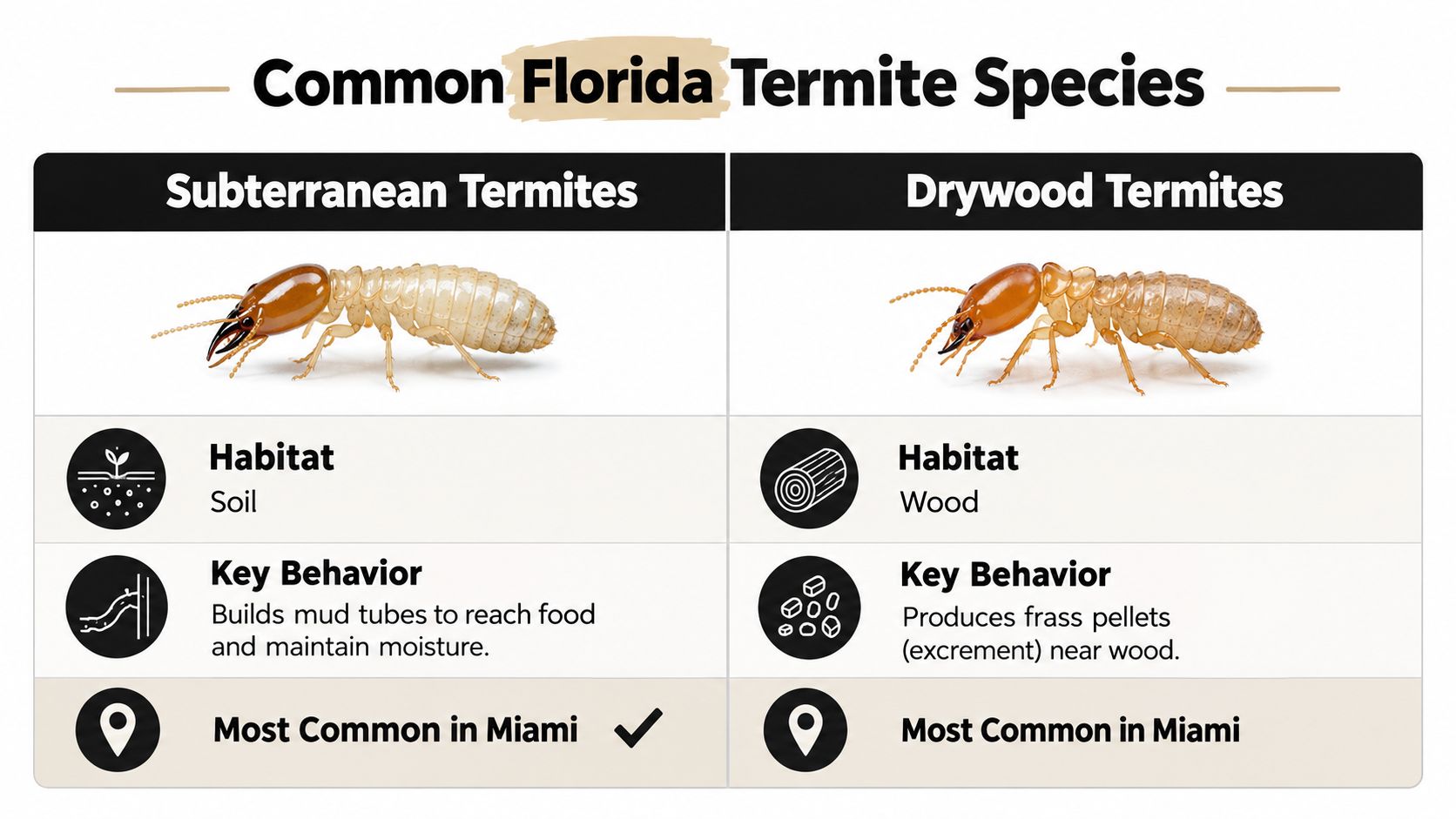
Subterranean termites
Subterranean termites establish colonies in or near soil, then travel through sheltered paths to reach wooden parts of a house. In a Miami property, those routes may include foundation edges, slab penetrations, crawlspaces, porch supports, irrigation zones, damp landscaping, and wood touching soil.
The familiar mud tube works like a covered walkway between the ground and the structure. A tube on a foundation or beside a wooden support therefore deserves more attention than an unrelated patch of dirt. Depending on the inspection findings, control may involve soil or foundation treatment, baiting, monitoring, or a combination of methods.
Drywood termites
Drywood termites can occupy wood without the same direct soil connection. Possible locations include window frames, roof areas, furniture, doors, and trim. Their common clue is frass, small pellets pushed from galleries through tiny openings. The pellets resemble coarse grains falling from a hidden pocket inside the wood.
One visible pile may mark only a local area. Other colonies or galleries can be elsewhere, so the search may need to extend to attic framing, roof sheathing, exposed beams, upper window assemblies, and furniture instead of stopping at the foundation.
Why Florida's map is changing
As noted earlier, University of Florida researchers reported that destructive invasive species have expanded beyond South Florida, increasing the risk to buildings across much of the state. A home outside the traditional high-concern area can still face termite pressure. Florida's changing species distribution makes location alone a weak reason to dismiss a hidden problem.
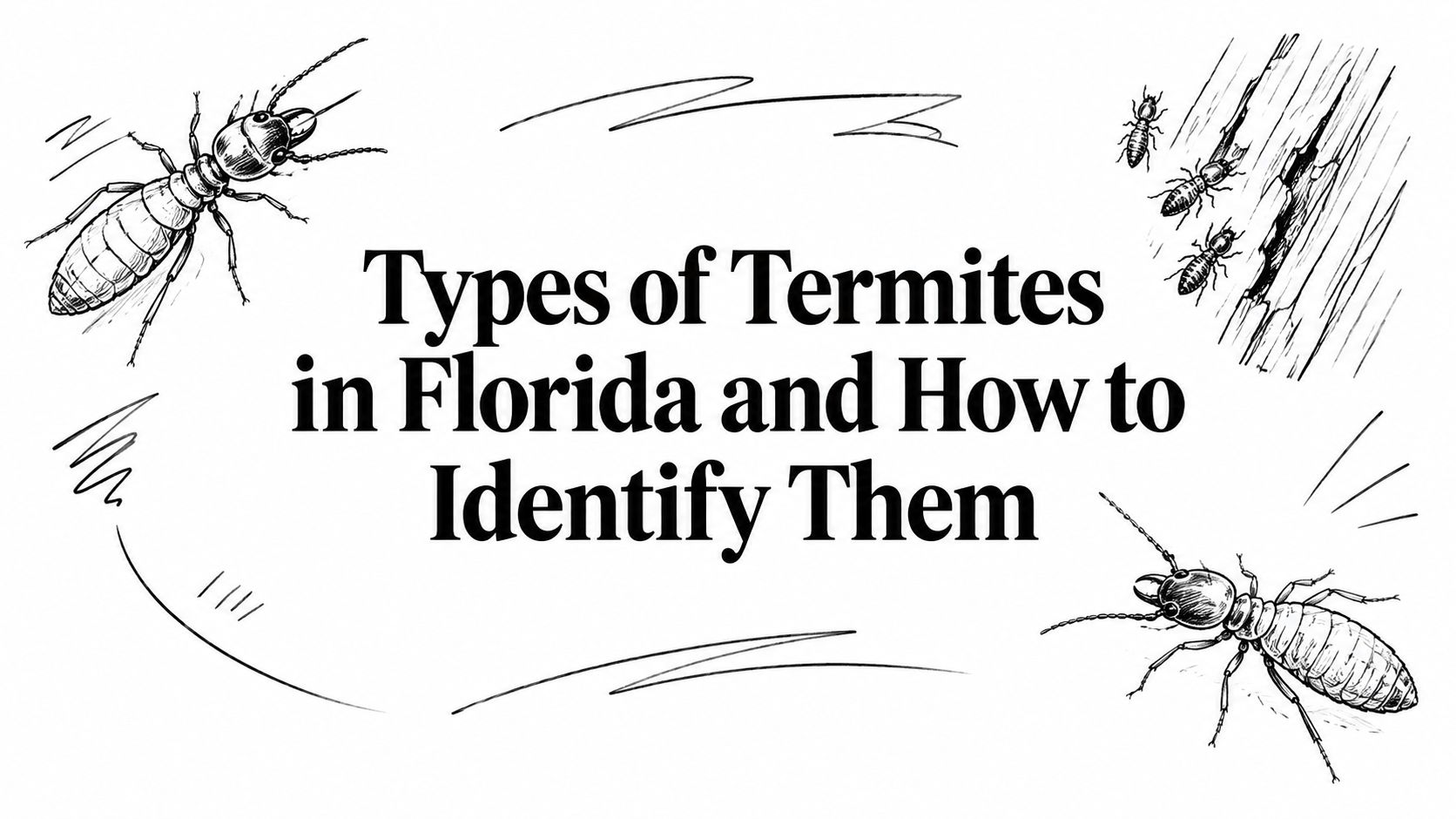
For a visual comparison, review this guide to types of termites in Florida. If evidence suggests activity, Termite Control can address the risk before concealed damage spreads.
Species identification affects treatment, but a photograph cannot show the colony's location, extent, construction conditions, moisture, or access. Move from suspicion to a licensed inspection before choosing fumigation, bait, or liquid products.
How Professional Termite Inspection and Assessment Works
A professional inspection should answer more than “Are there termites?” It should establish where evidence appears, whether activity may be current, which conditions support it, and what parts of the structure need further evaluation.

What the inspector checks
A careful inspection usually moves from the lower structure upward, because the foundation and moisture zones often reveal how termites may enter. The inspector may examine:
- Foundation perimeter: Look for mud tubes, cracks, soil contact, landscaping bridges, and damp areas.
- Crawlspaces or accessible lower areas: Check sills, joists, pillars, supports, and flooring for softness, galleries, frass, or shelter routes.
- Interior rooms: Inspect baseboards, door and window frames, plumbing penetrations, kitchens, bathrooms, laundry areas, and places where paint or wood has changed.
- Attic and roof framing: Look for drywood evidence, previous leaks, damaged sheathing, and accessible wood members.
- Moisture sources: Consider drainage, irrigation, leaks, condensation, ventilation, gutters, and standing water.
- Construction vulnerabilities: Note wood-to-soil contact, blocked access, concealed framing, and areas that could not be inspected.
Building age and condition matter. Surveys in different regions have associated infestation with older, untreated, or poorly maintained structures. One Benue State survey reported evidence in 71.4% of inspected houses, while other rural surveys reported infestation in 35.85% and 91% of homes, respectively, demonstrating that risk varies by location and construction conditions (termite damage survey summary).
Read what to expect during a termite inspection before scheduling so you can ask how the professional will document inaccessible areas and distinguish visible damage from suspected activity.
A short video can help homeowners understand the inspection mindset before a visit.
What a useful report should include
Ask for photographs, locations, observed evidence, moisture or access conditions, areas not inspected, and a clear separation between active signs, old damage, and recommendations for structural assessment. If a load-bearing component appears compromised, a contractor or structural engineer may need to evaluate repairs separately from pest treatment.
Call a licensed professional when you find mud tubes, frass, discarded wings, hollow or soft wood, repeated moisture damage, or unexplained floor and frame changes. You don't need to wait until you see live termites.
Treatment Options Timelines and Cost Considerations
At first, a small patch of damaged wood may seem like a limited repair. The treatment choice depends on what is causing the activity, where termites are traveling, and which parts of the structure can be reached. A localized drywood infestation may need a different plan from subterranean termites moving through soil near the foundation. The same visible sign can also lead to different recommendations because construction, access, and moisture conditions vary.
| Treatment Approach | Best For | Typical Timeline | Key Considerations |
|---|---|---|---|
| Liquid barriers | Subterranean activity around soil, foundations, or entry routes | Planned after inspection, with follow-up based on the provider's program | Requires careful application, access planning, and attention to drainage and construction details |
| Bait systems | Monitoring and managing subterranean termite activity around a structure | Ongoing monitoring rather than a single visit | Stations need inspection, documentation, and maintenance; placement depends on the property |
| Spot treatments | Confirmed, localized activity in accessible wood | May be completed in a focused service visit, followed by verification | A spot treatment can miss concealed or separate areas if the inspection scope is incomplete |
| Whole-structure fumigation | Broad or inaccessible drywood infestation when the licensed provider determines it's appropriate | Requires preparation, coordination, and temporary vacancy | The decision depends on species, extent, structure, safety requirements, and local regulations |
What changes the price
A quote is shaped by the problem being treated, not just by the size of the house. Cost drivers include the size and design of the structure, termite species, number of affected areas, access limitations, moisture correction, repair needs, monitoring requirements, and whether treatment covers one location or the whole building.
Treatment and repairs are separate decisions. A control plan may stop or manage termite activity, but it does not restore weakened wood, flooring, drywall, paint, or structural supports. The commonly cited $3,000 average repair benchmark for homeowners who discover termite damage shows why delayed detection can raise the repair side of the decision, as noted earlier.
A useful quote should answer these questions:
- What evidence supports the recommended treatment?
- Which termite type is suspected or confirmed?
- Which areas are included or excluded?
- How will activity be checked afterward?
- Does the price include moisture corrections, repairs, monitoring, or only insect control?
- What preparation, access, vacancy, and follow-up are required?
The timeline also matters. Bait systems involve repeated monitoring, while fumigation requires preparation and temporary vacancy. Spot treatment may be focused, yet concealed activity can remain if the inspection did not cover connected or inaccessible areas. For Florida-specific budgeting guidance, review termite treatment cost in Florida, then request itemized estimates from licensed providers.
Preventing Future Infestation and Choosing Trusted Local Help
Prevention starts with making the house less connected to the conditions termites use. In Miami-Dade, inspect drainage after heavy rain, keep irrigation from repeatedly wetting foundation walls, maintain airflow in enclosed areas, and correct leaks before damp wood remains exposed.
Build a practical maintenance rhythm
- After major rain: Walk the foundation and look for new mud tubes, standing water, soil movement, or wet wood.
- During yard work: Keep mulch, stacked lumber, branches, and firewood from creating concealed contact with the structure.
- During repairs: Don't cover suspicious wood with paint, trim, or flooring until it's evaluated.
- Around plumbing and air conditioning: Check for recurring leaks, condensation, or dampness near walls and floors.
- At inspection time: Keep access available to crawlspaces, attic areas, utility zones, porches, and foundation edges.
Prevention doesn't replace treatment when an infestation is active. It reduces invitations and helps a professional interpret the property's risk more accurately.
Choose help that can document the work
Verify that the provider is licensed and insured in Florida, explains the inspection findings, identifies limitations, provides written treatment details, and describes follow-up monitoring. Be cautious when a quote recommends a product before anyone has inspected the structure, or when the provider won't explain whether the plan targets subterranean or drywood behavior.
Pestless Inc. connects Miami and Miami-Dade homeowners with licensed, insured pest control professionals. It doesn't perform treatments itself. Instead, homeowners can describe the issue through a short form or phone call and receive introductions to local providers so they can compare zero-cost, no-obligation quotes.
The most useful next step is straightforward: photograph the evidence, note where and when you found it, correct safe moisture issues, and arrange a licensed termite inspection. Don't wait for visible structural failure to confirm that a hidden risk deserves attention.
If you've found mud tubes, frass, hollow wood, sticking frames, or other signs of a termite infestation in your house, visit Pestless Inc. to describe the problem and connect with licensed, insured Miami-area professionals. Request zero-cost, no-obligation quotes, compare your options, and choose a documented inspection and treatment plan that fits your home.
Dealing with this pest right now?
Pestless connects you with a licensed, insured Miami pest control provider for a free, no-obligation quote.