You're days from closing when the lender sends one more condition: a termite inspection for mortgage underwriting. The home looks solid, the general inspection found no obvious structural issue, and the closing date is already on the calendar. Then the wood-destroying organism report reveals inaccessible areas, an old treatment, or evidence that requires follow-up, and the transaction suddenly has a deadline problem.
That situation is avoidable. The key is to treat the inspection as a loan-timing requirement, not a casual pest check. Your loan program, property location, appraiser findings, report date, and lender instructions all determine what must happen before the lender can fund.
Table of Contents
- Why Mortgage Lenders Care About Termites
- When a Termite Inspection Is Actually Required
- Decoding the Wood-Destroying Organism Report
- Timelines and the 90-Day Validity Trap
- Inspection Costs and Who Pays the Bill
- Navigating Inspections in High-Risk Markets Like Miami
- Finding a Licensed Inspector and Closing the Deal
Why Mortgage Lenders Care About Termites
A lender isn't lending against your opinion of the house. The property itself secures the loan. If termites have weakened structural wood, the lender has a collateral problem, even if the damage isn't obvious during a casual walk-through.
That's why a wood-destroying organism, or WDO, report matters. It gives the underwriting file a formal record of what the inspector examined, what was visible, what couldn't be accessed, and whether the property shows infestation, prior treatment, or damage. The lender isn't just asking whether you dislike insects. It's asking whether the building supporting the loan has an unresolved biological or structural risk.

A clean home can still create a lending issue
Suppose a buyer is purchasing a house in a high-risk region. The visible living areas look well maintained, but the inspector can't reach part of the crawlspace or attic. The report may not say termites are present. It may say the area wasn't inspected. That distinction can still matter because the underwriter doesn't have enough evidence to close the risk question.
A general home inspection doesn't automatically solve that problem. A WDO inspection is a separate service, and the formal report must satisfy the lender's requirements. If the report identifies active infestation or visible damage, the lender may require treatment, repairs, additional documentation, or a clearance before closing.
Practical rule: Treat the WDO report like an underwriting document, not a courtesy inspection.
You can learn the visible warning signs in this guide to identifying termite damage, but visible signs aren't the same as a lender-acceptable report. The inspection has to document the property's accessible envelope clearly enough for the loan file.
That's the risk in a termite inspection for mortgage financing. A modest inspection issue can become a funding issue when the report is incomplete, the finding is unresolved, or the closing date leaves no room for treatment and reinspection.
When a Termite Inspection Is Actually Required
There isn't one national rule that makes a termite inspection mandatory for every purchase. The requirement usually comes from the loan program, property location, appraiser observations, state or local rules, and lender overlays.
VA financing is the clearest example. VA loans require pest inspections in more than 30 states and territories, plus some counties in eight additional states, according to mortgage guidance on pest inspections and VA requirements. The VA framework also uses a Termite Infestation Probability Map. Wood-destroying insect information is mandatory in areas rated moderate-to-heavy or very heavy.
FHA treatment is more conditional. An FHA loan generally requires the inspection when the appraiser finds evidence suggesting possible infestation, or when state, local, or lender rules trigger the requirement. Conventional loans usually follow the same practical pattern, but a lender can still impose its own condition.
Mortgage Program Inspection Triggers
| Loan Type | General Requirement | Geographic / Appraiser Triggers |
|---|---|---|
| VA | Required in designated areas | VA risk zoning, local rules, lender requirements, or applicable property conditions |
| FHA | Usually conditional | Appraiser evidence, state or local rules, or lender requirements |
| Conventional | Not universally required | Lender overlays, appraiser findings, contract terms, or local risk |
| Cash purchase | No lender requirement | Buyer's risk decision and contract terms |
A buyer shouldn't order a report blindly, but shouldn't assume it isn't needed either. Ask the loan officer for the requirement in writing, then confirm whether the lender accepts a seller-provided report, what form it requires, and whether a clearance or follow-up report will be necessary.
Geography matters because high-risk areas can make inspections routine even when a generic national guide calls them optional. In a market where termites are common, Termite Control addresses the practical concern of stopping silent structural damage before it spreads, but treatment isn't a substitute for the lender's required documentation.
The right question isn't just, “Are termite inspections required?” Ask, “What exact WDO documentation must my lender have before funding this property?”
Decoding the Wood-Destroying Organism Report
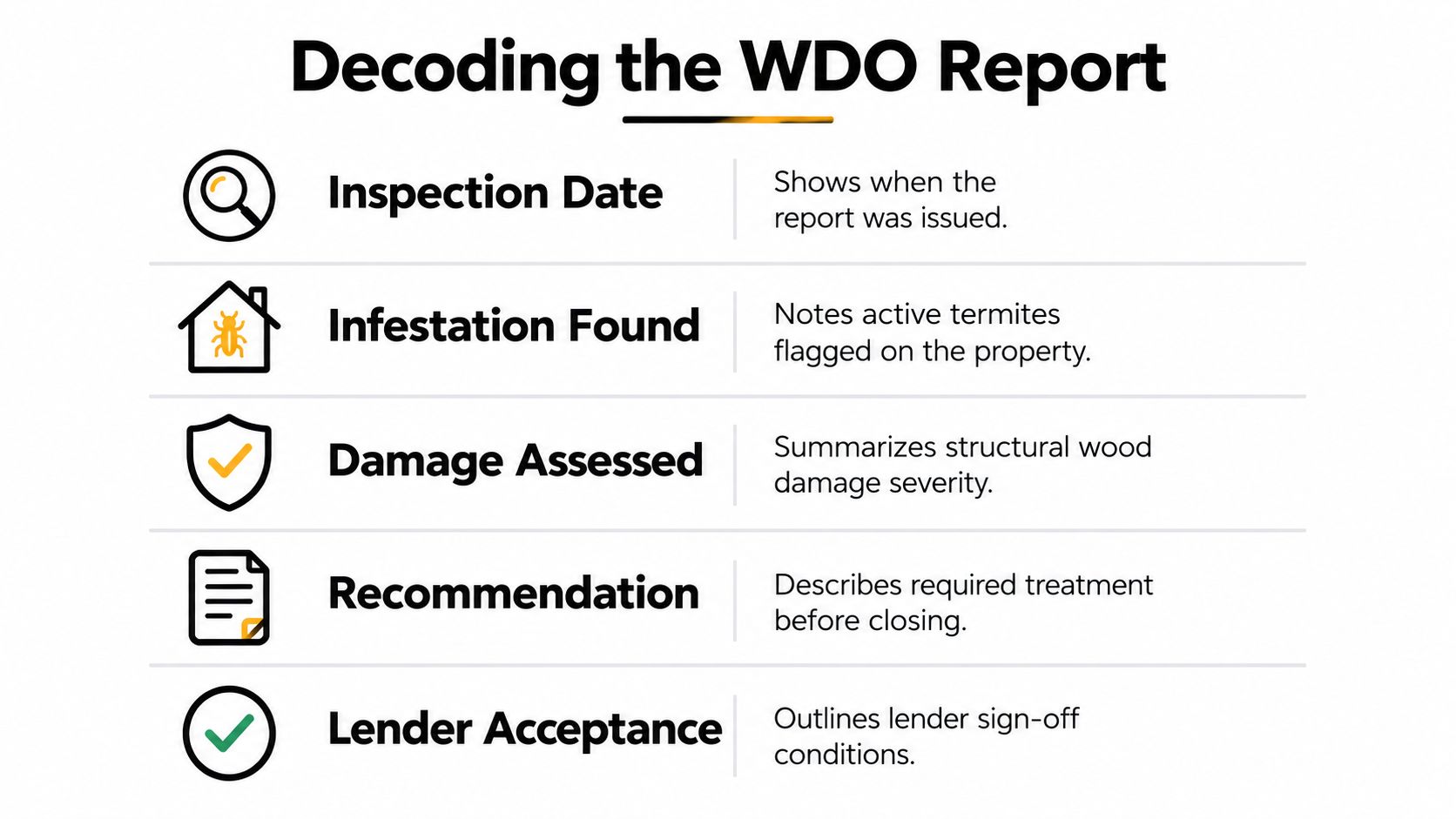
A WDO report isn't a simple pass-or-fail certificate. Underwriters read it for scope, dates, findings, and unresolved limitations. The report needs to tell them who inspected the property, when the inspection occurred, what areas were accessible, and what the inspector observed.
The required report structure typically records the inspector's name, inspection date, property address, inaccessible areas and reasons, evidence of prior treatment or infestation, organisms identified, and visible damage. Those details are set out in the industry baseline for wood-destroying organism inspection reporting.
Read the report in this order
Start with the property and date. Confirm that the address is correct and that the inspection date fits your lender's validity requirements. A report for the wrong unit, building, or address won't help an underwriter.
Check the scope. Look for crawlspaces, attics, garages, exterior walls, porches, decks, and other areas the inspector was expected to review. An inaccessible area isn't proof of infestation, but it is a gap in the evidence.
Separate active evidence from history. The report may identify current activity, old damage, evidence of treatment, or conditions that could support future infestation. Those findings have different consequences, so don't treat every notation as the same problem.
Review the organism and damage language. Termites aren't the only concern. The report can identify other wood-destroying organisms and visible damage. Ask the inspector or loan officer which findings require treatment, repair, clearance, or additional documentation.
Make access part of your closing preparation
Before the inspector arrives, clear stored items away from walls and structural areas. Unlock garages, sheds, crawlspace entries, and attic access points. Remove obstacles around panels and hatches, and tell the inspector about prior treatment or repairs.
A superficial walk-through creates a weak file. If the inspector can't examine a relevant area, the lender may request a reinspection, additional access, or another report. Buyers who want to understand the service expense can review this explanation of termite inspection costs for a home purchase, but the larger cost is often the delay caused by incomplete documentation.
Timelines and the 90-Day Validity Trap
Ordering the inspection early sounds sensible, but early isn't always better. A standard wood-destroying insect report used for mortgage purposes is considered invalid if it isn't used within 90 days of the inspection date, as explained in guidance on mortgage pest inspection timing.
That creates a trap for buyers who order the report immediately after going under contract, then encounter appraisal questions, underwriting delays, repair negotiations, title issues, or a postponed settlement. The report may still describe the property accurately, but the lender can require fresh documentation because the usable window has expired.
Use the closing date, not the contract date, as your anchor
Your loan officer should tell you when the lender needs the report in the file. Your agent should coordinate access and contract deadlines. The inspector should confirm how quickly the report can be delivered and what happens if a follow-up visit is required.
A workable sequence looks like this:
- Confirm the loan trigger. Ask whether the inspection is required before appraisal, underwriting approval, or closing.
- Check the expected settlement window. Don't order so early that the 90-day period is likely to run out before the lender uses the report.
- Build in repair time. If the report finds activity or damage, treatment and repairs may require separate scheduling.
- Ask about clearance documentation. A lender may need confirmation that required work is complete.
- Monitor the report date. If closing slips, ask the loan officer whether the report remains acceptable before assuming it does.
A clean report can still become unusable if the transaction outlasts its lender-approved validity window.
The most practical approach is coordinated timing. Order early enough to leave room for action, but not so early that the report becomes stale while other loan conditions remain open. If the property is in a high-risk zone or the transaction already has a complicated schedule, discuss timing before anyone books the inspection.
Inspection Costs and Who Pays the Bill
A termite inspection is usually a modest closing expense, but it can become a point of conflict when nobody decided who would pay. The current market figures give buyers a useful budgeting reference. A 2026 analysis of 401 licensed-inspector quotes found an average cost of $133, with a typical range of $110 to $156, while broader guidance places pest inspections at about $50 to $200. The same cost analysis says the work usually takes 30 minutes to one hour. See the termite inspection cost analysis for those figures.
The fee is small compared with the financial exposure of an unresolved infestation, but that doesn't mean payment responsibility is automatic. The purchase agreement, loan program, state practice, and lender instructions can all influence the answer.
Set the payment terms before the appointment
Put the responsibility in writing. Buyers should ask:
- Who orders the inspection? The buyer's agent, seller, lender, or another party may coordinate it.
- Who pays the inspection fee? Don't rely on custom or verbal assumptions.
- Who pays for treatment or repairs? That's a separate negotiation from the inspection fee.
- Who pays for a follow-up visit? A second inspection may be required if the first report identifies a problem or expires.
- What document does the lender accept? A seller's existing letter may not satisfy the current lender or loan program.
VA payment rules deserve specific attention. VA policy changed in June 2022, and current summaries note that borrowers are now allowed to pay for required inspections. That change removed a long-standing obstacle in transactions where the inspection had to occur but the traditional payment allocation created friction.
Don't let a small fee decide the closing at the last minute. Confirm the arrangement when the contract is negotiated, and keep the receipt and report with the loan documents. The inspection may be inexpensive, but the report can control whether underwriting has enough evidence to approve the collateral.
Navigating Inspections in High-Risk Markets Like Miami
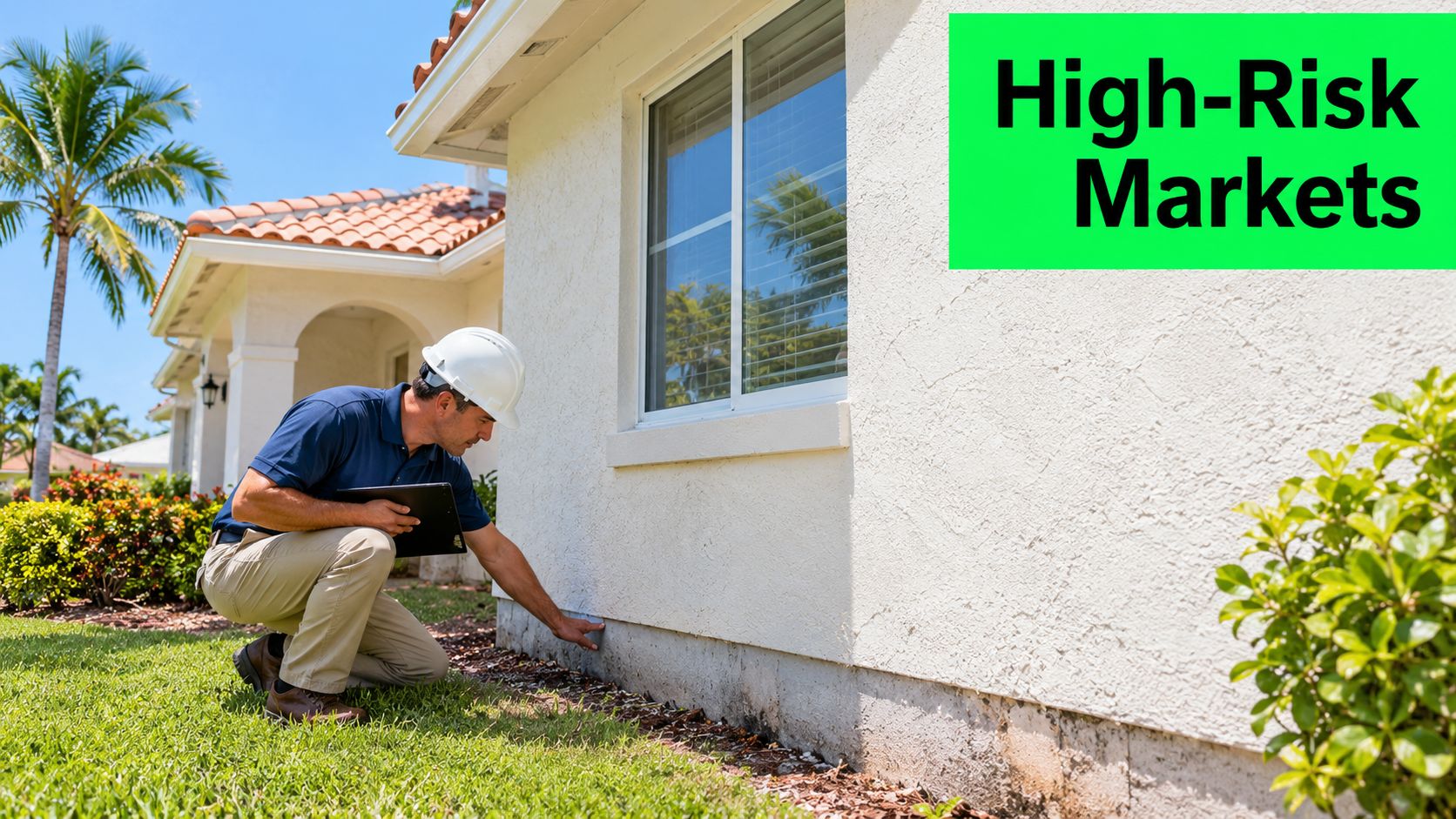
Miami buyers face a problem that national mortgage guides often oversimplify. A concrete or masonry home can have less exposed structural wood than a traditional wood-frame house, yet the lender may still require a WDO report because the property sits in a high-risk region, the appraiser observed a concern, or the lender applies a local requirement.
Masonry construction reduces exposure, not responsibility
Concrete block doesn't mean the property contains no wood. Inspectors may examine wooden furring strips, interior framing, door and window assemblies, roof structures, attached porches, decks, fences, cabinets, and other wood components. A steel-framed structure can still contain wood finishes or concealed components that warrant inspection.
That's why a buyer in Miami shouldn't argue that an inspection is unnecessary solely because the exterior walls are masonry. The lender's condition controls the loan. If the underwriter wants a WDO report, the buyer needs a report that documents the relevant accessible areas and explains the construction clearly.
Miami buyer rule: Construction type can change what the inspector examines, but it doesn't automatically cancel the lender's condition.
High-risk markets also create more negotiation pressure when a report identifies treatment needs. Get the actual finding in writing. Ask whether it describes active activity, previous damage, conducive conditions, or a limitation caused by inaccessible construction. Then have the loan officer identify what must be resolved before funding.
For local context, buyers can review this Miami termite inspection guide. It's also important to keep unrelated pest services separate in your decision-making. For example, Bed Bug Treatment concerns eliminating every life stage, including bugs and eggs, but it doesn't replace a WDO inspection or cure a mortgage condition.
Handle a finding as a transaction problem
If treatment is required, the parties need a written plan. That plan should identify who selects the licensed provider, who pays, what repairs are included, what documentation the lender needs, and when a follow-up inspection will occur.
A seller may offer treatment before closing. A buyer may request a credit or price adjustment. The lender may reject an arrangement that doesn't produce acceptable proof of completion. Don't assume a seller-provided clearance letter will work without confirmation from the loan officer.
A short educational overview can help buyers understand the inspection process:
The strongest position is preparation. Ask for prior treatment records, identify concealed or inaccessible areas before the inspection, and give the inspector enough time to document the property properly. In Miami, a “mostly concrete” description isn't a financing strategy. A lender-acceptable report is.
Finding a Licensed Inspector and Closing the Deal
The right inspector does more than identify termites. They produce documentation that the lender, buyer, seller, and agents can use to make a closing decision. Start by asking the loan officer what credentials, form, insurance, and report format the lender accepts.
A general home inspector may notice visible insect evidence, but that person may not be authorized to provide the formal WDO report your loan requires. Confirm that the pest professional holds an active state license and carries appropriate insurance. Ask for the company's license details, scope of inspection, turnaround time, and process for handling inaccessible areas.
Ask these questions before booking
Will the report satisfy my lender? Get the answer from both the inspector and the loan officer. The lender's acceptance controls.
What areas will you inspect? Ask specifically about attics, crawlspaces, garages, exterior structures, concealed wood, and areas that may be blocked by stored belongings.
What happens if you find activity? Find out whether the same company can provide treatment, whether it issues clearance documentation, and how quickly a follow-up can occur. You can choose a different provider for treatment, but you need to understand the handoff before the report arrives.
How fast will I receive the report? A fast appointment isn't useful if the written report arrives after your underwriting deadline.
What information should I prepare? Provide the property address, loan type, lender contact requirements, seller records, previous treatment documents, and the expected closing date.
Keep every party aligned
Give the inspector the loan officer's instructions before the appointment. Send the completed report to the lender promptly, and don't edit or summarize findings yourself. If the report identifies an issue, forward the complete document to your agent and loan officer so they can distinguish a pest treatment issue from a structural repair or documentation issue.
Pestless Inc. connects Miami and Miami-Dade County homeowners with licensed, insured pest control professionals through a short request process, helping route termite inspection or treatment needs to a local provider. It doesn't perform treatments itself, so ask the matched professional exactly what inspection documents and lender-facing services they provide.
A disciplined closing checklist is simple:
- Confirm the requirement in writing.
- Verify the inspector's license and insurance.
- Make every relevant area accessible.
- Order around the expected closing date.
- Send the complete report to underwriting.
- Resolve treatment, repairs, and clearance requirements in writing.
- Recheck the report date if settlement moves.
Don't wait for the final underwriting review to discover that the lender needed a WDO report. If you're buying in Miami or another high-risk market, contact Pestless Inc. to be matched with a licensed, insured local pest professional for your inspection or treatment needs. Submit the property and closing details early, then confirm the provider's report format and timing with your loan officer before the appointment.
Dealing with this pest right now?
Pestless connects you with a licensed, insured Miami pest control provider for a free, no-obligation quote.