
House centipedes are not considered dangerous to people. There are about 3,500 centipede species worldwide, but only about 15 are thought to pose a danger to humans, and a house centipede bite is rare and usually comparable to a mild bee sting.
You're barefoot on a cool tile floor in a Brickell condo when a fast blur shoots along the baseboard. It seems to have legs everywhere, disappears under the vanity, and leaves you wondering whether you should be worried about your family, pets, or the building itself.
After years of centipede calls around Miami, my advice is straightforward: don't panic about the centipede, pay attention to the conditions that brought it inside. In South Florida, that usually means indoor moisture, sheltered entry points, or enough smaller pests to provide a dependable food source.
Table of Contents
- What Miami Homeowners Should Know About House Centipedes
- How to Recognize a House Centipede
- Why Their Bites Rarely Hurt People
- What a Bite Actually Feels Like
- What Seeing a House Centipede Really Means
- Preventing Centipedes in a South Florida Home
- First Aid and When to See a Doctor
- When to Call a Miami Pest Professional
What Miami Homeowners Should Know About House Centipedes
The common house centipede is generally a low-risk household pest. Its venom is designed to subdue small arthropods, not people, and public-health guidance describes human bites as rare and usually limited to localized pain, redness, or swelling. The Poison Control overview of centipede stings reaches the same practical conclusion, house centipedes typically look far more threatening than they really are.
That doesn't mean you should grab one with your bare hand. A frightened centipede can sting, particularly if someone traps it against skin, squeezes it inside clothing, or handles it while moving laundry, shoes, boxes, or stored items. The sensible response is to remove it without direct contact and inspect the place where it appeared.
My rule for Miami homes: one centipede is a surprise. A pattern of centipedes is an inspection clue.
A sighting on a bathroom wall, near a kitchen sink, or beside a laundry room baseboard often points to two conditions working together. The first is persistent humidity or moisture. The second is an existing population of small prey, such as silverfish, roaches, ants, spiders, or other indoor arthropods. House centipedes are predators, so they tend to remain where hunting is worthwhile.
This guide covers identification, realistic bite risk, sensible first aid, moisture reduction, entry sealing, and the point at which DIY work has stopped being productive. The goal isn't to make you afraid of a many-legged visitor. It's to help you decide whether you're looking at an isolated intruder or a symptom of a broader pest problem.
How to Recognize a House Centipede
House centipedes have a distinctive appearance once you know what to look for. The body is usually yellowish-tan with darker stripes along the back, while the legs are unusually long and delicate-looking. The legs trail behind the body, giving the animal a much larger and more dramatic silhouette than its narrow torso suggests.
Their movement is even more useful than their color. A house centipede darts, stops abruptly, changes direction quickly, and can move across floors, walls, and baseboards before you get a good look. In a Miami home, check the areas where moisture and shelter overlap:
- Bathrooms, especially around vanities, plumbing openings, and baseboards.
- Kitchens, particularly beneath sinks and near appliances.
- Laundry rooms, where humidity and pipe penetrations create hiding places.
- Garages and utility spaces, where doors, stored items, and wall gaps offer cover.
The most common mistake is confusing one with a millipede. A millipede has a rounded, cylindrical body and moves slowly, often curling when disturbed. A house centipede is flatter, more delicate, and built for hunting. A soil centipede is generally darker and less visually exaggerated, and it doesn't usually make the same lightning-fast dash across an indoor wall.
Quick identification table
| Feature | House centipede | Soil centipede | Millipede |
|---|---|---|---|
| Body shape | Narrow and somewhat flattened | More compact and darker-looking | Cylindrical and rounded |
| Legs | Long legs that extend well beyond the body | Shorter-looking legs | Short legs arranged in dense rows |
| Movement | Fast, abrupt, and highly agile | Usually slower and less conspicuous | Slow, steady, and wave-like |
| Diet | Hunts small arthropods | Hunts small soil-dwelling prey | Feeds mainly on decaying plant material |
| Indoor clue | Often found near moisture and indoor prey | More commonly associated with soil and sheltered outdoor areas | Often wanders in from damp outdoor areas |
If it moves like a speedboat across the baseboard, you're almost certainly looking at a house centipede. Use a vacuum or a container and stiff paper to remove it. Don't use your fingers to confirm the identification.
Why Their Bites Rarely Hurt People
House centipedes do have venom. Their front legs are modified into pincer-like structures called forcipules, which deliver venom to the small arthropods they hunt. That sounds alarming until you consider the biological job those structures perform. The venom is meant to subdue prey such as silverfish, flies, ants, spiders, and other small pests, not to attack mammals.
The animal's equipment also creates a practical limitation. Its small forcipules are difficult to use effectively against human skin, and authoritative medical guidance says bites are uncommon and usually associated with rough handling. The MedlinePlus reference on centipede bites describes the usual outcome as temporary localized pain or swelling, similar to a bee sting rather than a serious systemic illness.
What changes the risk
Most encounters end without contact because the centipede tries to escape. The risk rises when a person:
- Picks it up, especially with bare hands.
- Pins it against the body while sleeping or changing clothes.
- Reaches into a dark hiding place without checking shoes, towels, clothing, or stored materials.
- Scratches the area afterward, creating an opportunity for secondary infection.
A healthy adult who sees one cross a floor doesn't need emergency treatment just because the animal has venom. The practical danger is usually the reaction to the sighting, such as grabbing it suddenly, rather than the centipede seeking out a person.
The WebMD guidance on house centipedes also emphasizes that severe reactions are rare. When a bite does cause trouble, the concern is more likely to involve an individual allergy or a complication from damaged skin than serious envenomation.
The bottom line is simple. Treat a house centipede as a venomous predator that should be handled carefully, not as a dangerous household attacker. Remove it safely, observe the skin if contact occurred, and then investigate why it was active indoors.
What a Bite Actually Feels Like
A house centipede sting can feel like a sharp pinch or sting at the moment of contact. The usual reaction stays close to the affected area, with localized pain, redness, or swelling. Those symptoms are the practical pattern described by public-health and medical sources, and most cases remain minor.
The appearance may resemble a small irritated welt rather than a deep wound. It can itch as the skin settles, which is why scratching creates a bigger problem than the original contact. If the area becomes increasingly irritated, keep it clean and avoid rubbing it against clothing or bedding.
Who needs extra caution
Children may try to pick up a fast-moving centipede because they don't understand the risk of handling it. Older adults and anyone with delicate or easily damaged skin should also avoid direct contact. People with a known sensitivity to insect venom should take any sting seriously and follow their clinician's existing emergency plan.
Laundry and footwear deserve attention in rooms where centipedes appear repeatedly. Shake out shoes, towels, and clothing before use, and move stored items with gloves if you suspect something is hiding underneath. That isn't because house centipedes normally seek people. It's because accidental pressure is the situation most likely to produce contact.
A centipede that runs away is behaving normally. A centipede trapped against skin is a different situation.
Seek urgent medical help if a reaction includes difficulty breathing, dizziness, widespread hives, swelling of the lips or throat, or rapidly spreading swelling. Intense pain that keeps getting worse instead of easing also deserves medical advice. These signs aren't the normal minor response, and you shouldn't wait to see whether they disappear.
Don't diagnose every unexplained welt as a centipede sting. Many household bites and skin irritations look similar, and the centipede may be blamed because one was seen nearby. If it can be done safely, preserve the specimen in a container for identification rather than trying to catch it by hand.
What Seeing a House Centipede Really Means
The important question isn't only, “Are house centipedes dangerous?” It's “What is supporting them inside my home?”
House centipedes are generalist indoor predators. They hunt pests including cockroach nymphs, bed bugs, flies, ants, silverfish, spiders, and moths, and they don't damage structures or stored products. The Missouri Department of Conservation house centipede guide explains why that matters: the centipede can be present because the home offers both shelter and a food supply.
A centipede on a bathroom wall may therefore be a visible sign of an invisible problem. Look for damp cabinets, slow plumbing drips, poor ventilation, condensation, cardboard storage, webs, shed skins, roach activity, or silverfish near paper and stored goods. You may not find the prey immediately, but repeated sightings tell you the room is meeting the centipede's basic needs.
Read the location, not just the insect
- Bathroom sightings suggest you should examine ventilation, pipe gaps, cabinets, and damp baseboards.
- Kitchen sightings call for an inspection beneath sinks, appliances, and plumbing penetrations.
- Laundry room activity points toward moisture, floor drains, stored fabrics, and wall openings.
- Garage or crawl-space activity may involve exterior entry points, clutter, damp soil, or perimeter shelter.
Miami's warm, humid conditions make moisture control especially important. A house can feel comfortable while hidden spaces remain damp enough to support small prey. The Clemson Cooperative Extension explanation of centipedes notes the same broader relationship, house centipedes are usually harmless, but their presence can indicate other moisture-loving pests.
Don't confuse this clue with evidence of structural damage. If you notice wood-destroying insects, that calls for a separate inspection and may warrant Termite Control to stop silent structural damage before it spreads. The centipede itself isn't eating your walls. It may be revealing conditions that deserve attention.
Preventing Centipedes in a South Florida Home
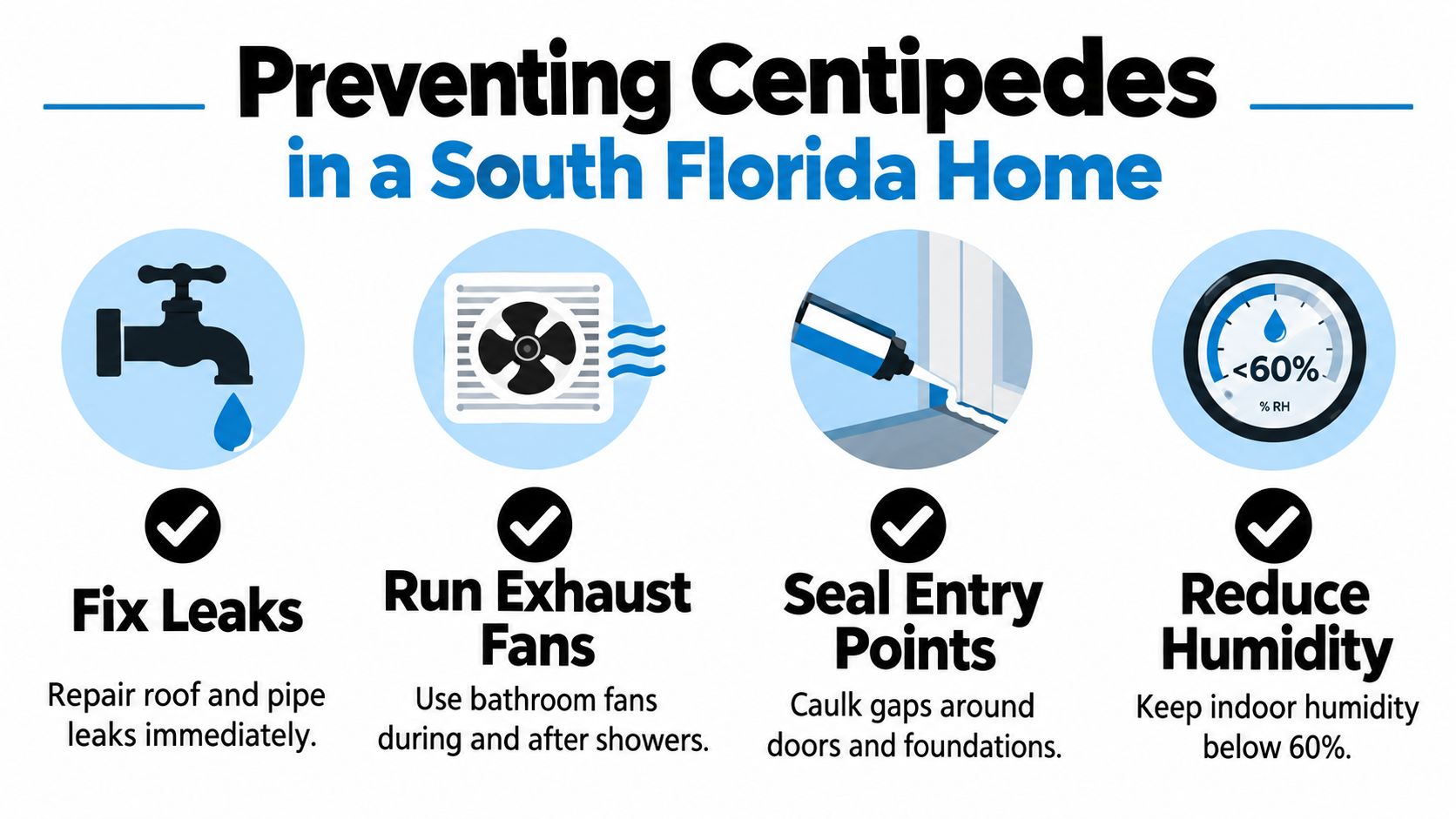
Start indoors, and start with moisture. House centipedes need suitable shelter and prey, while many of the pests they hunt thrive in damp areas. Run bathroom exhaust fans during showers and afterward, use a dehumidifier in persistently humid rooms, repair slow leaks under sinks, and empty water from refrigerator or window air-conditioner drip trays.
Work through the house in order
Find the moisture source. Check under vanities, around laundry connections, behind toilets, near air-conditioning equipment, and along garage walls. Drying the room without fixing the leak won't solve the attraction.
Seal the routes in. Caulk accessible gaps around pipe penetrations, dryer vents, doors, and foundation interfaces. Replace worn door sweeps and repair damaged screens. Older Miami-Dade homes often develop small openings as materials shift or settle, and those openings can serve several pests at once.
Adjust exterior lighting. Bright lights near doors can draw flying insects toward the structure, giving predators more reason to patrol the area. Use targeted, shielded lighting where practical and keep fixtures away from doors when placement allows.
Clear outdoor shelter. Trim vegetation away from walls, remove leaf litter and palm debris, and move firewood, dense materials, and potted plants away from the exterior. The goal is to reduce damp hiding places beside the home.
These are sensible steps for a homeowner to complete within a week. They also fit the broader principles in this guide to sustainable pest management, which emphasizes addressing conditions that let pests persist rather than relying only on repeated reactions.
Don't treat every insect the same way. A centipede sighting doesn't prove bed bugs are present, but if you find evidence of them, Bed Bug Treatment is designed to eliminate every life stage, including bugs and eggs. Identify the pest first, then match the response to its habits.
First Aid and When to See a Doctor
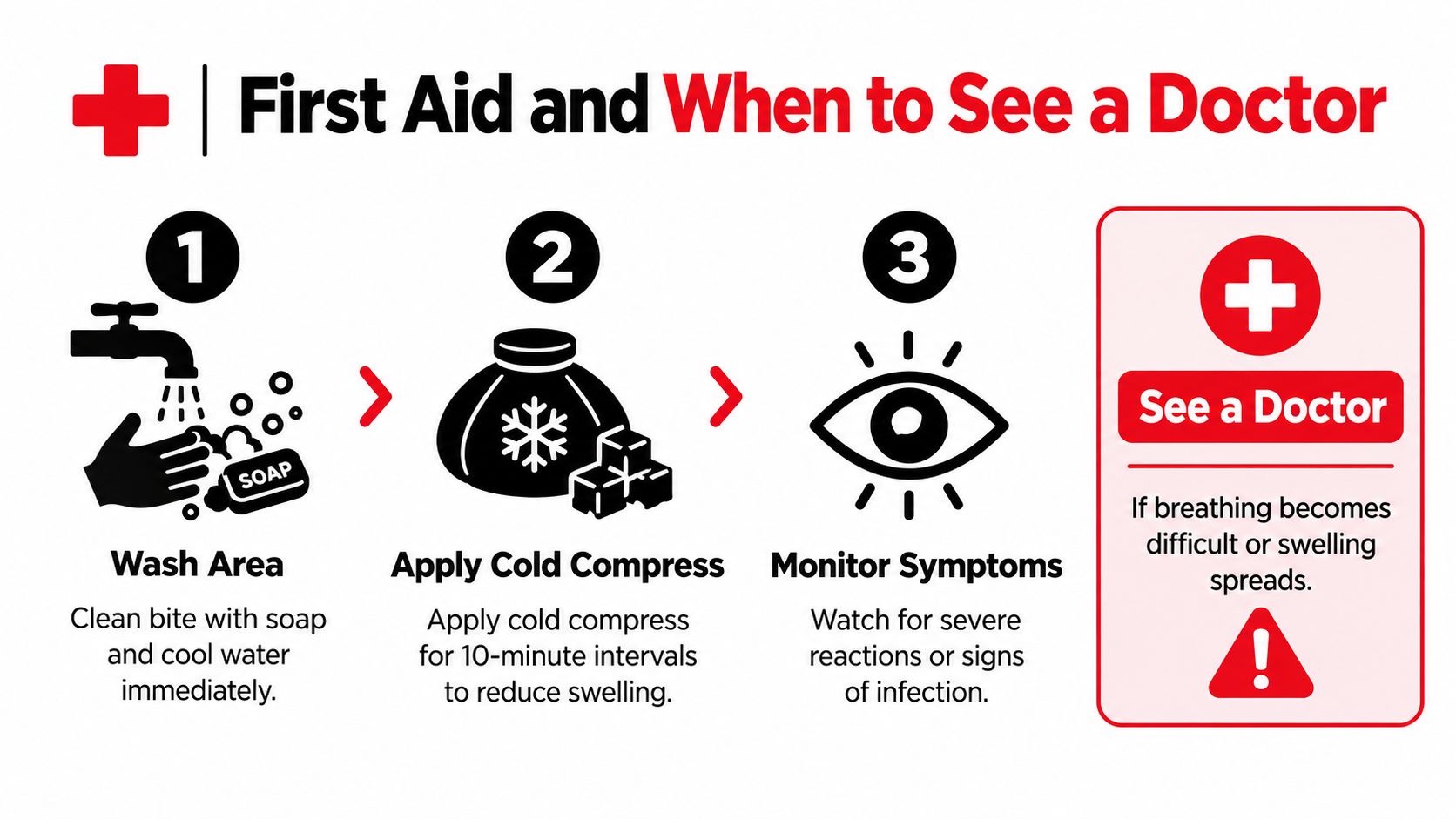
If you suspect a centipede sting, wash the area with soap and cool water. Apply a cold compress for short intervals, keep a cloth between the cold pack and your skin, and avoid scratching or applying heat. These steps are appropriate for a minor local reaction and help you avoid turning a small irritated area into damaged skin.
For itching or discomfort, ask a pharmacist or clinician which over-the-counter option is appropriate for you, especially if you take other medicines, have chronic conditions, or are treating a child. Don't put harsh chemicals, household cleaners, or unapproved remedies on the skin.
Watch for a change in the reaction
A mild local response should remain limited to the contact area. Get medical advice promptly if you notice:
- Spreading redness or swelling, particularly if it continues to expand.
- Hives, dizziness, wheezing, or breathing difficulty, which may indicate a serious allergic reaction.
- Swelling of the lips, tongue, or throat, which requires urgent attention.
- Worsening pain or drainage, which can signal a secondary infection.
Anyone with systemic symptoms should seek urgent medical care. The same applies to a person with a known insect-venom allergy, a young child, an elderly resident, or someone who is immunocompromised. Don't wait for a local reaction to become dramatic before calling for help.
A suspected centipede bite is often misidentified because many insects and skin irritations produce similar marks. If you can safely capture the specimen in a sealed container, bring it for identification. Never handle a live centipede just to prove what caused the irritation.
For comparison with other common household bite concerns, this guide to what spider bites look like at first can help you think about identification without assuming every skin mark came from the most recently spotted insect.
When to Call a Miami Pest Professional
A single house centipede near an exterior door isn't automatically a service call. You can remove it, check for moisture, seal an obvious gap, and monitor the area. The situation changes when sightings keep returning or start appearing in several parts of the home.
Call a licensed Miami-Dade pest professional when you see centipedes repeatedly, find them during daylight, or notice them alongside silverfish, roaches, spiders, ants, or earwigs. Those patterns suggest the centipedes aren't merely passing through. They may have access to shelter and a prey population that ordinary cleaning won't remove.
What a useful inspection should include
A professional shouldn't just spray the wall where you saw the insect. The inspection should look at:
- Moisture sources, including plumbing, air-conditioning equipment, crawl spaces, garages, and poorly ventilated rooms.
- Prey pests, with attention to droppings, shed skins, webs, live insects, and hiding areas.
- Entry points, such as door gaps, foundation openings, screens, utility penetrations, and wall voids.
- Exterior conditions, including vegetation, leaf debris, stored materials, and damp areas beside the structure.
- Follow-up needs, because Miami's humidity can keep recreating favorable conditions after the first visit.
Treating only visible centipedes is a short-term response. The durable solution addresses the smaller pests and moisture conditions that keep attracting them. Delaying that inspection gives the prey population more time to remain established and gives centipedes a reason to continue hunting indoors.
Homeowners comparing providers may also benefit from this guide to pest control software, which explains how pest companies organize inspections, service records, scheduling, and follow-up work. For the homeowner, the important question is whether the provider can clearly explain what was found and what happens next.
Use a licensed provider when the activity is recurring, widespread, difficult to trace, or connected to another pest problem. This guide to a licensed pest control professional can help you understand what credentials and service practices to check before authorizing treatment.
Pestless Inc. connects Miami and Miami-Dade homeowners with licensed, insured local pest professionals for problems such as centipedes, roaches, termites, ants, rodents, mosquitoes, and bed bugs. Visit Pestless Inc. to describe the activity, request a no-obligation quote, and get matched with a vetted provider who can inspect the moisture and prey-pest conditions behind recurring sightings.
Dealing with this pest right now?
Pestless connects you with a licensed, insured Miami pest control provider for a free, no-obligation quote.