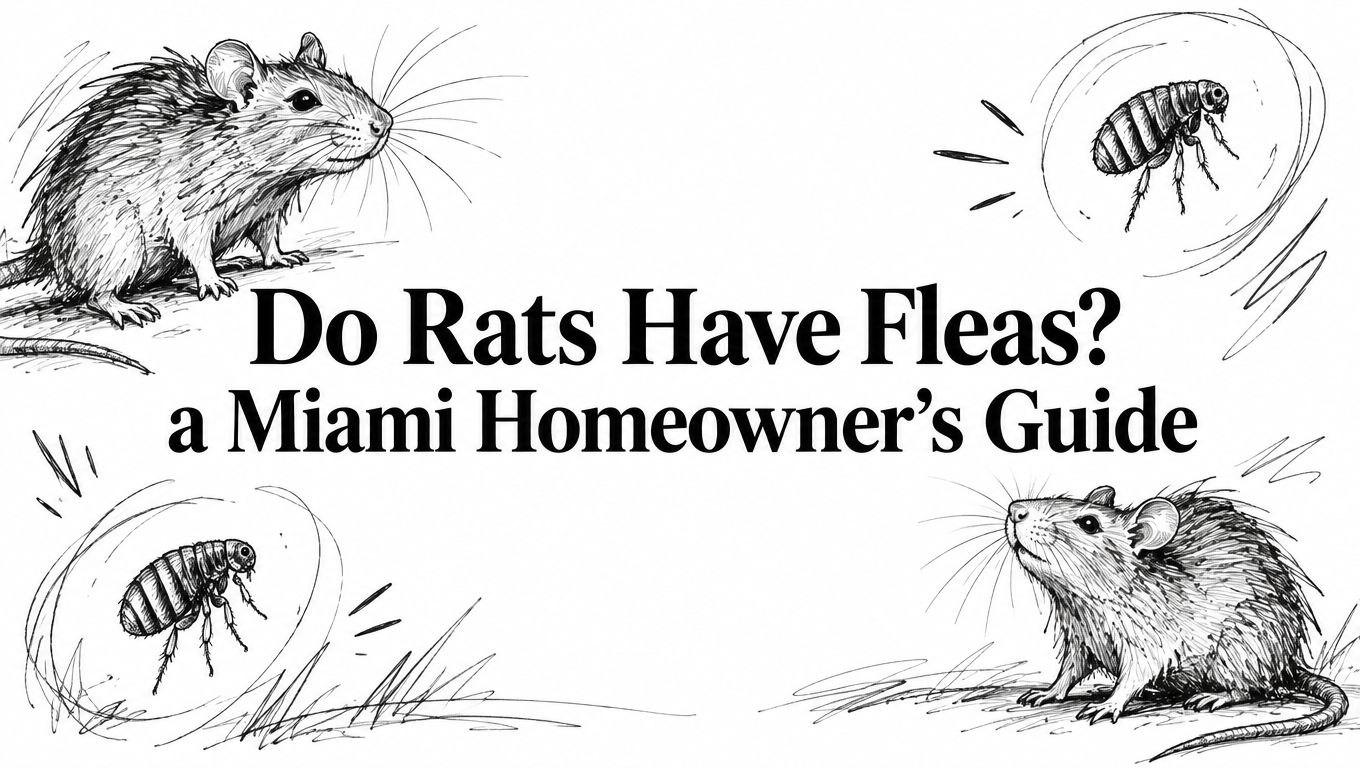
Yes, rats can have fleas, but infestation isn't universal. In one New York City survey, the Oriental rat flea appeared on 30.1% of captured Norway rats, with an average of 4.1 fleas per rat.
A Coral Gables homeowner may notice the problem in a familiar way: at dusk, a brown shape slips behind a stack of pool supplies in the garage. The rat disappears, but the concern remains. Could it have brought fleas inside?
The practical answer for a Miami home is that a rat sighting creates a plausible flea risk, not proof of an infestation. Fleas can remain on or near a rodent, then leave eggs in nesting material, wall voids, attic insulation, carpeting, or pet bedding. Treating only the rat can leave the flea reservoir behind. In some situations, removing the rodent first can even push hungry fleas toward pets or people.
Table of Contents
- What Happens When a Rat Shows Up in Your Miami Home
- Meet the Fleas That Ride on Rats
- How a Flea Population Builds Up
- Why One Rat Can Mean a Whole Colony of Fleas
- Spotting the Early Signs Before Things Get Worse
- Why Killing Rats First Can Backfire on You
- What a Coordinated Rodent and Flea Fix Looks Like
- Keeping Rats and Fleas Out for Good
What Happens When a Rat Shows Up in Your Miami Home
A single sighting doesn't tell you how long the rat has been nearby. Rats often stay hidden in attics, garages, crawlspaces, wall voids, sheds, and other protected areas before a homeowner sees one crossing an open room. The animal you notice may be using the house as a route to food, water, or shelter rather than appearing for the first time that evening.
Look for evidence around the sighting instead of focusing only on the animal. Check along garage walls, behind stored materials, near outdoor trash containers, around roofline access points, and beside openings for pipes or cables. Fresh droppings, gnawing, shredded nesting material, or repeated nighttime sounds suggest ongoing activity.
Practical rule: A visible rat is a rodent-control clue. It isn't a reliable measure of the flea activity hidden around its resting places.
The linked problem develops in stages. A flea may feed on a rat, while eggs fall into the material where the rat rests. Larvae and pupae then develop away from the animal, so the rat can leave while the immature fleas remain. If the rodent is removed without assessing nearby areas, the household may still face bites, pet scratching, or newly visible fleas.
This matters in multifamily buildings and attached Miami homes, where shared walls, trash areas, crawlspaces, and outdoor harborage can connect one unit to another. It also matters in a detached home if rats use the attic, garage, or shed and pets move freely between indoors and outdoors.
Start with two questions:
- Is the rodent still active? Check for fresh signs, access points, food sources, and nesting.
- Could fleas be nearby? Inspect pet resting areas, rugs, baseboards, upholstered furniture, and the places where the rodent may have rested.
The safest response treats the rodent and its ectoparasites as related problems. The order matters because a rat is not the only place where fleas live.
Meet the Fleas That Ride on Rats
A rat is more like a bus than a flea factory: fleas are passengers, and they can get off wherever the rat rests. Fleas are separate insects that use mammals for blood meals. Some species favor rats, while others use rats when their preferred host is unavailable or another blood source is close.
The Oriental rat flea, Xenopsylla cheopis, commonly uses rats as principal hosts. The northern rat flea, Nosopsyllus fasciatus, is also associated with Norway and roof rats. Homes may also have the cat flea, Ctenocephalides felis, which commonly infests indoor spaces and can feed on rats opportunistically. Identification usually requires magnification, so a flea found near a rat should not automatically be labeled a rat flea.
These insects are small, wingless, and built to move through fur and nesting material. They can leave a host and remain in protected areas until a person, pet, or other mammal approaches. That behavior explains why a dog or cat may start scratching after a rodent has vanished, even if no flea was seen on the rat.
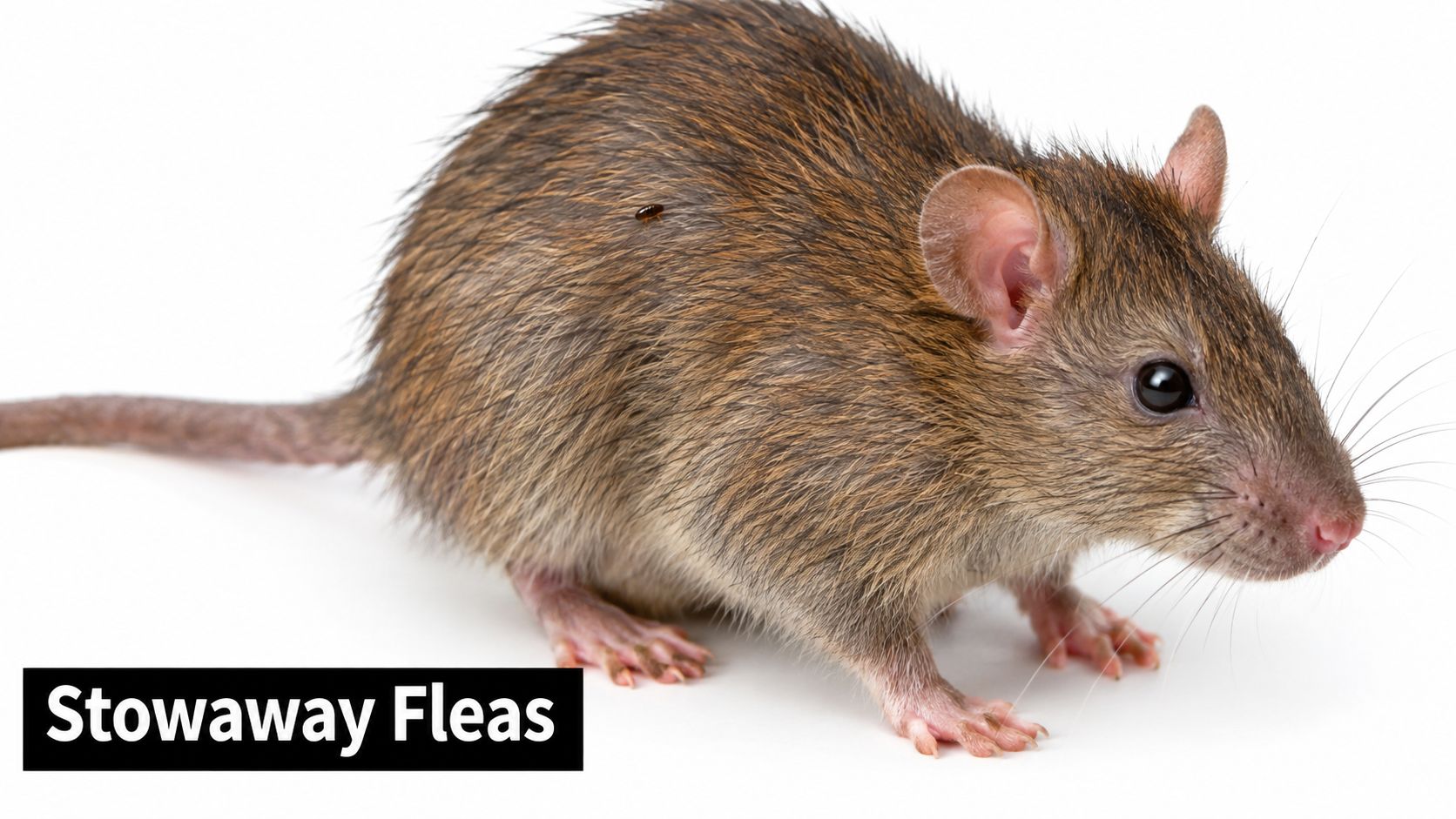
Public-health concerns depend on the flea species and the setting. The CDC's flea reference identifies X. cheopis as the primary vector of plague and describes rats as its major hosts. This does not mean every flea or rat carries a pathogen. It does mean that homeowners should handle rodents, carcasses, and nests carefully.
Fleas do not fly. They jump between nearby hosts and resting places. This explanation of whether fleas fly or jump describes how that movement works.
The treatment order matters. Removing a rat before addressing flea activity can leave the fleas searching for another host, including a pet or person inside the home. Adult fleas may be only the visible part of the problem, while eggs and developing stages remain protected near the rat's resting place.
How a Flea Population Builds Up
A rat disappears from an attic, but scratching begins downstairs days later. The reason may be a flea population developing in the rat's former nesting area, not fleas remaining on the animal itself. Understanding the life cycle helps homeowners inspect and treat the right places in the right order.
A flea passes through four stages: egg, larva, pupa, and adult. Only adults take blood meals. The other stages develop away from the host, often in dark, sheltered areas that receive little disturbance.
After feeding, adult fleas reproduce on or near the animal. Eggs can drop into bedding, nesting material, carpet fibers, baseboard cracks, upholstery seams, and wall voids. A rat resting in attic insulation or behind a wall plate can leave eggs where a homeowner is unlikely to look.
Larvae are small and avoid light. They feed on organic debris connected with adult flea activity before developing into pupae. Pupae stay inside protective cocoons. Vibrations, warmth, and movement can signal that a person, pet, or other mammal is close enough to provide a blood meal.
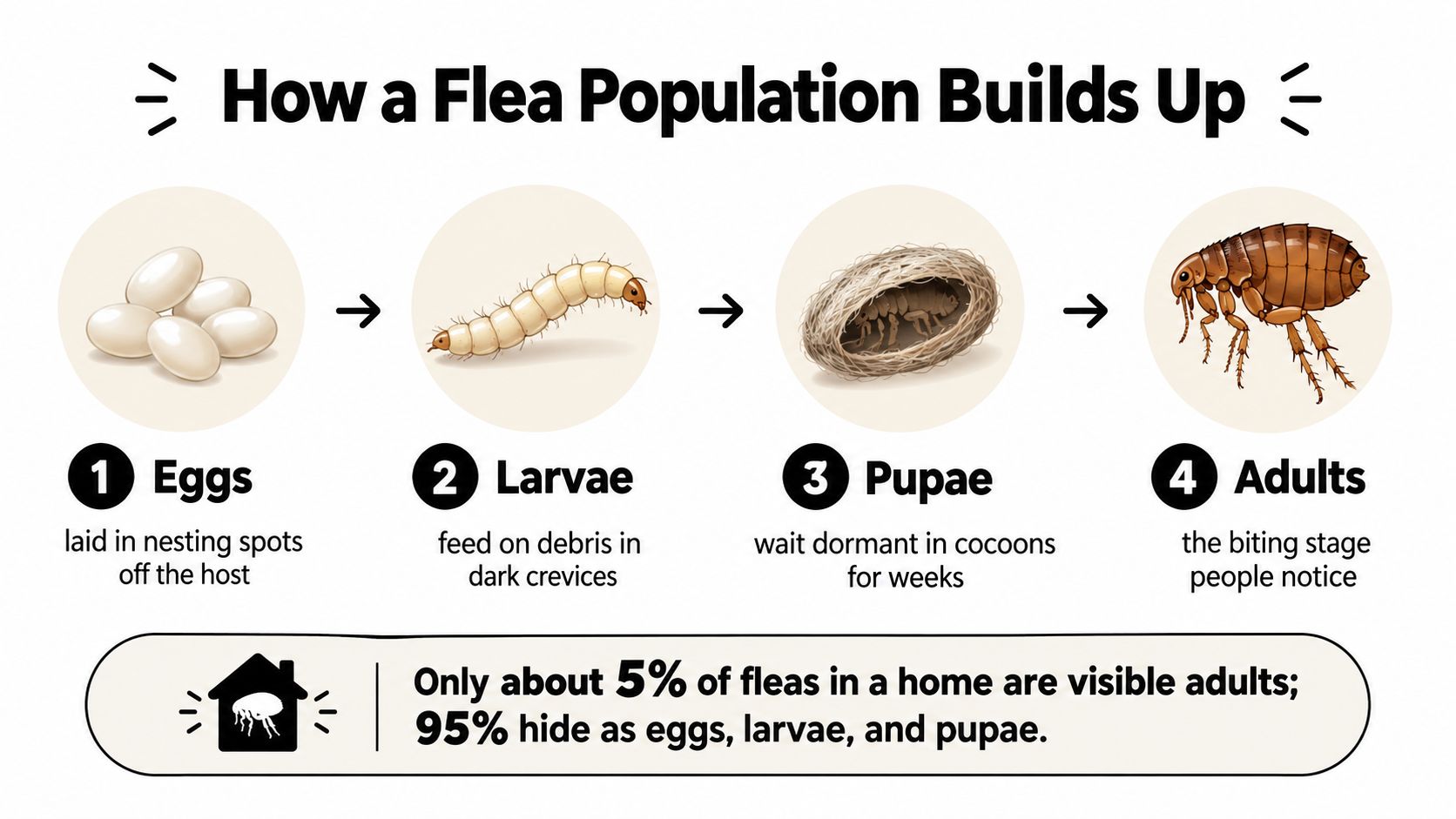
Why the visible flea count misleads
One adult flea on a pet says little about the immature stages nearby. Finding no flea on a rat also does not clear its nest. Adults may move or die, while eggs, larvae, and pupae remain hidden in the environment.
Follow the rat's habits during inspection:
- Locate resting places. Check attic corners, wall-void access points, garage clutter, shed materials, and spaces beneath stored items.
- Inspect household resting areas. Examine pet bedding, rugs, sofa seams, and room edges where people or pets spend time.
- Address the environment. Vacuuming, laundering suitable items, and professional treatment can remove or expose developing stages. One visible pass may miss protected areas.
- Coordinate the rodent work. Treating the flea sites while addressing the rodent problem helps avoid leaving adult fleas without a host and sending them toward living spaces.
A visible rat is only one part of the assessment. The developing population may be out of sight in the same nesting materials and sheltered gaps the rodent used, so flea control and rodent removal need to follow a planned sequence.
Why One Rat Can Mean a Whole Colony of Fleas
Flea loads vary sharply from one rat to another. The New York City survey described above found the Oriental rat flea on 30.1% of captured rats, not every rat. Across all rats examined, researchers recorded an average of 4.1 fleas per animal. Rats trapped indoors averaged 5.1 fleas, while rats from one particularly affected site averaged 25.7 fleas each. The same study also noted earlier surveys reporting 0.22 fleas per rat, showing why one universal flea-count estimate would be misleading. These figures come from the peer-reviewed Norway rat survey.
| Flea Load per Rat | Field Study Average | What It Means at Home |
|---|---|---|
| Earlier reported average | 0.22 fleas per rat | A low average doesn't rule out a heavily affected nest or another sampling pattern. |
| All rats examined | 4.1 fleas per rat | A rat can carry several fleas while leaving eggs and other stages away from its body. |
| Indoor rats | 5.1 fleas per rat | An indoor animal may place fleas closer to carpeting, storage, pets, and living areas. |
| Particularly affected site | 25.7 fleas per rat | A heavily infested rat can create a much greater flea concern around its resting place. |
The home impact depends on more than the number riding on the animal. A lightly infested rat can still leave eggs in a protected nest. A heavily infested rat may bring more adult fleas into an attic, garage, or wall void. Once the host moves, dies, or is removed, those fleas may search for another mammal.
This is why “one rat” doesn't necessarily mean “one flea problem,” and it also doesn't prove that a colony is present. The right interpretation is narrower and more useful: the rat's resting area deserves inspection, especially if people or pets later develop bites or itching.
The core question isn't only whether rats are in the kitchen. It's whether the rodent has created an unseen reservoir in a place where the household will eventually disturb it.
Spotting the Early Signs Before Things Get Worse
Begin with the easiest evidence to verify. Use a flashlight and inspect edges rather than standing in the center of a room. Rodents and fleas often leave clues along walls, beneath stored objects, around pet bedding, and in quiet areas that receive little daily traffic.
Check for rodent activity
Look for dark droppings, gnaw marks, shredded paper or fabric, disturbed insulation, and greasy marks along frequently used edges. In a garage or utility area, examine food storage, trash containers, pool equipment, and openings around doors, pipes, vents, and cables.
Don't handle droppings or nesting material bare-handed. If contamination is extensive, avoid stirring it up and arrange professional guidance rather than sweeping it into the air.
Check for flea activity
Flea dirt can look like black or reddish-brown specks on an animal's fur or bedding. On a damp white paper towel, some flea dirt may leave a rusty stain because it contains digested blood. Tiny pale eggs can be harder to see and may collect in carpet, upholstery seams, or places where a pet lies.
Pet behavior can provide an early warning:
- Repeated scratching: Watch for persistent scratching, biting, or intense grooming, especially after the pet rests in a suspected area.
- Resting-place clues: Inspect blankets, crates, sofa cushions, and rugs instead of checking only the animal's back.
- Human bites: Flea bites may appear as itchy spots around exposed lower legs and ankles, but bites alone can't identify the source.
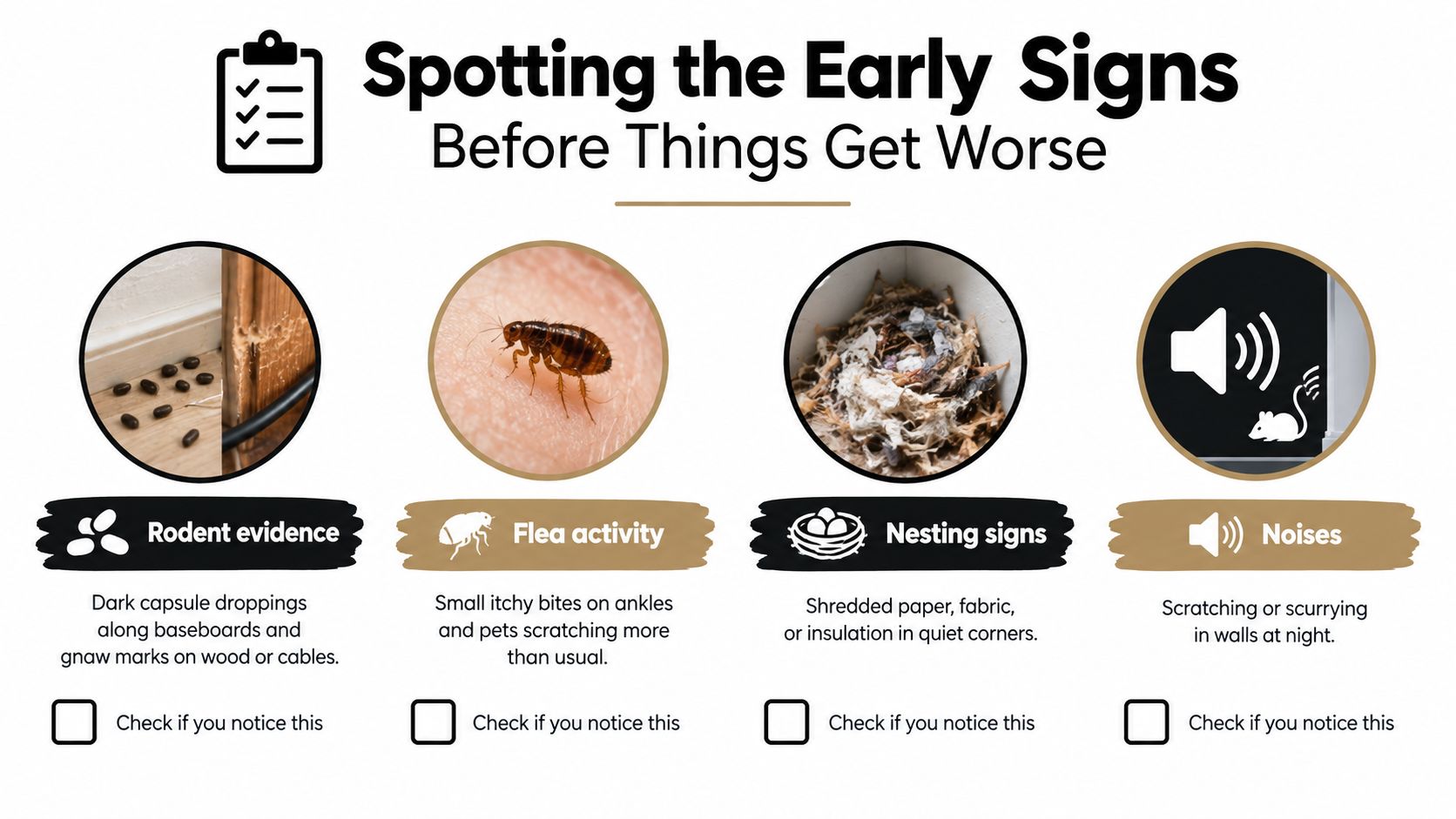
A single bite doesn't prove that rats or fleas are present. Repeated pet scratching combined with fresh rodent evidence deserves faster attention because it links the animal activity to a possible household exposure. Keep children and pets away from suspected nests, and don't apply a pesticide product unless its label permits the intended use and you can follow the safety directions.
Why Killing Rats First Can Backfire on You
Many homeowners assume the correct order is simple: kill the rat, then deal with fleas if they appear. In a flea-related rodent problem, that sequence can create a more visible nuisance.
When a rodent dies or leaves, fleas may abandon the host and seek another warm-blooded animal. That could be a dog sleeping nearby, a cat moving through the garage, or a person sitting in an adjoining room. The World Health Organization's plague guidance advises controlling fleas before eliminating rodents in plague-risk settings for this reason. Related public-health guidance also treats rodent ectoparasite control as part of preventing disease transfer, rather than as a separate task.
| Wrong order | Safer coordinated order |
|---|---|
| Place rodenticide or remove the rat, then wait for flea bites. | Assess and address flea activity around pets and premises while planning rodent control. |
| Treat only the garage because that's where the rat was seen. | Inspect connected indoor areas, resting places, nests, and access routes. |
| Assume the problem ends when the carcass or animal is gone. | Recheck for adult fleas and developing stages after the rodent work. |
This doesn't mean a homeowner should delay action when a rat is active. It means the response should be planned as one operation. Pet flea prevention should be discussed with a veterinarian, and premise treatment should use products labeled for the location and target pest. The Environmental Protection Agency's guidance, as summarized in the available public-health material, emphasizes label compliance and warns against using products restricted to certified operators.
The same principle of addressing every life stage appears in other pest services, including Bed Bug Treatment, whose catalog description is “Eliminate every life stage, bugs, eggs, and all.” Flea control requires its own labeled approach, but the reasoning is similar: visible adults aren't the entire problem.
Operational rule: Don't treat rodent removal and flea management as two unrelated appointments when both signs appear in the same home.
What a Coordinated Rodent and Flea Fix Looks Like
Consider a townhouse near Brickell with scratching sounds above a ceiling and a dog that begins grooming more than usual. A careful inspection starts outside, where a technician looks at roofline gaps, vents, utility penetrations, doors, and the route around the air-conditioning condensate line. Inside, the inspection follows the rodent run toward attic beams, wall voids, storage areas, and pet bedding.
The first task is to identify and reduce access and harborage. The technician may recommend exclusion work, secure rodent control, and removal of food or nesting opportunities. A service described as Rodent Control should address both parts of the job, removing the rodents and sealing the way back in.
Next comes environmental flea work. Homeowners may need to vacuum rugs and baseboards carefully, launder suitable bedding, empty the vacuum safely, and follow any professional treatment instructions. Vacuuming alone may not get rid of fleas, especially when developing stages remain in protected cracks or nesting areas.
What changes in a Kendall home
A single-family home in Kendall may have different pressure points. A shed, woodpile, side-yard compost area, outdoor pet run, or open storage corner can create separate harborage. The technician maps those locations rather than treating only the room where someone saw the rat.
The follow-up matters because fleas can emerge after the initial work, and new rodent activity can reopen the cycle. A written plan should identify what the homeowner does, what the technician treats, what pets need from a veterinarian, and when the property will be checked again.
For rentals and multifamily properties, responsibility may involve the tenant, landlord, property manager, or association. This pest responsibility FAQ from VerticalRent offers useful context for deciding who should report the issue and coordinate access.
Keeping Rats and Fleas Out for Good
Prevention works best as a routine, not as a one-time spray after the itching starts. Walk the outside of the home regularly and inspect the places where different materials meet: roof edges, doors, vents, utility lines, screens, and foundation penetrations. Seal openings with materials appropriate for rodents, and correct damaged vents or door gaps rather than covering them temporarily.
Food control matters just as much. Keep pet food, birdseed, and pantry items in closed containers. Secure trash, clean spills, and remove outdoor food sources that can support rats. Clear palm fronds, stacked lumber, dense clutter, and other sheltered material from beside the home, garage, shed, and fence line.
Pets need their own prevention plan. Ask a veterinarian which flea product fits the animal's species, age, health, and lifestyle. The flea and tick prevention guide from Bandana Rx can provide general background, but it doesn't replace veterinary advice for a particular pet.
When to stop handling it yourself
Arrange licensed help when you find a nest in an inaccessible void, see repeated fresh rodent signs, notice fleas across more than one room, or observe pet symptoms alongside rodent activity. Also seek help if children, pets, or vulnerable household members could contact contaminated materials or pesticides.
A practical home-maintenance reference is this guide to rodent-proofing your home. Use it while checking entry points, food storage, outdoor clutter, and areas that need monitoring. If the signs return, don't keep adding products without finding the access route or flea reservoir.
Pestless Inc. connects Miami and Miami-Dade homeowners with licensed, insured pest professionals for coordinated rodent and flea concerns. Describe the activity through the short request form or by phone, then visit Pestless Inc. to compare a local service option without committing to treatment.
Dealing with this pest right now?
Pestless connects you with a licensed, insured Miami pest control provider for a free, no-obligation quote.