Yes, some termites do eat live trees in Florida. In one tropical savanna study, termites damaged 45% of living trees, while a separate live-tree study found infestation in 58% of inspected slash pines.
That answer can be unsettling if you're standing beside a healthy-looking oak, mango, or Norfolk pine in Miami-Dade or Broward County. The more useful rule is this: species matters, but tree stress often determines whether an infestation gets established. A vigorous tree with intact bark and good growing conditions is usually a poor target. A tree with storm wounds, pruning cuts, dead internal wood, drought stress, root damage, or decay can provide the access and food a colony needs.
Formosan subterranean termites are the main concern in South Florida because they can occupy living trees while removing wood inside the trunk. The canopy may still look green while the tree's internal strength declines. This is why a homeowner's inspection shouldn't stop at leaves and bark color. The root flare, trunk cavities, old wounds, and nearby soil can reveal a problem earlier.
Table of Contents
- The Short Answer for South Florida Homeowners
- Which Termite Species Actually Attack Living Trees
- How Termites Get Into a Living Tree
- Warning Signs Homeowners Can Spot From the Ground
- The Risk to Your Home Versus Your Yard
- Treatment Options and When to Call a Pro
- Preventing Live Tree Infestations in Miami-Dade
The Short Answer for South Florida Homeowners
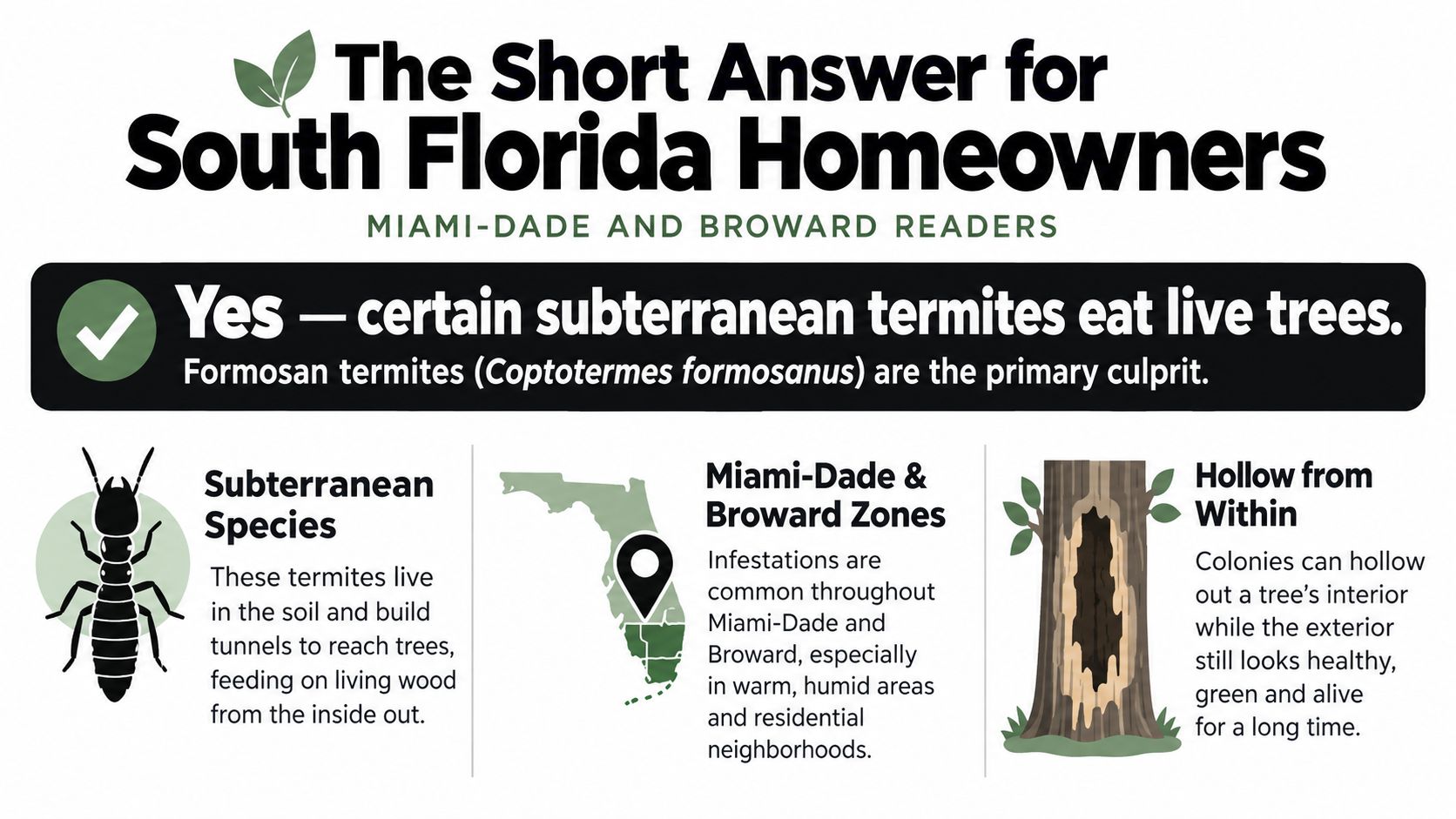
For a Miami-Dade or Broward homeowner, the practical answer is yes, certain subterranean termites can feed in live trees, especially Formosan subterranean termites, Coptotermes formosanus. They don't need a tree to be completely dead before they use it. They may consume dead xylem, decaying sections, and other less-defended wood inside a standing tree while the tree continues to live.
That doesn't mean every green tree in your yard is in danger. A healthy tree can resist invasion more effectively because its bark, sap flow, chemical defenses, and wound response make access difficult. Trouble becomes more likely after a hurricane breaks limbs, a string trimmer damages the trunk, construction cuts roots, or prolonged stress leaves dead wood inside the stem.
Practical rule: Don't ask only whether the tree is alive. Ask whether the tree has accessible dead wood, an open wound, internal decay, or contact with termite-infested soil.
Research has documented the difference between external appearance and internal damage. In one tropical savanna study, researchers found termite damage in 32 of 63 living trees, equal to 45%, with average biomass loss of 3.3% and a maximum loss of 28% (field study on termite damage in living trees). Those figures don't describe every South Florida tree, but they show why a green canopy isn't proof that the trunk is sound.
South Florida conditions make this worth taking seriously. Warm, humid weather supports termite activity, while hurricane damage and frequent pruning create repeated wounds. A tree can therefore become a bridge between soil, internal wood, and nearby structures without showing dramatic crown decline.
The right response isn't panic or automatic tree removal. Start by identifying the termite group, checking the tree's condition, looking for hidden entry points, and deciding whether the infestation is isolated to the yard or connected to your home.
Which Termite Species Actually Attack Living Trees
Not every termite found near a tree has the same behavior. Identification matters because a drywood termite in a dead branch presents a different problem from a subterranean colony hollowing the center of a living trunk.
Formosan subterranean termites
Formosan subterranean termites are the species South Florida homeowners should take most seriously around live trees. They can forage through soil, enter root flares and wounds, and establish protected galleries inside trunks. They may also build carton material in cavities or other sheltered locations, allowing the colony to remain above ground while workers continue feeding.
The important technical detail is that Formosan termites often target dead xylem in the tree's center rather than healthy cambium. The tree can remain alive while load-bearing internal wood disappears. The University of Florida guidance on Formosan termites in trees explains why internal hollowing can become a structural concern before the canopy visibly declines.
Native subterranean termites
Native subterranean termites generally favor damp, decaying wood, buried roots, stumps, and other cellulose that is already easier to consume. They can still use a stressed or wounded living tree when the conditions are favorable. Their presence doesn't automatically mean they caused the original tree problem. In many cases, existing decay or moisture creates the opportunity first.
A review of termite attacks on living trees describes the pattern worldwide and distinguishes between attacks that cause limited harm and attacks associated with trees weakened by other factors (review of termite attacks on living trees).
Drywood termites
Drywood termites live in dry, sound wood and are more commonly associated with structural timbers, furniture, dead branches, and seasoned wood than with healthy living trunks. They don't depend on soil contact in the same way subterranean termites do. Finding drywood pellets in a dead limb doesn't prove that a subterranean colony is hollowing the main trunk.
| Species | Attacks Live Trees? | Typical Tree Evidence | Risk Level in South Florida |
|---|---|---|---|
| Formosan subterranean termite | Yes, especially in stressed or internally decayed trees | Internal galleries, hollow sections, mud shelter tubes, carton material | High when near homes or valuable trees |
| Native subterranean termites | Sometimes, usually where wood is moist, damaged, or decaying | Root-collar activity, buried roots, damp galleries, shelter tubes | Variable |
| Drywood termites | Rarely attacks healthy living trees | Pellets and galleries in dry branches or dead wood | Usually limited to affected wood |
Homeowners who want a broader identification reference can compare the descriptions in this guide to types of termites in Florida. If an inspection confirms active termites near a structure, Termite Control is one treatment category to discuss with a licensed provider. The decision should follow species identification and a property inspection, not just the discovery of one insect.
How Termites Get Into a Living Tree
A termite colony usually doesn't begin by conquering an untouched, vigorous trunk. It starts where the tree's defenses have already been interrupted.
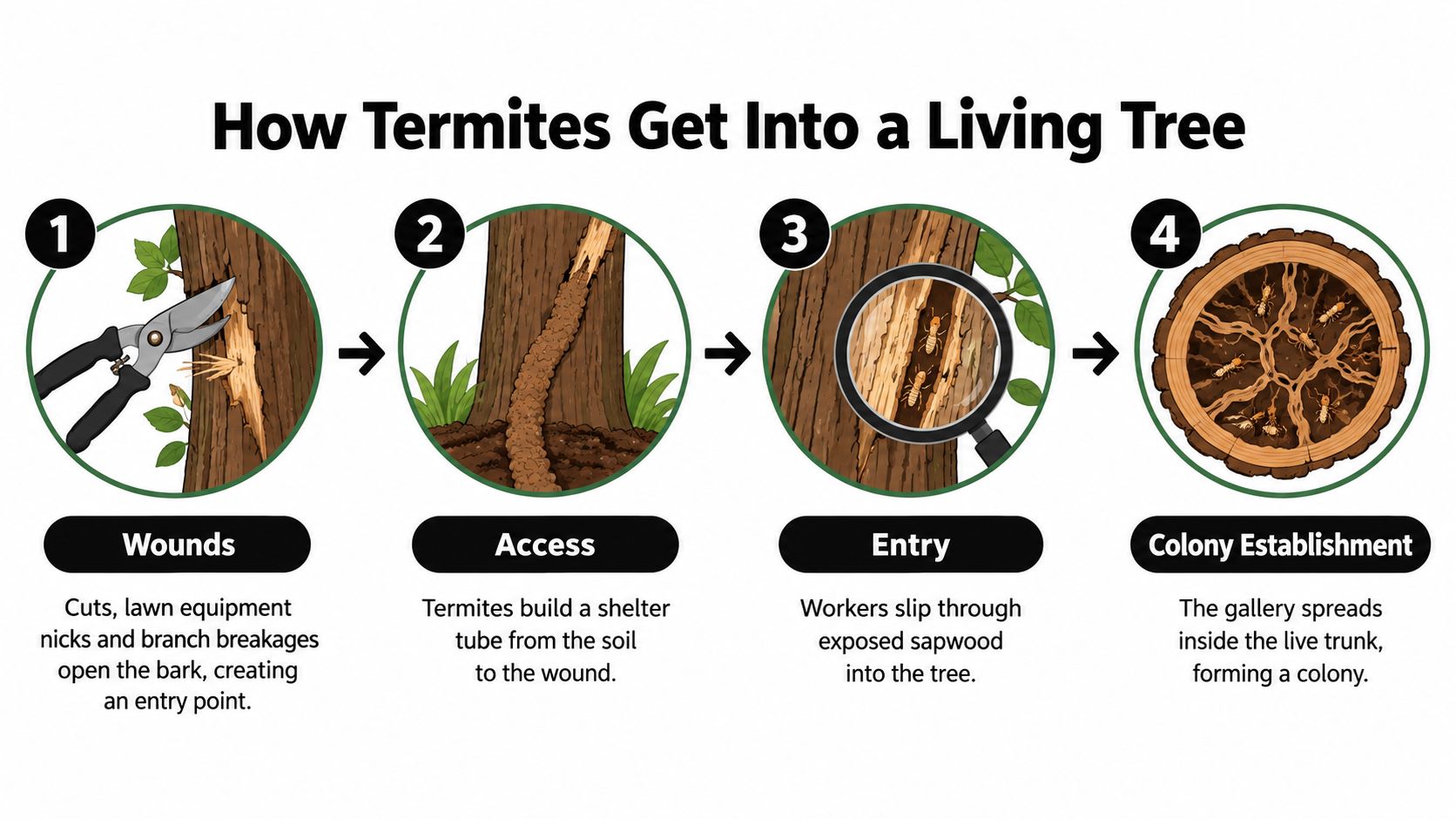
A pruning cut exposes tissue. A lawn mower or string trimmer damages the bark. A storm breaks a limb and leaves a ragged stub. Sunburn cracks, construction injuries, and root disturbance can create similar openings. Once moisture, decay, or insects weaken that area, termites have a more manageable route into the tree.
The entry pathway
A wound creates access. Termites can use damaged bark, exposed sapwood, root injuries, or existing cavities. A wound doesn't guarantee infestation, but it removes a layer of protection.
Workers reach the vulnerable area. Subterranean termites travel through soil and protected shelter tubes. At a tree, those tubes may be concealed behind vines, under loose bark, beside the root flare, or inside a natural hollow.
Workers enter less-defended wood. Formosan termites commonly feed on internal dead xylem. Native subterranean species may use damp decay or buried root material first.
Galleries spread inside the tree. As workers remove wood, the trunk can lose strength even though the outer bark and canopy remain alive.
Bark beetles and other wood-boring insects can make this process easier by damaging tissue before termites arrive. Decay fungi can have a similar effect. The termite may be the visible cause of hollowing, but the original weakness may have started with a storm injury, poor drainage, compacted soil, or an old pruning wound.
A termite infestation in a living tree can therefore be both a pest problem and a tree-health signal. A recent field study monitored 1,304 trees in public green spaces and used baiting to eliminate termite activity and protect trees. That finding supports a careful approach: treat the colony, but also ask why that particular tree offered a suitable location.
A visual check is useful, but don't carve into a sound-looking trunk just to search for termites. Probe only loose bark or an obviously decayed area, and stop if you encounter a structural defect that could make the tree hazardous.
Warning Signs Homeowners Can Spot From the Ground
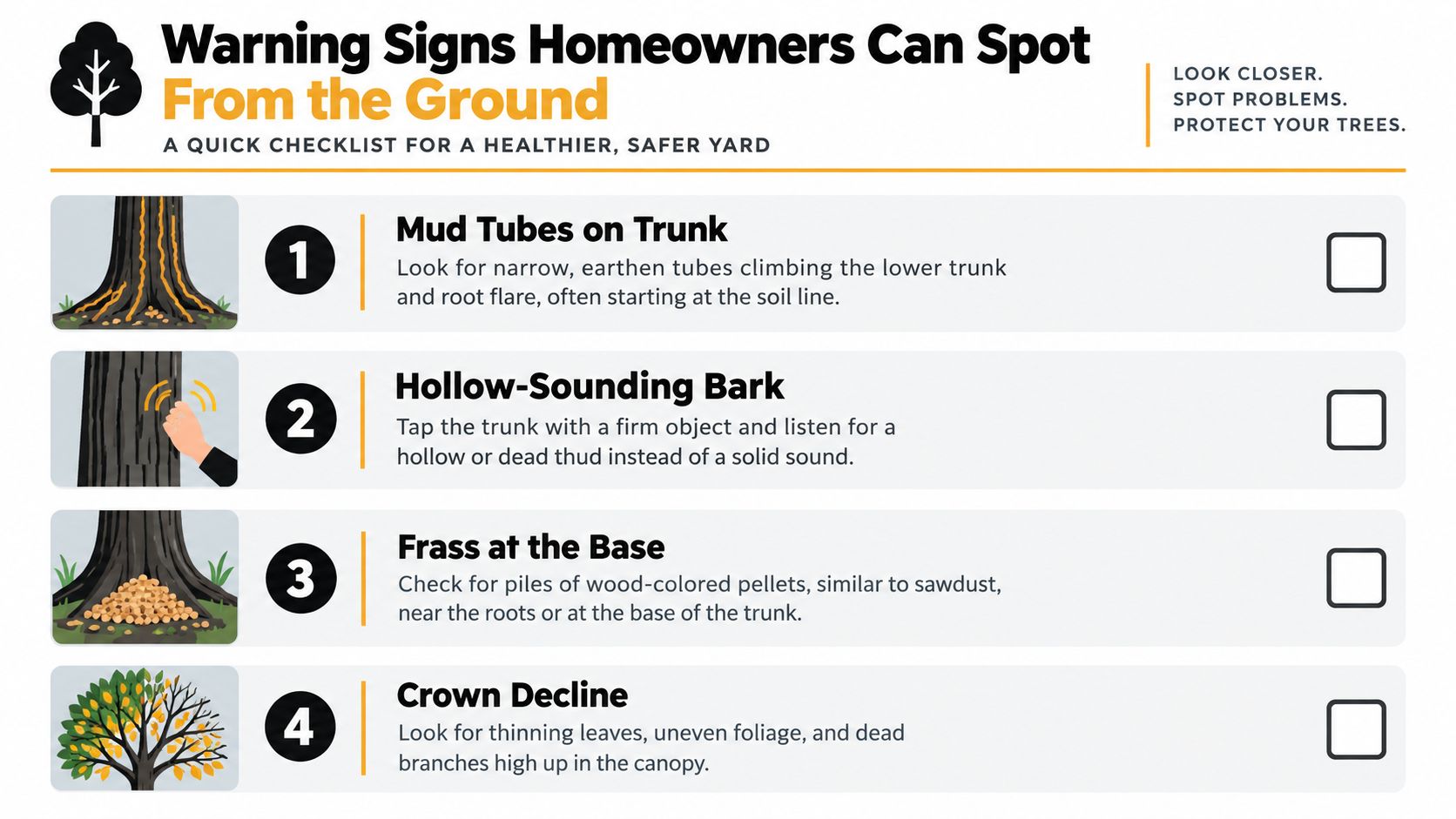
You don't need climbing equipment to perform a useful first inspection. Walk around the entire tree in daylight and examine the trunk from the soil line to the lowest major branches. Look for patterns rather than one isolated mark.
Start at the base
The root flare is the first place to inspect because subterranean termites often move from soil into sheltered wood. Look for narrow, soil-colored tubes climbing the bark or crossing a crevice. A tube that breaks easily and contains damp earthen material is different from a dry pile of pellets.
Tap suspicious sections lightly with the handle of a screwdriver. A hollow or dull sound can indicate a cavity beneath the bark, although healthy trees can also have irregular sounds because of natural structure. Don't use sound alone to diagnose an infestation.
Know what the debris means
Drywood termite pellets are hard, granular droppings pushed from small kickout holes. They may collect beneath a dead branch or inside a sheltered area. Subterranean termite shelter tubes are made from soil, saliva, and wood material. They usually look moist or earthen and remain attached to the bark or another protected surface.
Other clues include loose bark over a hollow area, small openings, dead patches, branch dieback, or a thinning crown. Those signs aren't exclusive to termites. Wood decay, boring insects, storm injury, and root problems can create similar symptoms.
The guidance on termite signs in trees describes hollow cavities, mud tubes, dead areas, and swarmers as useful inspection clues. Treat those clues as reasons to investigate, not as proof of species or active colony activity.
A green canopy can coexist with a weakened trunk. Check the wood, the root flare, and the connections around old wounds.
Warm, wet periods can make shelter tubes easier to notice, while swarmers may appear around wounds, cavities, lights, or nearby structures. If you find wings or flying insects, save a few specimens in a sealed container rather than relying on a quick glance. Winged ants and termites can look similar, and treatment depends on correct identification.
One sign may have another explanation. Two or more signs, especially a shelter tube combined with hollow-sounding wood or visible swarmers, justify prompt professional confirmation. Avoid sealing, painting, or breaking open every suspicious area before an inspection. You could destroy evidence while leaving the colony untouched.
The Risk to Your Home Versus Your Yard
A termite-infested tree in the middle of a large yard isn't the same situation as an infested tree touching a roof, deck, fence, or foundation. In both cases, the tree needs attention, but the pathway to property damage differs.
A yard-only problem may involve a dead stump, buried root, fallen branch, or isolated tree cavity. That material can support termites without proving that the house is infested. A structure-adjacent tree creates more concern because soil, roots, mulch, crawl spaces, slabs, siding, and other cellulose materials may connect the activity to the home.
Compare the two situations
| Factor | Yard-Only Infestation | Structure-Adjacent Infestation |
|---|---|---|
| Main concern | Tree health and local wood damage | Tree stability plus possible entry into the home |
| First action | Identify the insect and assess the tree | Arrange a property-wide inspection |
| Evidence to check | Trunk cavities, roots, stumps, fallen wood | Foundation edges, decks, fences, siding, plumbing penetrations, and tree base |
| Typical urgency | Prompt evaluation, especially if the tree is hazardous | Faster professional response because hidden pathways may exist |
| Treatment focus | Tree, stump, soil, and nearby debris | Tree and the connected structure, with follow-up monitoring |
Don't assume distance alone makes a tree harmless. Subterranean termites can move through connected soil and wood, and dead roots may provide a concealed route. A tree can also shed branches or create moisture and access points near the roof or exterior walls.
Remove fallen limbs and manage stumps responsibly, but don't treat stump removal as a substitute for an inspection. A practical resource on the physical side of that work is this DIY tree stump removal guide from Pool & Landscaping of Vistancia LLC. If termites are active in the stump, root zone, or adjacent tree, chemical or bait-based control may still be necessary.
Triage question: If the tree were removed tomorrow, would termite activity still have a clear route to your home? If the answer might be yes, inspect the structure rather than treating the tree in isolation.
A licensed professional should examine the home when you find shelter tubes, swarmers indoors, activity in a tree that contacts the structure, or unexplained wood damage near doors, decks, and foundation edges. Tree removal may reduce one food source, but it won't eliminate a colony that has already moved elsewhere.
Treatment Options and When to Call a Pro
Homeowners can reduce the problem around a tree, but an established subterranean colony usually requires more than a surface spray. Start by removing loose dead wood, fallen branches, and unnecessary wood debris. Correct irrigation or drainage problems, keep soil and mulch from covering the trunk, and avoid disturbing a suspicious gallery before it can be documented.
Direct treatments may include a liquid termiticide applied to the trunk or root flare, foam injected into accessible galleries, or a localized soil treatment. These methods require careful product selection and label compliance. A treatment that reaches one visible section may not reach a colony hidden in the soil, a root system, or carton material inside the tree.
What professional treatment may involve
- Bait stations: A licensed operator may place and monitor stations around the property to intercept foraging workers and reduce colony activity over time.
- Liquid barriers: Treatment may focus on soil zones around the foundation, tree roots, or other routes where termites travel.
- Localized tree treatment: An arborist and pest professional may coordinate when the tree's structural condition and pest activity need separate evaluation.
- Whole-structure treatment: If termites are emerging inside the home, a professional may consider a building-wide approach, including fumigation where appropriate and legally permitted.
Formosan termites can maintain protected activity above ground, so spraying the visible bark may not solve the underlying problem. The recent South Florida field work also found that previously treated trees can become infested again, which makes follow-up monitoring important rather than optional.
A homeowner-oriented overview of safe termite treatment for homeowners can help you understand the questions to ask before applying a product. For treatment approaches that don't rely on tenting, compare the options in no-tent termite treatment, then confirm the method with a licensed Florida pest control operator.
Call for professional help when you see shelter tubes, swarmers indoors, active termites under loose bark, repeated activity after treatment, or a tree cavity beside the home. Ask for a written inspection report and WDO documentation when appropriate, especially if you're selling, buying, refinancing, or filing an insurance-related record. The report should identify visible evidence, areas inspected, limitations, and recommended next steps.
Preventing Live Tree Infestations in Miami-Dade
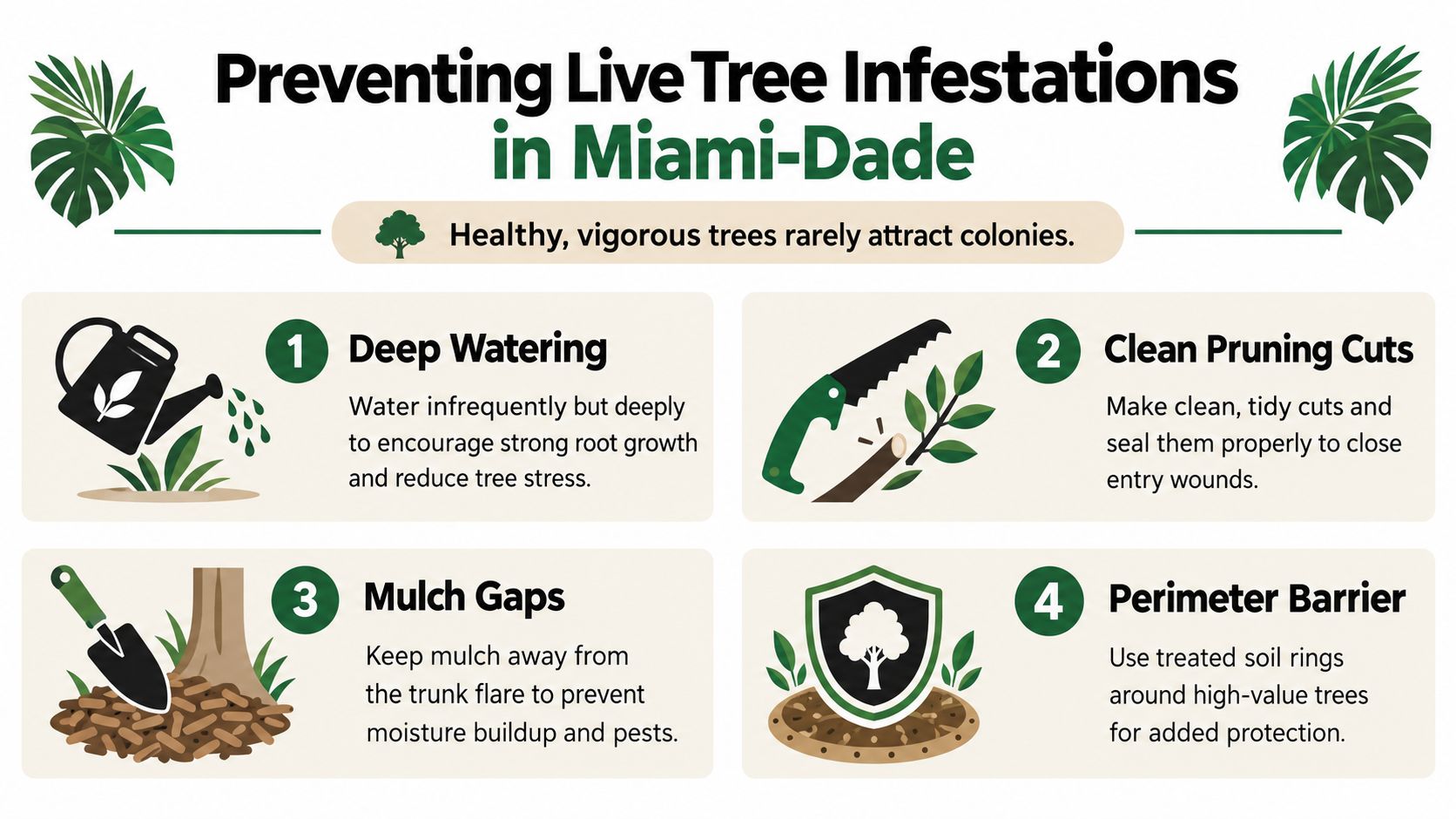
Tree care is termite prevention because healthy trees give colonies fewer easy entry points. You can't make a property immune, but you can remove the conditions that turn a pruning wound, root injury, or dead branch into a protected feeding site.
Begin with the root zone. During dry weather, water mature trees thoroughly according to the needs of the species, soil, and current rainfall. Don't keep the trunk constantly wet, and fix irrigation leaks that leave the root flare saturated. Good drainage matters as much as watering because persistent moisture supports decay.
A practical maintenance routine
- Inspect monthly: Walk the trunk, root flare, nearby stumps, fences, and exposed roots. Look for new tubes, loose bark, cavities, or unexplained debris.
- Prune carefully: Remove dead or broken limbs with proper cuts. Ask a certified arborist before applying wound products, because sealing every cut isn't appropriate for every tree or situation.
- Protect the bark: Keep mowers, string trimmers, ladders, stored materials, and vehicles away from the trunk. A small mechanical injury can become a long-term entry point.
- Keep mulch clear: Mulch can conserve moisture, but it shouldn't be piled against the trunk or root flare. Leave a visible gap so you can inspect the bark.
- Manage wood waste: Remove fallen branches and dispose of stumps thoughtfully. If you grind a stump, learn what happens to roots after stump grinding so you understand why buried woody material may still matter.
Species and planting conditions also affect risk. Oaks, citrus, Australian pine, and other common garden trees don't all respond to injury, moisture, or decay in the same way. A species planted in compacted soil or poor drainage can become more vulnerable than the same species growing in a healthy site.
Use a monthly visual check as a routine, arrange an arborist assessment when the trunk, canopy, or roots look abnormal, and ask a licensed pest professional to inspect when termite evidence appears or the tree stands close to the home. For a broader property plan, review termite prevention treatment alongside your tree-care routine.
Healthy trees are not automatically safe, and a termite finding doesn't automatically mean the tree must come down. Identify the species, locate the entry route, assess the internal damage, and inspect nearby structures before choosing treatment.
Pestless Inc. connects Miami and Miami-Dade homeowners with licensed, insured pest control professionals who can evaluate termite activity, explain treatment options, and provide quotes without obligation. If you find shelter tubes, swarmers, or suspicious tree damage, visit Pestless Inc. to describe the issue through the short request form and get matched with a local provider.
Dealing with this pest right now?
Pestless connects you with a licensed, insured Miami pest control provider for a free, no-obligation quote.