You wake up after a warm Miami rain and find a scatter of translucent wings on the windowsill by the front door. Later, you notice winged insects circling the porch light. The insects may be gone by breakfast, but the question remains: what time of year do termites swarm, and does this mean your home is infested?
In Miami-Dade, “spring” is only part of the answer. Subterranean, drywood, and dampwood termites follow different seasonal patterns, and weather can bring a sudden flight earlier or later within those windows. A swarm may happen outside near a light, or it may emerge from wood inside the building. Those details change what you should inspect next.
Table of Contents
- Why Miami Homeowners Ask This Question at the Worst Possible Time
- What a Termite Swarm Actually Is
- Swarm Season by Termite Species in Florida
- The Weather Triggers That Actually Launch a Swarm
- How Miami's Climate Reshapes the Calendar Answer
- How to Read the Signs When a Swarm Happens
- What to Do Next as a Miami Homeowner
Why Miami Homeowners Ask This Question at the Worst Possible Time
A Brickell homeowner might find shed wings beside the front door in May. A resident in Coconut Grove might see insects gathering around a patio light after rain. In both situations, the event can feel abrupt because termite colonies hide for long periods, then release winged reproductives during a short, coordinated flight.
The common advice, “termites swarm in spring,” works better in colder climates with a narrow warm season. It can mislead South Florida homeowners, where warm temperatures and humid conditions support overlapping activity windows. Florida guidance distinguishes subterranean termites, drywood termites, and dampwood termites rather than placing every species in one calendar box. Florida pest-management guidance explains these species-specific swarm periods.
Why the visible event feels sudden
A swarm is highly visible, but the colony that produced it is usually hidden. Winged termites may appear around a window, door, roof edge, porch light, or a piece of stored wood, then disappear when the flight ends. That disappearance doesn't prove the property is safe. It may just mean the reproductive termites have completed their flight.
The timing question also becomes confusing because an indoor swarm and an outdoor swarm don't carry the same implication. An outdoor flight may come from a soil-connected colony nearby. An indoor flight can indicate that drywood termites are established in structural wood or that swarmers have emerged through an interior pathway.
Practical rule: Treat the season as a clue, not a diagnosis. Species, location, lighting, rainfall, and the presence of discarded wings provide more useful evidence than the month alone.
This guide separates the calendar by species, then explains the weather conditions that launch a flight. That approach gives Miami homeowners a practical way to interpret a swarm instead of waiting for a generic “termite season” to begin or end.
What a Termite Swarm Actually Is
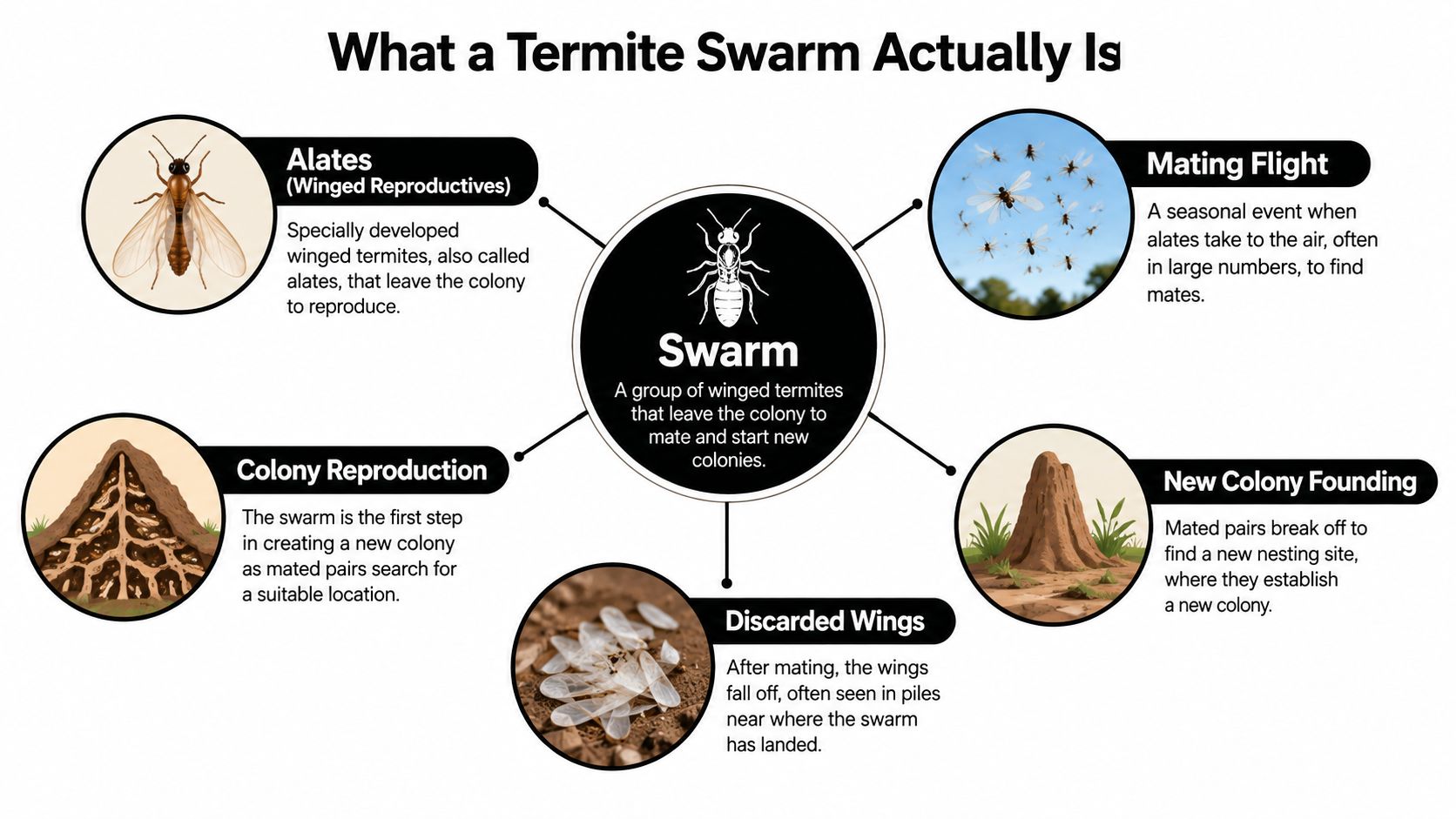
A termite swarm is a reproductive event, not a routine movement of worker termites. A mature colony produces winged reproductives called alates. These termites leave the colony, mate, shed their wings, and search for a suitable place to establish a new colony. The U.S. Forest Service research review on termite swarming biology describes this process and explains why a swarm points to colony maturity rather than the beginning of an infestation.
Think of the swarm as a colony sending out its next generation. The winged termites are not the insects that spend their lives feeding inside wood or maintaining tunnels. They're reproductive termites making a short dispersal flight, although the colony that produced them may have been developing out of sight for a long time.
What happens after the flight
After leaving the colony, alates look for conditions that can support a new nest. Successful individuals shed their wings and attempt to settle in suitable soil or wood. Many don't establish a colony, but the visible flight still matters because it shows that a mature termite colony exists somewhere in the surrounding environment or structure.
A pile of wings is therefore useful evidence. It often means the flight has already ended, not that the termites have vanished from the property. Look especially near windows, doors, light fixtures, baseboards, attic interfaces, and other places where flying insects may gather or enter.
Termites and flying ants aren't the same
Homeowners often confuse alates with flying ants. Use several features together rather than relying on one detail:
- Body shape: Termites generally have a straighter body profile, while flying ants have a visibly pinched waist.
- Antennae: Termite antennae appear relatively straight. Flying ants have elbowed antennae.
- Wings: Termites have wings of similar length. Flying ants have a longer front pair and a shorter rear pair.
- After the flight: Both insects can leave wings behind, so discarded wings alone don't identify the species.
A professional identification is especially important when insects appear indoors. A swarm outside near an outdoor feature may reflect a nearby subterranean colony. A swarm emerging from a wall, ceiling, attic, floor, or wooden furnishing suggests a different inspection path.
A swarm doesn't create the termite problem. It reveals that reproductive termites have reached the stage where they can leave an established colony.
Swarm Season by Termite Species in Florida
Miami's calendar becomes clearer when you separate termite biology from the word “season.” Subterranean termites generally use soil-connected nests, while drywood termites live in wood, and dampwood termites favor moist wooden conditions. Their flight periods overlap, but they aren't interchangeable.
The Florida Department of Agriculture and Consumer Services identifies April through July as the major swarm season for Formosan subterranean termites. Flights typically occur in the evening, and swarmers are attracted to artificial lights, making porch fixtures, windows, and illuminated building edges important observation points. FDACS surveillance guidance describes the Formosan flight pattern and light attraction.
UF/IFAS reports a distinct pattern for other South Florida termites. Asian subterranean termite flights in the Florida Keys have been recorded from February through April, while West Indian drywood termites commonly disperse from April through June. Drywood termites also show a broader warm-season pattern, with peak flights in late spring and summer. Dampwood termites tend to swarm in late spring or summer, particularly where humid conditions support moisture in structural wood.
| Species | Typical Florida swarm window | Common flight time |
|---|---|---|
| Subterranean termites, including Formosan | Some guidance places subterranean activity from roughly mid-December through mid-May, while Formosan activity is major from April through July | Varies by species. Formosan flights commonly occur in the evening and gather near artificial lights |
| Asian subterranean termites | February through April in the Florida Keys | Varies with weather and local conditions |
| Drywood termites, including West Indian drywood | April through June commonly, with warm-season activity extending into late spring and summer | Varies by species, weather, and location |
| Dampwood termites | Late spring or summer | Varies, with humid conditions important |
The ranges overlap most strongly from spring into early summer. That overlap explains why two Miami homes can report winged termites during the same week but require different inspections. A colony in soil beneath a structure isn't investigated in the same way as a colony inside roof framing, hardwood flooring, or stored lumber.
For a broader visual guide to identification and habitat differences, review the types of termites in Florida. If an inspection confirms an active issue, Termite Control can be evaluated as part of the response, with the scope based on species and colony location rather than the calendar alone.
The Weather Triggers That Actually Launch a Swarm
Termites don't follow a date circled on a calendar. They respond to a combination of temperature, humidity, rainfall, wind, atmospheric pressure, soil moisture, colony condition, and other biological signals. A warm month can pass without activity, then one suitable rain event can produce a sudden flight.
Research on subterranean termites found that approximately 602 accumulated heat units above a 4°C base temperature were required before swarming could occur. After that threshold, about 90% of initial swarms occurred within three days of the first qualifying rain event, according to research on environmental cues and termite swarming.
Four cues homeowners can understand
Temperature builds readiness. Termites need enough accumulated warmth before a colony can launch a swarm. The heat threshold explains why the first warm day isn't always enough.
Rain supplies the immediate trigger for some species. Moist soil and humid air make conditions safer for alates leaving the colony. In Miami, this can create a noticeable flight after a warm spell followed by rain.
Humidity affects survival. Winged termites are vulnerable once they leave protected tunnels or wood. Moist air and damp surfaces can improve the chances that a dispersing termite finds a viable nesting site.
Low wind helps the flight. Strong wind can interfere with dispersal, while calmer conditions make movement and landing more manageable. Light intensity and the time of day also influence where swarmers gather.
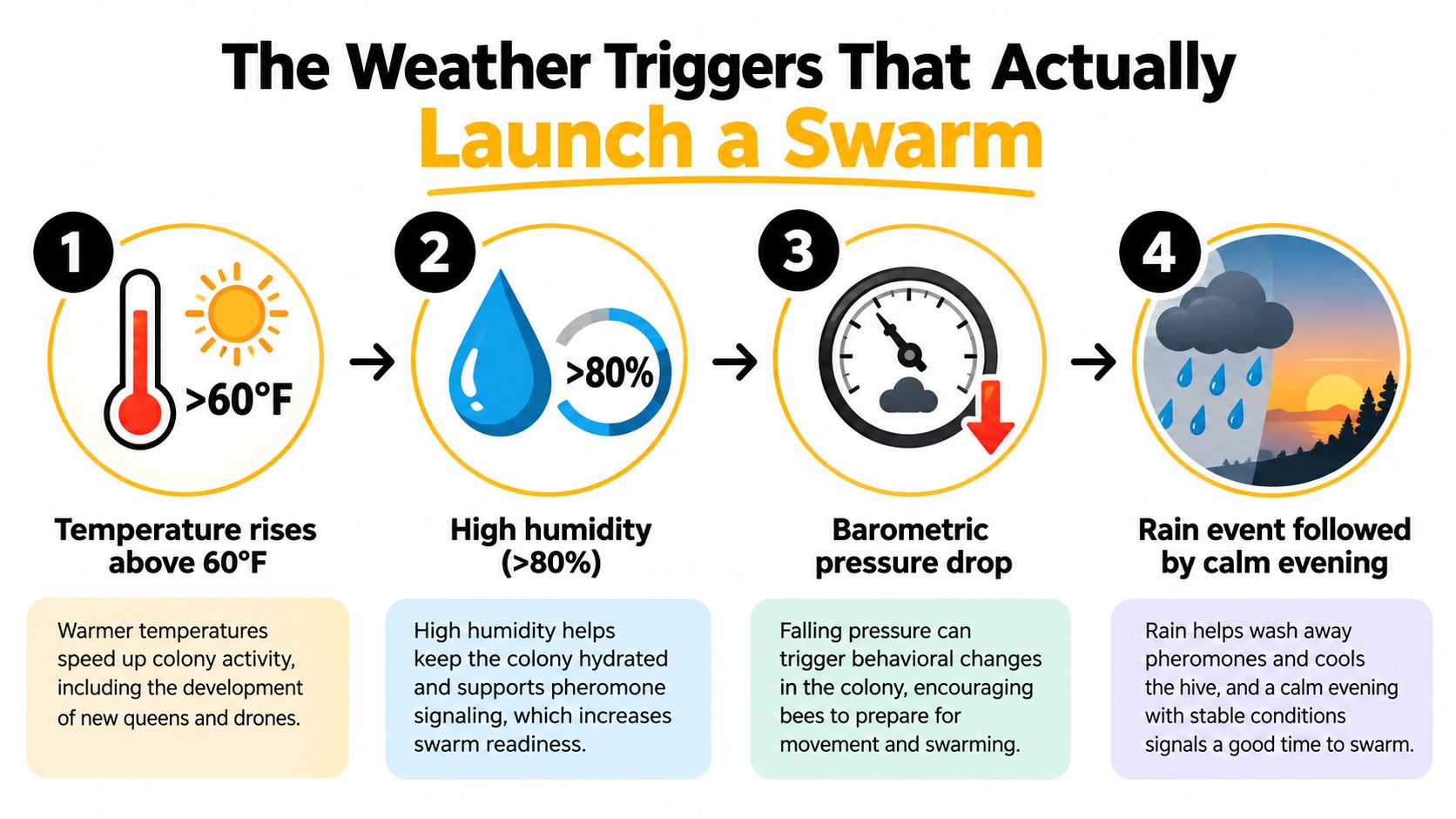
The image refers to bee swarming, but the practical weather lesson for a homeowner is still useful here. Temperature, moisture, pressure, wind, and colony readiness interact, so a swarm may cluster around a particular evening rather than appear evenly across a whole month. Weather-aware home maintenance also benefits from a broader resource such as this guide to storm season preparation for Central Coast, especially when checking roofs, eaves, drainage, and exposed wood before wet conditions arrive.
A short video can help you visualize how weather and insect activity interact:
A related pest issue, Bed Bug Treatment, follows a different biology and shouldn't be confused with termite control. The same principle applies, though: identify the pest before choosing a response.
How Miami's Climate Reshapes the Calendar Answer
Miami's long warm season creates a wider practical monitoring period than the classic northern image of one spring flight. The best mental model runs from December through July, with different species becoming more likely at different points and weather moving the exact event within each window.
December through February
Some Florida guidance places subterranean swarming as early as roughly mid-December, depending on species and local conditions. Asian subterranean activity recorded in the Florida Keys begins in February, so late winter isn't automatically a quiet period. A warm, humid stretch can justify attention to windows, exterior lights, soil-connected edges, and previously damp areas even when neighbors are still thinking about spring.
March through April
This is a transition period. Asian subterranean flights remain relevant through April in the Florida Keys, while other subterranean activity may increase as temperatures and soil moisture become more favorable. Rainfall can determine whether a given warm week produces visible alates or no flight at all.
May through June
This is the most important overlap for many Miami homeowners. Formosan subterranean activity falls within its major April-to-July period, while West Indian drywood termites commonly disperse from April through June. A swarm around an evening light may point toward one inspection pathway, while wings appearing inside a room may point toward another.

July and neighborhood differences
July can mark the later part of the drywood warm-season window and the continuation of dampwood activity in humid wooden areas. Local conditions still matter. Irrigation, dense tree cover, nearby water, drainage patterns, shaded walls, and wood-to-soil contact can create different moisture conditions in Brickell condos, Coconut Grove bungalows, Doral properties, and Hialeah homes.
A condo balcony near bright lighting presents a different observation setting from a shaded single-family home with a decorated perimeter. A Doral property beside irrigation or a lake-adjacent lot may deserve closer attention to soil moisture and hidden entry points. These neighborhood examples don't identify a species by themselves. They explain why Miami homeowners should record the setting instead of relying on a statewide month range.
How to Read the Signs When a Swarm Happens
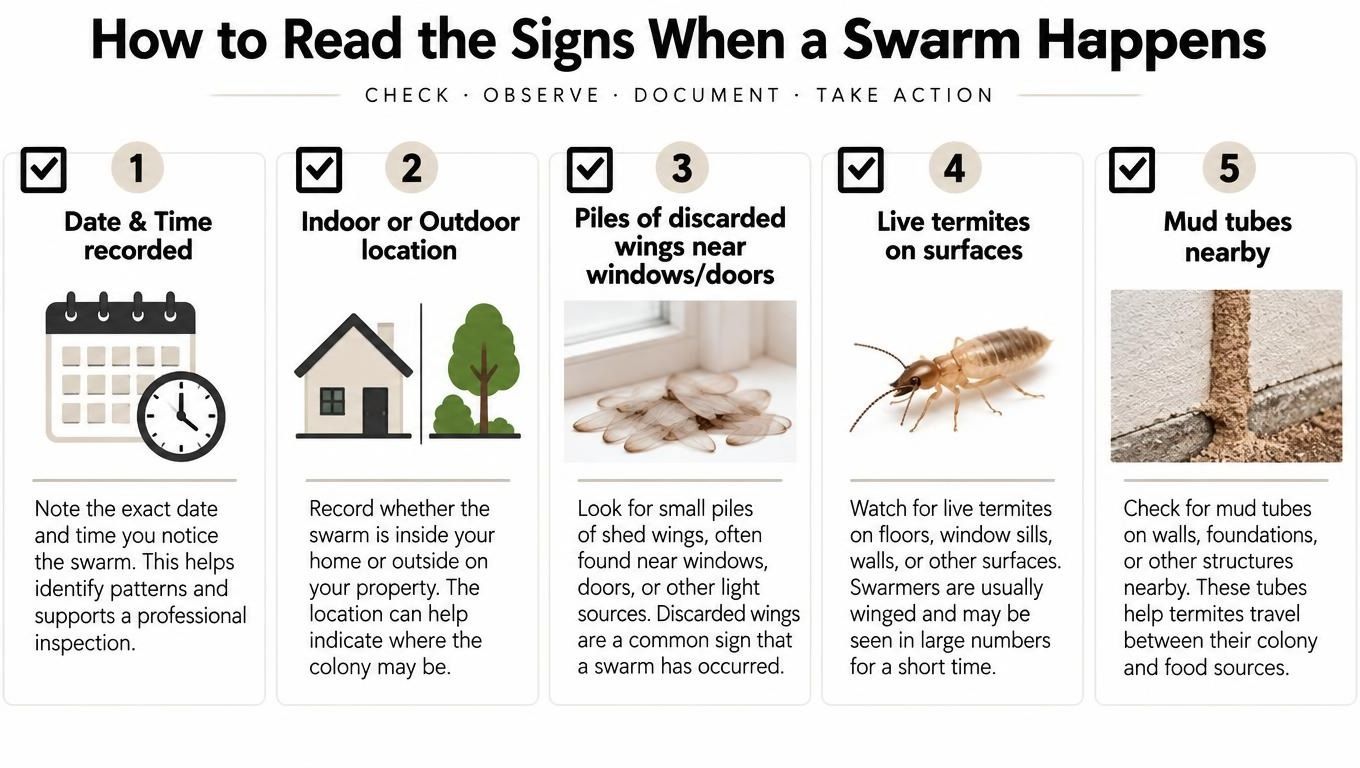
The moment a swarm appears, collect evidence before cleaning everything away. The most useful details are simple: date, time, weather, exact location, lighting, and whether wings remain.
Record the scene
- Date and time: Note when you first saw the insects and whether the event followed rain.
- Indoor or outdoor location: Record the room, wall, window, porch, yard, or building edge.
- Discarded wings: Photograph piles near windows, doors, lights, baseboards, or flooring.
- Live insects: Capture close images without disturbing the surrounding area.
- Mud tubes or wood damage: Check visible foundation edges and accessible wood, but don't remove tubes or break open damaged surfaces.
Daylight flights may be more consistent with some native subterranean species, while dusk or nighttime activity around artificial lights is associated with Formosan termites and some drywood species. Those are useful clues, not reliable identification rules. A licensed professional should confirm the insect and determine whether the colony is in soil, structural wood, a detached wooden item, or somewhere nearby.
A swarm outdoors doesn't automatically mean the structure is infested. An indoor swarm deserves more urgent attention because the colony may be within the building or connected to a concealed entry route. For additional visual guidance, use this guide to identifying termite damage, then preserve the evidence for an inspection.
What to Do Next as a Miami Homeowner
Start with the record, not the spray. Photograph the insects, wings, surrounding surfaces, and any mud tubes or visible wood changes. Write down whether the swarm was inside or outside, what time it occurred, whether exterior lights were on, and whether rain had recently passed.
Next, separate the likely inspection paths. Indoor swarmers can indicate drywood termites within structural wood or another wooden item, while outdoor swarmers may be associated with soil-connected subterranean colonies. Timing alone can't establish the treatment area, so arrange a licensed Florida inspection that confirms species and colony location.
If you want help locating a provider, Pestless routes Miami-Dade requests to licensed and insured pest control professionals, including providers serving Brickell, Coconut Grove, Doral, Hialeah, and Kendall. According to its service information, requests typically receive a response within one business hour during Monday through Saturday, 7 a.m. to 9 p.m. Eastern Time, with zero-cost, no-obligation quotes matched by neighborhood. You can also review practical guidance on what to do about swarming termites.
Termite timing is only one part of protecting a home over time. If you're comparing broader property-maintenance ideas, this resource on long-term pest protection from Wildlife Control Services offers additional context, though termite treatment still requires a termite-specific inspection.
If you've found swarmers or discarded wings in your Miami-Dade home, visit Pestless Inc. to describe what you saw and request a zero-cost, no-obligation quote from a licensed, insured local professional. Include the swarm location, date, time, and recent weather so the provider can begin with the most useful evidence.
Dealing with this pest right now?
Pestless connects you with a licensed, insured Miami pest control provider for a free, no-obligation quote.