You hear scratching above the ceiling, spot a dark pellet beside the pantry, or catch a small shape darting along the garage wall. In a Miami home, that could mean mice or rats, and a quick glimpse usually isn't enough to tell which. The more useful question is where the animal got in and whether the sign points to a problem in your unit, the building, or the surrounding property.
Color won't settle it. Focus on body size, tail shape, droppings, and where the animal moves, then inspect for entry points. Treat even one sighting as a reason to check the building, not proof that the animal is alone.
Table of Contents
- Mice and Rats Side by Side
- Reading Droppings, Gnaw Marks and Tracks
- Where Each Species Lives and Moves in a Miami Home
- Health Risks and Damage Each Species Causes
- Entry Gap Sizes That Decide Which Species Gets In
- Who Acts First in Miami Homes, Rentals and Condos
- Decide Whether to Call a Licensed Pro
Mice and Rats Side by Side
| Trait | House mouse | Roof rat | Norway rat |
|---|---|---|---|
| Adult weight | Small and light | Medium-sized | Large and heavy-bodied |
| Body length, nose to rump | Short | Longer than a mouse | Longest and thick-bodied |
| Tail | Thin, scaly, about as long as the body | Longer than the body | Shorter than the body |
| Ears | Large, thin, almost hairless | Large and thin | Small, blunt and furred |
| Snout | Pointed | Pointed | Blunt |
| Movement | Quick darting runs, often close to walls | Agile climber, travels along wires and rooflines | Deliberate, ground-level movement; may burrow |
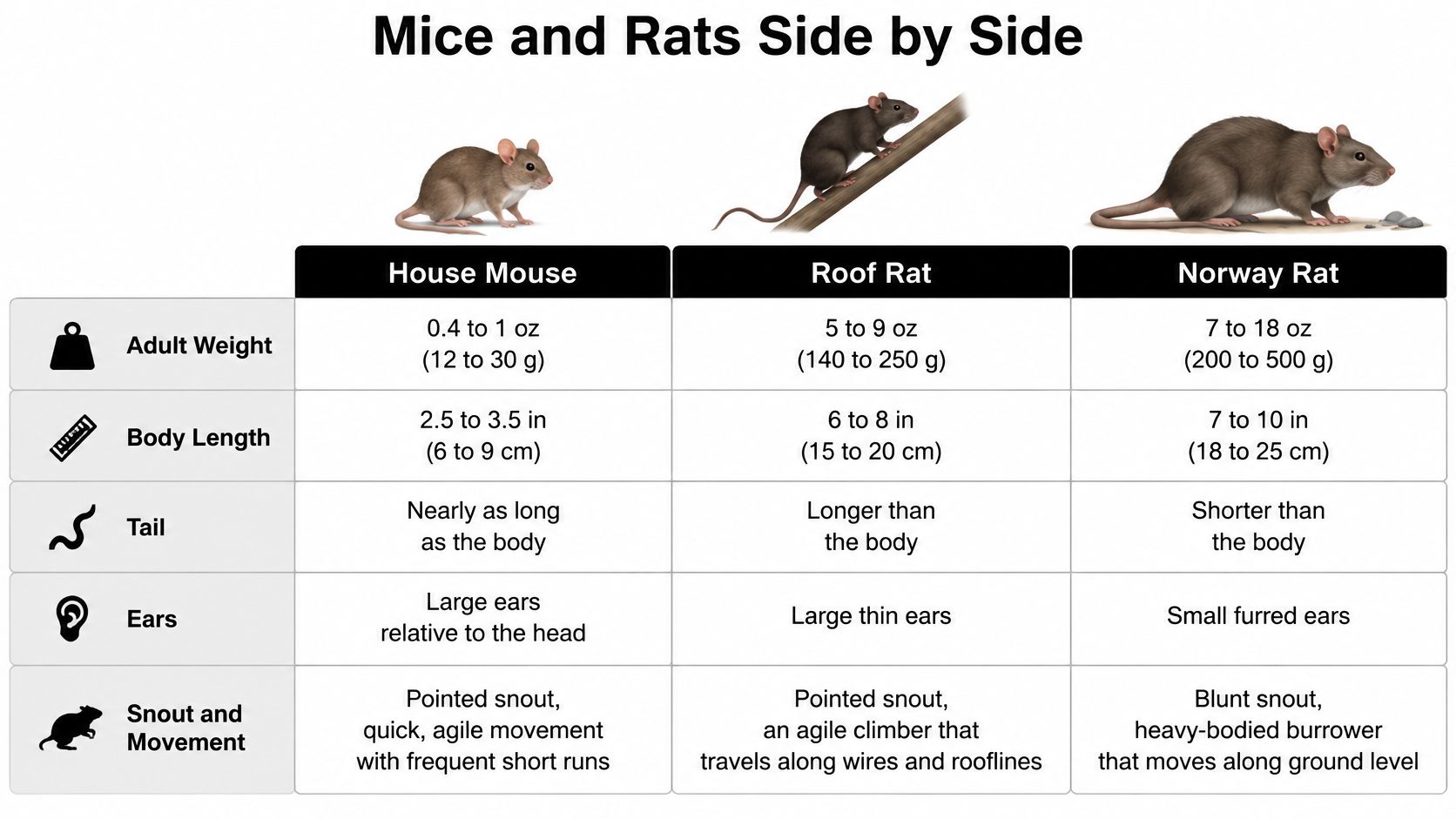
Size is more useful than color. House mice are much smaller than either rat species, but coat color can mislead: mice and rats may both look brown or gray, and roof rats in Miami can appear very dark. A small animal with large ears and a fine build points toward a mouse. A heavier, palm-sized animal near a roofline, garage, or drain points toward a rat.
The tail and head provide supporting clues. House mice have large ears relative to the head and a pointed snout. Roof rats also have large, thin ears and a pointed snout, while Norway rats tend to have smaller, furred ears and a blunter face. A brief nighttime glimpse rarely shows these features clearly, so don't make a treatment decision from a fleeting silhouette.
A mouse's tail is about as long as its body. A roof rat's tail is longer than its body, while a Norway rat's is shorter.
Movement and location help narrow it down. Mice make quick, short runs, often along edges and close to walls. Roof rats climb readily and use wires and rooflines; Norway rats are more grounded and are associated with burrows. Miami homes can have roof rats, Norway rats, or both, so inspect both the upper structure and ground-level access before deciding which animal is present.
Reading Droppings, Gnaw Marks and Tracks
| Sign | House mouse | Rat |
|---|---|---|
| Droppings per day, approximate | 50–60, according to Cornell's guidance on managing mice and rats | 40–50, according to Cornell's guidance on managing mice and rats |
| Dropping size and shape | Small, rice-grain-shaped pellets | Larger, more conspicuous pellets |
| Fresh versus old droppings | Fresh: moist, soft, shiny, and dark; old: dry, hard, dull, and grayish | The same freshness signs apply |
| Gnaw marks | Small, neat notches on packaging, wire insulation, and soft plastic | Wider, heavier gnawing, with larger damage to wood, drywall, and plastic |
| Rub marks along walls | Faint greasy smudges along narrow runways | Darker smudges along walls, beams, and pipes |
| Footprints in dust or flour | Small prints may appear near walls | Larger prints may appear near walls or burrows |
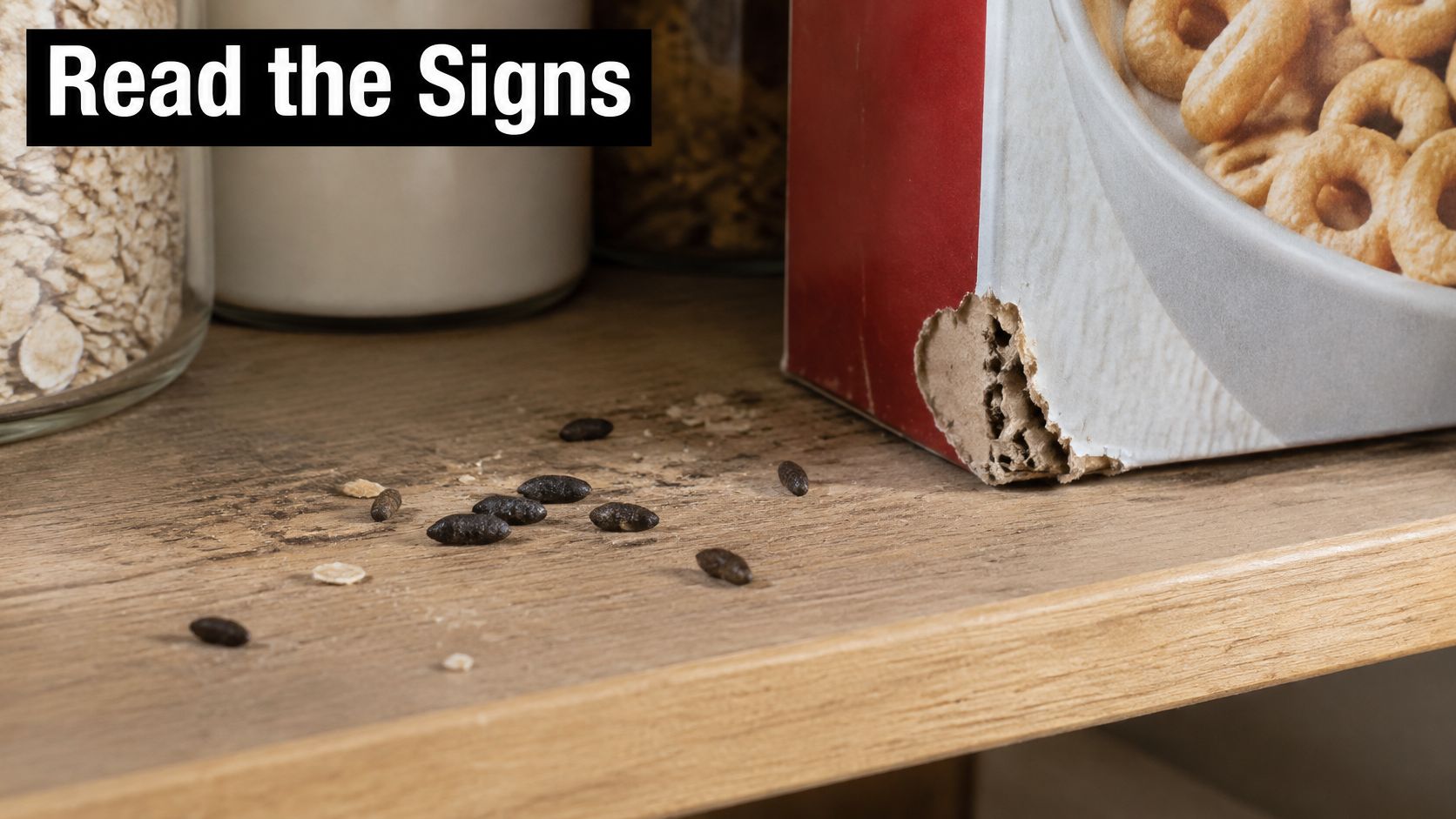
A dropping count helps assess activity, but it doesn't count animals. Cornell's approximate daily figures are 50–60 droppings for mice and 40–50 for rats. A pile of twenty pellets does not mean there are twenty rodents, and the pellets may not all be recent. Rats leave larger, more conspicuous droppings; mice can leave more, smaller ones. Cornell's guidance also explains how freshness can help indicate recent activity.
Fresh droppings are usually moist, soft, shiny, and dark. As they age, they become dry, hard, dull, and grayish. Location adds context: pellets near a food package, under a sink, or along a wall route matter more when considered with gnaw marks, nesting material, odors, and nearby food or water.
Inspect in a consistent order. Map droppings by room and height, note their size and condition, then check for chew marks, rub marks, nesting material, and signs of urine. A simple sketch lets you compare the cleaned areas after repairs. Use this guide to recognize rodent infestation signs.
Clean safely. Don't dry-sweep or vacuum droppings, urine, nesting material, or a carcass. Wear gloves and ventilate the space. Spray the material with disinfectant, let it soak, then wipe it up with paper towels and dispose of them safely. If signs continue, Rodent Control describes an approach that removes rodents and seals their entry routes.
For a visual walkthrough, use this video as a supplement to a careful inspection.
After cleanup and exclusion, new droppings are a stronger sign of active infestation than the original pile. Recheck cleaned areas rather than relying on an old count.
Where Each Species Lives and Moves in a Miami Home
| Rodent | Likely shelter | Typical route | What a sighting may point to |
|---|---|---|---|
| House mouse | Wall voids, cabinets, pantries, attic insulation, behind appliances | Short trips from a nearby nest | A nest or access point close to the room |
| Norway rat | Slab edges, drains, garages, sheds, crawlspaces and sewer or storm-drain routes | Ground level, often along edges | Activity around foundations, drains or waste |
| Roof rat | Attics, rooflines, palm fronds, fruit trees, upper floors and wires | Climbs along branches, wires and fences | Access through the roofline or nearby vegetation |
A mouse found in the kitchen may have a nest in a wall void, cabinet, pantry, or space behind an appliance. Mice tend to stay close to shelter and food, so a sighting in one room makes nearby cupboards, pipe openings, and appliance gaps worth checking. A clean countertop doesn't rule out a nest tucked inside a wall or cabinet void.
Norway rats use the lower parts of a property. Check slab edges, garages, sheds, crawlspaces, and openings around drains. They can forage away from a burrow and may approach food confidently, though a new object in their route can make them cautious at first.
Roof rats take a different route through a building. In South Florida, they can use palm fronds, fruit trees, hedges, fences, and wires to reach eaves or roof penetrations. Warm, humid conditions and dense landscaping can provide shelter and convenient routes between outdoor harborage and a home. For more local context, see this guide to rodents in Florida.
The problem isn't always confined to a kitchen or a single unit. A 2025 study of complaint, trapping, and inspection records from 16 cities found significant rat increases in 11 cities, or 69%, over an average period of roughly 12 years; increases were larger in cities that warmed more rapidly, according to this National Geographic account of the urban-rat findings. That finding isn't a Miami-specific forecast, but it supports inspecting beyond the room where an animal appeared.
Dumpsters, storm drains, construction, vegetation changes, and neighboring properties can all contribute to recurring indoor sightings. Check the perimeter and upper structure, not just the kitchen.
Health Risks and Damage Each Species Causes
| Concern | House mouse | Rat |
|---|---|---|
| Contamination pattern | Small traces can be hard to spot across surfaces | Larger droppings and urine can contaminate stored food |
| Bite risk | Uncommon; more likely if handled or cornered | Uncommon; more likely if handled or cornered |
| Typical damage | Can damage packaging and insulation | Can damage wiring, plumbing, wood, drywall, and vent structures |
| Practical priority | Check for hidden contamination and nearby nesting areas | Address contamination and damage promptly |
Rodents spread more than 35 diseases worldwide, according to the U.S. Centers for Disease Control and Prevention's history of environmental health work. They can transmit pathogens through bites, saliva, urine, feces, and handling, or indirectly through infected fleas, ticks, and mites. The immediate household concern is often contamination on surfaces or in food storage areas.
Rats are associated with leptospirosis and rat-bite fever; mice are more often associated with salmonella risk from contaminated food. Small traces may be scattered across concealed spots, while larger droppings and urine can make contamination easier to detect and stored food quicker to spoil. Discard food showing signs of rodent access. Do not taste it or try to salvage it.
Chewed wiring adds a fire risk. If you find exposed or damaged wiring, leave the area alone and arrange an appropriate electrical inspection. Rats can also damage plumbing and building materials, so visible damage warrants prompt attention rather than waiting for more signs.
Bites are uncommon when rodents are left alone. Keep children and pets away from the animal and contaminated material, and do not handle or corner either species. If someone is bitten or has direct contact with a rodent, seek medical advice instead of treating it as routine cleanup.
Entry Gap Sizes That Decide Which Species Gets In
| Species | Gap that lets it through | Common Miami entry points | Exclusion material |
|---|---|---|---|
| House mouse | About 6 mm, or about 1/4 inch | Utility line penetrations, door thresholds, cabinet voids, roof-wall junctions | Metal mesh or hardware cloth with openings no larger than 1/4 inch, plus sealant |
| Norway rat | About 13 mm, or about 1/2 inch, or larger | Foundation gaps, drain openings, garage door bottoms, damaged door sweeps | Metal mesh or hardware cloth with openings no larger than 1/4 inch, anchored at edges |
| Roof rat | About 13 mm, or about 1/2 inch, or larger | Roof penetrations, vent openings, eaves and soffits, palm-to-roof contact points | Metal mesh or hardware cloth with openings no larger than 1/4 inch, anchored at edges |
The Journal of Integrated Pest Management's rodent-exclusion guidance gives the practical threshold: house mice can pass through gaps of approximately 6 mm, while rats generally need openings around 13 mm or larger. Sealing only obvious wide gaps may stop rats but leave a building open to mice. Size the inspection and repair for the smallest species you may have.
Start with utility penetrations, door thresholds, cabinet voids, and roof-wall joints if the evidence points to mice. For rats, check foundation gaps, drains, vent openings, damaged door sweeps, and garage-door bottoms. In a condo, include plumbing penetrations and shared service spaces, not just the inside of the unit.
Soft expanding foam alone isn't a durable rodent barrier. Use metal mesh or hardware cloth with openings no larger than 1/4 inch, and secure and seal its edges so the animal can't push around it. In humid utility chases and around roof penetrations, corrosion or building movement can reopen a repair. If a suspected opening is at the roofline, schedule a professional roof inspection to assess the roofing condition alongside pest access.
After sealing, check the work rather than assuming the gap is closed:
- Test door closures. Confirm that door sweeps meet the threshold and the garage door seals along the bottom and sides.
- Inspect screens and vents. Check that coverings are intact and mesh is firmly fixed at the edges.
- Look for fresh activity. Recheck repaired areas for new droppings or gnaw marks and repair any gap that has reopened.
Who Acts First in Miami Homes, Rentals and Condos
| Situation | First step | Usually authorizes repair | Evidence to keep |
|---|---|---|---|
| Single-family home | Inspect and document, then contact a licensed professional | Homeowner | Dated photos of droppings, gnaw marks and entry points |
| Condo unit | Document the signs and notify the association if they are in shared walls or chases | Association for shared structures; owner for unit interior | Photos, location in the unit or shared wall, dates |
| Long-term rental | Send written notice to the landlord or property manager | Landlord or property manager | Copy of notice, dated photos, date of first sighting |
| Short-term rental | Notify the host or property manager promptly | Host or property manager | Guest-reported dates, photos, cleanup records |
| Home sale or purchase | Request a licensed inspection before closing | Buyer and seller as set by the contract | Inspection report, repair estimate, written findings |
Locate the evidence before deciding who to call. If signs are inside a privately owned unit, the owner or occupant can document them and arrange an inspection. Report activity in shared walls, plumbing chases, garages, trash areas, or roof spaces to the property manager or condo association in writing. If signs appear to come from a neighboring lot, record what you can observe and contact the manager or property owner.
A sighting inside one unit can signal activity elsewhere in the building. The location of the evidence helps identify who should respond, while the lease, condo bylaws, or purchase contract can clarify who authorizes repairs. Check those documents before approving work.
Inspection, exclusion, trapping, and monitoring serve different purposes. An inspector identifies activity and likely routes. The party responsible for the affected structure usually authorizes repairs. Trapping may reduce activity, but it does not close an entry point; monitoring helps establish whether activity returns after sanitation and exclusion.
For condos, defining condominium maintenance responsibilities can clarify who manages common elements before repair work begins. Keep dated photos, sketch suspected entry points, note which rooms or units are affected, and save copies of written notices. Clear records help the responsible party assess the issue without relying on conflicting recollections.
Decide Whether to Call a Licensed Pro
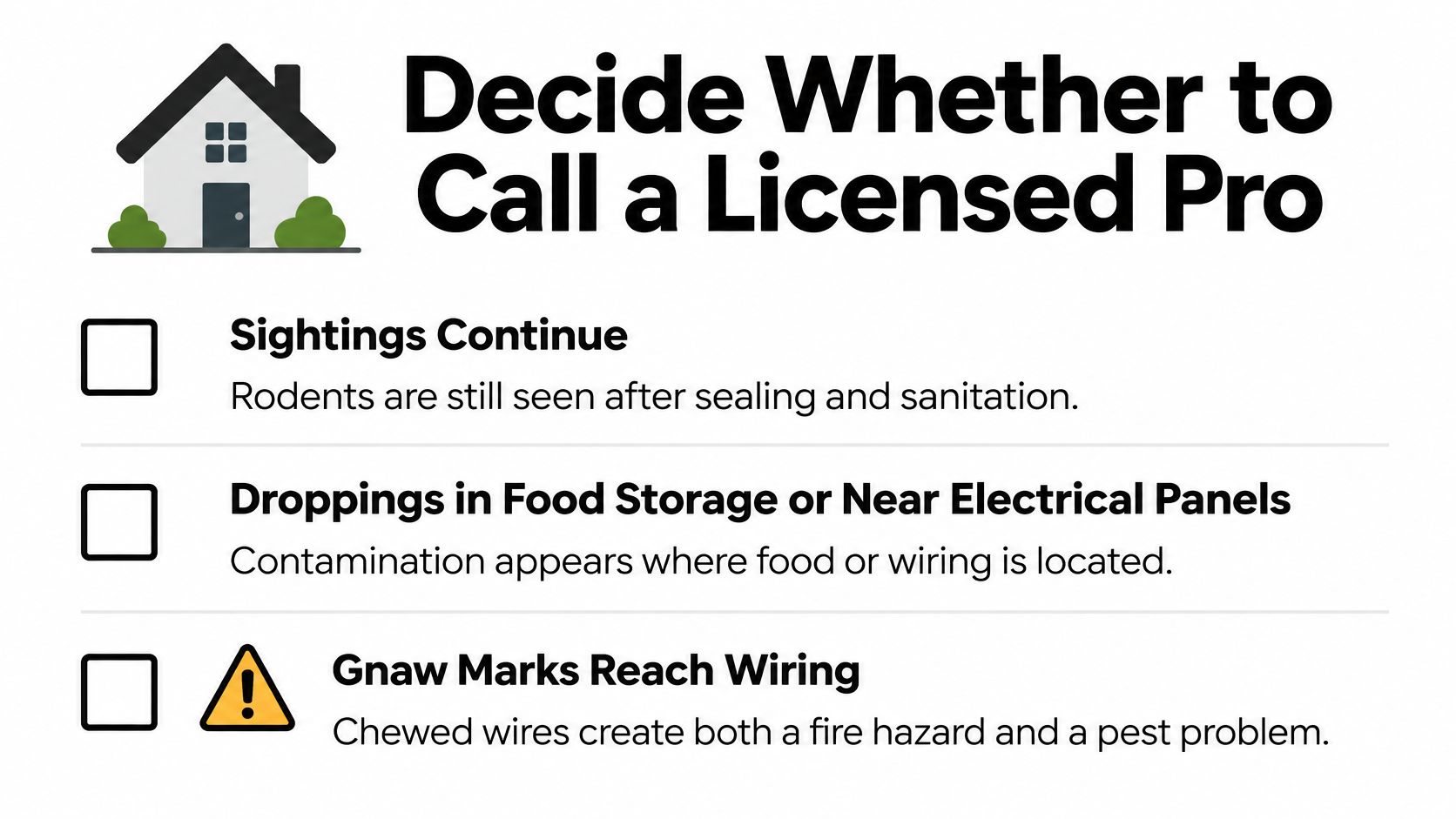
Call a licensed pest professional if any of these apply:
- Activity continues. You still see rodents or fresh signs after sanitation and sealing.
- Food or electrical areas are affected. Droppings appear in food storage or near an electrical panel.
- Gnawing reaches wiring or plumbing. The damage may require a separate repair professional as well as pest work.
- The route is shared. Activity is inside a shared wall, utility chase, or building system.
- There's direct contact. Someone has been bitten or has handled a rodent or contaminated material.
- The property needs documentation. You need written inspection findings for a sale, lease, or insurance matter.
- Occupants need extra caution. Young children or people with respiratory conditions live in the affected space.
Self-monitoring makes sense only when you find an old, dry cluster, no fresh signs, and no new droppings after cleaning and sealing. Keep checking the area rather than assuming the problem has ended. If fresh evidence returns, or you can't identify how the rodent entered, get a professional inspection.
Before hiring anyone, ask for a verified Florida license and proof of insurance. Request written findings with photos, an exclusion plan matched to the openings found, and a follow-up visit to check whether the repairs worked. A proposal that recommends traps but doesn't explain entry points may reduce sightings temporarily without addressing access.
Use this guide to choose a licensed pest control professional and ask the provider to explain the inspection, exclusion, trapping, and monitoring work separately. Pestless connects Miami and Miami-Dade homeowners with licensed, insured pest professionals through an online form or phone call; it doesn't perform treatments itself.
Take photos of the signs, check suspected gaps with a 1/4-inch reference, and request quotes if the evidence is fresh, recurring, or difficult to trace. That gives a professional a clear starting point and helps you compare plans based on the actual access problem.
Pestless Inc. connects Miami and Miami-Dade homeowners with licensed, insured pest control professionals who can inspect rodent activity and explain options for removal and exclusion. If you're ready to compare local quotes for mice or rats, visit Pestless Inc. to describe the issue and request a no-obligation introduction.
Dealing with this pest right now?
Pestless connects you with a licensed, insured Miami pest control provider for a free, no-obligation quote.