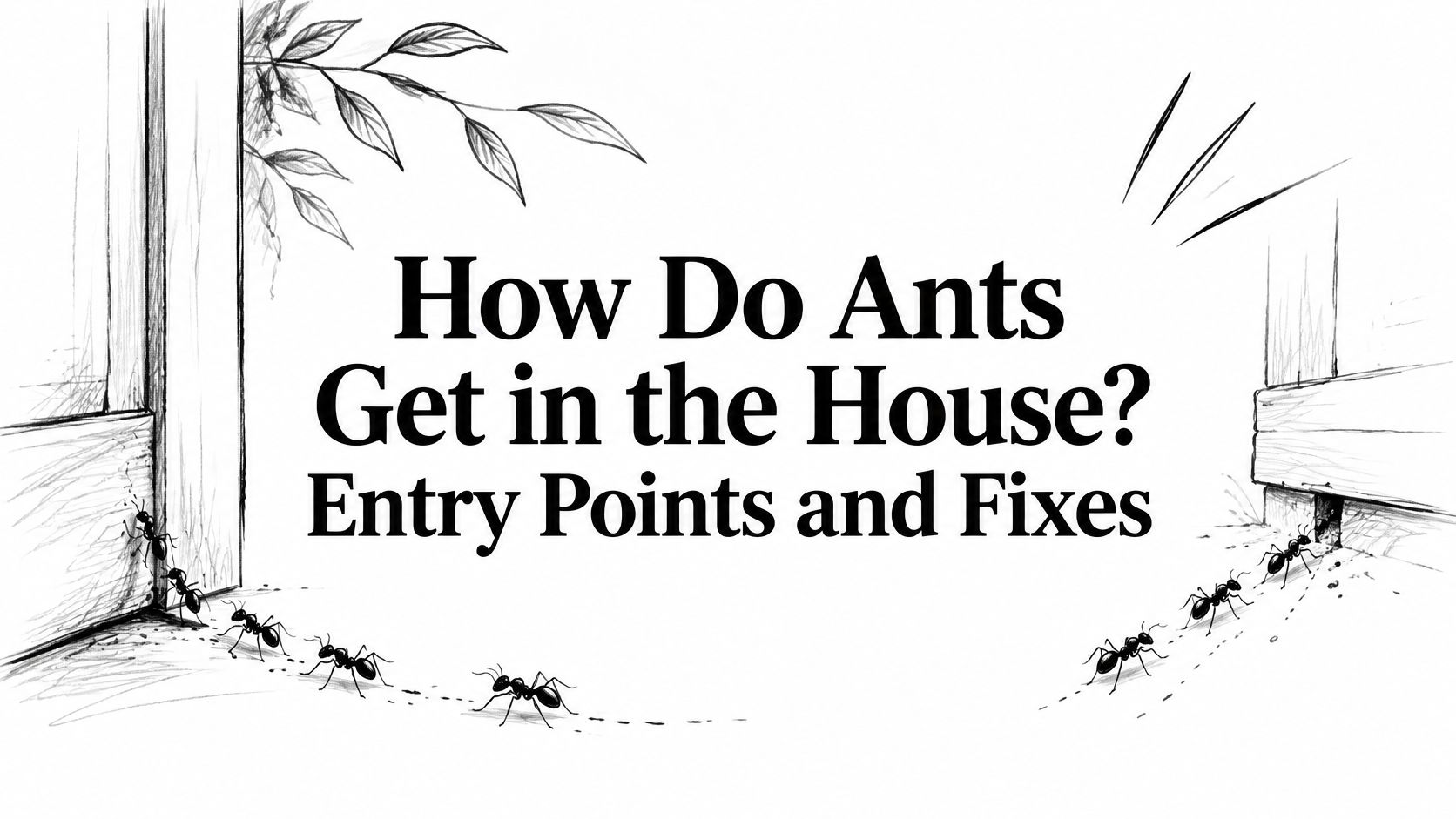
A line of ants has appeared beside the kitchen sink. You wipe the counter, but more workers follow the same route a little later. The important question isn't only where you see them. It's where they're getting in, and whether the colony is outside or nesting indoors.
In Miami homes, ants usually walk through gaps that already exist. They don't need to chew through solid stucco or block. Finding the access point, then checking where the trail leads, is more useful than treating every ant line as proof of a nest inside the wall.
Table of Contents
- Where Ants Actually Get Inside Miami Homes
- Why Ants Find Food and Water Inside
- Species That Behave Differently Once Indoors
- Trace the Trail and Seal the Gap
- Quick DIY Fixes That Clear Trails Fast
- Know When to Call a Licensed Miami Pro
Where Ants Actually Get Inside Miami Homes
Ants most often enter through existing gaps in the structure, including foundation cracks, spaces around doors and windows, and openings for pipes or electrical wires. Very small ants, such as white-footed and rover ants, can fit through openings that are difficult to spot. And the trail you see inside may lead to a crack even if the nest is some distance away. An indoor line doesn't, by itself, prove that a colony is in the wall. The Illinois Department of Public Health's guidance on ants describes exclusion as the first line of defense because ants often nest outdoors and enter to forage.
The table lists common routes around Miami homes. The order is a practical inspection sequence, not a measured ranking. Ants travel along edges and seams because those routes offer cover and connect sheltered spaces.
| Entry point | Where it shows up | Why ants use it |
|---|---|---|
| Foundation and slab cracks | Thin dark lines in stucco, masonry, or at the base of walls | A hidden, protected route into the structure |
| Door and window frames | Gaps between the frame and stucco, or worn weatherstripping | Shaded edges that can be easy to overlook |
| Sliding-door tracks | A trail along the track or threshold | A narrow channel that may stay damp |
| Utility penetrations | Gaps around water pipes, AC lines, and electrical conduit | Existing openings for pipes, cables, and lines |
| Vents and soffit openings | Dryer, bath-fan, or soffit vents with damaged screens | Gaps connecting to wall or attic spaces |
| Slab-level service openings | Ducts and service openings near slab edges | Routes toward spaces beneath the slab |
| Garage-door bottom seals | A gap beneath a cracked or worn seal | Direct access at ground level |
| Plant and mulch contact | Branches, shrubs, or mulch touching walls, windows, or roof edges | A bridge from outdoor nesting areas to the building |
Moisture can make a route more attractive. Leaks, condensation, clogged gutters, poor drainage, and damp spaces around the home can support insect activity and favorable nesting conditions. In humid South Florida, it makes sense to check both the gap and the damp area nearby.
Practical rule: The entry point matters more than the trail's indoor endpoint. Follow the route before you decide where the colony is.
Why Ants Find Food and Water Inside
A few ants cross the counter toward a sugar spill. One worker that finds food can lay a scent trail for other workers to follow. The steady line indoors does not prove the colony is inside the kitchen. The gap they use to enter and the colony's location are separate questions.
Common food draws include:
- Sugar spills on counters or floors
- Grease around the stove
- Pet food left out overnight
- Crumbs beneath a toaster
Check the places where these sources are easy to miss: beneath the toaster, along the stove edge, and around the pet bowl. A quick wipe may remove the food, but ants can keep following a scent trail for a time.
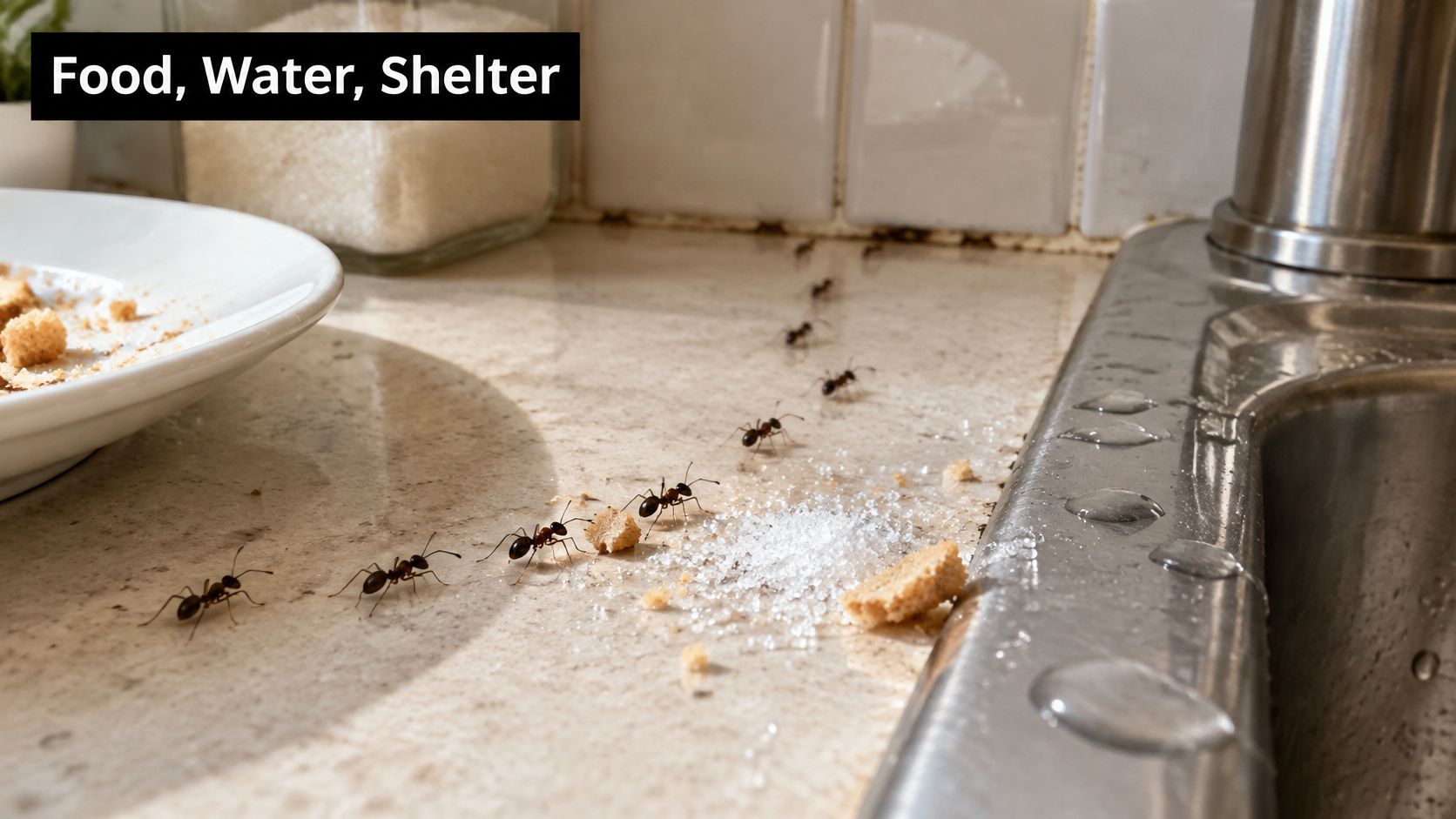
A trail can appear after a spill, rainfall, or a plumbing leak changes what is available. The Maine ant guidance describes Argentine ants using established routes to reach food. Watch where the line begins and ends before assuming the nest is behind the nearest wall.
Clean sticky residue and crumbs with a guide to cleaning your kitchen as a practical reference. If the trail returns, check the food source and the route separately. Removing food weakens the ants' reason to forage indoors. Sealing the access gap addresses how they get in.
Species That Behave Differently Once Indoors
The species can offer clues, but the trail's location doesn't identify the nest by itself. The comparison below is a field guide, not a substitute for confirming the ant.
| Species | Usual entry route | Can nest indoors | Telltale sign |
|---|---|---|---|
| Ghost ants | Near-foundation nests or vegetation touching the building | Yes, including wall voids, outlets, and switch plates | Tiny, pale workers moving erratically near sinks or outlets |
| Argentine ants | Trails from landscaping along edges and cracks | Usually outdoors | Persistent trails toward food or water |
| Odorous house ants | Cracks, door gaps, and utility openings | Yes, including wall voids | A rotten-coconut smell when crushed |
| Pavement ants | Slab cracks, edges, ducts, and service openings | Sometimes, including beneath the slab | Dark trails along baseboards or under cabinets |
| Carpenter ants | Gaps leading to damp or damaged wood | Yes, in damaged wood | Sawdust-like debris near wood and larger workers |
| White-footed and rover ants | Very small openings in walls and frames | Possible in small voids | Tiny workers that pass through narrow gaps |
Ghost ants are a common source of confusion in South Florida. They may travel from nests near foundations or from vegetation that touches the building. They can also establish indoors in wall voids, cracks, spaces between books, behind switch plates, and inside electrical outlets. UF/IFAS covers these indoor and outdoor nesting possibilities in its ghost ant guidance.
So, how can you tell whether ants are entering from outdoors or nesting inside a wall? A trail at the sink doesn't answer that on its own. Repeated activity after food is removed, ants emerging from outlets or wall seams, and ant activity near a leak are reasons to investigate indoor refuges and moisture, not just the exterior. If the pattern persists, professional inspection is more useful than repeatedly spraying the visible workers. For more on species and behavior, see this overview of ants in Florida.
Trace the Trail and Seal the Gap
Don't wipe the trail as soon as you spot it. Workers can leave useful evidence about their route and the likely access point. Extension guidance on pavement ants and inspection routes also emphasizes following trails and checking structural gaps rather than assuming ants have penetrated solid materials.
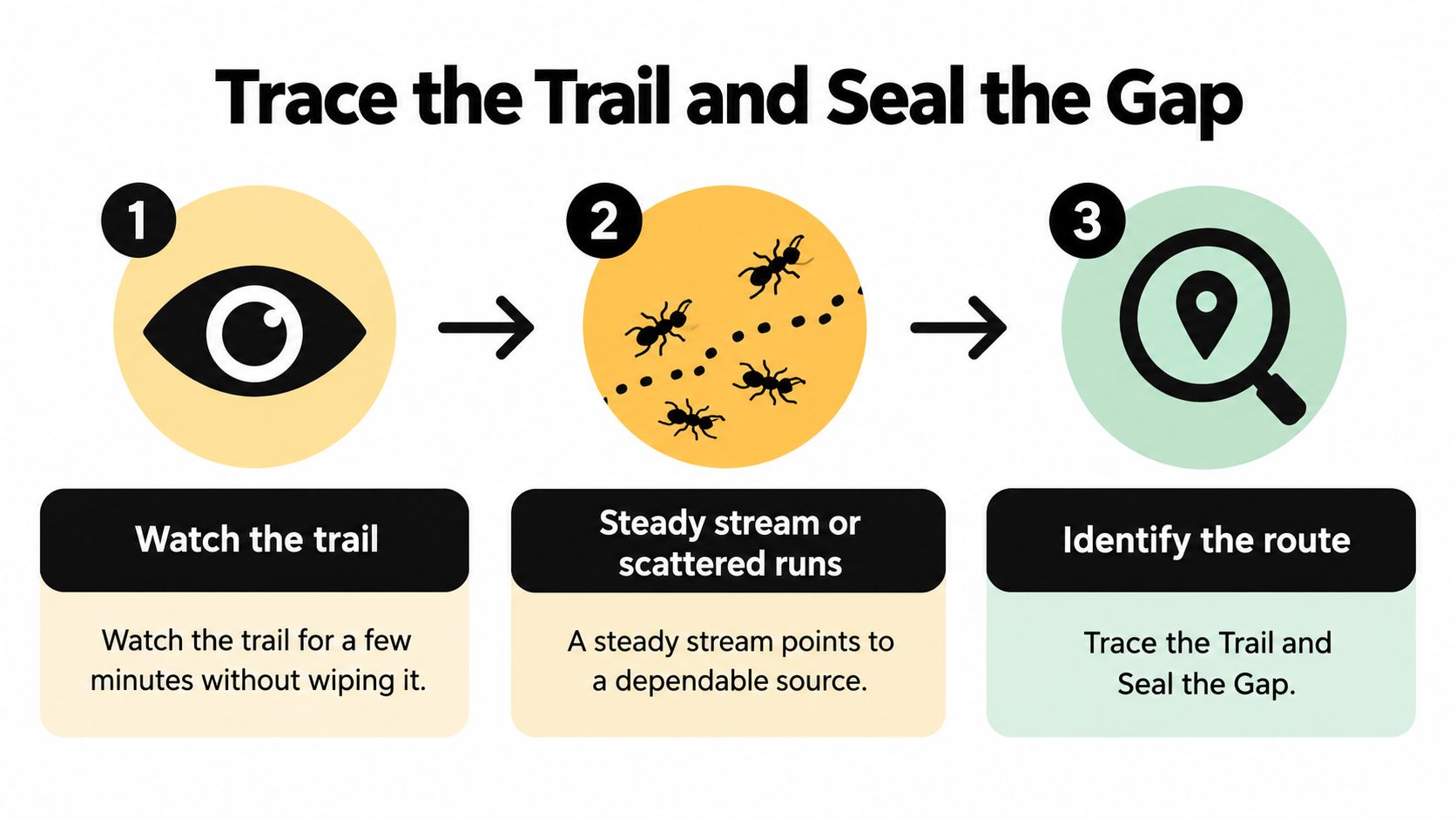
Watch the trail for a few minutes. Note whether workers move in a steady stream or appear in scattered runs. A steady route can point to a dependable food or water source.
Identify what the trail follows. Check baseboards, carpet edges, wall corners, pipes, electrical wires, utility lines, and plant stems. Ants often use edges because those routes are sheltered.
Follow the route toward the exterior. Look for where ants disappear at a frame, crack, track, or service opening. Painter's tape can mark the last visible point so you can find it again.
Inspect likely endpoints. Check foundation cracks, siding-to-foundation joints, window and door frames, sliding-door tracks, vents, and plumbing or electrical penetrations.
Use a small bait test beside the route. Watch which direction workers travel and where they disappear. The endpoint can help distinguish an exterior access gap from a trail leading toward an indoor refuge.
Photograph the route before cleaning. Record the location of the trail, the suspected gap, and any nearby leak or damp area. Wiping first removes evidence you may need to follow.
Prepare the gap before sealing it. Brush away loose debris and let the area dry so the sealant can bond.
Seal the identified opening from the exterior where practical. Use exterior-grade caulk for narrow cracks. For larger voids, use an appropriate backing material with sealant rather than filling the gap carelessly.
Close openings around pipes and cables. Use a suitable exterior- and UV-rated sealant around AC lines, plumbing, and electrical penetrations, while avoiding interference with the equipment.
Repair door, window, and vent barriers. Replace cracked door sweeps and worn weatherstripping, check sliding-door brush seals, and repair damaged vent screens or soffit covers. For a closer look at draft sealing materials, see this guide to weatherstripping.
Remove the scent route after documenting and sealing. Wash the trail with soapy water to reduce the chemical cue that can guide workers back along the same path.
Correct nearby moisture and exterior bridges. Repair leaks, clear clogged gutters, improve drainage, address AC condensate staining, and move mulch or firewood away from the wall.
Check the same route again. In a slab-on-grade home, pay close attention to cracks, ducts, and service openings because ants may be traveling from beneath the slab. Recheck the trail after the repair to see whether activity has stopped.
Three mistakes often waste effort: sealing only the indoor side, overlooking utility openings, and wiping the trail before tracing it. If larger ants or sawdust-like debris appear near damaged wood, document the area and use this guide to find a carpenter ant nest.
Quick DIY Fixes That Clear Trails Fast
A homeowner may wipe ants from the kitchen counter and see them return along the same edge. A cleanup can reduce visible activity, while the colony remains elsewhere. Choose a remedy for the immediate task, then address the route and watch whether activity changes.
| Remedy | Best use | Main limit |
|---|---|---|
| Soapy water wipe | Removing the scent trail after cleanup | Kills ants it touches; does not reach the colony |
| Soap-and-water cleaner | Wiping counters and sills | Cleans surfaces; does not control ants inside a nest |
| Commercial gel bait in closed stations | Reaching foragers along a traced route | May take several days or longer; keep away from pets |
| Borax-sugar or boric acid bait | A low-cost option in closed stations | Toxic to pets and children; place out of reach |
| Diatomaceous earth | Dry voids and crack edges | Loses effect when wet; wear a mask when dusting |
Place bait beside the route, not on top of it. Keep stations away from children and pets, and avoid spraying repellent nearby. Repellent may kill workers before they carry bait back. For a surface cleaner, this guide to making an everyday castile soap cleaner offers a starting point.
Essential oils and cinnamon provide, at most, a few days of short-term deterrence. Cleaning or rain can remove them, so don't rely on a scented barrier to control a trail.
If ants return after cleanup and a fresh bait test, switching products repeatedly may waste time. The access gap or colony location may still need attention. A visible trail can lead from an outdoor nest, a wall void, or beneath the slab, so persistent activity may need a closer inspection.
Know When to Call a Licensed Miami Pro
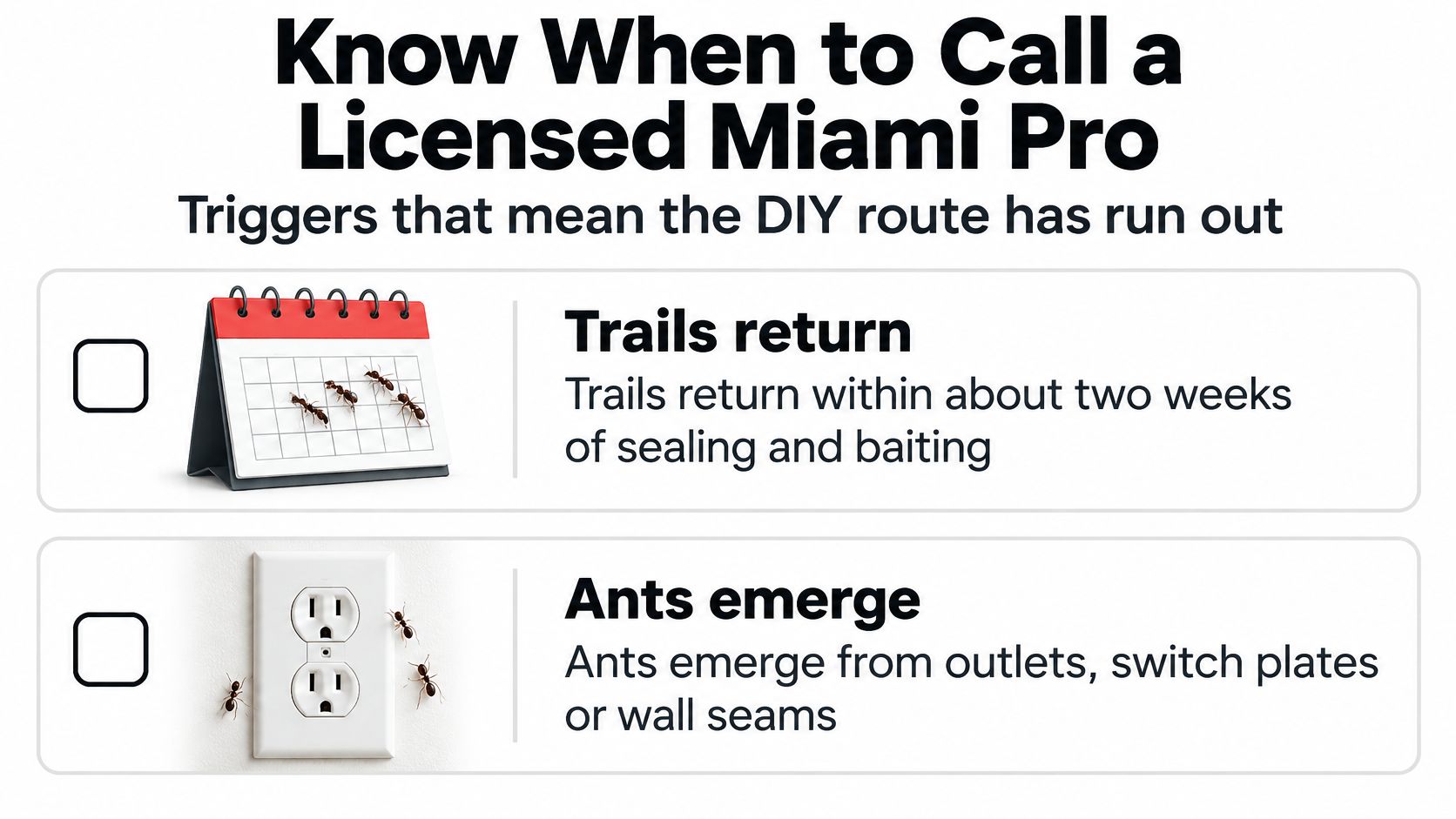
A trail across the kitchen counter may start at a small gap, while the colony sits outdoors or inside a wall. Call for an inspection if ants return after you seal gaps and test bait, emerge from outlets or switch plates, or keep appearing beneath the slab or near ducts. Large workers or sawdust-like debris near wood also warrant an inspection. Recurring activity after a leak repair, or difficulty placing bait safely around children or pets, are other reasons to get help.
A technician can follow the route, assess whether the colony is outdoors or inside the structure, and recommend a response. Before cleaning or sealing the area, take photos and note where the ants disappear. Those details can help a provider assess the problem. This guide to finding ant control service near you can help you prepare questions for a Miami provider.
Pestless Inc. connects Miami-Dade homeowners with licensed, insured local pest control providers through a form or phone call. Homeowners can describe the ant route and compare quotes for an inspection.
Dealing with this pest right now?
Pestless connects you with a licensed, insured Miami pest control provider for a free, no-obligation quote.