You hear scratching over the bedroom around 1 a.m., then find dark droppings behind the stove before coffee. In a Miami house, condo, or rental, that pattern usually means Norway rats, roof rats, or house mice already have a route in. A box of bait from the hardware aisle rarely ends it. The animals keep the same edges, the same palm-to-roof path, and the same gap under the garage door until someone maps the route and closes it.
Useful rodent control services do more than place poison. A real visit names the species, shows the nest, removes the animals already inside, cleans what they contaminated, seals the openings, and comes back to prove the activity stopped. I would treat any quote that skips written findings as incomplete, even when the price looks low.
Table of Contents
- What a Professional Rodent Control Visit Includes
- Rodent Species and Entry Points Common in Miami Homes
- Trap Spacing and Bait Placement That Work
- Why Poison Alone Often Fails
- Sealing Entry Points to Stop Rodents Returning
- Multi-Unit Buildings and Repeat Infestations
- What Rodent Control Costs and How Long It Takes
- Confirm Licensing and Insurance Before You Sign
What a Professional Rodent Control Visit Includes
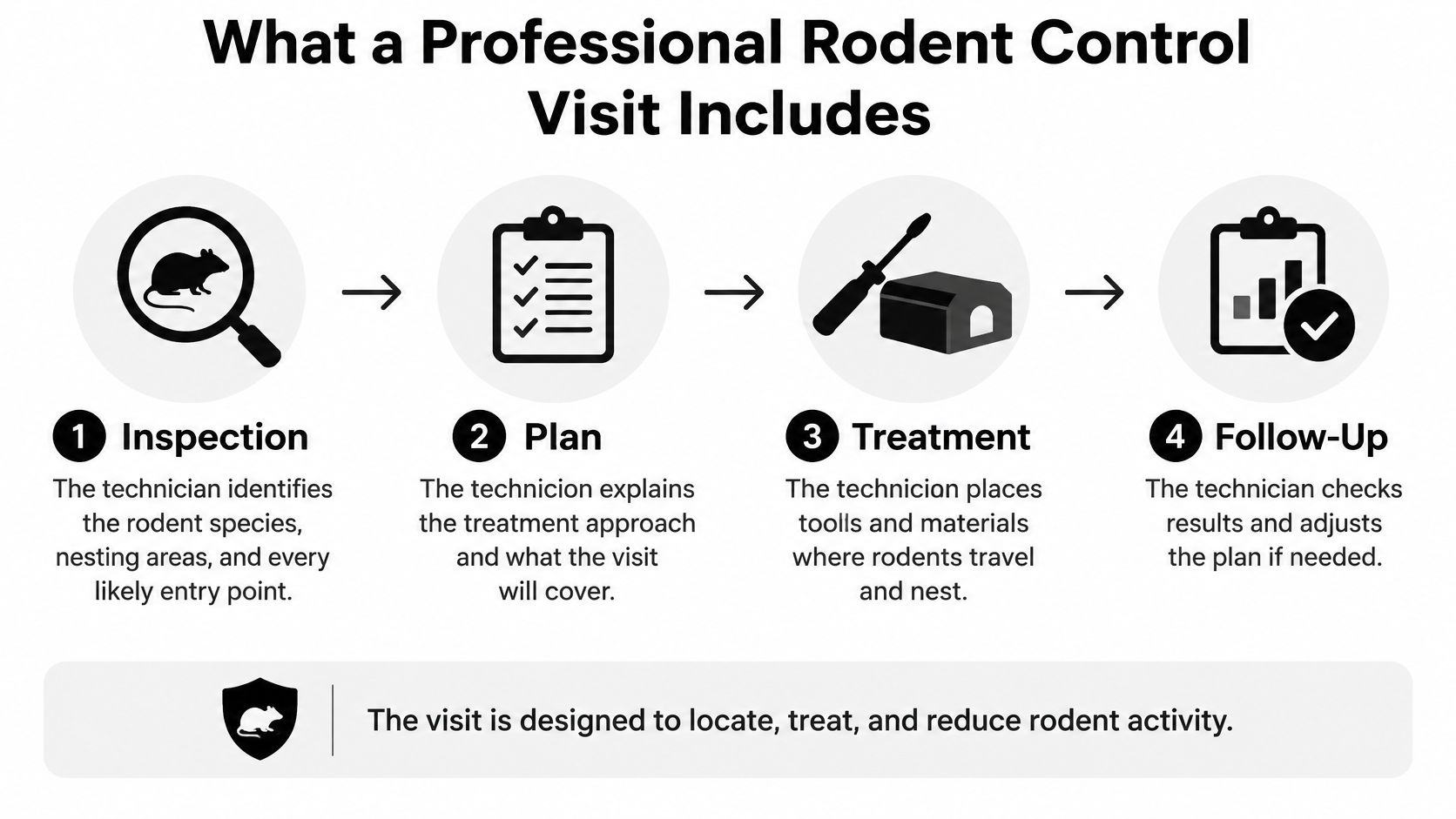
A complete visit runs in order. Skip a step and the rodents you removed get replaced by the next ones using the same hole.
Inspection and the written plan
Our inspection identifies the rodent species, the nesting areas, and every likely entry point. That walk covers roof and soffit lines, utility penetrations, garage doors, and trash areas, not only the cabinet where you saw droppings. After the walk, the technician should explain the approach in plain language. Where do traps go, which openings get sealed, what gets cleaned, and when does someone return?
You should leave with notes you can compare. Species, nest sites, and openings belong on paper. A verbal "we'll take care of it" is not a scope.
Removal, cleanup, and closing the building
Strategic trapping removes the rodents currently inside the structure. Traps sit on travel routes so animals already living in the walls are caught before anyone seals them in. Cleanup comes next. Droppings and contaminated material are removed, and insulation is remediated when it is soaked, tunneled, or packed with nesting. Leaving that material in an attic keeps odor and keeps the space attractive to the next animal.
Exclusion is the step that stops the return. Gaps, vents, rooflines, and utility penetrations get sealed so new rodents cannot walk the same path. Homeowners often want every hole closed on day one. Sealing before the interior population is accounted for can push animals deeper into voids. I would remove what is inside first, then close the openings the inspection found.
What the return visit should show
A return visit checks for renewed activity and confirms the population is collapsing. You are looking for three quiet signs. Fresh droppings stop. New gnaw marks stop. Night sounds in the walls fade. If those signs continue, the follow-up should move traps or find a missed opening, not add more bait.
Practical rule: Written inspection findings and a written scope are the two documents that let you compare providers. A price without those pages is not a comparable quote.
Ask for both before you approve work. If a company cannot name the species or list the openings, the visit has not started yet.
Rodent Species and Entry Points Common in Miami Homes
Start with what you can see without special tools. Dropping size, gnaw marks on food packaging and wood, dark grease marks along baseboards, and tracks in dust on a garage floor tell you which animal is using the house. Species decides the nest and the entry, so a wrong guess sends traps to the wrong floor.
Three commensal rodents show up again and again in developed Miami neighborhoods.
| Species | Where It Nests | Typical Entry | Droppings Size |
|---|---|---|---|
| Norway rat | Burrows at ground level, under slabs and sheds | Gaps at ground level, drains, door bottoms | About 3/4 inch, capsule-shaped |
| Roof rat | Attics, wall voids, palm fronds and tree canopy | Rooflines, vents, soffits, utility lines | About 1/2 inch, spindle-shaped |
| House mouse | Wall voids, cabinets, stored boxes, appliances | Openings about the size of a dime | About 1/4 inch, rice-shaped |
Norway rats stay low. They burrow beside foundations, travel drains, and hug the slab. You will see burrow holes under sheds and grease along the bottom of garage walls. Roof rats climb. Palm fronds, power lines, and soffit gaps put them in the attic, which is why attic noise at night often is not a mouse. House mice nest in wall voids, cabinets, stored boxes, and the warm void behind a refrigerator. If you are still unsure after the droppings, a side-by-side look at mice or rats keeps the signs straight before anyone sets a trap.
Why the nest location changes the health picture
Rodent control is a longstanding public-health service, not a recent household convenience. The U.S. Centers for Disease Control and Prevention reports that American rodent-control programs have operated for more than 100 years, with milestones from the 1900 San Francisco bubonic-plague epidemic to the 2012 hantavirus outbreak in Yosemite National Park. Rodents transmit pathogens directly through bites and contact with feces, urine, or saliva, and indirectly through fleas, ticks, and mites that previously fed on an infected animal. Reported U.S. rodent-associated illnesses include plague, hantavirus, leptospirosis, rat-bite fever, and murine typhus.
Norway rats, roof rats, and house mice also damage buildings while they create that exposure. An attic nest of roof rats means contaminated insulation over bedrooms. A Norway rat burrow at a sewer cleanout means a different contact path. The species and the nest tell a provider where people, pets, and food are most likely to meet droppings.
A qualified visit is worth the fee when it identifies entry points, cuts food and shelter, and documents that activity stopped, rather than only placing bait.
You should receive three findings in writing. The species is confirmed. Nesting areas are named. Every entry point found on that visit is listed. Those three lines are what you compare when a second company walks the same property.
Trap Spacing and Bait Placement That Work
Where a trap sits matters more than how many boxes you buy. Rodents travel beside edges. They do not stroll across an open kitchen floor, so a trap in the middle of the room mostly catches dust.
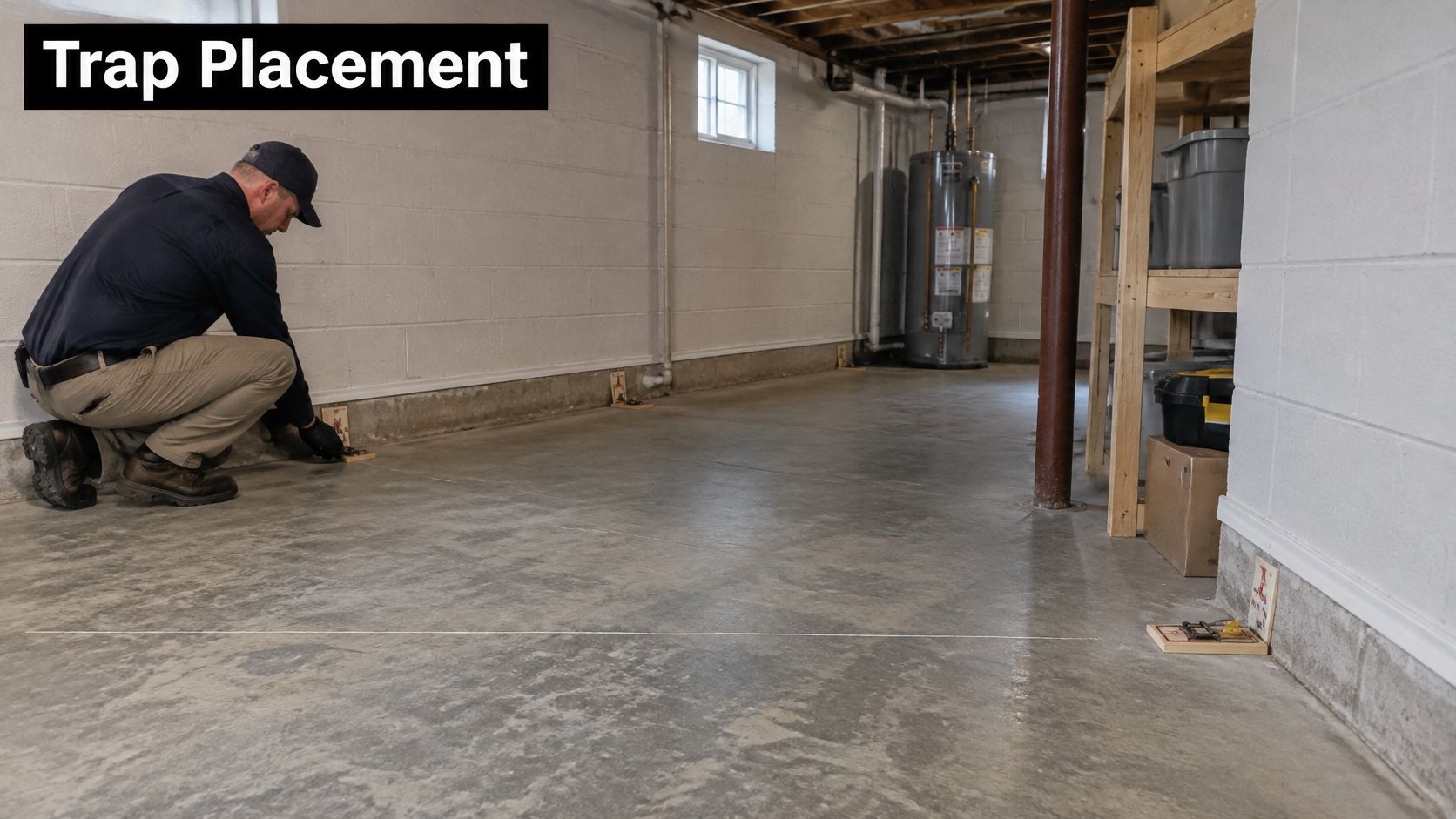
Washington State University extension guidance recommends placing rat traps one or two at approximately 15–20-foot intervals wherever tracks, droppings, or travel routes occur, while mouse traps should be spaced about every 5–10 feet. Set them along walls, beside entry holes, and near cover, with the trigger facing the wall. Outdoor traps should be enclosed so children, pets, and wildlife cannot reach the mechanism. The same guidance, drawing on EPA building practice, says mechanical or glue traps in food-service and storage areas must be checked daily, with trapped rodents removed within 24 hours.
| Device | Spacing | Where to Place | Check Frequency |
|---|---|---|---|
| Rat trap | 15-20 feet, one or two per run | Along walls, beside droppings and travel routes | Daily in food and storage areas |
| Mouse trap | 5-10 feet | Along walls, near entry holes and cover | Daily in food and storage areas |
| Enclosed outdoor trap | Along foundations and travel runs | Enclosed to keep out children, pets and wildlife | Daily while set |
Why trapping beats a hidden death
A poisoned rodent that dies inside a wall leaves odor and an access problem you cannot reach without opening drywall. Trapping puts the animal in a device you can see, remove, and count. That count is also how a technician knows the interior population is dropping. If traps stay empty and fresh droppings continue, the travel route was missed, or animals are still entering from outside.
A quote should name trap counts, locations, how often someone checks them, which openings get repaired, and how renewed activity gets documented. Rodent Control is built around that pairing. Remove the rodents and seal the way back in. Trap counts without locations, or locations without a check schedule, are not a placement plan.
On a typical Miami single-family house, I would prefer to see fewer traps on the active run than a dozen traps scattered for show. One pair of rat traps every 15 to 20 feet along the garage wall, plus mouse traps every 5 to 10 feet in the pantry, beats a pile of unset traps in a closet.
Why Poison Alone Often Fails
A bait station goes untouched while fresh droppings appear nearby. Or bait disappears, yet activity continues. In either case, adding more poison may miss the cause: rodents may be feeding elsewhere, avoiding the bait, or entering through an opening.
Some rodents carry genetic changes that reduce sensitivity to anticoagulant baits. A 2025 review of anticoagulant resistance reports widespread resistance among house mice and Norway rats in the United Kingdom, with 86.9% of sequenced Norway-rat samples carrying one of five major resistance mutations. The finding does not establish resistance levels in Miami, but it shows why bait response should be checked rather than assumed.
Telling bait failure from an open building
Read bait activity alongside signs in the building:
- Bait disappears and activity stops: The bait may be working. Continued monitoring can show whether activity returns.
- Bait disappears and droppings continue: Rodents are feeding, but bait alone has not stopped the activity. They may have another food source or an access route.
- Bait sits untouched: The placement may miss the travel route, or another food source may be more attractive.
- Activity continues after a full bait cycle: Ask to see monitoring records before changing to a stronger anticoagulant.
Shared walls, utility penetrations, trash rooms, and neighboring units can sustain activity in multifamily buildings. Treating one kitchen with bait will not address a source in a shared area.
Anticoagulants can also harm sensitive terrestrial vertebrates, including scavenging mammals and birds. Stations should be placed to limit access by children, pets, and wildlife.
Before more poison is recommended, ask for monitoring records showing dates, bait take, and locations of fresh droppings or tracks. Those details help distinguish bait that is being ignored from activity that continues despite feeding, and give the provider evidence for choosing the next control step.
Sealing Entry Points to Stop Rodents Returning
Sanitation removes food and shelter. Exclusion stops replacement rodents from moving in after treatment. You need both. A clean kitchen with an open soffit still gets roof rats. A sealed soffit with an open trash lid still feeds the ones outside.
Our service seals gaps, vents, rooflines, and utility penetrations so rodents cannot return. Judge that work against the limits in EPA housing guidance, which is part of a wider integrated sequence: identify activity, remove food, water, and shelter, exclude openings, deploy traps or other controls, and verify results. Mice can enter openings approximately the diameter of a dime. Door-bottom gaps should stay below 1/4 inch. Mesh over vents should have openings no larger than 1/4 inch.
| Opening | Limit to Check | Usual Fix |
|---|---|---|
| Mouse entry opening | About the diameter of a dime | Seal with steel wool and sealant, or metal hardware cloth |
| Door-bottom gap | Below 1/4 inch | Install a door sweep or threshold seal |
| Vent openings | Mesh openings no larger than 1/4 inch | Cover or replace with metal mesh |
Where Miami inspections actually find the holes
Droppings are a poor map of access. They show up in kitchens and bedrooms while the opening is at the roof or behind an appliance. A Miami inspection should cover roof and soffit lines, utility penetrations, garage doors, plumbing penetrations, trash areas, kitchens, attics, and shared-wall or mechanical spaces. Structural repairs matter even more in multifamily and rental buildings, because one untreated chase undoes trapping that looked successful in a single unit.
Foam alone is a weak fix. Rats chew it. Steel wool packed into a gap, then locked with sealant, or hardware cloth screwed over a vent, holds. Door sweeps wear out in the humidity and need a look after a few months. While you are on the roof line, it is worth the time to protect roof openings before hurricane season, because storm-lifted flashing and open penetrations become new rodent doors as soon as the weather clears.
EPA prevention guidance also covers the conditions that make a sealed house stay quiet. Reduce clutter, keep food and waste secured, cut back overgrown vegetation, and eliminate standing water. A monthly check you can do yourself is simple. Walk the exterior, look for fresh gnawing at door sweeps and vent mesh, and note any new droppings inside. Write the date. That note is what you hand a technician if activity returns.
Multi-Unit Buildings and Repeat Infestations
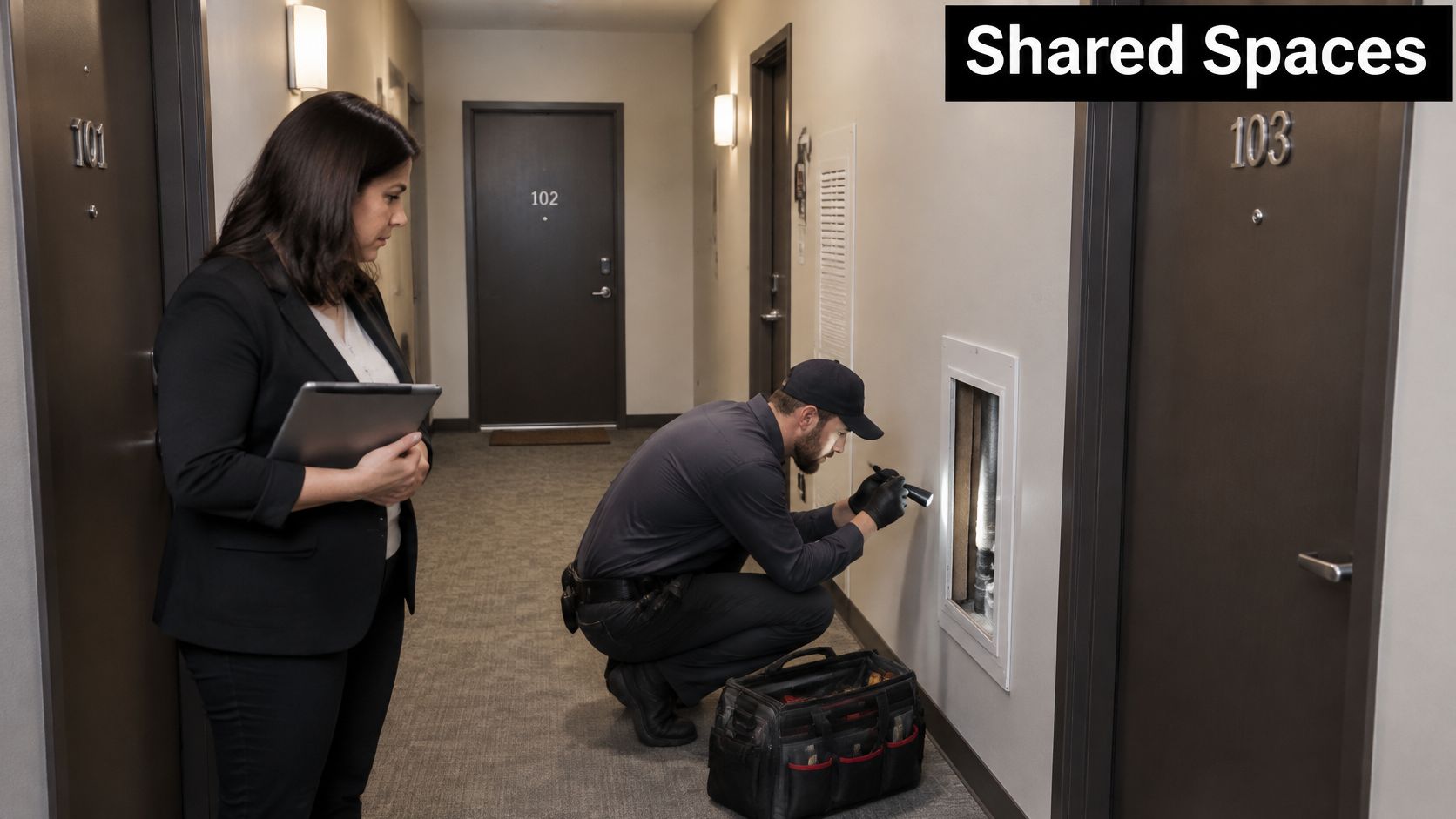
A rodent problem in one apartment can point to a building-wide access or waste issue. Rats and mice move through shared walls, utility penetrations, trash rooms, and neighboring units. An untreated route or food source elsewhere can undermine work in the unit that first reported activity. Landlords, HOA boards, and short-term rental hosts need a plan for the whole property.
A 2025 analysis of complaint and inspection data from 16 cities found that 11 cities with significant increases in reported rat activity also experienced greater temperature increases over time. The authors described this as a correlation, not proof that warming caused the increase. In a dense building, delayed attention can turn a nuisance report into a health concern.
Miami's heat supports rodent activity, while construction and storm damage can open new routes into buildings. A vacant condo with an open pantry can also provide food and shelter. Baiting only the unit that called first leaves those wider conditions untouched.
What managers should collect before the next visit
- Sightings: Record the date, time, and exact location, including common areas and unit numbers.
- Findings: Note droppings, gnawing, and burrows in units, chases, trash rooms, and garages.
- Waste: Track pickup schedules, overflowing containers, and lids damaged after storms.
- Vacancies: List empty units and check whether food was left behind.
- Disturbance: Record recent construction, roof work, or storm damage that may have opened penetrations.
Give the inspection team a building-wide record, not just a report from the first unit. The matched provider can inspect for species, nesting areas, and likely entry points, then recommend work across shared penetrations and affected areas. Managers should also address waste handling and give residents clear instructions on food storage and access for inspections. Follow-up should be based on inspection and treatment findings, not on a promise that one visit will solve the problem.
At a Coconut Grove walk-up, droppings in unit 3B alongside an overflowing alley dumpster suggest more than a unit-level issue. Treating 3B alone leaves the waste source and any open shared plumbing route unaddressed. A building-wide inspection and coordinated treatment give the provider a basis for deciding what work and follow-up the property needs.
The video shows a technician inspecting a wall opening before placing bait. The same attention to shared chases and trash areas helps managers address repeat reports at their source.
What Rodent Control Costs and How Long It Takes
The price depends on the work: how many areas need inspection, how much rodent activity is present, whether contaminated insulation needs remediation, and how many gaps require sealing. Compare written quotes that cover the same tasks. A quote limited to trapping leaves out other work that may be needed to keep rodents from returning.
| Component | What Drives the Price | What the Quote Should State |
|---|---|---|
| Inspection | Property size and number of entry zones | Written findings and species identified |
| Trapping and removal | Number of traps and level of activity | Trap count, locations, and removal plan |
| Exclusion repairs | Number and size of openings | Each sealing location |
| Cleanup and insulation | Extent of contamination | Areas to be cleaned and any insulation remediation |
| Follow-up visits | Monitoring needs | Visit schedule and reassessment date |
A staged timeline, not a single afternoon
At a Kendall home with attic noise and droppings in the garage, the first step is an inspection to identify the species, nesting areas, and likely entry points. The provider then sets traps along rodent travel routes and schedules checks. The quote should specify those visits rather than leave them open-ended.
Once rodents inside the structure are removed, the provider can clean droppings and contaminated material, address insulation if needed, and seal likely entry points. Follow-up visits check whether activity has stopped. A written reassessment date gives the homeowner a clear point to review progress, though renewed access or activity can extend the process.
For a closer look at the factors behind a rodent control cost estimate, review the scope before agreeing to a one-line price. A useful quote names the inspection findings, trap locations, cleanup work, sealing points, and follow-up schedule. That makes it possible to compare providers on the work proposed, not just the total.
Confirm Licensing and Insurance Before You Sign
Pest control services in Florida are regulated by the Florida Department of Agriculture and Consumer Services (FDACS) under Chapter 482, Florida Statutes. Every provider we match holds the pest control license required by the State of Florida and carries active insurance. Confirm that yourself before you sign, using the provider's own paperwork, not a logo on a truck.
- License number: Ask for it and confirm it on the state record. A walkthrough of how to check a pest control license shows what the record should contain.
- Insurance: Request a certificate with current dates, not a verbal assurance.
- Inspection first: The technician inspects before any treatment. A price texted from a photo of droppings is not an inspection.
- Written scope: Trap counts, trap locations, sealing points, cleanup, and follow-up visits are listed.
- If activity returns: Ask what happens during the follow-up period, and whether any guarantee is written.
- Three quotes: Compare at least three on that same scope so a missing exclusion line cannot hide inside a lower price.
Red flags are blunt. No license number. A quote given without an inspection. A poison-only plan with no exclusion. No written documentation of what was found. Any one of those is a reason to stop.
We are a free referral service. We do not perform treatments, and we make no guarantee about work performed by third-party providers. Read each provider's own terms. The inspection and the treatment are done by the matched pro, not by us. Your job is to hold that pro to the written scope.
This week, request an inspection and lay the written scopes side by side. Match species, openings, trap counts, sealing locations, cleanup, and the reassessment date. Sign the one that names the work, not the one that only names a price.
Pestless Inc. connects Miami and Miami-Dade homeowners with licensed, insured providers for rodent problems, from attic roof rats to mice in the kitchen. You describe the issue, compare no-obligation quotes, and choose the pro whose written scope covers inspection, removal, and sealing. Visit Pestless Inc. to request a match and start that comparison this week.
Dealing with this pest right now?
Pestless connects you with a licensed, insured Miami pest control provider for a free, no-obligation quote.