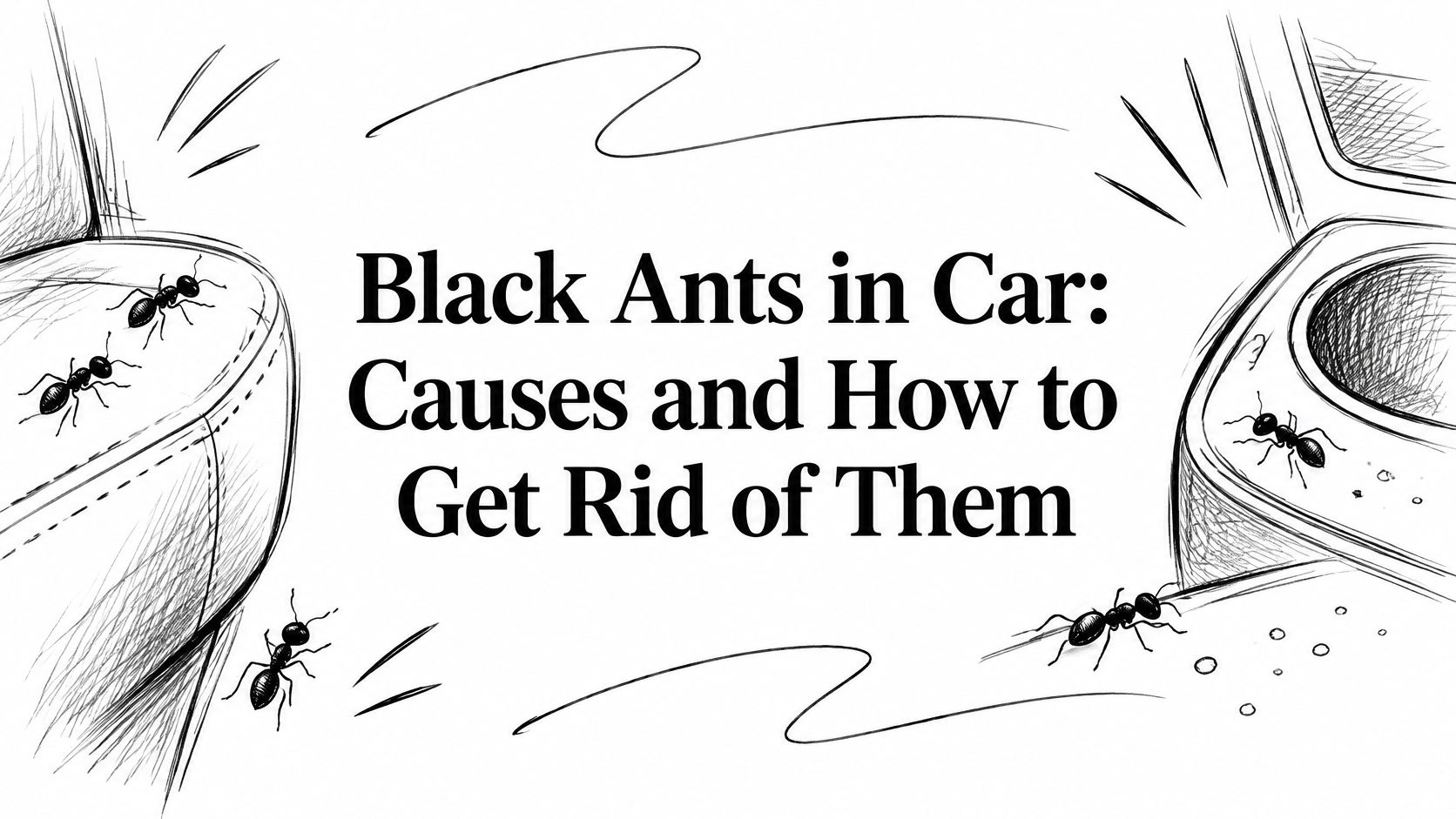
Spraying the ants on your dashboard is usually the wrong first move. It removes the workers you can see without answering the question that matters: is your car a nest, or just a stop on a trail from the parking spot?
Black ants in a car can mean spilled soda, an outdoor colony beside the driveway, or activity inside a protected vehicle compartment. Start by locating the source, then clean and choose a vehicle-authorized treatment if needed. Ants near wiring deserve a different response from ants collecting crumbs under a floor mat.
Table of Contents
- Find Out Whether Ants Live in the Car or Just Pass Through
- Identify the Ant Species Before You Treat
- Bait Rules and the Products to Keep Out of Your Car
- How to Clear Ants Out of Your Car Step by Step
- Warning Signs of Electrical Damage or a Colony
- Keep Ants Out of Your Car Between Drives
- Decide Whether to Call a Pro This Week
Find Out Whether Ants Live in the Car or Just Pass Through
Before buying pesticide, check whether the ants follow the vehicle or remain around its usual parking space. An urban-entomology expert cited by Car Talk's explanation of ants in automobiles notes that most ant species don't nest in cars, and recurring activity often traces to a nearby nest or parking location.
That distinction prevents unnecessary cabin treatment. A clean car parked beside an active colony can still attract exploring workers, while a car with hidden food residue may keep attracting ants wherever you leave it.
Where the ants are coming from
| Pattern | Likely source | Next step |
|---|---|---|
| Ants appear only after parking under trees or near mulch | Exterior foragers passing through | Move the car, remove nearby litter, and compare activity at the car and original spot |
| A trail returns to the same door seal or dashboard edge | Entry through a gap or food residue | Vacuum, repair damaged weather stripping where practical, then assess whether the trail needs labeled bait |
| Ants keep returning from trim, the fuse area, or engine-bay edge after cleaning | Possible nest in a protected void | Inspect accessible edges and call a professional if activity repeats |
| Brood, nest material, or electrical symptoms appear | Possible established colony, potentially near wiring | Stop DIY chemical use and arrange pest and automotive inspections |
The location alone doesn't prove a colony is inside. Workers can travel behind trim on their way to food, and an electrical fault may have another cause. Brood or nesting material makes colonization more concerning than a trail of workers alone.
Inspect without taking the car apart
Use a flashlight to inspect door weather seals, trunk edges, wheel wells, and accessible engine-bay edges with the engine off and cool. Look for moving trails rather than pulling panels or opening electrical enclosures.
Walk the parking space, too. Check curb cracks, garage edges, trash areas, mulch, and branches touching the vehicle. Remove loose leaf litter, but don't disturb a suspected nest just to see what happens.
Diagnostic rule: A trail entering the car tells you where ants travel, not necessarily where they live.
Move to a clear parking space if practical. Keep a brief log of whether activity follows the car or stays at the original spot, including where workers first appear.
Identify the Ant Species Before You Treat
Check body size and markings before choosing a bait. A phone's close-up setting, a magnifier, and a photograph beside a coin can reveal much more than the description “small black ant.”
Florida and the wider Southeast have several dark-looking species. Black is a description, not a diagnosis, and pale body parts can disappear against dark upholstery or in a blurry photograph.
Small dark ants found in Florida cars
The sizes and identifying marks below are described in the Pest Control Basics ant-identification guide.
| Species | Length | Body and color | What it suggests |
|---|---|---|---|
| Little black ant | Approximately 1/16 inch | Dark, relatively uniform body | Inspect cabin food residue and the trail leading to it |
| Ghost ant | About 1 millimeter | Dark head and thorax; pale or translucent abdomen and legs | Look closely around sweets and moisture |
| Pavement ant | Generally about 2.75–3.2 millimeters | Dark brown to nearly black | Check nearby pavement and landscaping cracks |
| White-footed ant | Confirm from a specimen or magnified photograph | Small dark southeastern ant; color alone isn't enough | Obtain identification before choosing bait labeled for that ant |
| Florida carpenter ant | Roughly 5.5–11 millimeters | Reddish-brown head and thorax; black abdomen | Investigate nearby damp wood and protected voids with professional help |
Don't force an identification from this table if the photograph doesn't show enough detail. Lighting, posture, and camera focus can make different ants look alike.
Our ant-control process starts with species identification because each species responds to a different bait and strategy. The practical benefit is avoiding a treatment selected only because its packaging shows an ant.
Match the insect to its surroundings
In Miami, a tiny trail ending at a sticky drink spill calls for a food-and-entry investigation. Large ants repeatedly appearing beside a garage with damp wood require a broader inspection; their presence doesn't mean they're eating the vehicle.
Species identification narrows the search, but it doesn't establish the nest's location by itself. Combine the insect's appearance with its route, the parking environment, and any signs of nesting.
For a broader comparison, our guide to ants in Florida can help you recognize likely candidates. Save a sharp photograph showing the entire ant, ideally beside a coin, for the pest professional. Photograph it before applying anything that could damage the specimen or obscure its markings.
Bait Rules and the Products to Keep Out of Your Car
A household spray can make the dashboard look clear while leaving the underlying problem unresolved. In a passenger compartment, it can also put pesticide where people sit, touch controls, and handle food.
The product label controls the application, not a general recommendation to use ant bait. The EPA-approved bait label for Maxforce Quantum includes transportation equipment such as cars, trucks, vans, and recreational vehicles, but only within its listed target-ant and application directions.
That's an example, not permission to use every household bait inside a vehicle. Read the complete label before purchase, including application sites, restrictions, occupant precautions, and cleanup instructions.
Placement matters more than a large dose
A suitable bait belongs in a protected, label-authorized location beside activity, not smeared across the console. Horizontal surfaces can hold gel better than vertical ones, but accessibility and occupant safety still determine whether a placement is appropriate.
Keep pesticide away from:
- Driving controls: Pedals, steering controls, switches, and anything the driver must touch.
- Passenger-contact areas: Seats, child restraints, exposed upholstery, and reachable storage pockets.
- Electrical components: Connectors, fuse boxes, wiring assemblies, and electronic modules.
- Food-contact surfaces: Cup-holder surfaces and compartments used for unpackaged food.
Never inject bait into electronics, soak upholstery, substitute outdoor-only granules, or make a homemade pesticide mixture. If an active route disappears into an electrical opening, that isn't an invitation to push the applicator inside.
Why an appropriate bait can still fail
Old or dried bait may receive little attention. Cleaner residue, contamination from handling, and competing crumbs can also interfere with feeding, so prepare the site before application and keep cleaners away from an accepted placement.
More bait isn't automatically better. Replenishment should follow the label and actual consumption, not the urge to fill every gap.
The principle behind Ant Control is to treat the colony, not just the trail. For a vehicle, that also means knowing when the application site is unsuitable for DIY work.
Before opening the package: If the label doesn't clearly authorize your intended vehicle use, stop and have a licensed professional select the treatment.
How to Clear Ants Out of Your Car Step by Step
Prepare a crevice-tool vacuum, flashlight, microfiber cloths, and a cleaner compatible with the vehicle's interior. Park safely, switch off the engine, and photograph active routes before cleaning so you don't lose useful evidence.
The cleaning sequence is straightforward. Treatment requires more care because its placement must remain inaccessible during ordinary vehicle use.
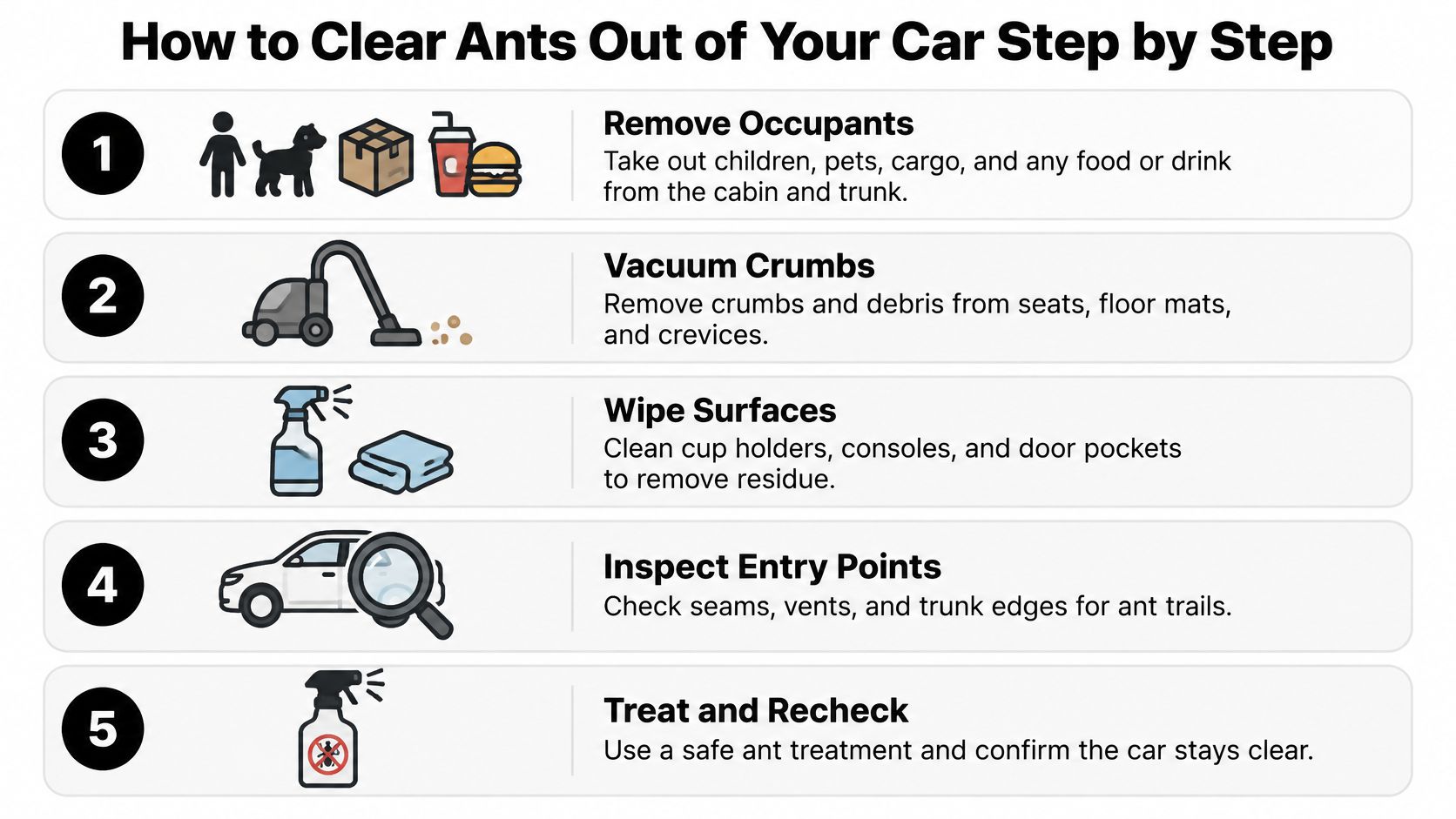
Use this visual checklist for the basic workflow.
Clean first, then assess treatment
Empty the vehicle. Remove occupants, pets, cargo, food, and drinks from the cabin and trunk so you can inspect concealed surfaces without exposing anyone to cleaning or treatment products.
Vacuum the collection points. Use the crevice attachment around seat tracks, console edges, door pockets, floor-mat borders, and trunk seams because loose debris often sits beyond the visible carpet.
Remove sticky residue and moisture. Apply interior-compatible cleaner to a cloth rather than spraying into gaps, then wipe cup holders and surrounding surfaces and dry damp areas so competing food and water aren't left behind.
Map the remaining route. Note the entry seam, direction of travel, and destination because a trail ending at a wrapper needs a different response from workers disappearing into a wiring opening.
Place suitable bait only where authorized. Use a small label-directed placement beside an active trail or in a protected crack, provided occupants, children, and pets can't contact it.
Check acceptance. Watch whether workers feed; if they ignore the placement, choose another vehicle-authorized bait type rather than increasing the dose, because extra unwanted bait won't improve acceptance.
Protect the feeding route. Keep repellent sprays and cleaners away from accepted bait so workers can continue collecting it rather than abandoning the route.
Maintain the placement. Replace consumed or dried bait as directed, and allow the accepted treatment time to work rather than removing it as soon as visible activity drops.
The UF/IFAS ant-management guide recommends observing feeding for several minutes, leaving accepted bait undisturbed for at least 3–4 days after feeding stops, and recognizing that elimination may take several weeks to several months.
Judge progress by activity, not a spotless dashboard
Bait works through food sharing, called trophallaxis. Workers distribute it among colony members, allowing treatment to reach hidden areas that wiping or contact spraying won't reach.
Record whether the trail is shrinking, relocating, or remaining unchanged during your daily check. Don't keep adding pesticide because a few workers are still present, and don't assume a temporary disappearance means the colony is gone.
If you find insects you can't confidently identify, the guide to getting rid of roaches in a car addresses a different vehicle-pest problem. Confirm the insect before changing treatments.
Exterior bug residue is a separate cleaning job. For that task, SwiftJet's windshield cleaning guide provides useful context without substituting for interior pest inspection.
Warning Signs of Electrical Damage or a Colony
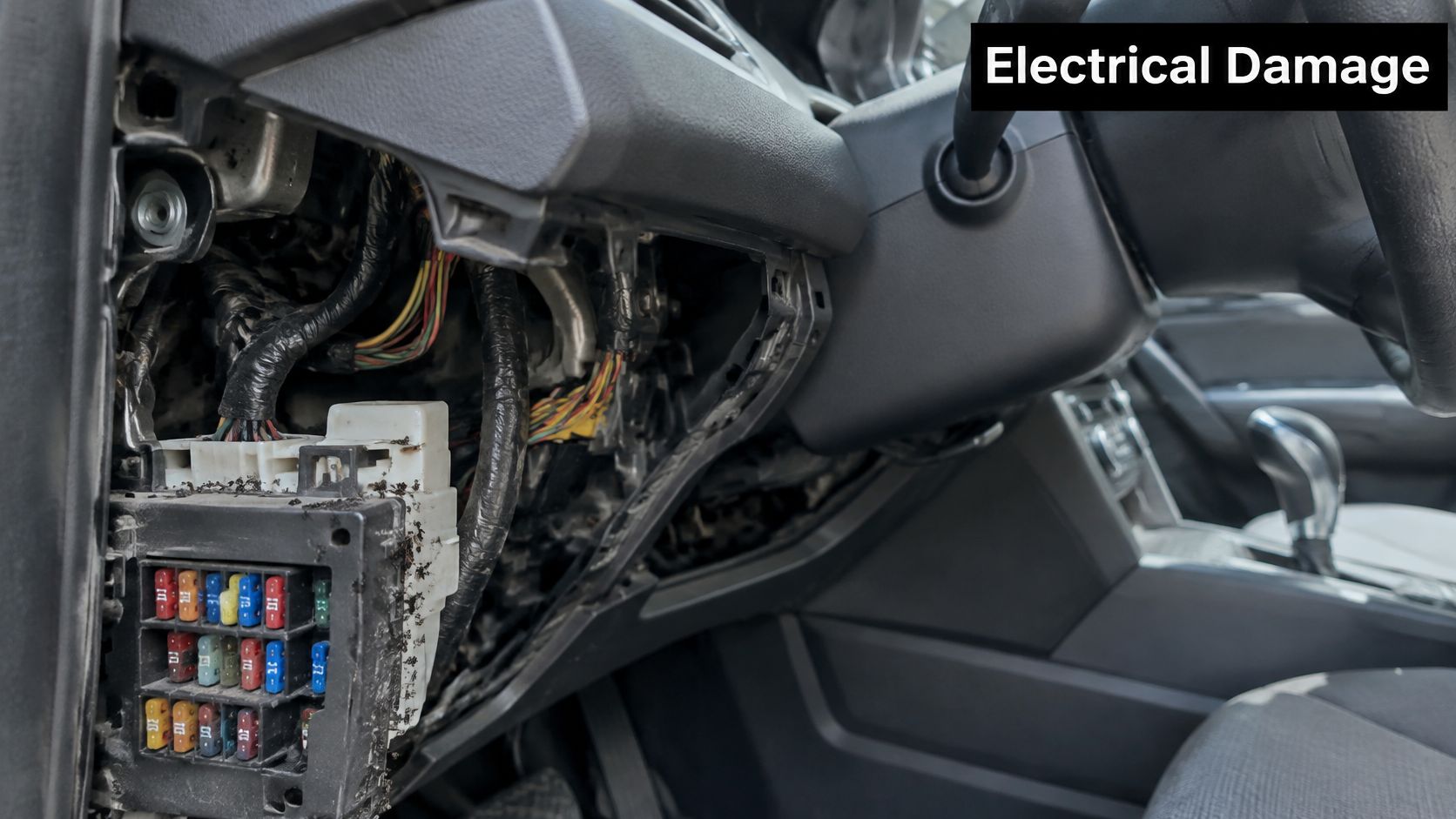
Ants near electrical components aren't just a housekeeping issue. An SAE automotive-engineering paper on ant entry into electronic components describes ants entering electrical enclosures, fuse boxes, and connectors, where they can contribute to short or open circuits.
The image illustrates the kind of protected electrical area that requires professional attention, not owner disassembly.
Separate nuisance activity from warning signs
Workers collecting crumbs on a floor mat, without other symptoms, generally justify careful cleaning and monitoring. Recurring activity at electrical openings changes the decision.
- Persistent hood-area trails: Document their location with the engine off and cool.
- Warning lights or unexplained faults: Arrange an automotive diagnosis rather than assuming ants are the cause.
- Fan or sensor problems: Report both the malfunction and nearby insect activity.
- Brood or nesting debris: Leave protected compartments intact and arrange a pest inspection.
Contact pesticide on hot components creates avoidable exposure and damage risks. Stop invasive disassembly, photograph accessible activity, and involve both a licensed pest professional and an automotive technician when ants persist around wiring or control modules.
The pest inspection should include indoor voids, exterior mounds, and moisture sources to locate the colony. The automotive technician handles component access and evaluates electrical damage.
This video offers additional visual context.
Documented ant hitchhiking on vehicles
Vehicle hitchhiking requires ants to climb aboard, forage or colonize, and tolerate conditions where they settle. Observations from Taiwan demonstrate that transportation is possible, not that every cabin trail represents a nest.
| Finding | Figure | Period | Source |
|---|---|---|---|
| Ants actively hitchhiking on cars and scooters in Taiwan | 52 cases | 2017–2023 | Virginia Tech figure reported in 2024 by Interesting Engineering |
| Ant species using personal vehicles in Taiwan, including species considered invasive where found | 9 species, including 7 invasive species | 2017–2023 | Virginia Tech, 2024 |
| Share of documented Taiwan cases involving black cocoa ants | Nearly 60% | 2017–2023 | ExplorersWeb, 2024 |
These observations support checking vehicles for transported ants. They aren't a Florida identification list, and they don't establish how often Miami cars develop colonies.
Keep Ants Out of Your Car Between Drives
A detailed clean won't last if the car goes back beside an active trail with a sticky drink in the console. Prevention works best when you remove both the reason to enter and the easy route aboard.
Miami's warm, humid conditions make ongoing attention more useful than a seasonal deep clean alone. Choose habits that fit how you use the vehicle.
Make the parking space part of prevention
Leave clearance from vegetation. Avoid branches, shrubs, and leaf litter touching the car, since direct contact gives foragers another route onto it.
Choose a spot without visible activity. Check garage edges, trash areas, and curb cracks before settling into a regular space; moving away from a known trail can be more useful than repeatedly treating the cabin.
Watch the ground when activity returns. Follow accessible trails toward landscaping or pavement without disturbing the nest, so you can give a professional a useful starting location.
Repair damaged seals correctly. Replace loose or deteriorated weather stripping where practical, but don't plug drainage holes, ventilation openings, or unfamiliar wiring penetrations with household sealant.
Remove the reward after each trip
Bring food and drinks indoors. If snacks must travel in the car, use sealed containers and remove wrappers and leftovers when you unload.
Wipe spills before they spread. A damp cloth can remove fresh residue before it runs beneath a console edge; stubborn buildup may need a vehicle-compatible cleaner.
Keep storage pockets usable. Empty door pockets and cup holders rather than stacking new items over crumbs, and check grocery bags for leaking packages before leaving them in the trunk.
Clean beneath removable mats. Lift them during routine vacuuming and let wet mats dry before reinstalling them, so concealed debris and dampness don't remain undisturbed.
For hardened drink residue, Nanak Car Wash's guide on how to clean sticky car cup holders is a useful companion to routine wiping. Keep liquid out of nearby switches and seams.
Prevention doesn't require a showroom-clean car. It requires removing food rewards and correcting the access routes you can safely repair.
For rental vehicles or shared family cars, assign responsibility for unloading food and reporting new trails. Otherwise, everyone may assume someone else checked the console.
Decide Whether to Call a Pro This Week
If activity disappears after cleaning and appropriate baiting, keep checking the former route during normal use. You don't need to escalate chemical treatment just because ants were present before.
Call a licensed professional if activity persists despite correct treatment, large numbers emerge from vents or protected compartments, or nesting evidence appears. Electrical symptoms warrant an automotive assessment as well, especially if they affect safe operation.
Prepare a useful inspection request
Give the provider information that helps distinguish a vehicle problem from a parking-site problem:
- Identification evidence: A clear ant photograph, preferably with a size reference.
- Exact location: The door seal, trim edge, trunk seam, vent, or exterior area where activity begins.
- Timing: When you first noticed ants and whether sightings follow a particular parking location.
- Extent: An occasional worker, a continuous trail, or activity in several compartments.
- Treatment history: Product names, placement locations, and whether ants accepted the bait.
Providing when the pest first appeared and how widespread it seems helps the matched provider prepare. Keep the pesticide packaging or a photograph of its label rather than relying on memory.
Match the inspection to the address
We connect Miami homeowners and drivers with licensed, insured local professionals. Submit the form for your specific address so we can match you with a pro serving your Miami neighborhood.
Our guide to finding an ant-control professional near you can help you prepare for that process. Describe both the vehicle and its usual parking location so the provider can assess the appropriate inspection scope.
Pestless doesn't perform treatments itself. Compare the matched professionals' quotes and proposed work, including whether the parking-site source and vehicle activity are both addressed.
The decision rule is simple: monitor a resolved food-related trail, but book an inspection for persistent concealed activity or warning signs. Today, photograph an ant and write down exactly where and when it appears.
Pestless Inc. connects Miami and Miami-Dade residents with licensed, insured pest professionals who can assess recurring ant activity and its source. Visit Pestless Inc. to describe your vehicle and parking-site problem, request a no-obligation quote, and connect with a local provider.
Dealing with this pest right now?
Pestless connects you with a licensed, insured Miami pest control provider for a free, no-obligation quote.