Pavement ant bites are generally a nuisance, not a medical danger, and usually cause a brief pinprick with mild redness, itch, or a small welt rather than a fire ant style pustule. A severe allergic reaction is uncommon, but it's still possible, so a fading welt and a spreading or whole body reaction shouldn't get the same response.
Why do so many small, itchy marks get blamed on this one ant? That's the gap that causes trouble. If you don't confirm the species, you can't tell simple mechanical irritation from a true sting, and you might treat a fire ant injury too casually or worry over a harmless welt for days.
Table of Contents
- What a Pavement Ant Bite Really Is
- How Pavement Ant Bites Look and Feel
- Pavement Ants Versus Ants That Sting Harder
- How to Treat a Pavement Ant Bite
- When a Small Mark Is Not a Pavement Ant Bite
- How to Stop Repeat Pavement Ant Encounters
- Decide Whether You Need a Miami Ant Pro
What a Pavement Ant Bite Really Is
Say you're sitting on a patio step, an ant gets trapped between your leg and the concrete, and you feel a quick prick. You brush it off and find a tiny dark ant. That trapped against skin moment is the typical story behind reported pavement ant bites, not an ant hunting you for food.
The Utah State University Extension guide to pavement ants identifies the pavement ant commonly found in the United States as Tetramorium immigrans, a name that replaced Tetramorium caespitum in older literature, with workers approximately 2.5 to 4 millimeters long. Colonies commonly occur beneath sidewalks, concrete slabs, stones, patios, and building foundations, which explains why contact happens on steps, driveways, and slab floors.
Bite, sting, or just irritation
Pavement ants do have a stinger, but it's small and often retracted. On intact skin it frequently can't pierce far enough for a real venom injection, so many events are closer to a pinch or surface irritation. When venom does get in, the usual result is short lived, a pinprick sensation, mild redness, itching, or a small welt.
That pattern separates them from fire ants. Pavement ants aren't characterized by a sting and venom response that routinely produces pustules or extensive tissue injury. Their main problem for homeowners is repeated indoor nuisance activity, plus confusion with ants that carry higher medical risk.
There's no reliable population wide bite rate or allergy rate published for pavement ants, so any precise percentage you see online is unsupported.
Workers are dark brown to black and often enter through foundation cracks, wall voids, or gaps around slabs. Repeated trails indoors can make it look like you're being bitten night after night when you're meeting foragers again and again. The useful questions come next, what the mark should look like, how to care for it, which look alikes change the answer, and which signs end the wait and see period.
How Pavement Ant Bites Look and Feel
Start with the comparison, then match your mark to a row. Most confusion comes from calling every burning, blistering sting a pavement ant bite.
| Feature | Pavement ant | Fire ant | Bee or wasp |
|---|---|---|---|
| Usual sensation | Brief pinprick, then itch | Burning sting, often several | Sharp sting, then throbbing pain |
| Skin result | Mild redness, small welt, or itchy papule | Pustules are common | Raised wheal, sometimes larger swelling |
| Venom delivery | Stinger often fails to pierce intact skin | Effective sting and venom | Effective sting and venom |
| Typical trigger | Ant trapped on skin or nest disturbed | Mound disturbed | Accidental contact or provocation |
| Systemic allergy | Uncommon but possible | Recognized clinical risk | Recognized clinical risk |
Reading the pavement ant row
A typical contact feels brief. You notice a pinprick, then itch takes over. The skin shows limited redness, a small raised welt, or an itchy papule, a small solid bump. Swelling stays local, around the contact point, rather than spreading across a limb.
The U.S. Navy harmful animals field guide notes that pavement ants possess a stinger, but their small stinging apparatus generally has difficulty piercing intact human skin, so what homeowners describe as a bite is often minor mechanical irritation rather than an effective venom injection. That's why some people feel almost nothing. The ant made contact, but no meaningful venom dose followed.
A small stinger still leaves room for a real reaction. When contact does produce a response, a localized itchy papule, redness, or limited swelling is expected. Severe systemic reactions are uncommon, but ant venom can contain allergenic proteins, so a whole body response is biologically possible even if it isn't the norm.
Rows people misread
The pustule and venom delivery rows carry most of the diagnostic weight in the table above. If your mark fits the pavement ant column everywhere except one row, trust the mismatch. A single fading welt after sitting on a step reads differently than a cluster of painful spots that fill with fluid after standing in grass, and the pattern of contact, one trapped ant versus a disturbed mound, is usually the detail that settles it.
Bee and wasp stings announce themselves differently. The puncture is sharper, pain arrives immediately and throbs, and the wheal, the raised pale area ringed with redness, tends to be larger. Their allergy risk is also far better documented, which is why an allergist won't accept "small ant" as a complete history.
If reactions repeat or one seems unusually severe, capture these details while the evidence is fresh.
- The ant: Photograph it beside a coin so its size can be judged against the roughly 2.5 to 4 millimeter pavement ant range, and note whether it looks dark brown to black.
- The surface: A slab, patio edge, foundation crack, or indoor trail line points one way; a raised soil mound in the lawn points another.
- The count: One ant pressed against your skin, or several contacts at once.
- The timeline: When the pinprick happened and how many minutes passed before the itch or welt appeared.
That record lets a clinician or pest professional match your event to the right column of the table, rather than guessing from a fading mark.
Pavement Ants Versus Ants That Sting Harder
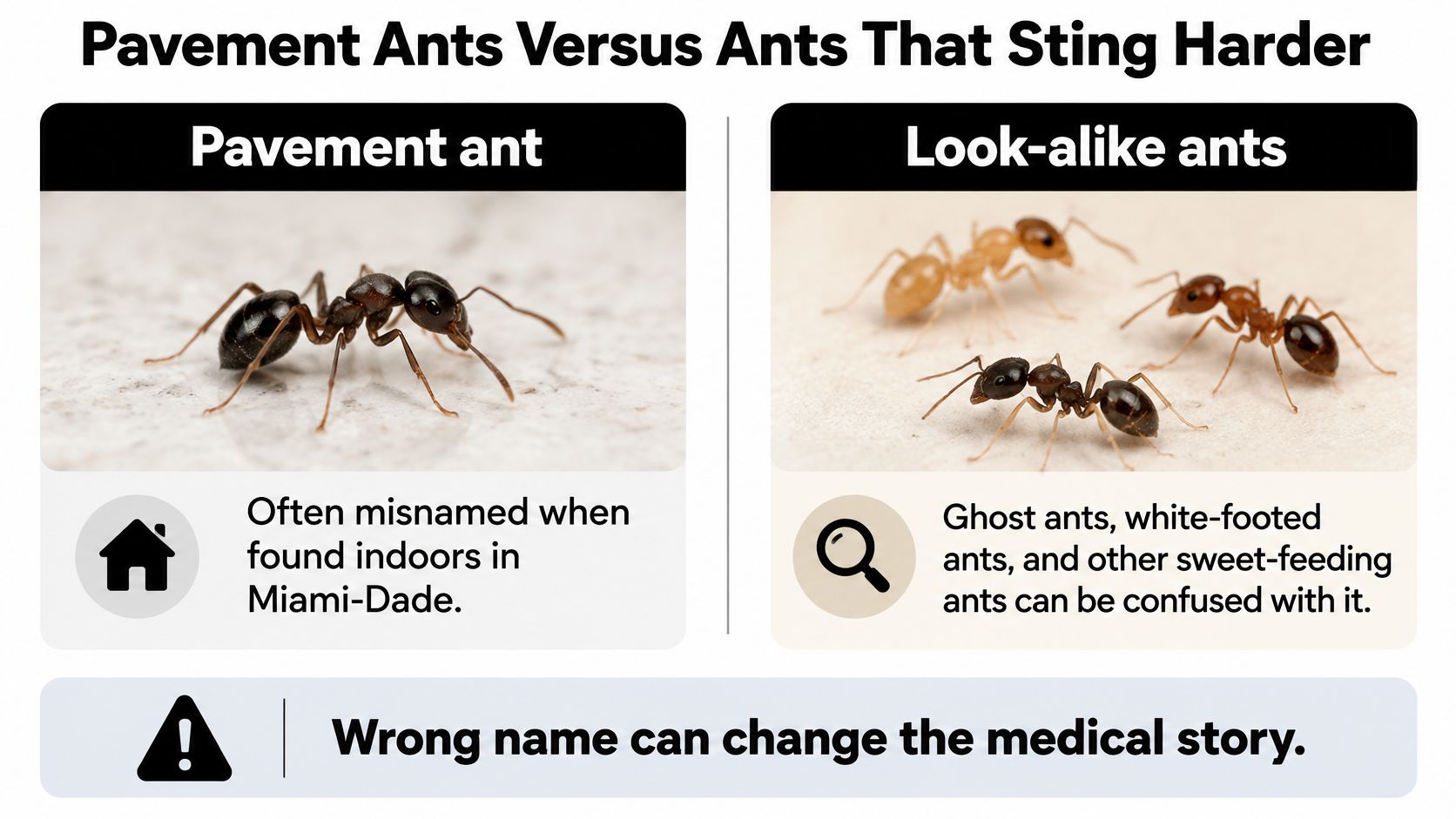
A wrong name changes both the medical story and the treatment plan. In Miami-Dade, a tiny dark ant on a counter often gets called a pavement ant when it's a ghost ant, a white-footed ant, or another sweet feeding species. A mound in the yard gets the opposite mistake, brushed off as pavement ants when it's red imported fire ants.
| Ant | Look | Where it shows up | Medical note |
|---|---|---|---|
| Pavement ant | 2.5–4 mm, dark brown to black, grooved head and thorax | Sidewalks, slabs, foundations, indoor trails from cracks | Nuisance; sting often fails to pierce skin |
| Red imported fire ant | Reddish, workers of mixed small sizes | Outdoor mounds in lawns and beds | Multiple stings; pustules; higher allergy concern |
| Carpenter ant | Much larger, often black or red-black | Moist wood, wall voids, night trails | Pinch more than a venom event; structural pest |
| Ghost ant | Smaller, dark head, pale legs and abdomen | Kitchens, sweets, bathrooms | Nuisance trailer, not a pustule-forming stinger |
Field marks a phone photo can capture
You don't need a microscope to get useful evidence. With a phone lens or a cheap hand lens, look for parallel grooves on the head and thorax and two nodes at the waist, the narrow segments between thorax and abdomen. Those marks support a pavement ant identification far better than "small and dark" alone.
Location is the second clue. Pavement ants trail from slab cracks, expansion joints, and foundation gaps. Indoor sightings often follow those seams in a line, especially where a patio or sidewalk meets the house. Ghost ants behave differently, showing up around sweets and moisture indoors, with a dark head and noticeably pale abdomen and legs.
Fire ants defend outdoor mounds. Disturb one and workers pour out, climb, and sting repeatedly. Carpenter ants are much larger and signal a wood and moisture problem more than a venom problem, even though a trapped worker can pinch.
Take three photos before you clean anything up, the ant itself, the trail, and any mound or crack it's using. That set is usually enough for a later identification. It matters because our ant control process starts with identifying the ant species, since each species responds to a different bait and strategy. A bait a ghost ant carries readily may be ignored by another species, and a mound treatment makes no sense for ants nesting under a slab.
If you want species specific reading, our blog offers six free Miami ant guides, including guides on ghost ants, sugar ants, carpenter ants, and winter ants. The guide to ghost ant bites and identification is a good next read if your kitchen ant has that pale rear half.
How to Treat a Pavement Ant Bite
For a mild, local reaction, keep the routine simple and do it in order. The sequence matters because each step handles a different problem: the first removes the cause, the last prevents the complications.
- Brush or flick every ant off the skin so more aren't trapped against you.
- Wash with soap and water to clean the surface.
- Apply a cool compress for itch and swelling, using a clean cloth with cold water.
- Use an oral antihistamine for itch if it's appropriate for that person, following the label or a clinician's advice.
- Use acetaminophen or ibuprofen for discomfort only when medically appropriate for that person.
- Don't scratch, because broken skin is what turns a simple welt into a possible infection.
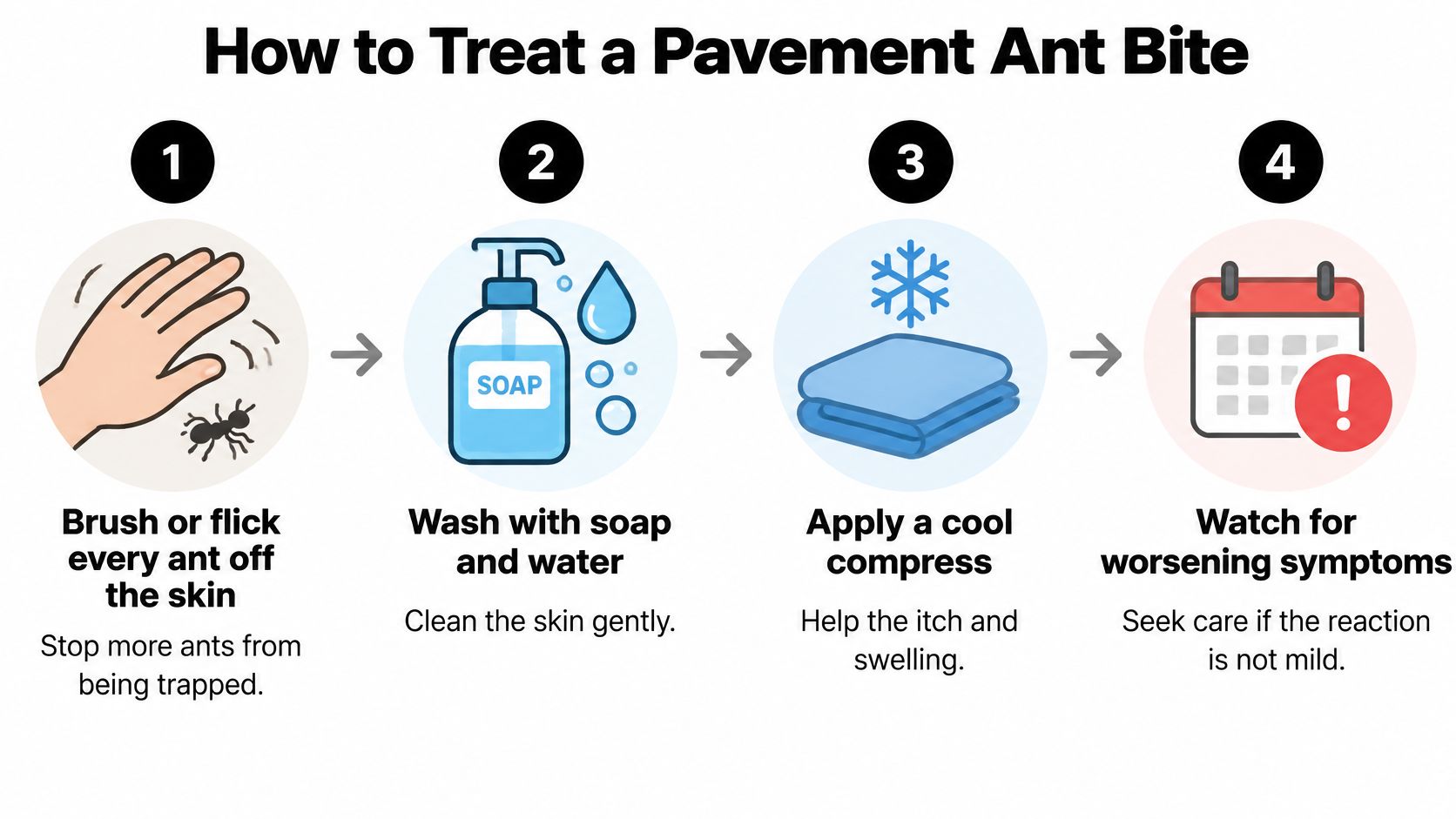
That sequence matches the Australasian Society of Clinical Immunology and Allergy insect allergy guidance, which advises removing ants, washing the area, and applying a cool compress, with oral antihistamines to reduce itch and acetaminophen or ibuprofen for discomfort when medically appropriate. Stick with cooling, not warming: heat on an itchy, inflamed welt tends to aggravate the reaction, so save warming products for unrelated aches and compare types of pain relief patches for that purpose instead.
When home care stops being enough
| Sign | Possible meaning | What to do |
|---|---|---|
| Pinprick, mild redness, small itchy welt | Routine local irritation | Wash, cool compress, antihistamine if appropriate, watch |
| Itch without spreading redness | Local histamine response | Oral antihistamine; do not scratch |
| Redness, warmth, pain, drainage, or swelling worse after 24–48 hours | Infection or delayed inflammation | Medical assessment |
| Pus, fever, or rapidly spreading redness | Possible skin infection | Same-day medical care |
| Facial swelling, generalized hives, vomiting, dizziness | Possible systemic allergy | Emergency care |
| Trouble breathing or throat or tongue swelling | Anaphylaxis | Epinephrine if prescribed, then emergency care |
Timing is the clue people miss. A routine welt should peak, then fade, so a mark that looks worse on day two than it did on day one has already left the "watch it" column. Escalating redness, warmth, pain, drainage, or swelling after 24 to 48 hours warrants medical assessment because those features may indicate infection or a delayed inflammatory reaction rather than a routine minor bite.
Emergency signs don't get a waiting period. Breathing difficulty, throat or tongue swelling, dizziness, generalized hives, and vomiting require emergency evaluation.
Epinephrine rule: If epinephrine has been prescribed, use it immediately, and don't treat antihistamines as a substitute for epinephrine.
A single small welt that fades is the expected pavement ant course, while fever, pus, facial swelling, or a reaction that keeps growing signals something beyond home care. When you're unsure which side of that line you're on, a clinician who can see the skin will give you a better answer than another day of watching.
When a Small Mark Is Not a Pavement Ant Bite
Three short cases show how the same phrase, "ant bite," can hide three different problems. A photo of the skin reaction helps, and so does a photo of where it happened.

Case one fits pavement ants. A child sits on a Miami patio, feels one itchy pinprick, and the spot fades overnight. A single ant trapped against skin explains that pattern well, and home care plus watching is reasonable.
Case two involves no ant at all. A gardener clears weeds along a slab edge and develops a red, irritated patch that never shows a single puncture point. Contact irritation from soil, plants, or debris can mimic a bite closely enough to fool anyone, and it follows the same watch-and-wait course.
Case three is an emergency regardless of species. A person with a known insect sting allergy develops hives beyond the spot, dizziness, or throat tightness within minutes. At that point the ant's name doesn't change the first action: emergency care comes first and identification comes later.
The Utah State University Extension structural pest guide describes pavement ants primarily as a household nuisance and notes the stinger is usually retracted and not readily visible. That anatomy is why an alleged bite may be contact irritation, a different insect, or a secondary skin reaction. In Miami-Dade, where several small household ants overlap, that caution matters.
This short video walkthrough shows the difference between a single trapped ant and a disturbed colony before you decide how to respond.
There's also a delayed edge case. A welt looks calm at hour two, then grows warmer, more painful, or weepy after one to two days. That usually signals infection from scratching, and it still needs medical assessment.
A single fading welt can be watched; breathing trouble, rapidly spreading symptoms, pustules after a disturbed mound, or a worsening wound after 24 to 48 hours cannot.
If reactions keep happening, species confirmation is what an allergist needs. Bring your notes on place, timing, and number of ants, plus a clear photo if you have one.
How to Stop Repeat Pavement Ant Encounters
Spraying the visible trail is the common mistake. It kills the foragers you can see, scatters the rest, and hides the nest you need to find. Repeat welts usually mean a nest and entry problem that wiping counters alone will never fix.
The ants on your counter work like commuters on a subway line, and the station sits under the sidewalk. Removing commuters never closes the station.
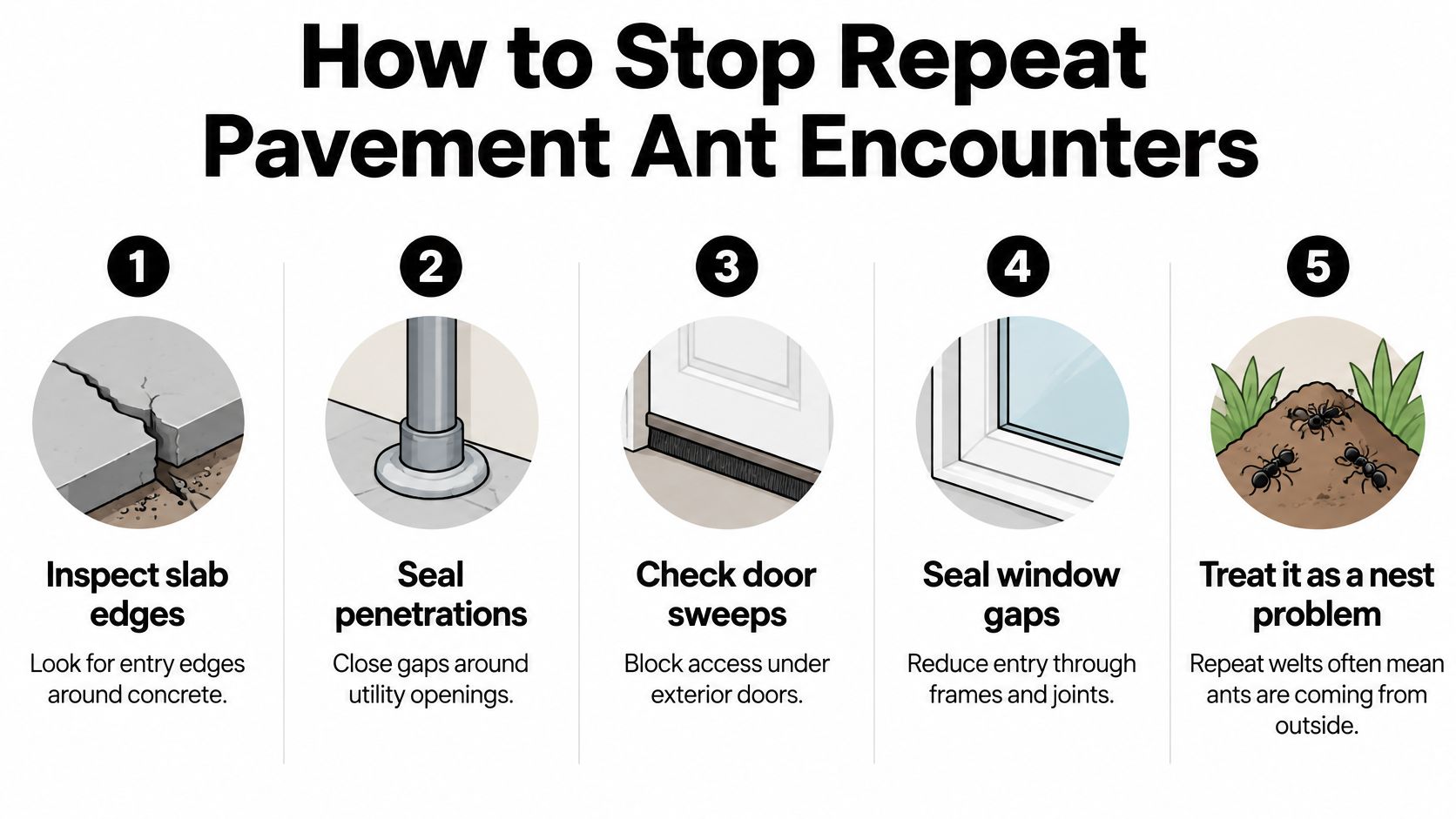
A home check in order
- Wipe trails with soap and water so the scent path is gone, knowing this does not kill the colony.
- Store sweets and pet food in sealed containers, wipe crumbs and grease, and fix dripping lines or damp slab edges.
- Map the trail first, then seal cracks at the slab, around pipes and utility penetrations, and at door thresholds. Sealing before you map just pushes ants to a new gap.
- Use bait workers will carry, placed near the trail but out of children's and pets' reach, instead of a repellent spray on the line. Give it several days before judging, since workers need time to haul it back.
- Escalate if trails return for more than a few days or ants emerge from a wall void, because the exterior nest has to be located rather than sprayed again at the baseboards.
Check the specific entry points pavement ants favor: slab edges, expansion joints, utility penetrations, door sweeps, and window gaps. A worn door sweep with daylight underneath is an open route, and so is an unsealed pipe entry under a kitchen sink. Our explainer on how ants get in the house through gaps and voids walks through those routes room by room.
Your own health baseline can shape the pace of that checklist. Someone who already tracks personal metrics, whether recurring skin changes or a resource like body mass index explained in plain terms, knows a repeated small signal carries information. A welt that keeps reappearing near the same slab edge is evidence the colony is still active, so treat the pattern as data and work the steps in order: food, moisture, entry, then colony.
Skip brand lists and price hunting. The right bait depends on correctly naming the ant and placing it where workers already travel, then leaving it alone long enough to be carried back instead of spraying over the trail.
Decide Whether You Need a Miami Ant Pro
One welt that fades on its own, with no trail indoors and no mound disturbed, is a stay-home situation. Clean the skin, watch it for a day, and check the nearest slab crack when you have time. The calculus changes when the pattern repeats. Indoor trails that survive cleaning and sealing, ants emerging from a wall void or slab crack you can't reach, or a photo that looks like fire ants all justify a professional inspection. A severe skin reaction also calls for getting the insect identified, even after medical care is handled.
What Pestless does and doesn't do
For Miami and Miami-Dade homeowners who need help, Pestless is not a pest control company and doesn't perform treatments. We match your address to a licensed, insured local pro through a short form or a phone call, with typical responses within one business hour on Monday through Saturday, 7am to 9pm ET. Quotes are zero cost and no obligation.
When you request help, say which ant you think you have and whether anyone was stung. That detail changes what the pro brings. Ant control covers ghost ants, white-footed ants, carpenter ants, and red imported fire ants, and each species responds to a different bait and strategy. If you're comparing local options, our page on finding an ant control service near you in Miami explains what to ask before you book.
The work itself follows a fixed order: identify the species first, then use slow acting, non repellent bait that workers carry back to the queen, then finish with exterior barriers and sealed entry points. Spraying the visible line skips step one and leaves the colony feeding new scouts. The goal is to treat the colony that feeds the trail.
You're matched with a licensed ant control pro serving your Miami neighborhood, and you submit the form for your specific address so the match fits your area. If trails keep returning from the same crack, that specific detail belongs in your request.
If pavement ant trails keep returning to your Miami kitchen, patio, or slab, Pestless Inc. can match your specific address with a licensed, insured local pro who identifies the species first and treats the colony that feeds the visible line. Visit Pestless Inc. to submit a zero cost, no obligation request and get a fast local response.
Dealing with this pest right now?
Pestless connects you with a licensed, insured Miami pest control provider for a free, no-obligation quote.