A damp, tightly packed cellulose job above a Miami ceiling raises a different safety question from a dry, properly installed one. Cellulose is made from paper, so homeowners may worry about fire or fragility. The practical health concern indoors is often hidden moisture: check for dampness or water staining near the fill, especially after a leak or humid weather. A product's fire-test performance does not show whether it was installed with proper clearances or whether the insulation has stayed dry. Those checks help explain why the material's everyday presence is only part of the safety picture.
Table of Contents
- The Short Answer on Cellulose Insulation Safety
- What Cellulose Insulation Is Made Of
- Fire Risk and Why Clearance Matters
- Indoor Air Quality and Emission Levels
- Humidity, Mold and Pests in Florida Homes
- Installation Day Controls and Pre-Acceptance Checklist
The Short Answer on Cellulose Insulation Safety
Cellulose is safe under specific conditions, not by default. For a Miami homeowner, the practical health question is whether the material stays dry and whether the installed product and its placement meet safety requirements. A label alone cannot answer those questions.
Federal fire-test figures give one concrete check. Under the Consumer Product Safety Commission interim standard in 16 CFR Part 1209, covered cellulose must achieve a critical radiant flux of at least 0.12 W/cm² for each of three test specimens. Each specimen must also show no flaming combustion and lose no more than 15% of its initial weight during the specified fire test, as set out in 16 CFR Part 1209.
What Those Numbers Do and Don't Prove
These thresholds set a minimum for performance in a lab test. They address ignition, flame spread, and corrosive materials. Passing the test does not show how the material was installed, whether it is damp, or whether a leak is wetting it out of sight.
Federal labeling rules followed fire incident information, engineering analysis, and laboratory testing that identified hazards when cellulose is too close to recessed electrical light fixtures or exhaust flues serving furnaces, water heaters, and other heat-producing equipment. A compliant product can still create a fire risk if placed badly.
Five conditions that decide whether cellulose insulation is safe
| Condition | What to Verify | Risk if Ignored |
|---|---|---|
| Certified fire performance | Product meets 16 CFR Part 1209 thresholds: radiant flux of at least 0.12 W/cm², no flaming, and weight loss of 15% or less | Uncertified or poorly treated fill may ignite or spread flame faster |
| Clearance from heat sources | Manufacturer-specified spacing from recessed lights, furnace and water-heater flues, chimneys, and exhausts | Heat-producing equipment can pose a fire risk even with compliant product |
| Dry material | Fill is dry, not clumped or wet; roof, plumbing, and HVAC leaks are fixed | Reduced fire-retardant performance and conditions favorable to mold |
| Dust control during install | Respiratory and eye protection, gloves, and local ventilation during spreading | Exposure to borate-containing dust for installers and occupants |
| Documentation | Technical data sheet, safety data sheet, and installed depth and density are confirmed | Unverified product, thin coverage, or unidentified additives |
Use the table as a quick acceptance check. Before work, ask the installer to identify the product and show its documentation. After installation, check for damp or clumped fill and look for signs of roof, plumbing, or HVAC leaks. If a spot feels wet or smells musty, trace the moisture source before treating the insulation as safe.
What Cellulose Insulation Is Made Of
Cellulose insulation is a loose, fibrous material made mostly from recycled paper that's shredded, treated, and blown into place. Think of a wall cavity filled with treated paper like a dense stack of tissue dipped in a fire resistant bath. The fiber provides the bulk that slows heat flow. The treatment decides how that stack behaves when it's heated.
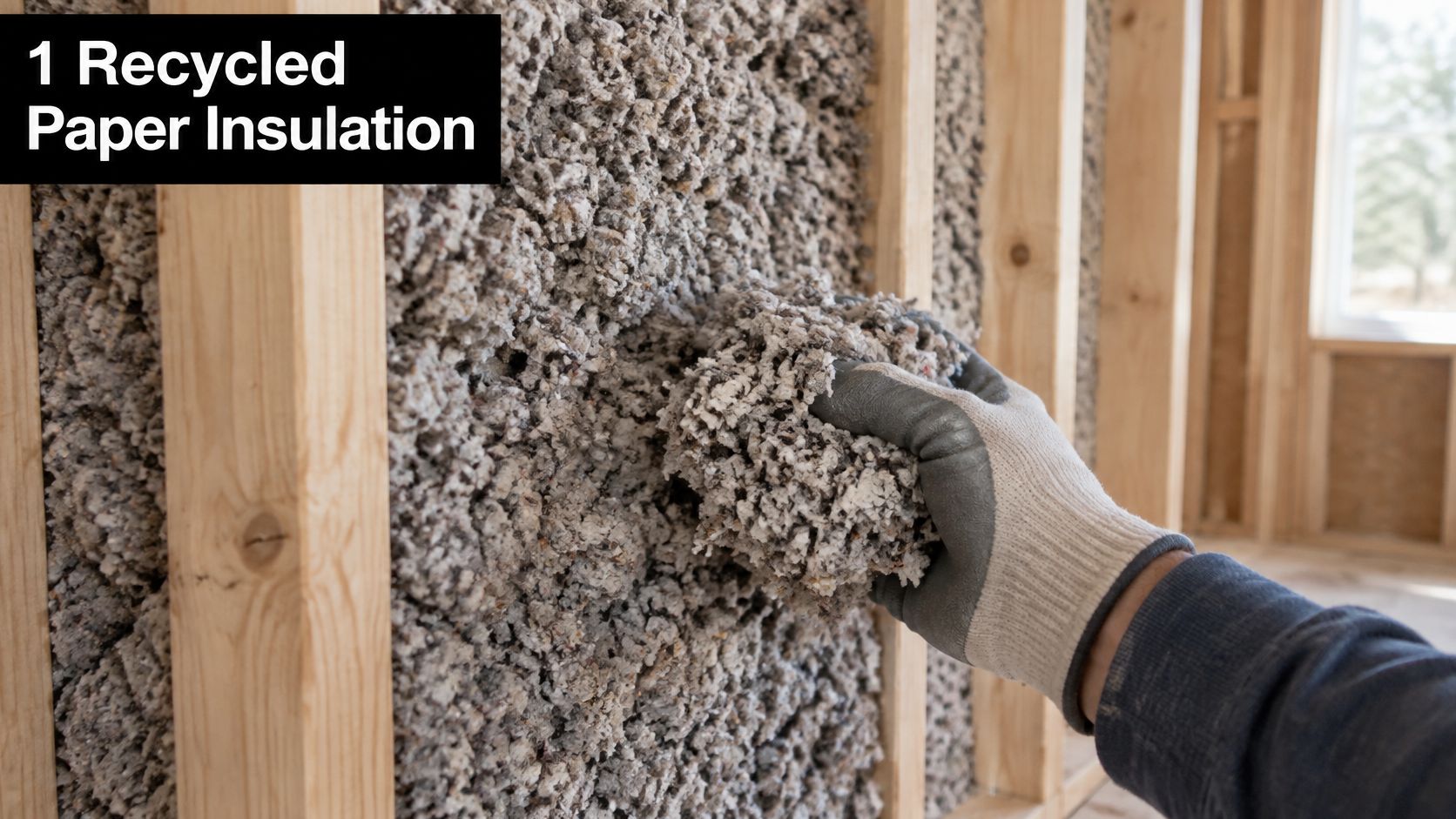
You'll see it in two forms. Loose-fill is blown into open attics to a set depth, where it settles like a blanket over the ceiling. Dense-pack is pushed into closed wall cavities at higher density, which limits air movement through the wall and helps the fill stay in place around wiring and framing.
The Two Variables That Separate Products
Two things separate one bag from another. The first is the paper feedstock, meaning what recycled paper went in and how clean and consistent it is. The second is the fire retardant treatment, added during manufacturing and sometimes supplemented at installation. Change either one and you change how the finished fill performs.
Cellulose sits alongside familiar options, not apart from them. Fiberglass uses spun glass fibers, often as batts or loose fill. Mineral wool uses spun rock or slag fibers and handles heat well. Each material has handling and moisture tradeoffs. Cellulose isn't an outlier, it's one choice with its own set of checks.
Before you approve any job, you should be able to name three things about what's going into your home.
- The material: Loose-fill for the attic or dense-pack for walls
- The treatment: Which fire retardant the manufacturer uses
- The installed density: The depth and density the crew will verify
Fire Risk and Why Clearance Matters
Borate retardants make cellulose resist ignition and flame spread, but they don't make it noncombustible. That one distinction explains most confusion. Treated paper is harder to light and slower to burn. It can still burn under enough heat.
The diagram below separates what the treatment does from what it can't do.
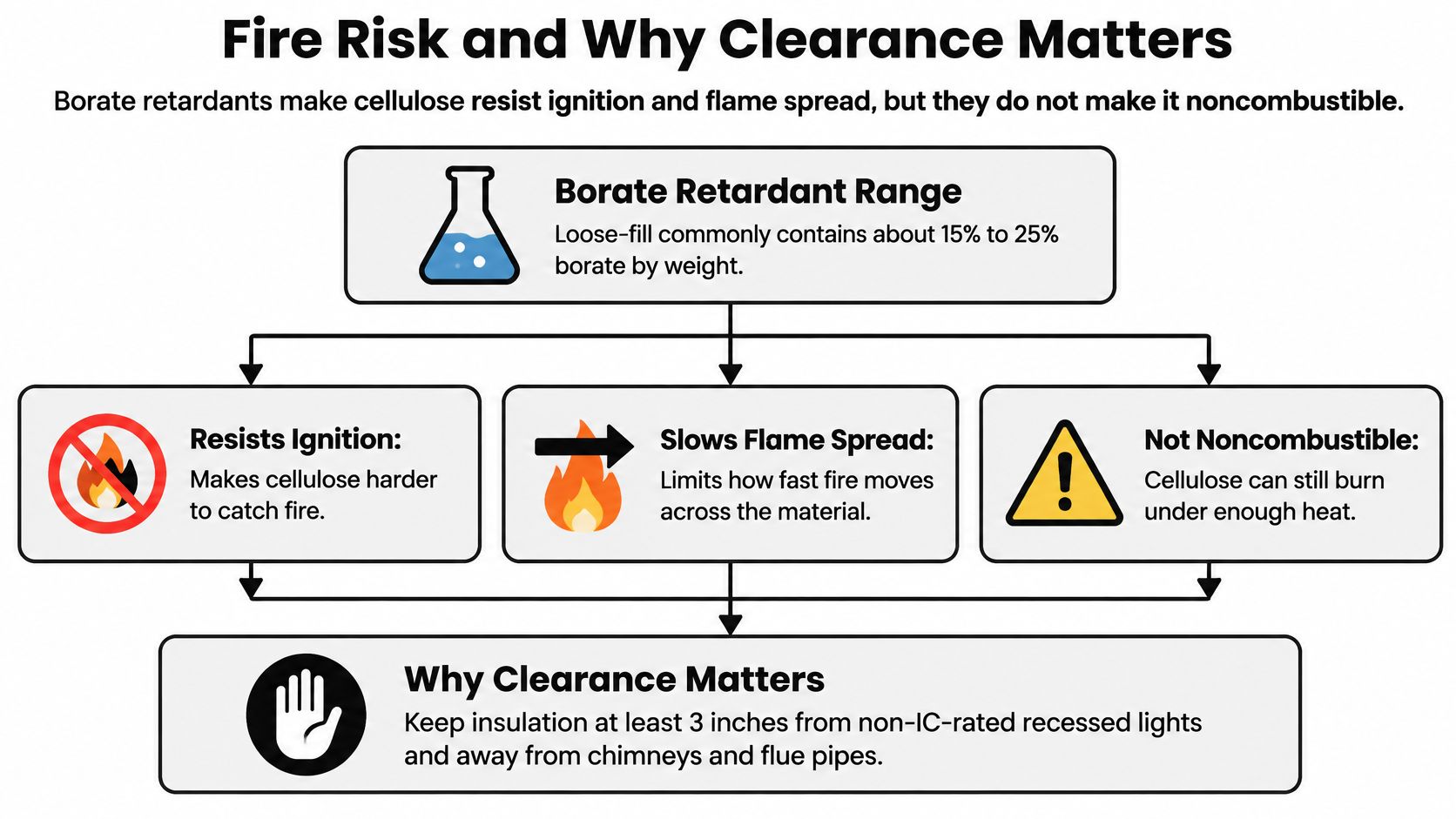
U.S. government fire research in a NIST report on cellulose fire performance reports that loose-fill cellulose commonly contains approximately 20 to 25% boric acid and borax by weight as fire retardant additives. Performance also depends on retardant concentration, fiber density, particle size, and how uniformly the additive coats the fibers. In laboratory work, aqueous application produced more uniform treatment and better flame spread resistance than dry powder application.
The Humidity Caveat and the Limits of a Rating
Miami heat and humidity add a long term question. NIST testing found that high temperature and high humidity cycling, or high temperature and low humidity cycling, can reduce the protection provided by chemical fire retardants. Keeping cellulose dry and at its specified density isn't cosmetic. It protects the treatment you paid for.
Don't lean on a single flame spread number either. ASTM E84 provides comparative surface flame spread and smoke density measurements. It doesn't measure ignition temperature, heat release rate, structural fire resistance, or how fire behaves inside a hidden cavity. A good rating is useful information. It isn't a complete fire safety assessment.
A flame spread rating tells you how a surface behaved in one test. It doesn't tell you what happens when fill touches a hot fixture inside a closed ceiling.
Clearance is the hazard you can control directly. Recessed electrical light fixtures, furnace and water heater flues, chimneys, and exhaust vents all need the manufacturer's required spacing, with shields or approved covers where specified. Heat builds up in those spots hour after hour, which is different from a brief lab exposure.
The short video below shows how treated cellulose responds to flame compared with untreated material.
Ask your installer for the manufacturer's clearance specification in writing before work starts. Walk the attic plan together, point out every recessed light and flue, and confirm how each one will be boxed off or kept clear.
Indoor Air Quality and Emission Levels
Cellulose insulation's routine presence indoors is not the main health question for a Miami homeowner. The practical question is whether it stays dry and whether the home can ventilate. Under controlled testing, reported emissions were low, but those results describe tested materials and conditions, not every attic.
Volatile organic compounds, or VOCs, are gases released by building materials, much like the odor from fresh paint. Testing reports their emission rates in micrograms per square meter per hour, written as µg/m²·h. A lower rate means less material is emitted from each square meter over time.
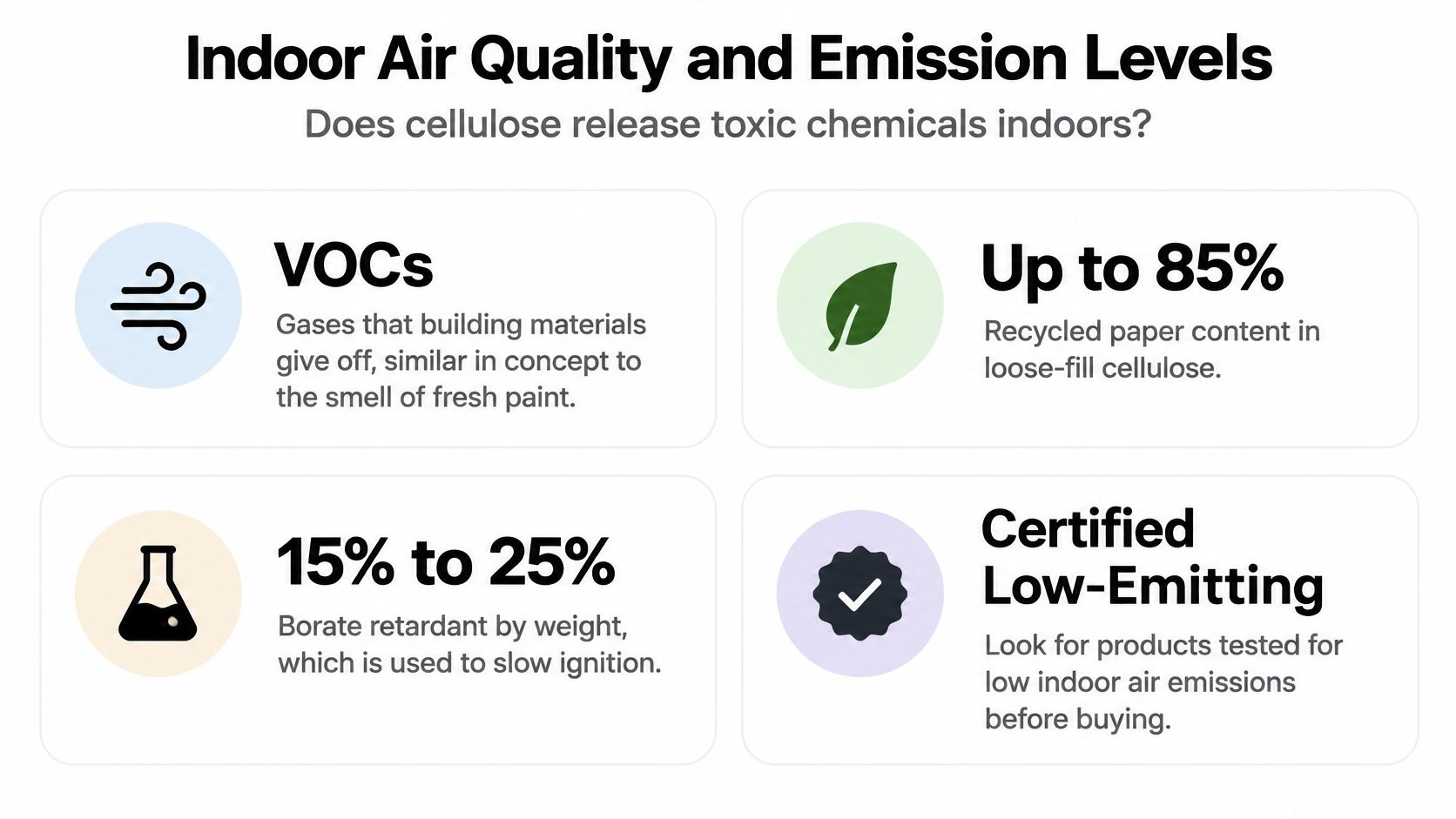
A peer-reviewed review of bio-based insulation emissions describes testing cellulose flakes and other bio-based materials over periods ranging from 3 to 28 days. In that study, VOC and formaldehyde emissions were categorized as low, with no expected impact on health and well-being.
Reported emission values for bio-based insulation, including cellulose
| Measure | Reported Value |
|---|---|
| Total VOC emission rate | Below 34 µg/m²·h at 3 days in six of seven tested insulation types |
| Formaldehyde emission rate | About 1 to 19 µg/m²·h at 3 days across tested materials |
| Emission drivers | Formulation, recycled feedstock, additives, ventilation, temperature, and humidity can affect results. |
What Can Change Your Result at Home
A test result does not mean every product emits the same amount. Formulation, recycled paper feedstock, additives, installation method, ventilation, temperature, and humidity can all affect emissions. A hot, still attic in August differs from a controlled test, just as one product's feedstock may differ from another's.
Choose a product with documentation, ventilate during installation or renovation, and avoid closing fresh work into an unventilated space. Check that your home's ventilation and filtration are working as intended; this overview of indoor air quality and HVAC explains how those systems relate to indoor air. If an attic visit for air sealing reveals droppings or nesting, use a guide to what a pest control inspection covers to decide whether that issue needs attention before the space is closed.
Humidity, Mold and Pests in Florida Homes
Say a summer storm drives rain under a lifted shingle on a two-story home in Kendall. A brown stain spreads across the bedroom ceiling a week later. The cellulose above it is damp, clumped, and starting to smell musty. That scenario, not routine indoor exposure, is the practical health question in South Florida.
Research summarized in a review on cellulose materials and moisture finds that prolonged high humidity can create conditions favorable to mold growth in cellulose materials and notes that antifungal treatment may be necessary, while also emphasizing that treatment applied during manufacturing may be insufficient in some cases. Wet conditions can also increase moisture in sheathing and raise mold risk. Correctly installed dense-pack can reduce air movement and may help control moisture, but it doesn't cancel out a leak.
What to Do After a Leak
Work in order, and don't bury the problem under fresh fill.
- Find and fix the source first: Check roof flashing, plumbing penetrations, and air conditioning condensate lines before you touch the insulation.
- Judge the wet material: Lightly damp fill near a fixed, one time leak may dry in place. Saturated, clumped, or visibly moldy cellulose usually needs removal, because it has lost loft and may hold moisture against the ceiling.
- Measure attic humidity: A simple hygrometer left in the attic for a few days tells you whether you're chasing a single leak or a persistent humidity problem.
- Separate dust from mold: Settled gray dust on framing is common and usually harmless. A musty odor, dark staining spreading across drywall or sheathing, or fuzzy visible growth points to a microbial problem.
Practical rule: Don't add insulation over a moisture problem. Fix the water, confirm the assembly is dry, then insulate.
Pests in Loose Fill
Loose fill is comfortable nesting material. Rodents tunnel through attic cellulose, shred it for nests, and can open paths along wiring and plumbing into living spaces. If you hear scratching overhead, guidance on how to get mice out of an attic walks through removal and entry points. For ongoing activity, Rodent Control covers the basic approach described for the service. Remove the rodents and seal the way back in.
Damp attics also attract moisture seeking insects such as ants and roaches, which follow water and food residue along framing. Borate treatment can deter some insects that contact the fill. It doesn't replace a termite inspection of the wood framing underneath, and it doesn't seal a single rodent entry hole.
South Florida attic and wall risks for cellulose insulation
| Risk | Where It Hides | Warning Sign |
|---|---|---|
| Roof leak or wind-driven rain | Above ceilings and along attic decking | Brown stains, sagging drywall, clumped damp insulation |
| Air-conditioning condensation | Around ducts and air handlers in the attic | Dripping, musty smell, dark spots on framing |
| Rodent activity | Loose fill in attics and wall cavities | Droppings, shredded insulation, gnawed wiring |
| Termite activity | Wood framing beneath the insulation | Mud tubes, hollow-sounding wood, discarded wings |
| Persistent high humidity | Attic air above the ceiling | Condensation on nails or roof sheathing |
Mold prevention here is mainly a building envelope and maintenance issue. Leaks, vapor and air control layers, drying potential, installation density, and climate decide the outcome. The product alone doesn't.
Installation Day Controls and Pre-Acceptance Checklist
Installation is the time when airborne dust matters most. The crew blowing cellulose through a hose can encounter dust and particles containing borate; after the insulation is enclosed and undisturbed, occupants are in a different exposure situation. The distinction is practical: focus first on protecting workers and keeping dust out of living areas.
A European borate exposure assessment for cellulose insulation estimated long-term inhalation exposure of approximately 0.025 mg/m³ for storage or closed transfer tasks. For hose-based spreading, it modeled exposure near 1.04 mg/m³ and a risk-characterization ratio of 0.717 under the assessed scenario. These figures describe particular work tasks and conditions. They are not measurements of exposure in every home or proof that a specific installation is safe without appropriate controls.
Controls for Crew and Occupants
Installers should follow the product safety data sheet for respiratory protection, including the appropriate fit and filter type. Eye protection, gloves, protective clothing, and local ventilation also help limit contact with dust. If workers enter the attic without the protection called for by the product instructions, pause the work and ask the installer to address it.
Occupants should leave the work area and keep children and pets away until dust has settled and cleanup is complete. This is especially important for anyone with asthma or dust sensitivity. Cover or close registers near the work zone, then check that the crew has cleaned up before the system is used. That helps prevent dust from being carried through the ducts after installation.
Moisture control is part of installation readiness. Have active roof, plumbing, or HVAC leaks and persistent condensation corrected before cellulose goes in. Insulation placed over a drip can hide the evidence while the assembly stays wet, creating conditions for microbial growth and potentially affecting fire-retardant performance.
Pre-Acceptance Checklist
Before signing off, walk the installed work with the crew. Focus on what can be checked on installation day:
- Confirm the product and application: Check that the product is certified to 16 CFR Part 1209 and labeled for the installation type, such as attic loose-fill or wall dense-pack.
- Get the product documents: Ask for the technical data sheet and safety data sheet, and keep copies with your home records.
- Verify depth and density: Compare the installed depth and density with the job specification. Use depth markers or bag counts rather than judging by eye.
- Photograph covered details: Before fill obscures the area, photograph clearances around recessed lights, flues, chimneys, and exhaust vents. Confirm that spacing follows the manufacturer's instructions.
- Inspect the material as it is used: Ask the crew to set aside material that is wet, clumped, musty-smelling, or contaminated, and confirm that no unidentified additives are being used.
These are installation checks, not a substitute for diagnosing a leak or evaluating mold. If a moisture problem appears during the work, stop and have the source addressed before it is covered.
Sign off after checking the installed depth, material condition, and clearance photos. These details are easiest to confirm while the work is visible.
When to Call a Licensed Professional
Some findings need a professional whose work covers that specific problem. Use the table to separate installation corrections from pest or moisture concerns.
Which licensed professional to call
| Problem | Who to Call | Why |
|---|---|---|
| Recessed light or flue appears too close to cellulose | Licensed electrician or HVAC technician | Confirm the required clearance and address the fire risk |
| Installed depth or density does not match the specification | Licensed insulation contractor | Correct the installation to meet its stated requirements |
| Visible mold or wet cellulose | Licensed remediation professional | Address the wet material and conditions supporting microbial growth |
| Rodent droppings, nesting, gnawed wiring, or termite signs | Licensed, insured pest control professional | Inspection, removal, and exclusion are separate from applying cellulose |
For rodent activity, the remedy includes removing the animals and closing their entry routes. This guide to rodent exclusion materials explains the difference between materials that block entry points and those rodents can chew through. Mosquito treatment is a separate outdoor scope; Mosquito Control addresses biting mosquitoes in the yard, not attic insulation.
Before hiring for rodent or termite signs, check the Florida pest control license and active insurance. For Miami-Dade homeowners, Pestless connects residents with licensed, insured local pest control professionals. Describe the problem, compare quotes, and choose a provider; Pestless arranges the introduction rather than performing treatment.
If your inspection finds rodent nesting, termite signs, or insect activity around damp cellulose, Pestless Inc. connects Miami and Miami-Dade homeowners with licensed, insured pest control professionals through a form or phone call. Describe what you found, compare quotes, and decide whether to hire a provider.
Dealing with this pest right now?
Pestless connects you with a licensed, insured Miami pest control provider for a free, no-obligation quote.