Termites damage an estimated 600,000 homes in the United States each year, while annual control and repair spending reaches about $5 billion. A typical homeowner repair bill is about $3,000 when damage is discovered, and standard homeowners insurance usually excludes termite damage, according to Orkin's termite statistics. In Miami-Dade, that makes a termite inspection before buying a house a financial safeguard, not a routine form buried in the closing paperwork.
South Florida buyers also face a particular combination of warmth, humidity, rain, slab construction, crawl spaces, older wood framing, and dense development. A clean-looking interior doesn't prove that concealed wood is sound. The inspection gives you information while you still have contractual options, lender requirements to satisfy, and a seller who may share responsibility for treatment or repairs.
Table of Contents
- Why Termite Inspections Are Non-Negotiable in Miami
- Finding a Licensed Inspector in Miami-Dade County
- Distinguishing Termite Inspections from Home Inspections
- Navigating the NPMA-33 Report and Its Findings
- Negotiating Repairs and Treatment Plans with Sellers
- Real-World Scenarios for Miami Homebuyers
Why Termite Inspections Are Non-Negotiable in Miami
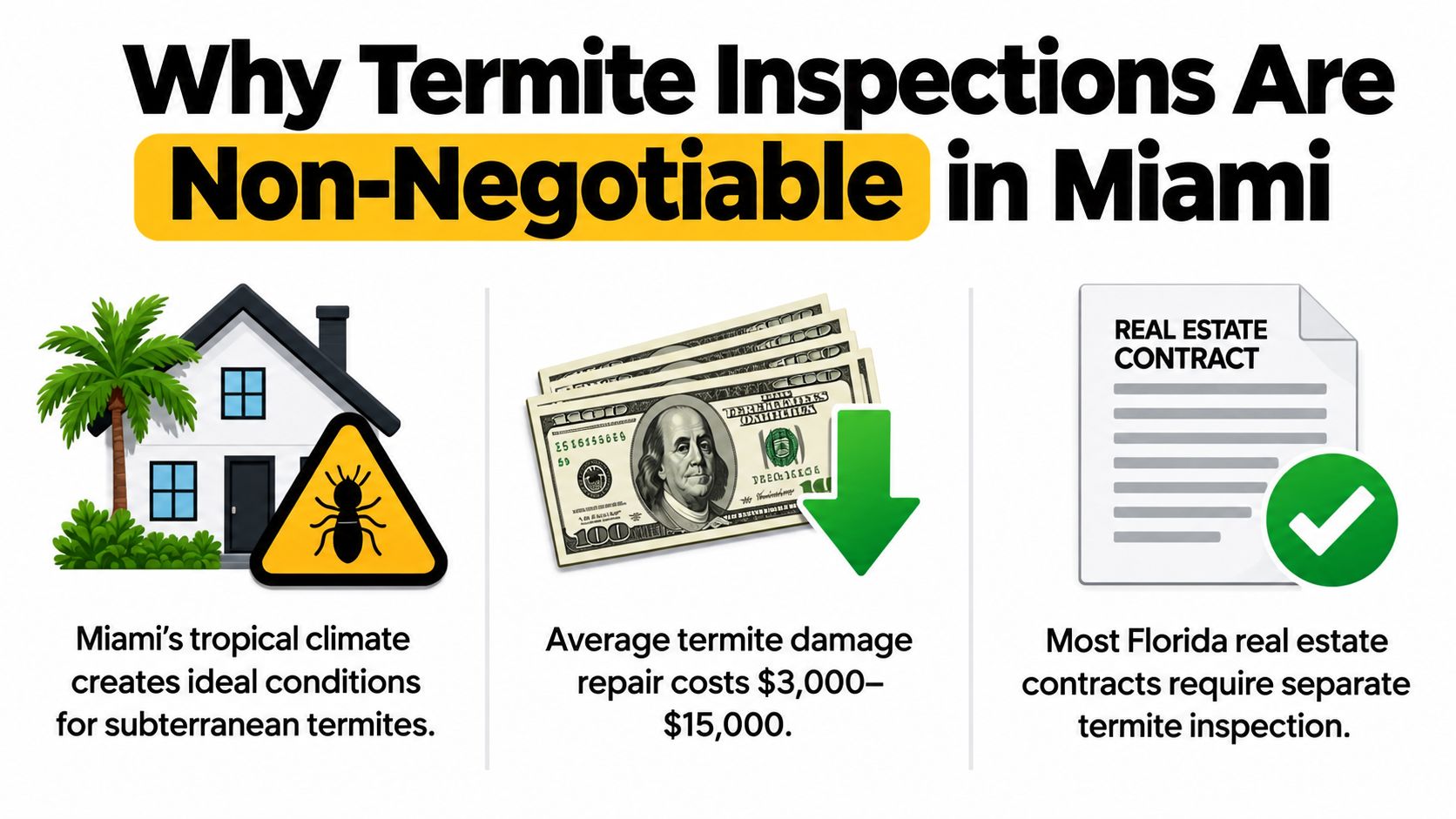
Miami's climate supports termite activity through much of the year. Warm conditions and persistent moisture can make foundations, sill plates, wall penetrations, roof areas, landscaping edges, and other wood components worth careful examination. The risk isn't limited to older detached homes. Condominiums, townhouses, renovated properties, and newer construction can all have accessible or concealed conditions that deserve review.
The financial logic is straightforward. If homeowners insurance generally excludes termite damage, the buyer may be left paying for treatment, repairs, and any structural investigation after closing. A relatively small due-diligence expense can therefore reveal a problem before the property becomes your responsibility. The national figures are not a prediction of what will happen to a particular Miami home, but they show why termites are treated as a serious ownership risk rather than a minor maintenance issue.
Miami conditions that deserve scrutiny
A buyer shouldn't ask only, “Are there termites?” Ask a broader set of questions:
- Is there active evidence? Look for live insects, fresh activity, mud tubes, discarded wings, or other signs identified by the inspector.
- Is there historical damage? Old treatment or repaired wood may indicate a resolved problem, but the remaining damage still needs interpretation.
- What encourages recurrence? Moisture, wood-to-soil contact, poor drainage, leaks, and blocked access can increase future concern.
- Which areas couldn't be inspected? A report limited by stored belongings, finished surfaces, insulation, or inaccessible cavities carries less certainty than a fully accessible inspection.
That last point is frequently overlooked. A report doesn't promise that every wall, floor cavity, or concealed framing member has been opened. It describes visible conditions in accessible areas on the inspection date. Buyers should read the limitations with the same attention they give the conclusion.
Practical rule: Treat the inspection as a way to measure uncertainty, not as a guarantee that hidden termites don't exist.
The inspection also belongs in the broader process of preparing for ownership. Buyers who want additional guidance on contracts, due diligence, and transaction planning can use the residential sales training blog as a complementary real-estate resource. Your agent, lender, and pest professional each answer different questions, so don't rely on any one of them to perform the others' work.
Finding a Licensed Inspector in Miami-Dade County
Start with the lender and contract, then find the professional. Ask your loan officer whether the transaction requires a Wood Destroying Insect report and which form the lender will accept. In the United States, the commonly used transaction document is the NPMA-33, although local practice and lender instructions can affect the exact paperwork.
The provider should be authorized to perform the relevant inspection in Florida, properly insured, and experienced with the property type you're buying. A company that regularly works in Miami-Dade should understand the practical differences between a Brickell condominium, a Coral Gables bungalow, a Hialeah block home, and a newer property in Kendall or Doral. Local familiarity doesn't replace licensing, but it helps the inspector recognize recurring construction and moisture patterns.
A practical vetting process
Use this sequence before scheduling:
- Ask who will perform and sign the report. You want clarity about the inspector's qualifications, the company responsible for the document, and whether the report satisfies your lender.
- Confirm the inspection scope. Ask whether the provider examines accessible foundation areas, sill plates, crawl spaces or basements, garages, attics, exposed wood, frames, and relevant penetrations.
- Request the limitations in advance. Find out what the inspector won't move, open, or dismantle. A non-destructive inspection is normal, but inaccessible zones must be disclosed.
- Check insurance and documentation. Ask for evidence of active business insurance and a written report rather than relying on a verbal “looks fine.”
- Discuss timing. Schedule early in the due-diligence window, not immediately before closing. Treatment, repairs, lender review, and a follow-up inspection may take coordination.
- Keep the parties separate. Your real-estate agent can help coordinate access, but the pest professional should report independently.
A general search result isn't enough. Compare the scope and report quality, not just the appointment fee. The licensed pest control professional guidance can help buyers think through licensing questions and provider selection before they authorize the visit.
Prepare the property before the appointment
Access affects the value of the inspection. Ask the seller or listing representative to clear stored items away from walls, open known crawl-space or attic access points, and make utility and garage areas reachable. The inspector may document an area as inaccessible if belongings, construction, finishes, or safety conditions prevent a proper view.
For a condominium, confirm what the inspection covers. The unit may have limited wood exposure, while common areas, roof assemblies, utility chases, grounds edges, and building-wide maintenance remain governed by the association. Review the association's records and ask your professionals how the unit-level report fits into the larger building risk.
Distinguishing Termite Inspections from Home Inspections
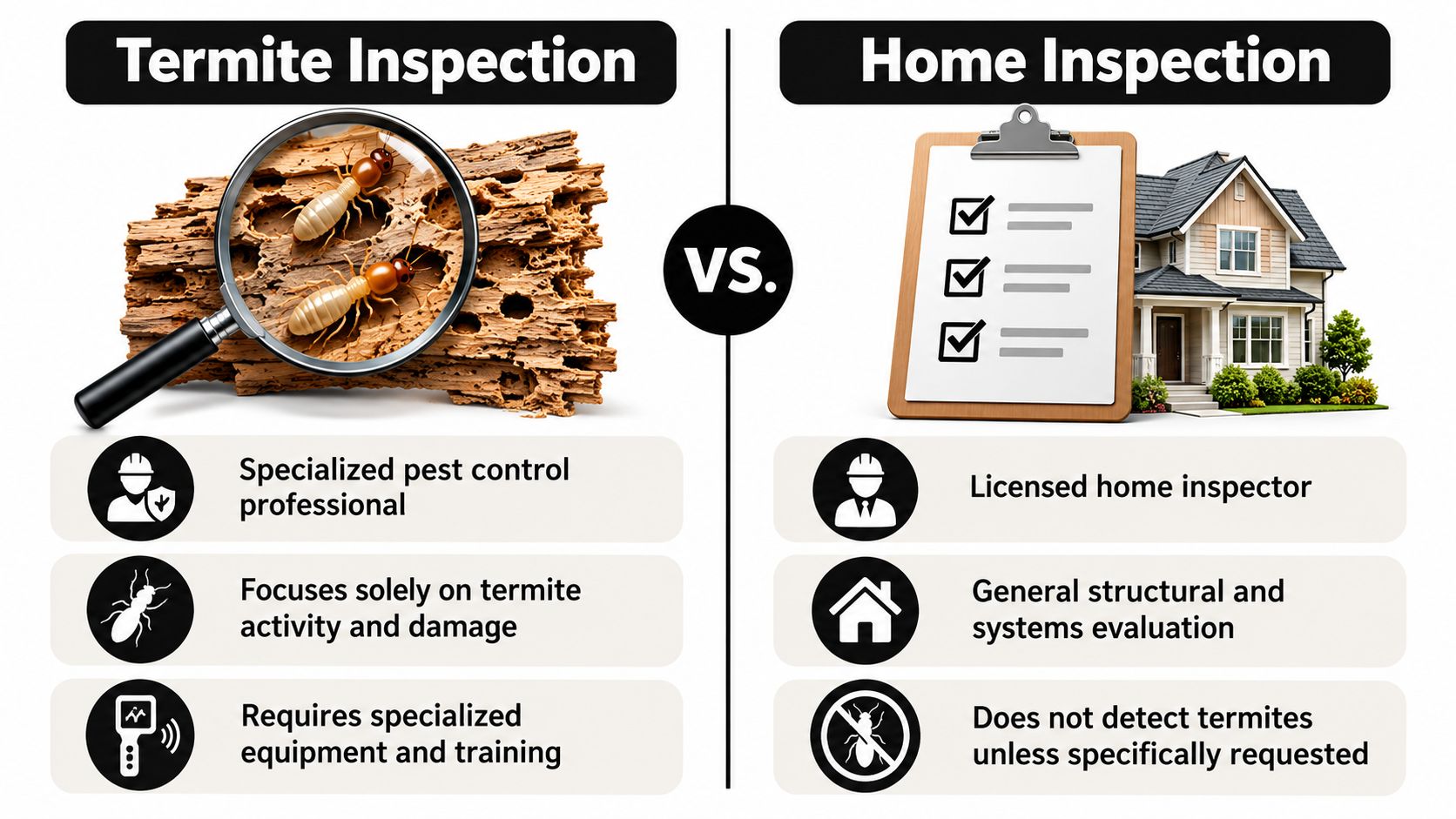
A general home inspection and a termite inspection answer different questions. The home inspector evaluates accessible structural components, systems, and visible condition across the property. The termite or Wood Destroying Insect inspector focuses on evidence of wood-destroying organisms, associated damage, and conditions that can support infestation.
A home inspector may notice a mud tube or damaged trim, but that observation doesn't automatically create the specialized report your lender or contract requires. Conversely, a pest inspector isn't a structural engineer and shouldn't be expected to determine the full load-bearing consequence of severe wood damage. Buyers need both perspectives when a finding raises structural concerns.
What each professional is looking for
| Inspection | Primary question | Typical output |
|---|---|---|
| General home inspection | What is the visible condition of the home's structure, systems, and components? | A broad property-condition report |
| Termite or WDI inspection | Is there visible evidence of infestation, prior damage, or conducive conditions? | A specialized WDI report, commonly the NPMA-33 |
| Structural evaluation | Has damage affected structural performance or required repair design? | An opinion or recommendations from a qualified structural professional |
The termite inspection is visual-first and non-destructive. The inspector examines readily accessible areas, probes suspect timber where appropriate, and records both findings and limitations. That limited scope matters because termites can remain behind walls, under flooring, inside insulation, or around other obstructions.
The Amerispec explanation of Wood Destroying Organism inspections notes that the standard U.S. transaction form is commonly the NPMA-33. It also cites an evaluation in which visual inspection was only 33% effective in preventing termite damage, meaning a visual-only approach could miss roughly 67% of infestation and damage issues. That finding doesn't mean every inspection misses problems. It does show why access, method, experience, and careful reporting matter.
A general inspection can tell you that a wall looks normal. A WDI inspection asks whether the accessible evidence around that wall supports confidence in the wood.
Why the distinction affects your budget
If the pest report identifies activity, treatment may solve the biological problem without addressing weakened wood. If it identifies old damage, the termites may be gone while the repair remains necessary. If it identifies moisture or soil contact, correcting that condition may reduce future risk but won't substitute for treatment when active evidence exists.
Buyers should also distinguish inspection from remediation. Termite Control is a treatment category intended to stop silent structural damage before it spreads, but the inspection itself is the diagnostic step. Don't accept a treatment recommendation as proof that the entire property has been structurally evaluated.
Navigating the NPMA-33 Report and Its Findings
Read the NPMA-33 as a risk document, not a one-word pass or fail. Confirm the property address, inspection date, inspector identification, and areas examined before reviewing the conclusion. Then focus on the findings for evidence, damage, conducive conditions, and inaccessible locations.
The report should distinguish active infestation, evidence of prior infestation, visible damage, and conditions that could support future activity. These findings call for different responses. Active termites require a treatment discussion. Historical damage may require repairs or structural review even when no live insects appear. Conducive conditions may need correction because they can increase the chance of reinfestation.
The four questions I ask buyers to mark
Use the report to answer four questions in plain English:
- What was observed? Identify the location and type of evidence. “Damage noted” provides little direction unless it identifies a sill plate, frame, attic member, or another component.
- Is the condition active or historical? Ask what evidence supports that conclusion and whether the seller has records of earlier treatment.
- What couldn't be seen? Mark every inaccessible area, including blocked perimeter sections, concealed framing, finished walls, and spaces with insufficient clearance.
- What happens next? Separate treatment, moisture correction, wood repair, and structural evaluation. Different findings may require different professionals, documents, and contract terms.
The accessible areas commonly surveyed include the foundation, sill plates, crawl space or basement, window and door frames, garage, attic, and exposed wood, as described in this buyer-focused termite inspection guide. Inspectors may probe suspect wood and look for mud tubes, discarded wings, moisture, and other visible indicators. A visual, non-destructive inspection still cannot expose every concealed space.
Read limitations as risk indicators
An inaccessible area does not prove infestation, but it lowers confidence in a clear result. If blocked storage, dense landscaping, or limited clearance prevented inspection, ask whether the seller can provide access and whether a supplemental inspection fits within the inspection contingency period.
Miami-Dade's humid conditions make moisture findings especially relevant. A leak, damp crawl-space condition, poor drainage pattern, or soil-to-wood contact may not confirm termites today. It can explain why the inspector recommends follow-up, and it gives you a concrete condition to investigate before accepting the report's conclusion.
Read the treatment and repair recommendations separately. Treatment addresses termite activity. Moisture correction reduces conditions that support future activity. Wood repair addresses damage, while a structural evaluation determines whether that damage affects the building. One recommendation does not prove that the other steps are complete.
For financed purchases, the NPMA-33 may also support the lender's documentation process. This explanation of termite inspections for mortgages provides useful background, but the loan officer controls the documents and conditions required for underwriting. Ask for that review early. A report with an uninspected area, unclear finding, or missing treatment documentation can affect closing timing and your options with the seller.
Negotiating Repairs and Treatment Plans with Sellers
A termite finding does not automatically make a Miami-Dade property unbuyable. It changes the negotiation from price alone to scope, responsibility, documentation, and timing. Read the report closely, then make a written request tied to the actual finding. “Take care of the termites” is too vague. Identify the condition reported, the professional work required, the records the seller must provide, and the date each item must be completed.
Start with the NPMA-33 and any supporting inspection notes. Active infestation, old damage, conducive moisture conditions, and inaccessible areas require different responses. A treatment contract does not repair damaged framing. Replacing visible wood does not resolve active termite evidence. In Miami-Dade's humid climate, correcting leaks, drainage, or soil-to-wood contact may also belong in the plan because those conditions can support future activity.
Read the lender's requirements alongside the report. Some financed purchases require treatment, repairs, or acceptable documentation before funding. Ask the loan officer what the underwriter will accept before agreeing to a seller credit or repair schedule. That answer can determine whether the request is a closing negotiation or a condition that must be satisfied before the loan proceeds.
Choose the remedy that matches the risk
Seller-completed treatment can work when the lender requires resolution before closing or when the buyer wants a documented professional service record. The contract or addendum should identify the provider, treatment scope, completion date, warranty or service terms, and any follow-up inspection. A promise to “spray before closing” provides no usable standard for judging completion.
A closing credit gives the buyer more control over provider selection and may suit a buyer who has already found a qualified professional. Confirm with the lender that the credit is allowed and structured correctly. The credit should not replace a structural repair that must be completed before financing or occupancy. Ask for estimates before choosing this option, since a vague allowance can leave the buyer responsible for a larger bill than expected.
A repair agreement fits damaged wood, compromised trim, or another defined component. Keep treatment and repair as separate line items. If the report suggests structural weakening, obtain an evaluation from an appropriately qualified structural professional before accepting a final scope or amount. The seller's contractor should not be the only person deciding whether damage affects the building.
Walking away may be reasonable if the seller refuses access, will not address active evidence, dismisses extensive inaccessible areas, or cannot provide credible treatment and repair records. Inspection and financing contingencies control the buyer's rights. Have the agent review the contract and consult a real-estate attorney before sending a formal notice.
Keep the timeline under control
Order the inspection early in the due-diligence period. Treatment, carpentry, structural review, lender approval, and clearance documentation require coordination. Waiting until the closing date removes bargaining time and can turn a manageable finding into a closing crisis.
Put the agreement in the contract or an approved addendum. Specify:
- The responsible party: State who pays for treatment, repairs, inspection, and follow-up.
- The work standard: Name the licensed provider and require a written scope.
- The evidence: Request treatment records, repair invoices, warranties or service agreements, and any lender-required follow-up report.
- The access plan: Require access to areas previously blocked or unavailable.
- The closing condition: Confirm whether funding depends on treatment, repairs, or a satisfactory NPMA-33 or related report.
A WDI inspection can identify evidence and conducive conditions that a general home inspection may not address. PestWorld's buyer guidance explains that distinction. Use the report's specific limitations and recommendations as negotiation points, especially when the seller wants to minimize the issue or offer an unsupported repair promise.
Keep unrelated pest problems separate. Bed Bug Treatment concerns bugs, eggs, and all life stages, while termite activity and wood repair require a different provider and written scope. Combining them in one demand makes responsibility and completion harder to verify.
For budgeting, request itemized estimates instead of relying on a headline treatment figure. A market-facing guide places a termite inspection commonly around $75 to $150, with the standardized report potentially adding about $50 to $100. This termite inspection cost guide notes that financing and local requirements can affect the transaction. Our guide to termite inspection costs for a home purchase can help organize the inspection budget, while treatment, moisture correction, and structural repairs should be priced separately.
Real-World Scenarios for Miami Homebuyers
A buyer under contract on an older Miami-Dade single-family home receives a clean general inspection, but the WDI report identifies old damage near an accessible sill plate and moisture around the perimeter. In humid South Florida, those findings deserve more than a quick seller promise. The buyer requests treatment records, a qualified assessment of the wood, correction of the moisture source, and enough time for the lender and buyer to review the completed work.
A renovated property can hide a different risk. Fresh finishes may suggest low exposure, while stored materials block part of the garage and a finished wall prevents inspection of another area. That limitation belongs in the negotiation. Before the contingency expires, the buyer can request access, a supplemental inspection where appropriate, or a contract decision that reflects the remaining uncertainty.

Condominium purchases add shared responsibility. A unit may show no visible evidence, while the association controls common elements and holds maintenance records. The buyer should review the unit report, ask about prior building-wide treatment or damage, and confirm what the association's documents cover. A high-rise changes access and responsibility, but concealed areas and shared systems still require answers.
Financing can determine which report the buyer needs. VA loans usually require a Wood Destroying Insect report, while FHA loans often require one in high-pressure termite regions. Conventional loans typically do not, although an individual lender may request one. The termite inspection cost and financing guide summarizes these differences, but the buyer should confirm current instructions directly with the lender. Cash buyers have more flexibility, yet skipping the inspection removes information that could support a repair request or price adjustment.
Read the NPMA-33 for access limitations, evidence, conducive conditions, and recommendations. “No active termites observed” does not mean the property carries no risk. Documented findings, incomplete access, lender requirements, and itemized treatment or repair scopes give the buyer a stronger position before deadlines pass.
Pestless Inc. connects Miami-Dade buyers and homeowners with licensed, insured pest control professionals for termite inspection and treatment needs, without performing the treatment itself. Submit a request through Pestless Inc. to describe the property and receive local provider introductions.
Dealing with this pest right now?
Pestless connects you with a licensed, insured Miami pest control provider for a free, no-obligation quote.