Food alone rarely explains an infestation: accessible calories, moisture, hidden shelter, and entry gaps as small as a pencil, about 6 mm, are what sustain mice indoors. Miami homes can offer all of those conditions year-round, so removing food smells without addressing the habitat leaves important work undone.
The familiar advice to sweep up crumbs isn't wrong. It's incomplete. A spotless counter won't close a plumbing opening, dry a leaking cabinet, or remove the sheltered space behind garage storage.
Think like a home inspector rather than a mouse-bait shopper. Instead of asking which snack brought a mouse inside, ask what makes your property a convenient place to stay.
Table of Contents
- Why a Clean Kitchen Still Gets Mice
- The Four Conditions That Make a House Attractive
- Food Sources You Might Be Overlooking
- Water Sources and the Moisture You Forget
- Entry Points and the Pencil-Sized Gap
- Why Miami Homes Stay Mouse-Prone Year-Round
- Tailored Prevention by Property Type
- Your Weekend Plan and When to Call a Pro
Why a Clean Kitchen Still Gets Mice
A clean kitchen can sit beside an excellent mouse habitat. Consider a hypothetical Miami homeowner who washes dishes nightly but keeps pet food in the garage, rarely opens the utility cabinet, and stores cardboard boxes against a wall. The visible room is tidy, but the less visible spaces deserve inspection.
Cleanliness and exclusion solve different problems. Cleaning reduces accessible food. Exclusion closes the routes mice use to reach protected spaces. Neither task substitutes for checking moisture or storage.
Ordinary household routines can also create opportunities without any obvious neglect. Purdue Extension's house mouse guidance identifies pet food, bird feeders, uncovered garbage, bulk foods, patio cushions, clothing, and other stored materials as potential food or nesting resources.
Separate housekeeping from habitat
For the housekeeping side, Sweet Home Cleaning Service's deep cleaning kitchen checklist for Alabama homes is a useful companion resource. Its location differs from Miami, but a room-by-room cleaning checklist can help organize the work. Treat it as a cleaning aid, not a substitute for inspecting the building.
Then widen your attention:
- Beyond the counters: Look inside food-storage cabinets and around appliances.
- Beyond the kitchen: Examine garage storage, utility spaces, and rarely disturbed closets.
- Beyond your unit: In shared buildings, ask who manages garbage rooms and common maintenance areas.
A clean room isn't necessarily a closed room. Check what mice can reach, not just what visitors can see.
When you're deciding what attracts mice into your house, separate the reason for entering from the conditions that allow continued activity. A smell might explain interest in a doorway. It doesn't explain the whole infestation.
The Four Conditions That Make a House Attractive
Use a simple mental model: a house becomes more attractive when mice can reach resources while staying near cover. The CDC's rodent-control guidance identifies food, water, and shelter as the primary conditions that sustain infestations.
The diagram organizes those resources alongside the access routes that make them reachable.
Resources inside the house
Accessible calories means food a mouse can reach. For example, a Doral garage might contain an unopened-looking birdseed bag that isn't stored inside a rigid, tightly closed container. The inspection question isn't whether the bag looks neat. It's whether its contents remain accessible.
Reliable moisture can be less obvious than a puddle. In a hypothetical Hialeah utility room, condensation beneath an air-conditioning line would be worth investigating. Look for recurring dampness rather than assuming that a dry floor at inspection time settles the question.
Protected shelter is the quiet space around those resources. A Kendall attic packed with holiday decorations illustrates the inspection challenge: you can't assess the wall edges or stored materials if every surface is hidden.
Routes into those resources
An opening around a utility line is an access route, not a food attractant. For a Coconut Grove homeowner, that distinction changes the response: cleaning the nearby room won't repair the opening around a gas-line penetration.
Apply the model without turning it into a rigid checklist:
- Ask what's available: Food, dampness, and concealment may occur in different adjoining spaces.
- Ask what's connected: Follow the route between the exterior, storage areas, and kitchen.
- Change what you can verify: Remove an accessible resource or close a confirmed gap, then monitor rather than assuming the problem is finished.
For a visual companion to your inspection, use the embedded video below.
The practical lesson is to inspect resources and access together. Removing an important condition can make the home less suitable, but established activity still needs follow-up.
Food Sources You Might Be Overlooking
Start with food that remains available repeatedly, not with the isolated crumb you noticed this morning. A nightly pet-feeding routine or an accessible pantry bag gives you a clearer prevention target than trying to make every corner permanently spotless.
Utah State University Extension's house mouse overview describes their flexible diet and preference for seeds and cereal grains. That makes pantry goods, birdseed, and dry pet food sensible inspection priorities.
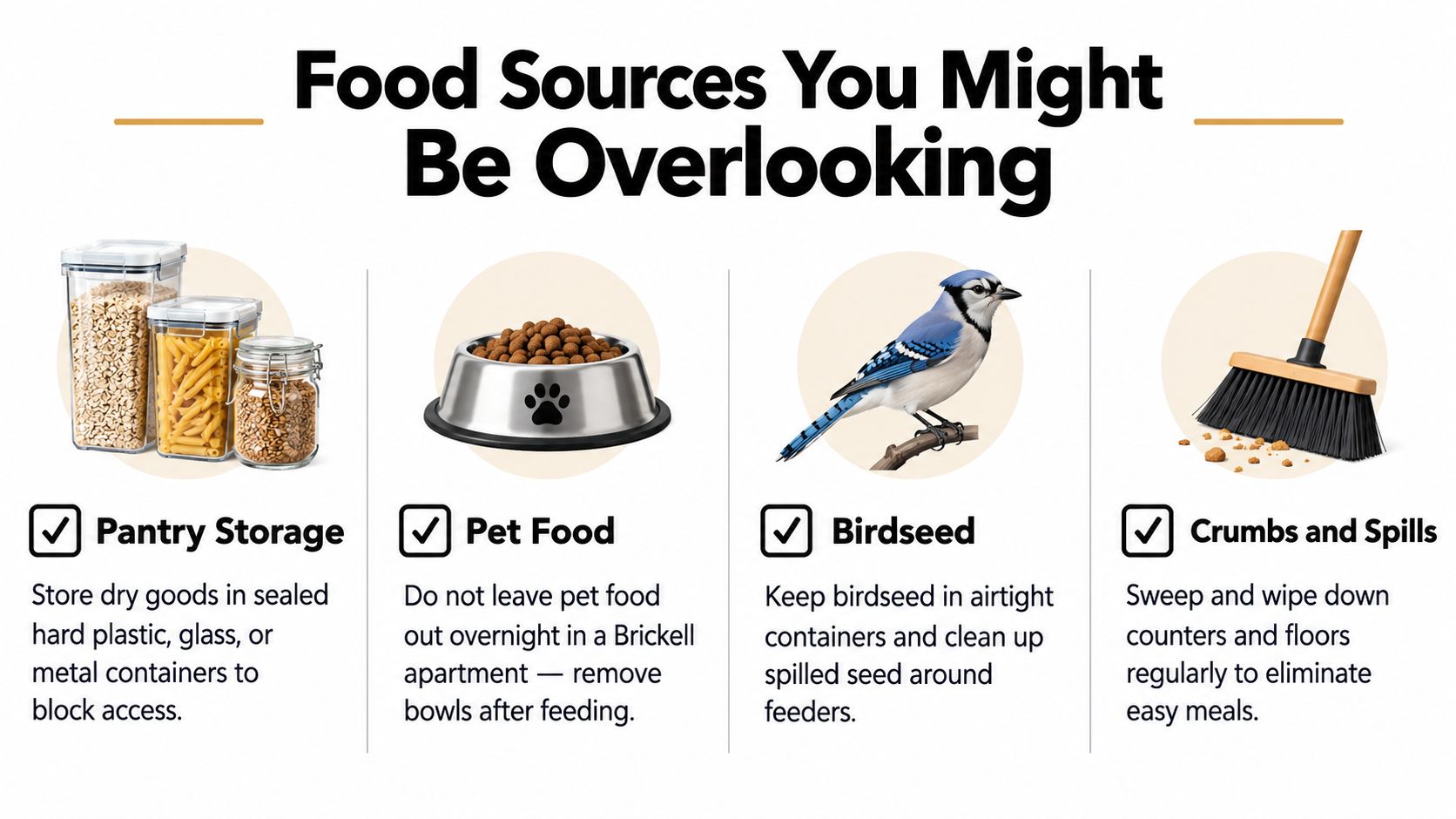
Use this checklist to organize the food-storage work.
Start with repeat access
- Change the pet-feeding routine: In a Brickell apartment, remove leftover food after feeding rather than leaving it available overnight. Keep the stored supply in a tightly closed container.
- Upgrade grain storage: Transfer accessible rice, cereal, and similar dry goods into thick plastic, glass, or metal containers with tight lids. A folded bag top isn't the same as protected storage.
- Check the garage supply: For a Pinecrest household storing birdseed, inspect both the container and the floor around it. Clean spills when they happen rather than allowing them to become a recurring resource.
Then tackle food residue in less visible places. In a hypothetical Miami Beach condo, the countertop may look immaculate while the accessible edge beside the range still needs cleaning. Don't move heavy appliances or disconnect gas equipment just to investigate an inaccessible corner.
A useful distinction is odor versus access. You don't need to identify the most tempting smell before taking action. Secure what mice could eat, remove residue, and check whether food packaging shows damage.
Finish by reviewing garbage handling. Close containers, remove exposed food waste, and make the routine easy enough that everyone in the household can maintain it.
Water Sources and the Moisture You Forget
Suppose you're checking the accessible space behind the stove and notice droppings near the wall. This is an inspection example, not a documented case. Your next move should be to record the location and look for nearby conditions, not just set a trap in the middle of the kitchen.
A cabinet beside that wall might contain a damp pipe connection. A utility closet farther along could have condensation. The point is to investigate what connects the evidence, the moisture, and the protected route.
Look for recurring dampness
Humidity and accessible moisture aren't the same inspection finding. A room can feel humid without an obvious drinking source, while a small plumbing leak can leave a damp spot inside an otherwise comfortable home. Check the surface and the cause rather than relying on how the room feels.
Run water at the sink, then inspect beneath the cabinet with a flashlight. Look around the P-trap and supply connections without loosening anything. Check accessible air-conditioning components for dampness, but leave refrigerant lines, electrical components, and equipment repairs to qualified tradespeople.
For a broader look at managing damp indoor spaces, consult the moisture control advice from Home Dehumidifier Reviews. Treat humidity equipment as a separate decision from repairing a leak. A dehumidifier shouldn't become your workaround for a plumbing fault.
Common Indoor Moisture Sources and Quick Fixes
| Moisture Source | Where It Hides | Lowest-Cost Fix |
|---|---|---|
| Small plumbing leak | Beneath sinks and around supply connections | Identify the source and arrange the appropriate repair |
| Condensation | Accessible AC lines or nearby surfaces | Investigate the cause before buying equipment |
| Pet-water residue | Under and around bowls | Clean spills and manage placement without compromising the pet's water needs |
| Damp stored materials | Utility closets or garage corners | Remove wet items and find out why they became damp |
| Excess irrigation | Landscaping beside the building | Adjust watering and check whether water reaches the structure |
These are starting actions, not guaranteed cost comparisons. The least expensive sound repair depends on what's wrong.
Read evidence without overinterpreting it
Record what you find before changing the area:
- Droppings and urine staining: Mark their locations; don't assume appearance alone establishes when they were deposited.
- Gnaw marks and nibbled packaging: Photograph the damage and check nearby stored goods.
- Nesting material: Note disturbed paper, fabric, or insulation without pulling apart concealed spaces.
- Greasy rub marks: Inspect adjacent wall edges and openings for a possible travel route.
- An unusual odor: Treat it as a reason to investigate, not proof of mice by itself.
A blacklight reading alone shouldn't decide your diagnosis. Likewise, a mark on wiring needs professional assessment rather than a guess about its cause.
Inspection habit: Record where evidence occurs before rearranging the room. Location is often more useful than the size of the mess.
You're looking for a pattern you can act on, not trying to date an infestation from a single sign.
Entry Points and the Pencil-Sized Gap
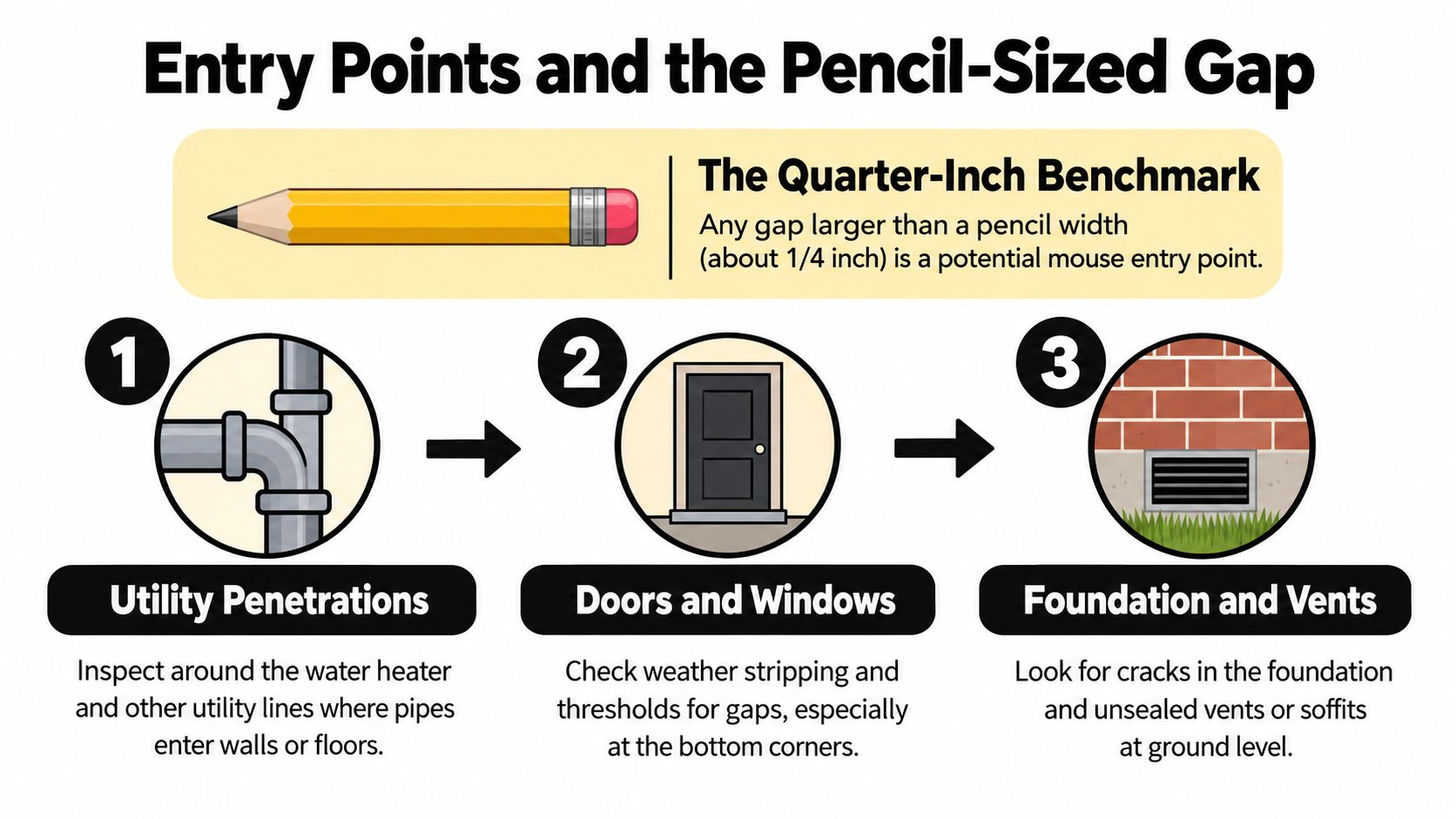
Use the pencil comparison as an inspection benchmark, not an invitation to force a pencil into equipment. The CDC's hantavirus prevention brochure notes that mice can pass through openings about 1/4 inch, or 6 mm, wide.
The illustration shows where to focus your visual inspection.
Walk the building in a consistent order
Begin indoors around accessible plumbing and utility penetrations. Check under sinks, near the water heater, and where cables or AC lines pass through walls. Don't disturb gas fittings, electrical equipment, or sealed appliance assemblies.
Next, examine exterior doors and garage-door corners. Look for damaged sweeps, loose weatherstripping, and openings at thresholds. Finish with accessible foundation openings, vent covers, and visible roof-edge defects from a safe position.
The related guide to how rats get into a house can help you organize a broader rodent-entry inspection, but use the mouse benchmark when evaluating small openings.
Match the repair to the opening
- Small gaps: Use steel wool secured with caulk where appropriate.
- Larger or chew-prone openings: Consider metal mesh, hardware cloth, cement, or sheet metal.
- Functional vents: Preserve required airflow and equipment operation; don't plug the opening.
The CDC guidance also cautions against relying on expanding foam alone where rodents can gnaw through it. For venting, roof work, and unfamiliar utility penetrations, have a qualified professional select the repair.
If mice are already inside, exclusion should accompany removal rather than replace it. Position traps along active walls or near recorded evidence, not randomly across open rooms, and follow the device instructions for safe placement.
Rodent Control addresses that combined task: remove the rodents and seal the way back in.
Why Miami Homes Stay Mouse-Prone Year-Round
For Miami homeowners, the useful question isn't which month deserves attention. It's whether the property continues to provide shelter and resources as household routines change.
A 2025 study of wild house mice found their strongest immediate response was seeking shelter in a den box, with substantially more visits than to food, water, rodenticide, or odor treatments. That finding concerns immediate preference under the study conditions, not proof that food never matters in a house.
Inspect local exposures, not seasonal stereotypes
For a Coral Gables or Palmetto Bay property, examine dense landscaping and stored outdoor materials beside the building. In a Doral or Sweetwater home, include the garage and utility room rather than limiting the inspection to occupied living spaces.
Those are examples of where to look, not claims that every home in those neighborhoods has the same defects. The shelter finding gives you a reason to inspect concealed spaces even when no food waste is visible.
Treat seasonal changes as maintenance prompts:
- During wet weather: Check drainage and newly damp storage areas.
- During a dry spell: Revisit leaks and other dependable moisture sources without assuming weather caused the infestation.
- During holiday hosting: Review added food supplies and decorations brought out of storage.
Don't assume rodents have become inactive because the calendar says winter. The companion explanation of whether mice hibernate in winter addresses that common question.
Short-term rental turnover adds another practical consideration. A Miami Beach or Brickell host can't assume each guest will handle leftovers, pet supplies, or garbage consistently. Build those checks into turnover work rather than waiting for a complaint.
Tailored Prevention by Property Type
The same inspection lens leads to different priorities depending on who controls the building. A homeowner can repair an exterior door directly; a condo resident may need approval before anyone alters a common utility chase.
The examples below are prevention profiles, not reports of actual infestations.
Match responsibility to the exposure
| Property Profile | First Inspection Priority | Who Needs to Act |
|---|---|---|
| Cutler Bay single-family home | Outdoor feeding areas, garage storage, and exterior access | Homeowner and relevant repair professionals |
| Brickell short-term rental | Turnover food handling, accessible cabinets, and utility openings | Host, cleaners, and building management where required |
| Aventura condo association | Shared garbage areas, storage rooms, and common penetrations | Board, property manager, residents, and approved contractors |
For the single-family homeowner, start where outdoor routines meet indoor storage. Assign someone to review feeding practices and garbage handling while another person records accessible building defects. Separate the housekeeping list from repairs that require a tradesperson.
For the rental host, make the inspection repeatable. Ask cleaners to report damaged packaging, droppings, damp cabinets, and visible openings rather than merely removing the evidence. Keep repair requests separate from ordinary turnover cleaning so they don't disappear into a completed housekeeping task.
Shared-building principle: Assign responsibility for common areas before asking residents to solve a building-wide problem individually.
Escalate beyond the unit
For a condo board, map reports by location and date. Arrange access to relevant common spaces, and coordinate permitted repairs rather than encouraging residents to stuff materials into unfamiliar openings.
Self-help becomes less appropriate when evidence appears across units, access is unsafe, or repairs affect shared systems. Ask a licensed Florida provider to inspect those conditions, explain the proposed work, and identify which repairs require a different trade.
Your Weekend Plan and When to Call a Pro
Make the weekend about documenting conditions and completing safe repairs, not buying a collection of products. Prepare a flashlight, inspection notes, tightly closing food containers, and materials appropriate to confirmed gaps.
Keep the work manageable:
- Saturday inspection: Record evidence, inspect accessible routes, and photograph defects. Complete only repairs you can perform safely without affecting utilities or ventilation.
- Sunday housekeeping: Secure food supplies, address accessible spills, reduce obstructive storage, and arrange repairs for recurring dampness.
- Follow-up monitoring: Recheck the recorded locations over the coming weeks. Track whether evidence recurs and whether unfinished repairs have been completed.
Don't treat a quiet evening as proof that the work succeeded. Consistent follow-up is more useful than repeatedly moving traps without recording results.
Know when to stop DIY work
Recurring droppings after repairs, a mouse seen during the day, or suspected gnawing on wiring are reasons to request professional assessment. These observations don't establish infestation size by themselves, but they shouldn't be dismissed.
If you're preparing for outside help, the guide to rodent infestation removal provides a related planning resource. Ask providers how they'll inspect, remove rodents, address entry routes, and check the outcome.
For unsafe attic access, electrical damage, or shared-building defects, don't wait until you've exhausted every home remedy. Compare proposals for the same scope of work, verify licensing and insurance, and ask about response timing directly rather than assuming availability.
The practical goal is a home with fewer accessible resources, fewer concealed opportunities, and fewer usable entry routes. A trap may address the mouse you encounter; a coordinated plan addresses why another could follow.
Pestless Inc. connects Miami and Miami-Dade County homeowners with licensed, insured local pest control professionals; it facilitates introductions rather than performing treatments. Visit Pestless Inc. to describe your mouse evidence and suspected entry points, request no-obligation quotes, and compare providers who can assess removal and exclusion together.
Dealing with this pest right now?
Pestless connects you with a licensed, insured Miami pest control provider for a free, no-obligation quote.